

Nanotechnology In Medical Devices Market Report
First published: 21 October 2024 | Last updated: 25 May 2026 | Report Code: nanotechnology-in-medical-devices
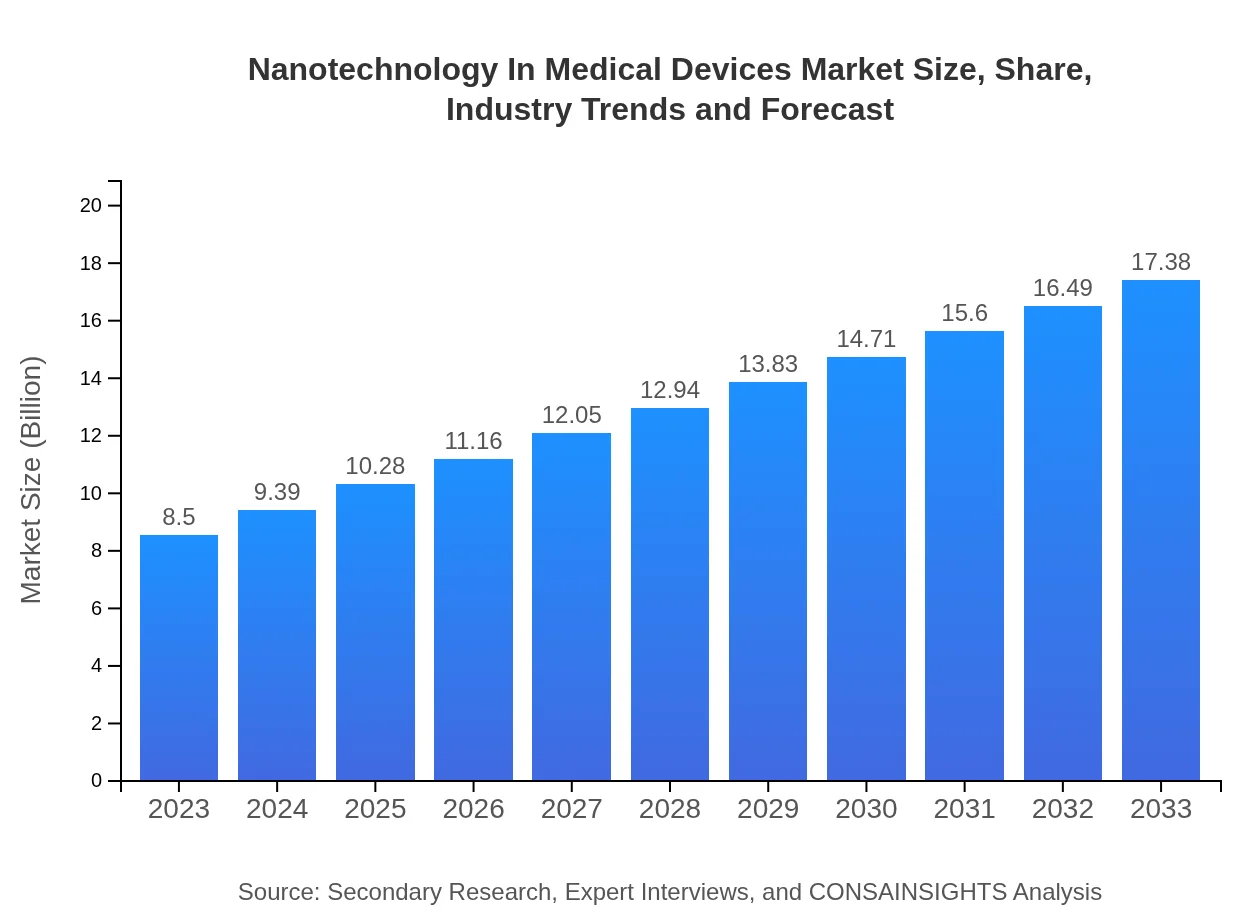
Nanotechnology In Medical Devices Market — USD $8.5 Billion in 2023, Growing to USD 17.38B by 2033 at 7.2% CAGR
This report covers the Nanotechnology In Medical Devices market, providing insights into market size, growth projections, trends, and a regional analysis from 2023 to 2033.
Key Takeaways
- Global market expands from $8.50 Billion in 2023 to $17.38 Billion in 2033 at a 7.2% CAGR.
- Europe is largest regional market, while no single fastest-growing region is stated because regional CAGR differences remain within 0.15 percentage points.
- North America grows from $2.84 Billion in 2023 to $5.80 Billion in 2033, reflecting strong demand for advanced medical technologies.
- Asia Pacific increases from $1.56 Billion in 2023 to $3.19 Billion in 2033 amid rising innovation and healthcare investment.
- Key industry players include Johnson & Johnson, Medtronic, Thermo Fisher Scientific, Stryker Corporation, and Siemens Healthineers.
Nanotechnology In Medical Devices Market Report — Executive Summary
Europe remains largest market by forecast-period value, while no single fastest-growing region is stated because top regional growth rates are separated by less than 0.15 percentage points. The report examines market dynamics for nanotechnology applications in medical devices from 2023 to 2033. Market size rises from $8.50 Billion to $17.38 Billion at a 7.2% CAGR, supported by advancements in nanosensors, drug delivery systems, and nano-enabled implants. Growth is driven by material science innovations, demand for precision diagnostics and therapies, and sustained investments in R&D. Regulatory frameworks and standards remain important considerations for commercialization and safety assurance. Regional patterns show Europe as the largest market, with notable expansions in North America and Asia Pacific. The analysis integrates primary interviews with industry specialists, company publications, and triangulated data to provide actionable insights for manufacturers, investors, and research organizations. Major vendors profiled include Johnson & Johnson, Medtronic, Thermo Fisher Scientific, Stryker Corporation, and Siemens Healthineers.
Key Growth Drivers
- Continued material science improvements enabling more effective nanoscale implants and coatings.
- Rising demand for precision diagnostics and targeted drug delivery solutions in clinical settings.
- Sustained R&D investment from manufacturers and research institutions accelerating product development.
- Regulatory clarity and the establishment of standards that support market adoption and safety testing.
- Integration of nanosensors and advanced imaging techniques into diagnostic workflows enhancing clinical utility.
| Metric | Value |
|---|---|
| Study Period | 2023 - 2033 |
| 2023 Market Size | $8.50 Billion |
| CAGR (2023-2033) | 7.2% |
| 2033 Market Size | $17.38 Billion |
| Top Companies | Johnson & Johnson, Medtronic , Thermo Fisher Scientific, Stryker Corporation, Siemens Healthineers |
| Published Date | 21 October 2024 |
| Last Modified Date | 25 May 2026 |
Nanotechnology In Medical Devices Market Overview
Customize Nanotechnology In Medical Devices Market Report market research report
- ✔ Get in-depth analysis of Nanotechnology In Medical Devices market size, growth, and forecasts.
- ✔ Understand Nanotechnology In Medical Devices's regional dynamics and industry-specific trends.
- ✔ Identify potential applications, end-user demand, and growth segments in Nanotechnology In Medical Devices
What is the Market Size & CAGR of Nanotechnology In Medical Devices Market Report market in 2023?
Nanotechnology In Medical Devices Industry Analysis
Nanotechnology In Medical Devices Market Segmentation and Scope
Tell us your focus area and get a customized research report.
Nanotechnology In Medical Devices Market Report Market Analysis Report by Region
Europe Nanotechnology In Medical Devices Market Report:
Europe is largest regional market, rising from $2.94 Billion in 2023 to $6.01 Billion in 2033. 94 Billion in 2023 to $6.01 Billion in 2033 and is the largest regional market. Expansion reflects active innovation ecosystems, supportive research institutions, and regulatory frameworks that influence device deployment.Asia Pacific Nanotechnology In Medical Devices Market Report:
Asia Pacific grows from $1.56 Billion in 2023 to $3.19 Billion in 2033. Growth is driven by rising healthcare investment, expanding clinical research, and increasing adoption of advanced medical technologies across emerging markets.North America Nanotechnology In Medical Devices Market Report:
North America grows from $2.84 Billion in 2023 to $5.8 Billion in 2033. Regional adoption is supported by strong healthcare infrastructure, high investment in medical R&D, and demand for advanced diagnostic and therapeutic devices.South America Nanotechnology In Medical Devices Market Report:
Latin America grows from $0.14 Billion in 2023 to $0.29 Billion in 2033. Market momentum is shaped by gradual healthcare modernization, increasing diagnostic capacity, and greater interest in precision therapies.Middle East & Africa Nanotechnology In Medical Devices Market Report:
Middle East and Africa grows from $1.02 Billion in 2023 to $2.09 Billion in 2033. Development is supported by targeted healthcare investments, growing clinical capabilities, and a focus on improving diagnostic and treatment infrastructure.Tell us your focus area and get a customized research report.
Research Methodology
Nanotechnology In Medical Devices Market Analysis Nanotechnology_in_medical_devices_market_by_product
Global Nanotechnology in Medical Devices Market, By Product Market Analysis (2023 - 2033)
The product segments in this market include drug delivery systems, diagnostic devices, implants, and nanomaterials. Drug delivery systems, leading the market, are expected to grow significantly with advances in targeting methods, while diagnostic devices are gaining traction due to improved accuracy and efficacy.
Nanotechnology In Medical Devices Market Analysis Nanotechnology_in_medical_devices_market_by_application
Global Nanotechnology in Medical Devices Market, By Application Market Analysis (2023 - 2033)
Applications of nanotechnology span from advanced imaging systems to therapies aimed at precision medicine. The application segments highlight the growing inclination towards personalized healthcare solutions assisted by nanotechnology.
Nanotechnology In Medical Devices Market Analysis Nanotechnology_in_medical_devices_market_by_end_user
Global Nanotechnology in Medical Devices Market, By End-User Market Analysis (2023 - 2033)
End-user segments consist of hospitals, research institutes, and diagnostic laboratories. Hospitals lead in terms of market share and have increasingly integrated these technologies into their operations to enhance patient outcomes.
Nanotechnology In Medical Devices Market Analysis Nanotechnology_in_medical_devices_market_by_technological_advancements
Global Nanotechnology in Medical Devices Market, By Technological Advancements Market Analysis (2023 - 2033)
This segment focuses on advancements in nanoparticle formulations, nanobiosensors, and nanoimaging techniques. Research and development efforts are crucial to delivering innovative solutions that address current medical challenges.
Nanotechnology In Medical Devices Market Analysis Nanotechnology_in_medical_devices_market_by_regulatory_environment
Global Nanotechnology in Medical Devices Market, By Regulatory Environment Market Analysis (2023 - 2033)
The role of regulatory frameworks is significant in ensuring the safety and efficacy of nanotechnology applications in medical devices. Ongoing collaborations between industry leaders and regulatory bodies are essential to streamline approvals and ensure public health standards.
Nanotechnology In Medical Devices Market Trends and Future Forecast
Tell us your focus area and get a customized research report.
Global Market Leaders and Top Companies in Nanotechnology In Medical Devices Industry
Johnson & Johnson:
A major player in the healthcare space, Johnson & Johnson has incorporated nanotechnology to develop advanced drug delivery systems and innovative implant designs.Medtronic :
Medtronic is recognized for its contributions to the field of medical devices and has pioneered the use of nanotechnology in various therapeutic and diagnostic solutions.Thermo Fisher Scientific:
Known for its cutting-edge laboratory equipment, Thermo Fisher integrates nanotechnology into biotechnology and pharmaceutical solutions.Stryker Corporation:
Specializing in surgical equipment and devices, Stryker is leveraging nanotechnology for better implant and surgical solutions.Siemens Healthineers:
Siemens is enhancing imaging diagnostics through the application of nanotechnology, providing high-resolution imaging products.We're grateful to work with incredible clients.









FAQs
What is the market size of the Nanotechnology In Medical Devices Market Report in 2023?
The market size in 2023 is $8.50 Billion as stated in the report's baseline figure for the analysis period.
How big is the market expected to be in 2033?
The market is projected to reach $17.38 Billion by 2033 according to the report's forecast horizon and provided end-period value.
What is CAGR for the forecast period?
The compound annual growth rate for the 2023 to 2033 forecast period is 7.2% as specified in the report data.
Is there a single fastest Growing region in the Nanotechnology In Medical Devices Market Report market?
No single fastest-growing region is stated for the Nanotechnology In Medical Devices Market Report market because the top regional implied CAGR values are within 0.15 percentage points of each other, making the ranking too close to call reliably.
Which companies are featured in the report?
Top companies listed include Johnson & Johnson, Medtronic, Thermo Fisher Scientific, Stryker Corporation, and Siemens Healthineers.
What are primary technological trends covered?
The report highlights trends such as nanotechnology sensors, advanced imaging techniques, nano-robotics, and innovations in drug delivery and implants.
How is regulatory environment treated in the analysis?
Regulatory frameworks, standards, and certifications are included as a segmentation lens and discussed for their impact on product development and market access.
Who contributed to the report research?
Research combined primary interviews with industry experts and secondary sources like company reports, alongside data triangulation and expert validation.