
Reports >
Life Sciences
>
Obstetrics Devices Market Report

Obstetrics Devices Market Report
First published: 21 October 2024 | Last updated: 28 May 2026 | Report Code: obstetrics-devices
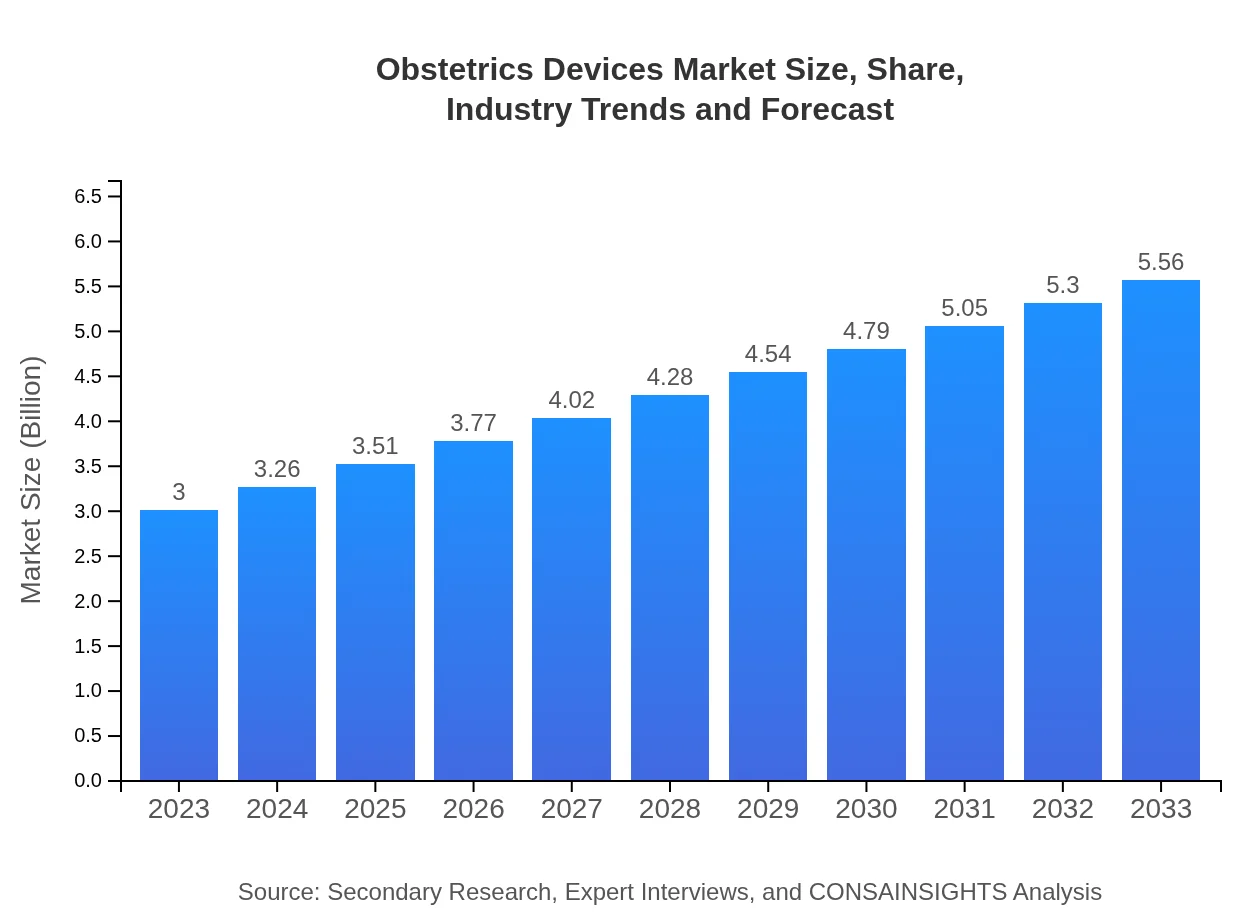
Obstetrics Devices Market — USD $3 Billion in 2023, Growing to USD 5.56null by 2033 at 6.2% CAGR
This report provides an in-depth analysis of the Obstetrics Devices market, covering key trends, market segmentation, and forecasts from 2023 to 2033, alongside insights on competitive landscape and technological advancements.
Key Takeaways
- Global market increases from $3.00 Billion in 2023 to $5.56 Billion in 2033, reflecting a 6.2% CAGR over 2023 to 2033.
- North America is the largest region, rising from $1.09 Billion in 2023 to $2.02 Billion in 2033.
- North America is largest regional market; Latin America is regional market region based on implied CAGR across 2023 to 2033.
- Europe expands from $0.97 Billion in 2023 to $1.79 Billion in 2033, supported by healthcare investments and maternal care initiatives.
- Key product categories include ultrasound equipment, fetal monitoring devices, labor room devices, and surgical instruments.
Obstetrics Devices Market Report — Executive Summary
This report examines the obstetrics devices market from 2023 to 2033, documenting growth from $3.00 Billion to $5.56 Billion at a 6.2% CAGR. Drivers include rising maternal health initiatives, adoption of digital technologies, and increased investment in prenatal and postnatal care infrastructure. Regional analysis shows North America as largest market and Latin America as fastest-growing region by implied CAGR. The study evaluates product-type segments—such as ultrasound equipment and fetal monitoring devices—applications across prenatal, intrapartum and postpartum care, and end users including hospitals, clinics and home care. Competitive coverage profiles major players including GE Healthcare, Siemens Healthineers, Philips Healthcare and Medtronic. Methodology combines primary interviews, secondary sources and data triangulation to validate market estimates and trends for actionable insights.
Key Growth Drivers
- Increased public and private investment in maternal health infrastructure expands demand for obstetric equipment across care settings.
- Rising adoption of digital tools and portable monitoring supports growth in prenatal and home-based care solutions.
- Heightened awareness of prenatal and postpartum care drives procurement of ultrasound and fetal monitoring devices.
- Hospital upgrades and expanded clinic services boost demand for labor room devices and surgical instruments.
- Regulatory support and targeted maternal health programs in multiple regions encourage device deployment and training.
| Metric | Value |
|---|---|
| Study Period | 2023 - 2033 |
| 2023 Market Size | $3.00 Billion |
| CAGR (2023-2033) | 6.2% |
| 2033 Market Size | $5.56 Billion |
| Top Companies | GE Healthcare, Siemens Healthineers, Philips Healthcare, Medtronic |
| Published Date | 21 October 2024 |
| Last Modified Date | 28 May 2026 |
Obstetrics Devices Market Overview
Customize Obstetrics Devices Market Report market research report
- ✔ Get in-depth analysis of Obstetrics Devices market size, growth, and forecasts.
- ✔ Understand Obstetrics Devices's regional dynamics and industry-specific trends.
- ✔ Identify potential applications, end-user demand, and growth segments in Obstetrics Devices
What is the Market Size & CAGR of Obstetrics Devices Market Report market in 2023?
Obstetrics Devices Industry Analysis
Obstetrics Devices Market Segmentation and Scope
Tell us your focus area and get a customized research report.
Obstetrics Devices Market Report Market Analysis Report by Region
Europe Obstetrics Devices Market Report:
Europe grows from $0.97 Billion in 2023 to $1.79 Billion in 2033. Regional drivers include government-backed maternal health programs, technology adoption in clinical settings, and upgrades to prenatal and intrapartum care equipment across hospitals and clinics.Asia Pacific Obstetrics Devices Market Report:
Asia Pacific grows from $0.52 Billion in 2023 to $0.96 Billion in 2033. Growth is driven by expanding healthcare access, increased awareness of maternal health, adoption of portable monitoring devices, and investments in ultrasound and fetal monitoring capacity.North America Obstetrics Devices Market Report:
North America is largest regional market, rising from $1.09 Billion in 2023 to $2.02 Billion in 2033. This expansion reflects established healthcare infrastructure, steady investment in maternal care, and demand for advanced ultrasound and monitoring solutions in hospitals and clinics.South America Obstetrics Devices Market Report:
Latin America is fastest-growing region by implied CAGR, increasing from $0.18 Billion in 2023 to $0.34 Billion in 2033. 18 Billion in 2023 to $0.34 Billion in 2033 and is noted as the regional growth market at an implied 6.57% CAGR. Drivers include rising healthcare investment, growing demand for maternal care services, and increased deployment of monitoring and diagnostic equipment.Middle East & Africa Obstetrics Devices Market Report:
Middle East and Africa grows from $0.24 Billion in 2023 to $0.44 Billion in 2033. Expansion is supported by investments in maternal health infrastructure, growing clinical capabilities, and rising adoption of essential obstetrics devices across healthcare facilities.Tell us your focus area and get a customized research report.
Research Methodology
Obstetrics Devices Market Analysis By Product Type
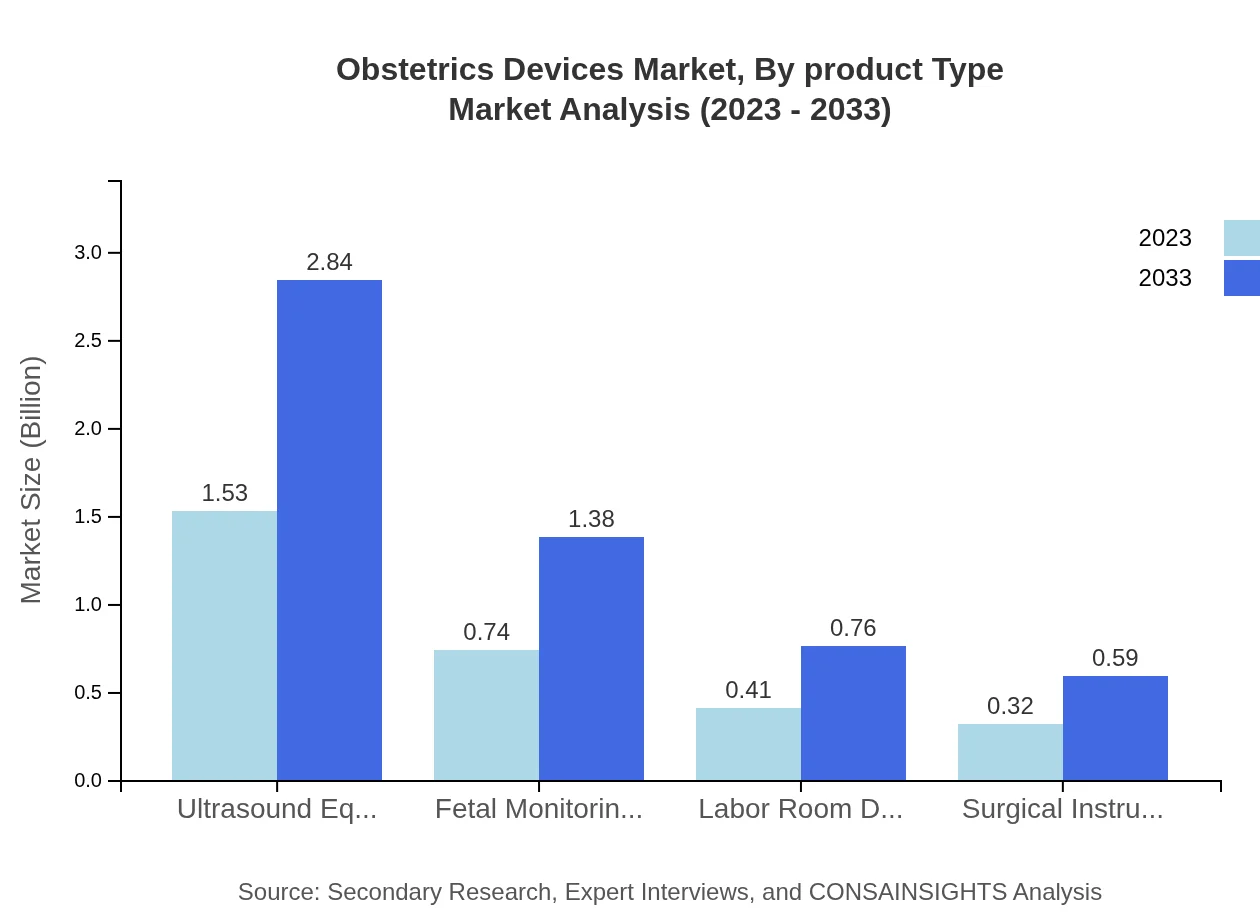
The Obstetrics Devices market by product type includes categories such as fetal monitoring devices, surgical instruments, ultrasound equipment, and prenatal care devices. Fetal monitoring devices dominate the market due to their critical role in monitoring fetal health during pregnancy, constituting approximately 51.08% of the market in 2023 and growing steadily. As the industry progresses, digital technologies are increasingly becoming significant contributors, emphasizing the blend of traditional practices with modern innovations.
Obstetrics Devices Market Analysis By Application
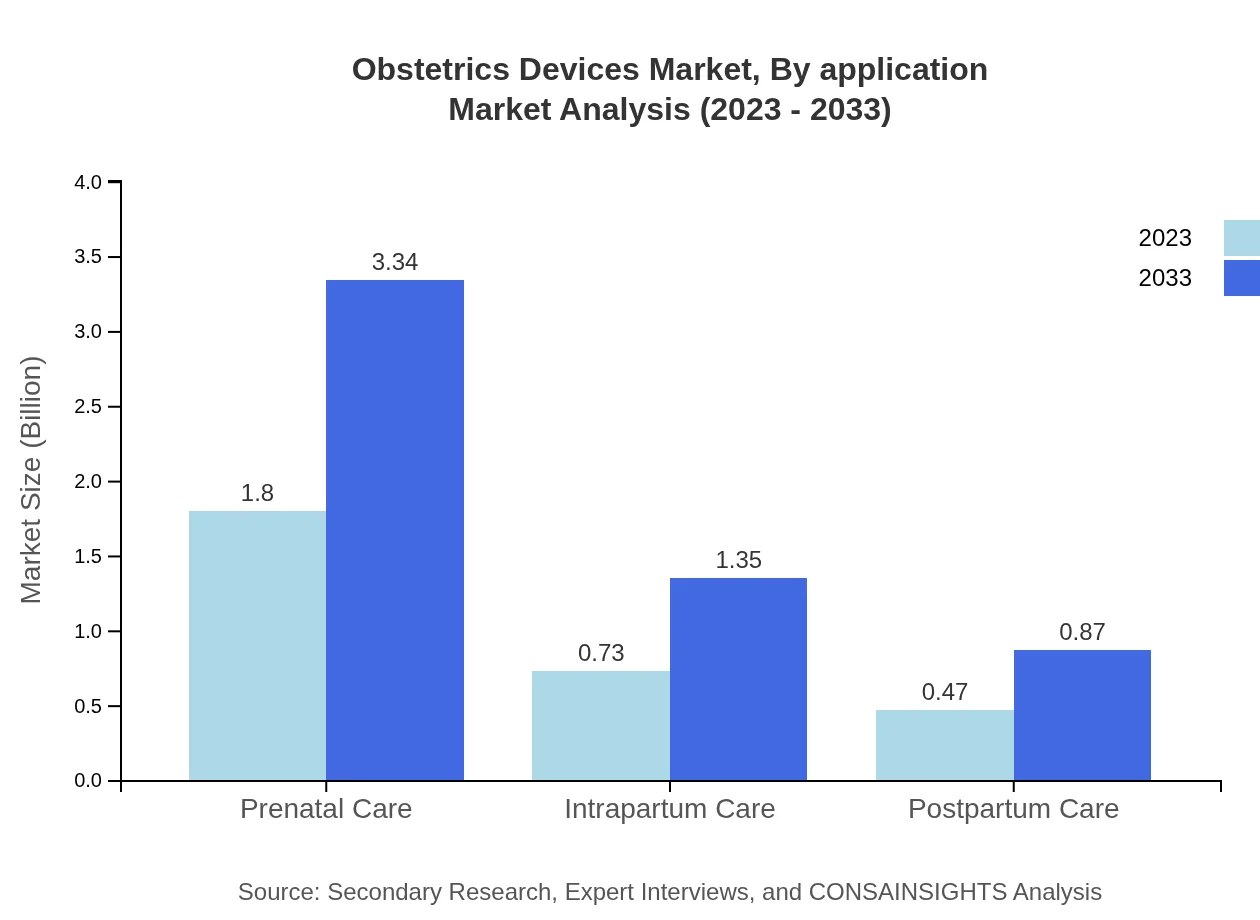
The market analysis by application reveals prenatal care, intrapartum care, and postpartum care as key segments. Prenatal care accounts for 60.07% of the market share in 2023, highlighting its importance in ensuring the health of both mother and child. The increasing focus on comprehensive maternity services is anticipated to further bolster these segments, as healthcare providers prioritize holistic maternal care.
Obstetrics Devices Market Analysis By End User
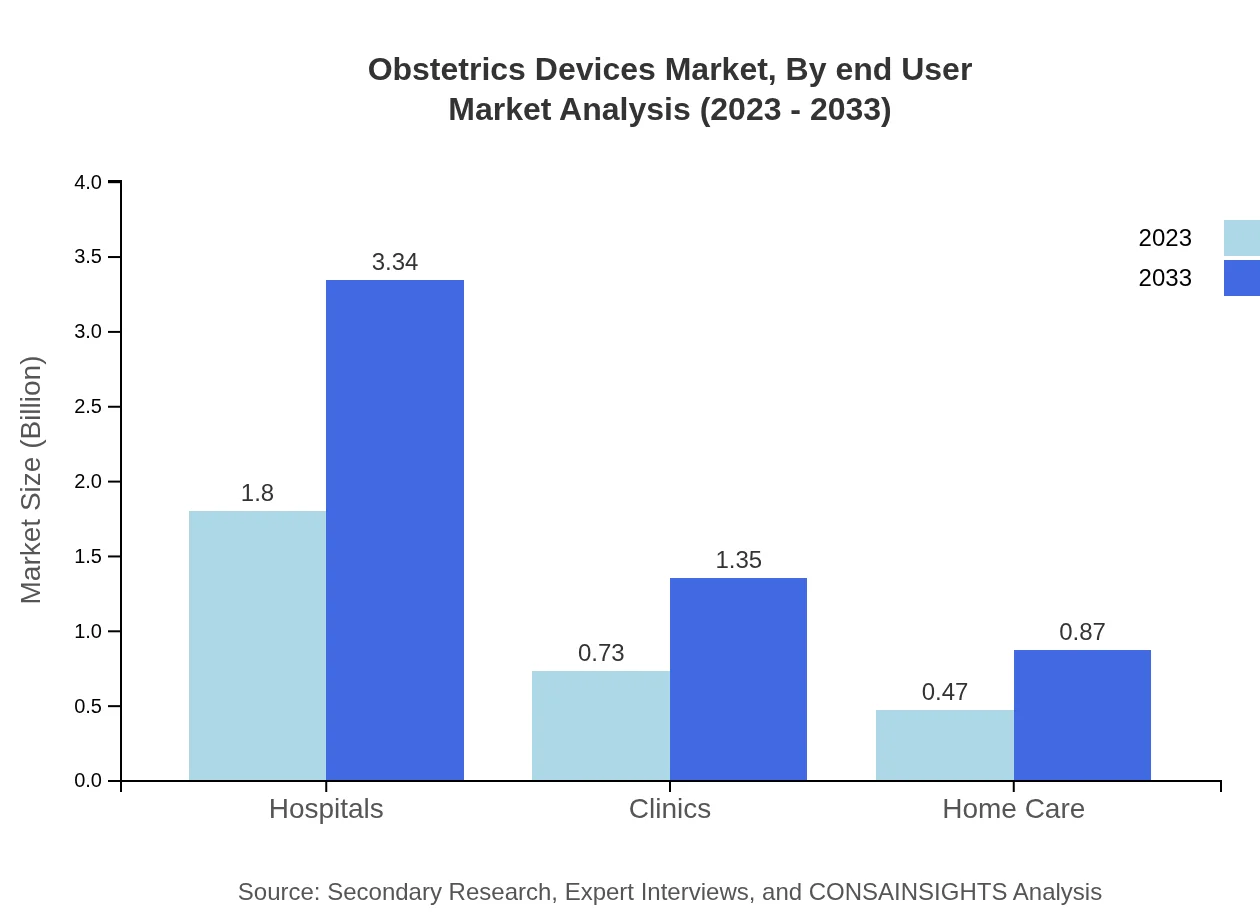
The segmentation by end-user reveals hospitals as the primary users of obstetrics devices, accounting for over 60% of the market share. Clinics and home care facilities are also significant contributors. The hospital segment is expected to grow from $1.80 billion in 2023 to $3.34 billion by 2033, driven by the demand for specialized maternal care services and advanced medical technologies.
Obstetrics Devices Market Analysis By Technology
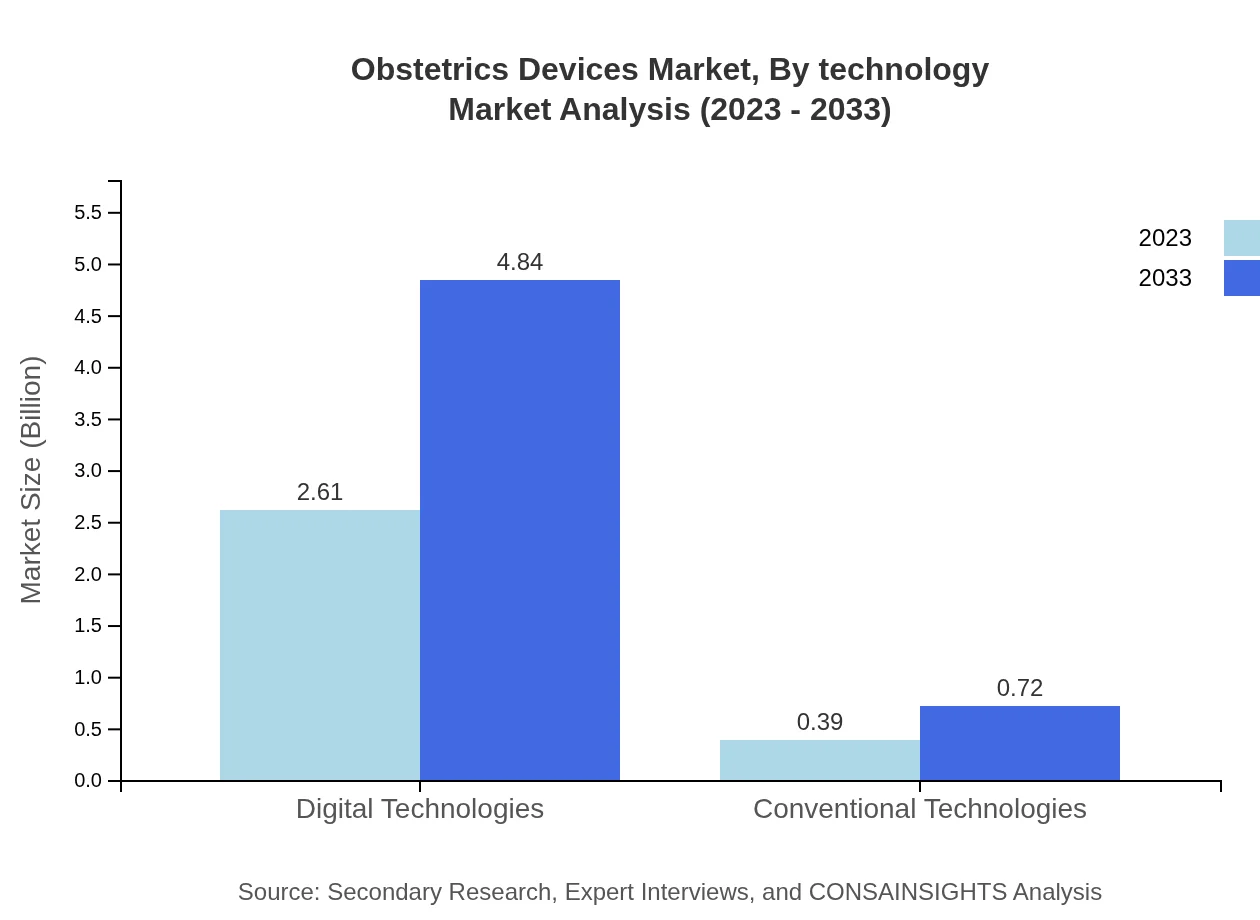
The Obstetrics Devices market is increasingly influenced by technological advancements. Digital technologies dominate with a market share of 87.01% in 2023, showcasing the growing reliance on innovation to enhance patient care and operational efficiency. As the healthcare space continues to adopt electronic health records and telehealth solutions, the market is poised for further technological integration.
Obstetrics Devices Market Trends and Future Forecast
Tell us your focus area and get a customized research report.
Global Market Leaders and Top Companies in Obstetrics Devices Industry
GE Healthcare:
A leading global provider of medical imaging and monitoring solutions, known for its innovative ultrasound systems and fetal monitoring technologies.Siemens Healthineers:
Renowned for its cutting-edge medical devices, particularly advanced imaging and laboratory diagnostics equipment that enhance maternal care.Philips Healthcare:
Specializes in various healthcare solutions, including high-quality ultrasound devices and software for enhanced patient monitoring during pregnancy.Medtronic :
A major player in the medical technology space, offering a range of devices and solutions for maternal-fetal medicine and surgical interventions.We're grateful to work with incredible clients.









FAQs
What is the market size of the obstetrics devices market in 2023?
The market size for obstetrics devices in 2023 is $3.00 Billion, based on the provided market valuation for that year.
How big will the obstetrics devices market be in 2033?
The market is projected to reach $5.56 Billion by 2033 according to the supplied forecast figures for the 2023 to 2033 period.
What is CAGR of the market over the forecast period?
The reported compound annual growth rate (CAGR) for the forecast period 2023 to 2033 is 6.2% as provided in the input data.
Which region is the fastest Growing in the Obstetrics Devices Market Report market?
Latin America is the fastest-growing region, projected to expand from $0.18 Billion in 2023 to $0.34 Billion in 2033, reflecting an implied 6.57% CAGR over the forecast period.
Which region is the fastest Growing and why?
Latin America is noted as the regional market region, rising from $0.18 Billion in 2023 to $0.34 Billion in 2033 at an implied 6.57% CAGR, reflecting emerging market expansion.
Who are the top companies operating in this market?
Top companies listed include GE Healthcare, Siemens Healthineers, Philips Healthcare and Medtronic as key market participants.
What product types are covered in the segmentation?
Product-type segmentation includes ultrasound equipment, fetal monitoring devices, labor room devices and surgical instruments as specified in the input.
How are applications categorized in the report?
Applications are segmented into prenatal care, intrapartum care and postpartum care, aligning with clinical stages of maternal healthcare delivery.
What end User segments are analyzed?
End-user segments examined include hospitals, clinics and home care settings, reflecting where obstetrics devices are deployed.
What research methods were used to compile the report?
The methodology combines primary interviews with industry experts, secondary research from company reports and publications, plus data triangulation and internal validation.