
Reports >
Life Sciences
>
Non Opioid Pain Patch Market Report

Non Opioid Pain Patch Market Report
First published: 20 October 2024 | Last updated: 25 May 2026 | Report Code: non-opioid-pain-patch
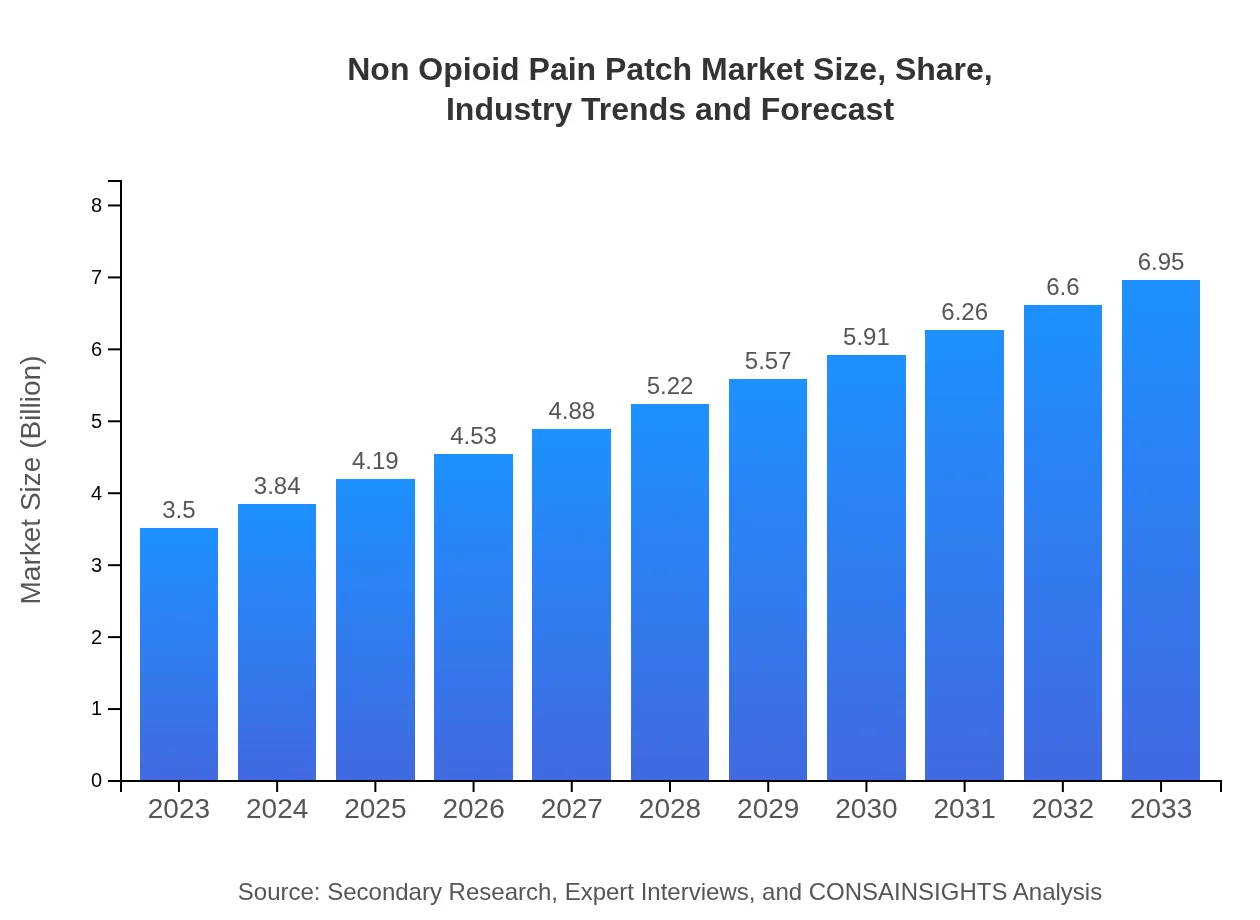
Non Opioid Pain Patch Market — USD 3.5 billion in 2023, Growing to USD 6.95B by 2033 at 6.9% CAGR
This report provides an in-depth analysis of the Non Opioid Pain Patch market from 2023 to 2033. It includes insights into market conditions, size, trends, regional analysis, and forecasts for future growth and challenges.
Key Takeaways
- Global market projected from $3.50 Billion in 2023 to $6.95 Billion in 2033 at a 6.9% CAGR.
- North America is largest regional market, while no single fastest-growing region is stated because regional CAGR differences remain within 0.15 percentage points.
- Europe grows from $1.02 Billion in 2023 to $2.02 Billion in 2033, reflecting strong adoption of non-opioid therapies.
- Asia Pacific expands from $0.67 Billion in 2023 to $1.32 Billion in 2033 amid rising awareness and healthcare investment.
- Key companies include Lidoderm, Qutenza, Salonpas and Purdue Pharma focusing on product innovation and partnerships.
Non Opioid Pain Patch Market Report — Executive Summary
North America remains largest market by forecast-period value, while no single fastest-growing region is stated because top regional growth rates are separated by less than 0.15 percentage points. The Non Opioid Pain Patch market is advancing as clinicians and patients seek opioid alternatives and safer pain-management options. Market size is $3.50 Billion in 2023 with a forecast to reach $6.95 Billion by 2033 at a 6.9% CAGR. Growth is supported by rising awareness of opioid risks, investments in transdermal technology, and collaboration between established firms and new entrants. Regional expansion varies: North America is the largest market, with Europe and Asia Pacific also showing notable increases. Product categories include lidocaine and capsaicin patches and other formulations. Leading companies such as Lidoderm, Qutenza, Salonpas and Purdue Pharma are investing in R&D and distribution to capture demand across hospitals, clinics and homecare channels.
Key Growth Drivers
- Heightened concern over opioid dependence prompting adoption of non-opioid transdermal solutions.
- Ongoing research and development into patch formulations and delivery technologies improving efficacy.
- Collaborative partnerships and clinical studies enhancing product credibility and market uptake.
- Expansion of distribution channels, including pharmacies, hospital supplies and e-commerce, widening access.
- Patient-centric care trends and preference for outpatient and homecare pain-management options.
| Metric | Value |
|---|---|
| Study Period | 2023 - 2033 |
| 2023 Market Size | $3.50 Billion |
| CAGR (2023-2033) | 6.9% |
| 2033 Market Size | $6.95 Billion |
| Top Companies | Lidoderm, Qutenza, Salonpas, Purdue Pharma |
| Published Date | 20 October 2024 |
| Last Modified Date | 25 May 2026 |
Non Opioid Pain Patch Market Overview
Customize Non Opioid Pain Patch Market Report market research report
- ✔ Get in-depth analysis of Non Opioid Pain Patch market size, growth, and forecasts.
- ✔ Understand Non Opioid Pain Patch's regional dynamics and industry-specific trends.
- ✔ Identify potential applications, end-user demand, and growth segments in Non Opioid Pain Patch
What is the Market Size & CAGR of Non Opioid Pain Patch Market Report market in 2023?
Non Opioid Pain Patch Industry Analysis
Non Opioid Pain Patch Market Segmentation and Scope
Tell us your focus area and get a customized research report.
Non Opioid Pain Patch Market Report Market Analysis Report by Region
Europe Non Opioid Pain Patch Market Report:
Europe grows from $1.02 Billion in 2023 to $2.02 Billion in 2033. 02 Billion in 2023 to $2.02 Billion in 2033, reflecting broader clinician acceptance of non-opioid therapies and regulatory environments that favor alternative pain-management strategies alongside R&D activity.Asia Pacific Non Opioid Pain Patch Market Report:
Asia Pacific grows from $0.67 Billion in 2023 to $1.32 Billion in 2033. 67 Billion in 2023 to $1.32 Billion in 2033, driven by rising healthcare expenditure, growing awareness of non-opioid options and expanding access through retail and hospital channels.North America Non Opioid Pain Patch Market Report:
North America is largest regional market, rising from $1.28 Billion in 2023 to $2.54 Billion in 2033. Regional growth is supported by high clinical adoption, strong distribution networks and investment by leading manufacturers, reinforcing its dominant share in the market.South America Non Opioid Pain Patch Market Report:
Latin America grows from $0.27 Billion in 2023 to $0.54 Billion in 2033. 27 Billion in 2023 to $0.54 Billion in 2033, with market development supported by increasing patient awareness and gradual expansion of distribution networks into clinics, pharmacies and homecare.Middle East & Africa Non Opioid Pain Patch Market Report:
Middle East and Africa grows from $0.27 Billion in 2023 to $0.53 Billion in 2033. 27 Billion in 2023 to $0.53 Billion in 2033, reflecting incremental adoption of non-opioid patches, healthcare investment and growing availability through key regional suppliers and channels.Tell us your focus area and get a customized research report.
Research Methodology
Non Opioid Pain Patch Market Analysis By Product
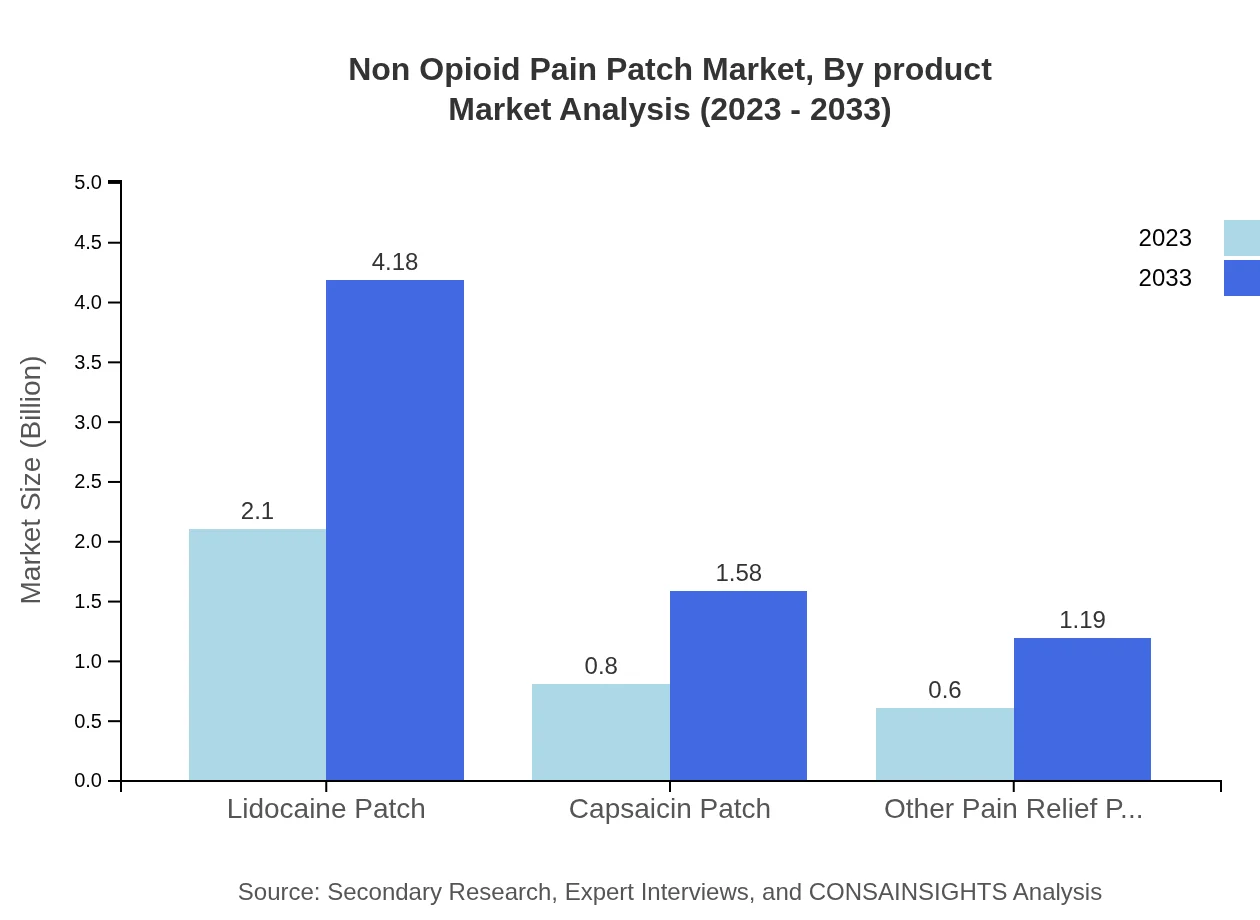
The product segment is led by Lidocaine patches, which represent a market size of $2.10 billion in 2023 and are expected to grow to $4.18 billion by 2033, maintaining a market share of 60.12%. Capsaicin patches, currently valued at $0.80 billion, are projected to grow to $1.58 billion, capturing 22.79% of the market. Additionally, other pain relief patches comprise $0.60 billion in 2023 and are expected to grow to $1.19 billion.
Non Opioid Pain Patch Market Analysis By Indication
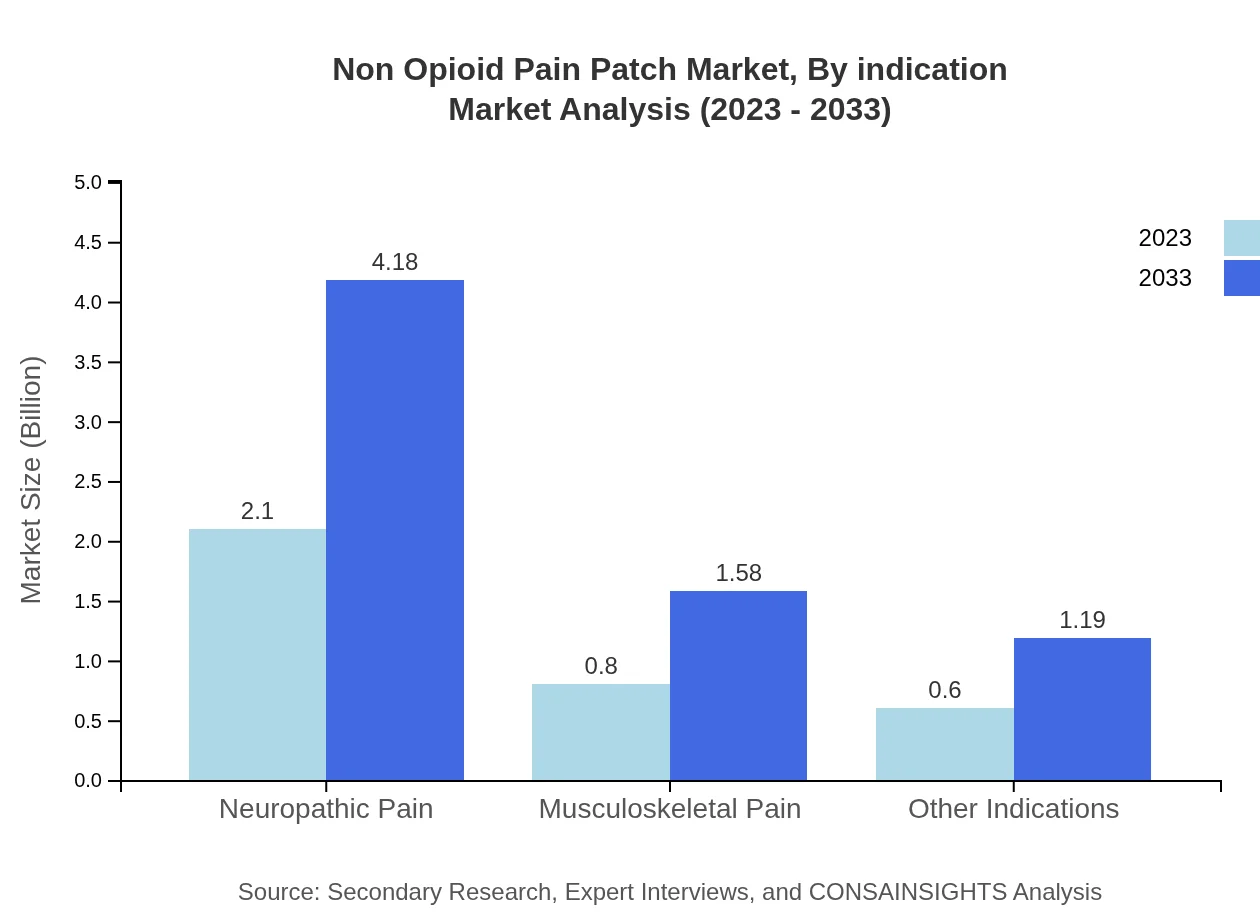
The indications segment shows neuropathic pain leading with a size of $2.10 billion in 2023, spotlighting a significant share of 60.12%. Musculoskeletal pain accounts for $0.80 billion currently, projected to rise significantly. Overall, the increasing need for non-invasive and effective treatment options propels the growth across all indications.
Non Opioid Pain Patch Market Analysis By End User
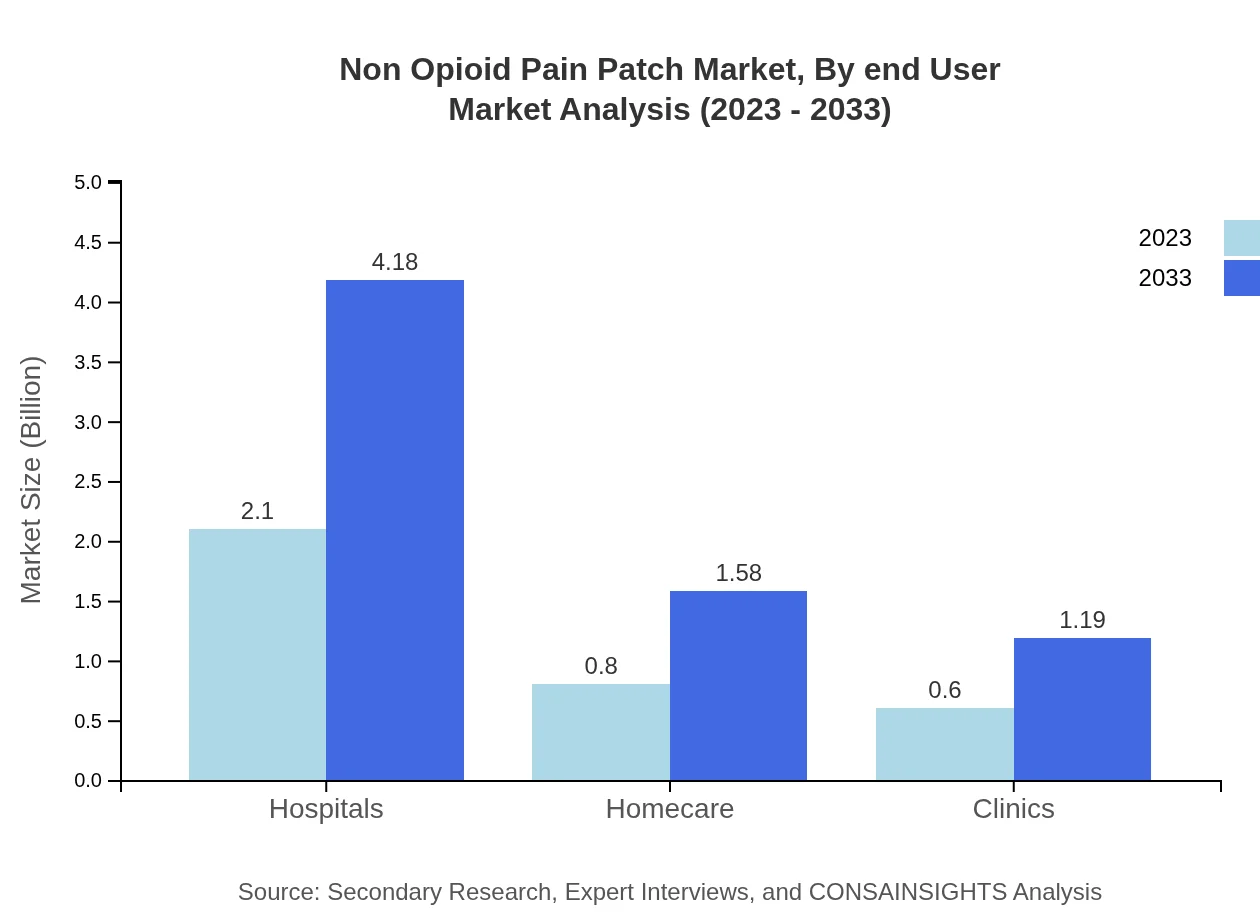
End-users are dominated by hospitals, which hold a market size of $2.10 billion, indicating a robust demand for non-opioid pain management in clinical settings. Homecare settings and pharmacies maintain a combined market estimation supporting further segment growth, with each segment poised to expand as healthcare practices evolve.
Non Opioid Pain Patch Market Analysis By Distribution Channel
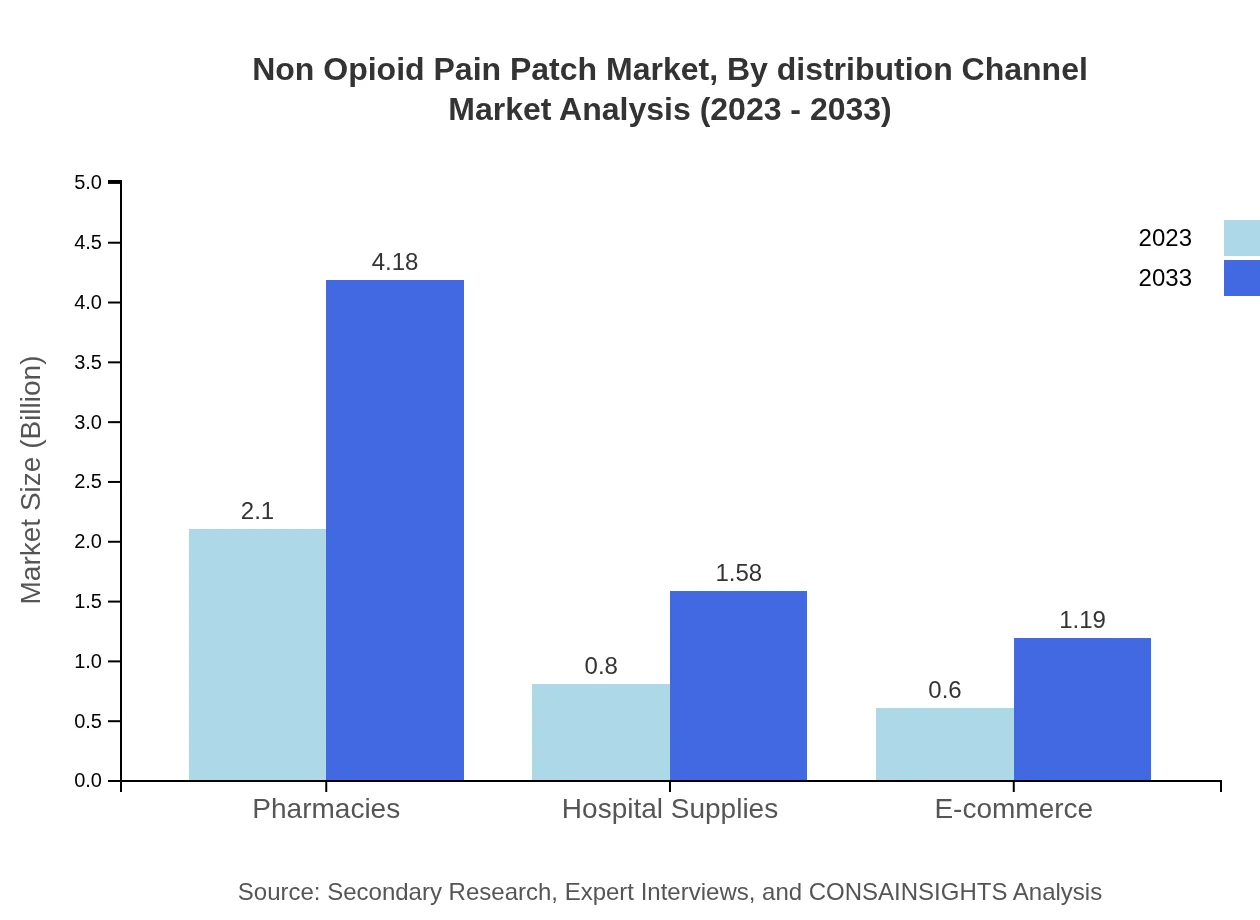
The distribution channels reveal pharmacies leading the market with a size of $2.10 billion in 2023. E-commerce, clinics, and hospital supplies channels contribute significantly to overall revenue, demonstrating a shift towards more integrated pain management delivery approaches.
Non Opioid Pain Patch Market Trends and Future Forecast
Tell us your focus area and get a customized research report.
Global Market Leaders and Top Companies in Non Opioid Pain Patch Industry
Lidoderm:
A leading brand in the lidocaine patch segment, Lidoderm is known for its effective pain relief solutions based on lidocaine technology.Qutenza:
Developed for neuropathic pain relief, Qutenza is a capsaicin patch gaining market traction due to its innovative approach and effectiveness.Salonpas:
Salonpas offers a range of patches for pain relief and is recognized for its extensive distribution across pharmacies and clinics.Purdue Pharma:
Known historically for opioid products, Purdue is pivoting towards non-opioid solutions to provide viable alternatives for pain management.We're grateful to work with incredible clients.








FAQs
What is the market size of the Non Opioid Pain Patch market in 2023?
The market size in 2023 is $3.50 Billion, according to the report data, reflecting current demand for non-opioid transdermal pain-relief products across major regions.
How big is the market expected to be in 2033?
The market is expected to reach $6.95 Billion by 2033, driven by innovation, increased adoption of non-opioid therapies, and broader distribution through pharmacies and e-commerce.
What is CAGR of the market for 2023 to 2033?
The compounded annual growth rate for the forecast period 2023 to 2033 is 6.9%, based on the provided market projections and trend analysis.
Is there a single fastest Growing region in the Non Opioid Pain Patch Market Report market?
No single fastest-growing region is stated for the Non Opioid Pain Patch Market Report market because the top regional implied CAGR values are within 0.15 percentage points of each other, making the ranking too close to call reliably.
Which companies lead the Non Opioid Pain Patch market?
Top companies listed include Lidoderm, Qutenza, Salonpas and Purdue Pharma, recognized for product portfolios, clinical development and distribution reach in key markets.
What are primary channels for product distribution?
Primary distribution channels include pharmacies, hospital supplies and e-commerce, enabling access across hospitals, clinics and homecare settings for patients and providers.
How do product subsegments shape the market?
Product subsegments include lidocaine patches, capsaicin patches and other pain-relief patches, each addressing different pain indications and clinical preferences in treatment protocols.
What drives adoption in Europe and Asia Pacific?
Adoption in Europe and Asia Pacific is driven by increasing awareness of non-opioid treatments, investments in healthcare infrastructure, and growth from $1.02 Billion to $2.02 Billion and $0.67 Billion to $1.32 Billion respectively.