

Non Vascular Stents Market Report
First published: 23 October 2024 | Last updated: 25 May 2026 | Report Code: non-vascular-stents
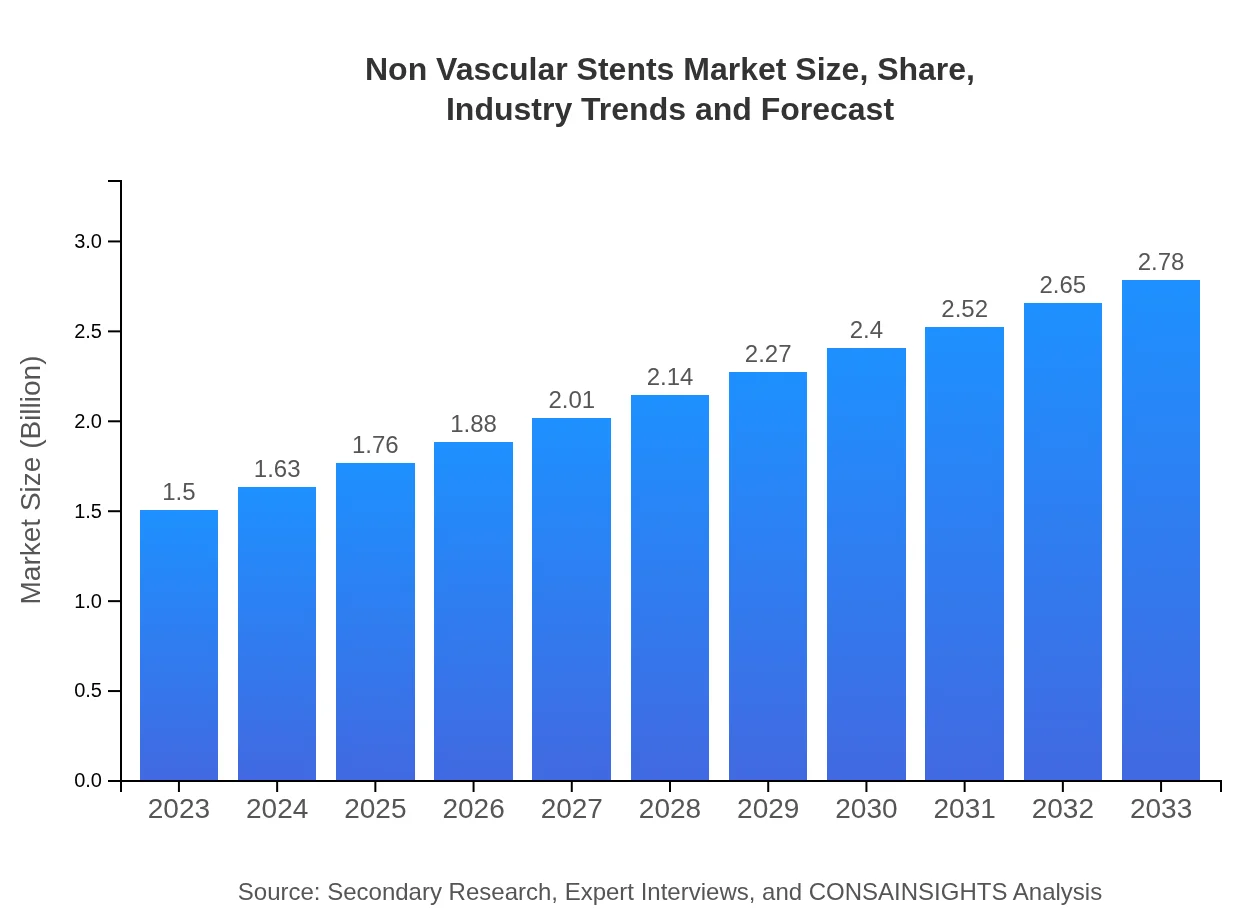
Non Vascular Stents Market — USD $1.5 Billion in 2023, Growing to USD 2.78null by 2033 at 6.2% CAGR
This report provides a comprehensive analysis of the Non Vascular Stents market, covering market size, growth forecasts, segmentations, and industry trends from 2023 to 2033. Insights into regional dynamics and key players are also included to guide stakeholders in making informed decisions.
Key Takeaways
- Global market projected from $1.50 Billion in 2023 to $2.78 Billion in 2033 at a 6.2% CAGR.
- North America is largest regional market, while no single fastest-growing region is stated because regional CAGR differences remain within 0.15 percentage points.
- North America is the largest region, rising from $0.57 Billion in 2023 to $1.06 Billion in 2033.
- Europe grows from $0.47 Billion in 2023 to $0.86 Billion in 2033, while Asia Pacific increases from $0.27 Billion to $0.49 Billion.
- Product innovation, material advancements, and minimally invasive procedure adoption are central market enablers.
Non Vascular Stents Market Report — Executive Summary
North America remains largest market by forecast-period value, while no single fastest-growing region is stated because top regional growth rates are separated by less than 0.15 percentage points. The Non Vascular Stents market is expected to expand from $1.50 Billion in 2023 to $2.78 Billion in 2033 driven by a 6.2% CAGR during the 2023 to 2033 forecast period. Growth stems from technological improvements in stent design, rising clinical adoption of minimally invasive interventions, and advancements in material science such as drug-eluting and bioresorbable options. Regional demand varies, with North America recorded as the largest regional market, supported by strong healthcare infrastructure. Market segmentation covers usage (temporary and permanent), product types (bare metal, drug-eluting, bioresorbable), materials (metal, polymer, composite), and applications including gastrointestinal, urological, and pulmonary uses. Competitive activity features established players like Boston Scientific, Medtronic, Abbott Laboratories, and C. R. Bard. Regulatory considerations and product adoption challenges influence timelines, while continued innovation and clinical evidence generation are expected to shape vendor strategies and product portfolios through 2033.
Key Growth Drivers
- Advances in stent materials and coatings improving clinical outcomes and widening indications.
- Increased uptake of minimally invasive procedures for non-vascular conditions, driving demand for specialized stents.
- Rising awareness and diagnosis of conditions requiring non-vascular stenting across clinical specialties.
- Ongoing product launches and improvements by major manufacturers such as Boston Scientific, Medtronic, Abbott Laboratories, and C. R. Bard.
| Metric | Value |
|---|---|
| Study Period | 2023 - 2033 |
| 2023 Market Size | $1.50 Billion |
| CAGR (2023-2033) | 6.2% |
| 2033 Market Size | $2.78 Billion |
| Top Companies | Boston Scientific, Medtronic , Abbott Laboratories, C. R. Bard |
| Published Date | 23 October 2024 |
| Last Modified Date | 25 May 2026 |
Non Vascular Stents Market Overview
Customize Non Vascular Stents Market Report market research report
- ✔ Get in-depth analysis of Non Vascular Stents market size, growth, and forecasts.
- ✔ Understand Non Vascular Stents's regional dynamics and industry-specific trends.
- ✔ Identify potential applications, end-user demand, and growth segments in Non Vascular Stents
What is the Market Size & CAGR of Non Vascular Stents Market Report market in 2023?
Non Vascular Stents Industry Analysis
Non Vascular Stents Market Segmentation and Scope
Tell us your focus area and get a customized research report.
Non Vascular Stents Market Report Market Analysis Report by Region
Europe Non Vascular Stents Market Report:
Europe grows from $0.47 Billion in 2023 to $0.86 Billion in 2033. Regional expansion is influenced by growing clinical awareness, investments in minimally invasive care, and ongoing adoption of drug-eluting and bioresorbable stents.Asia Pacific Non Vascular Stents Market Report:
Asia Pacific grows from $0.27 Billion in 2023 to $0.49 Billion in 2033. Growth is tied to expanding healthcare access, rising procedural volumes, and interest in innovative stent materials and minimally invasive techniques.North America Non Vascular Stents Market Report:
North America is largest regional market, rising from $0.57 Billion in 2023 to $1.06 Billion in 2033. Local drivers include established healthcare infrastructure, high procedure volumes, and adoption of advanced stent technologies supporting sustained demand.South America Non Vascular Stents Market Report:
Latin America grows from $0.01 Billion in 2023 to $0.01 Billion in 2033. 01 Billion in 2023 and remains $0.01 Billion in 2033. Market movement is influenced by access to care and gradual uptake of stent technologies in selected clinical centers.Middle East & Africa Non Vascular Stents Market Report:
Middle East and Africa grows from $0.19 Billion in 2023 to $0.35 Billion in 2033. Regional gains reflect investments in healthcare infrastructure and selective adoption of advanced stenting solutions.Tell us your focus area and get a customized research report.
Research Methodology
Non Vascular Stents Market Analysis By Product
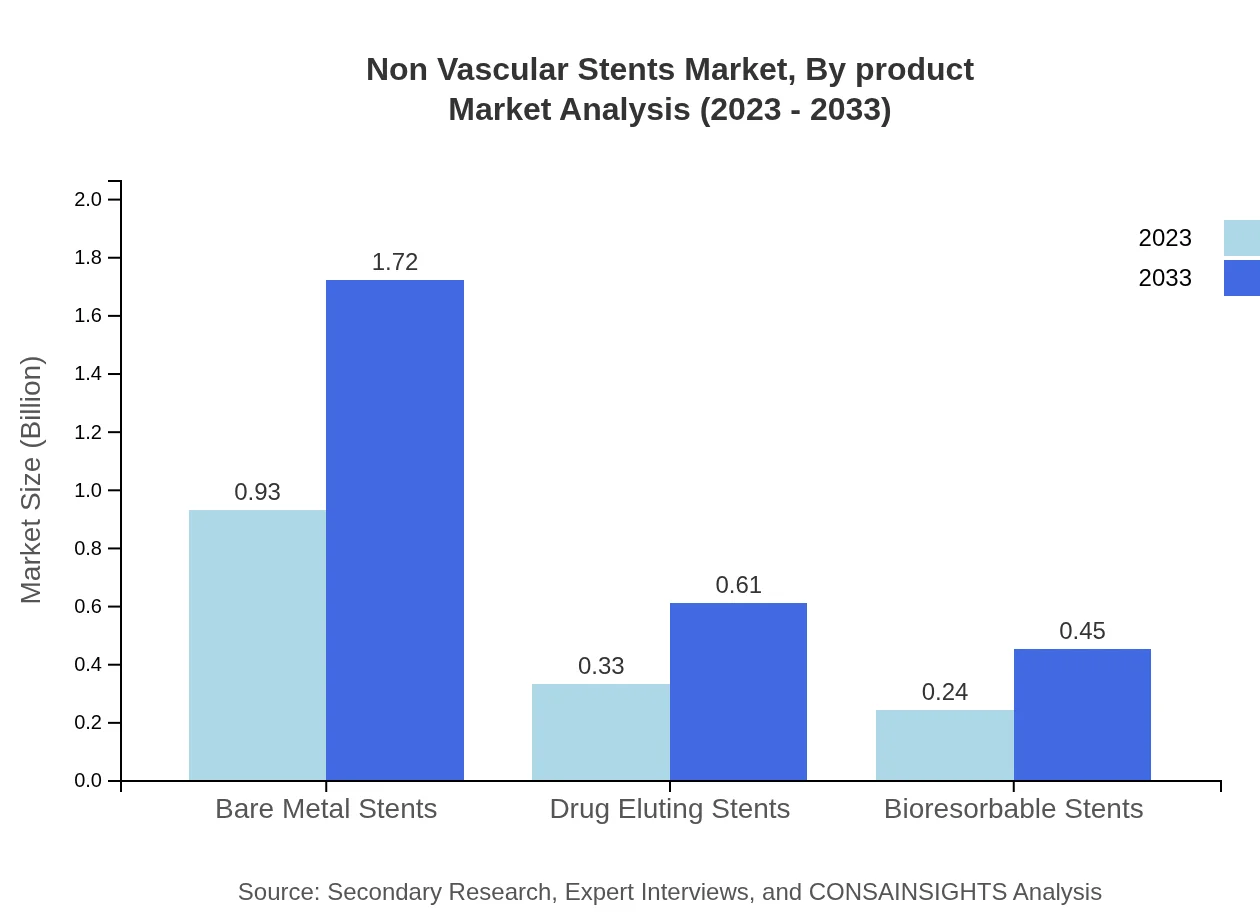
The Non-Vascular Stents Market is dominated by temporary stents which accounted for $1.31 billion in 2023 and are expected to rise to $2.43 billion by 2033, capturing 87.37% market share. Permanent stents, on the other hand, represent a smaller segment valued at $0.19 billion in 2023, growing to $0.35 billion by 2033 and maintaining a 12.63% share.
Non Vascular Stents Market Analysis By Application
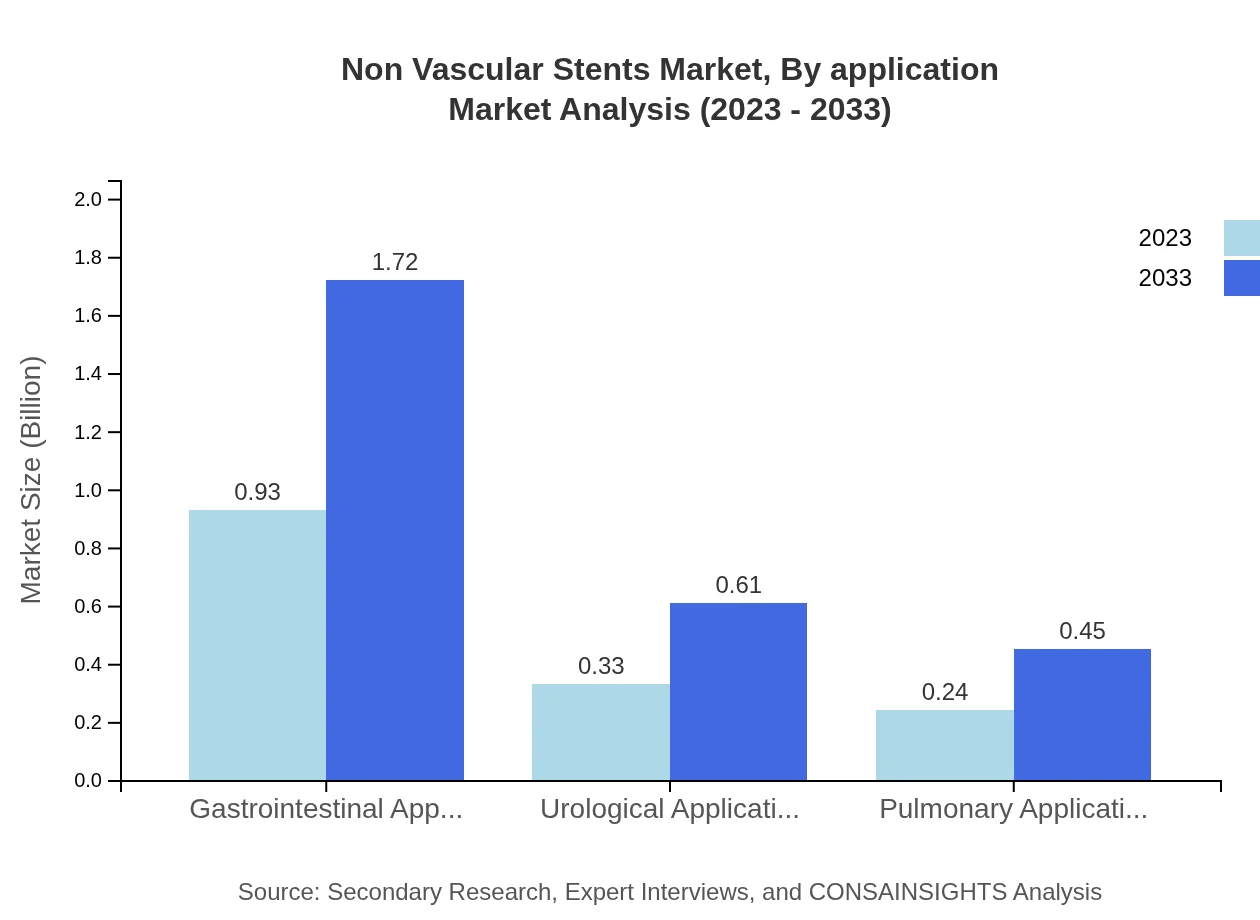
The key applications for Non-Vascular Stents include gastrointestinal, urological, and pulmonary applications. Gastrointestinal applications account for the largest market size of $0.93 billion in 2023, expected to grow to $1.72 billion by 2033. Urological applications currently stand at $0.33 billion, rising to $0.61 billion in the same period, while pulmonary applications will grow from $0.24 billion to $0.45 billion by 2033.
Non Vascular Stents Market Analysis By Material
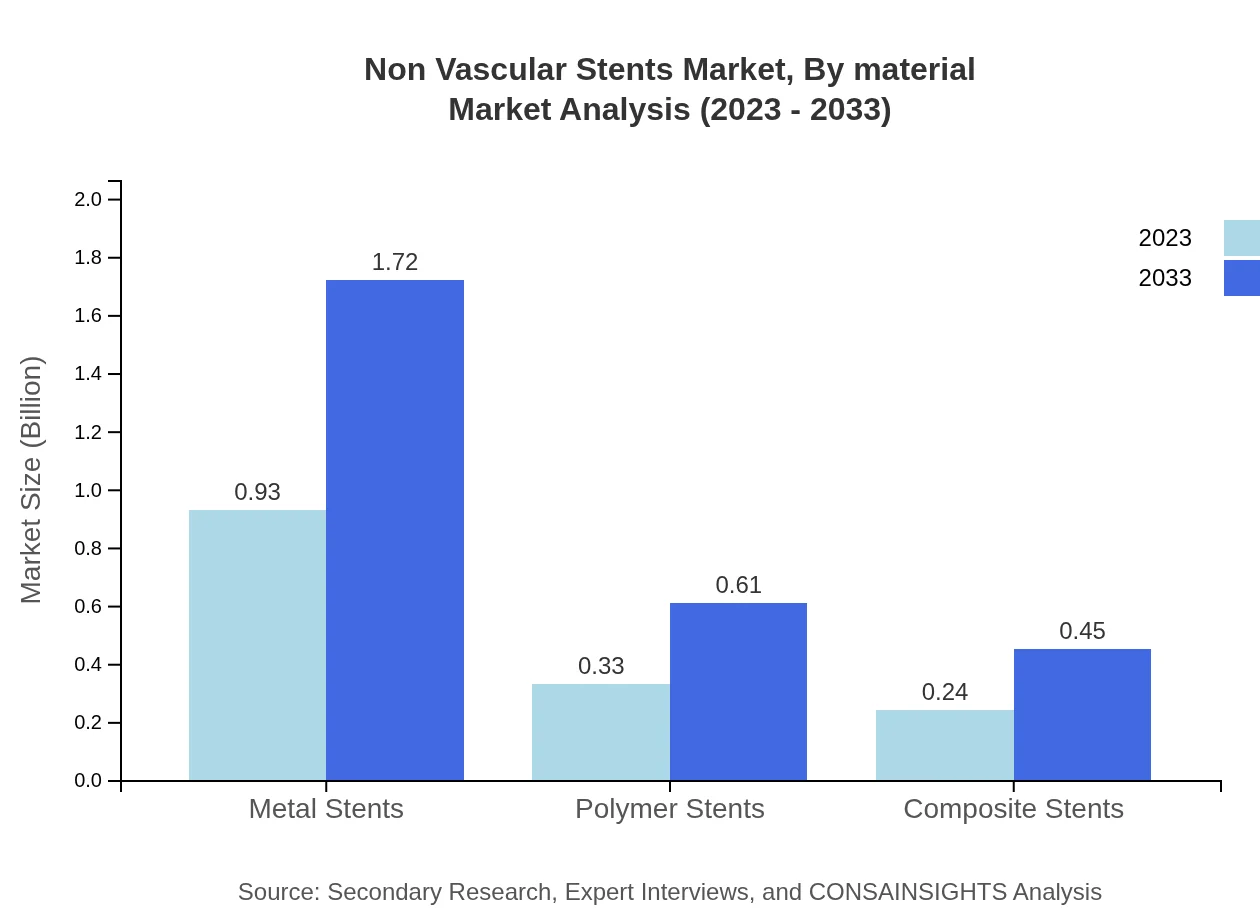
Metal stents are the leading material choice, dominating the market with $0.93 billion in 2023 and forecasted to reach $1.72 billion by 2033 with a 61.88% share. Followed by polymer stents at $0.33 billion in 2023, expected to grow to $0.61 billion, and bioresorbable stents which are estimated to increase from $0.24 billion to $0.45 billion.
Non Vascular Stents Market Analysis By Usage
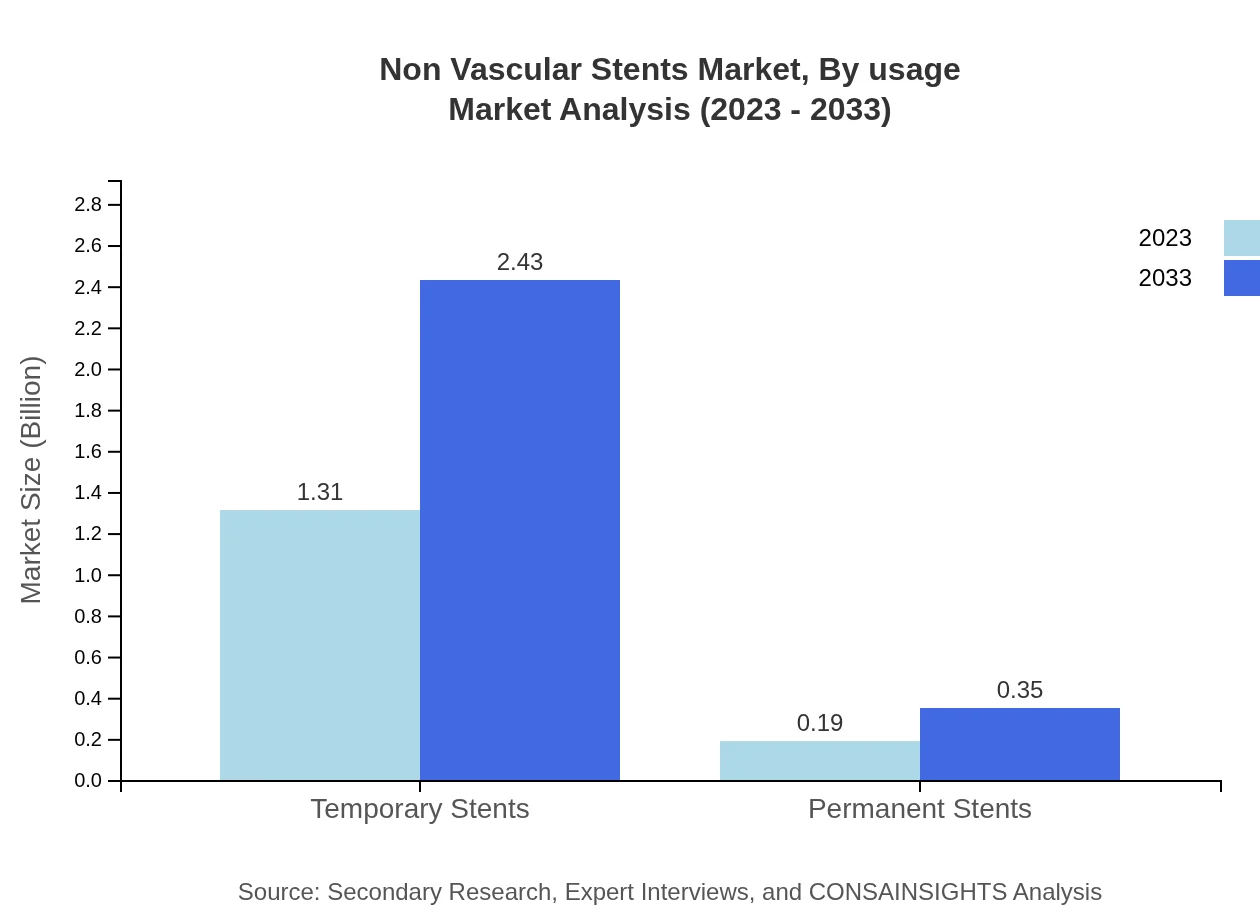
The usage of Non-Vascular Stents is primarily bifurcated into temporary and permanent categories. Temporary stents are favored due to their effectiveness in acute conditions with a current market size of $1.31 billion projected to increase to $2.43 billion, while permanent stents are valued at $0.19 billion, growing to $0.35 billion.
Non Vascular Stents Market Trends and Future Forecast
Tell us your focus area and get a customized research report.
Global Market Leaders and Top Companies in Non Vascular Stents Industry
Boston Scientific:
Boston Scientific is a leading innovator in the medical device industry, providing a range of solutions including advanced stents for non-vascular applications that enhance patient outcomes.Medtronic :
Medtronic develops and manufactures stents, focusing on comprehensive treatment for a wide range of medical conditions with a strong emphasis on technology and patient safety.Abbott Laboratories:
Abbott Laboratories specializes in innovative medical devices and technologies, including numerous solutions for non-vascular stenting applications, ensuring quality and efficiency.C. R. Bard:
C. R. Bard is known for its medical products and technologies, leading in the non-vascular stent market with a focus on both advanced design and patient care.We're grateful to work with incredible clients.








FAQs
What is the market size of the Non Vascular Stents market in 2023?
The market size for Non Vascular Stents in 2023 is $1.50 Billion, based on the provided market data for the baseline year.
How big will the market be in 2033?
By 2033 the Non Vascular Stents market is projected to reach $2.78 Billion according to the supplied forecast figures for the period.
What is CAGR for the forecast period?
The compound annual growth rate for the forecast period 2023 to 2033 is stated as 6.2% in the input data.
Is there a single fastest Growing region in the Non Vascular Stents Market Report market?
No single fastest-growing region is stated for the Non Vascular Stents Market Report market because the top regional implied CAGR values are within 0.15 percentage points of each other, making the ranking too close to call reliably.
Which companies are leading the market?
Top companies listed include Boston Scientific, Medtronic, Abbott Laboratories, and C. R. Bard as notable participants in the market landscape.
What are the main application areas for non Vascular stents?
Key applications noted are gastrointestinal, urological, and pulmonary uses, each supporting demand for different stent designs and material choices.
What drives product innovation in this market?
Innovation is driven by material science developments, demand for drug-eluting and bioresorbable options, and the need for improved patient outcomes and procedural efficiency.
How is regional growth distributed across markets?
Regional figures show North America at $0.57 Billion to $1.06 Billion, Europe $0.47 Billion to $0.86 Billion, Asia Pacific $0.27 Billion to $0.49 Billion, Latin America $0.01 Billion to $0.01 Billion, and Middle East and Africa $0.19 Billion to $0.35 Billion.