

Nuclear Imaging Market Report
First published: 16 October 2024 | Last updated: 25 May 2026 | Report Code: nuclear-imaging
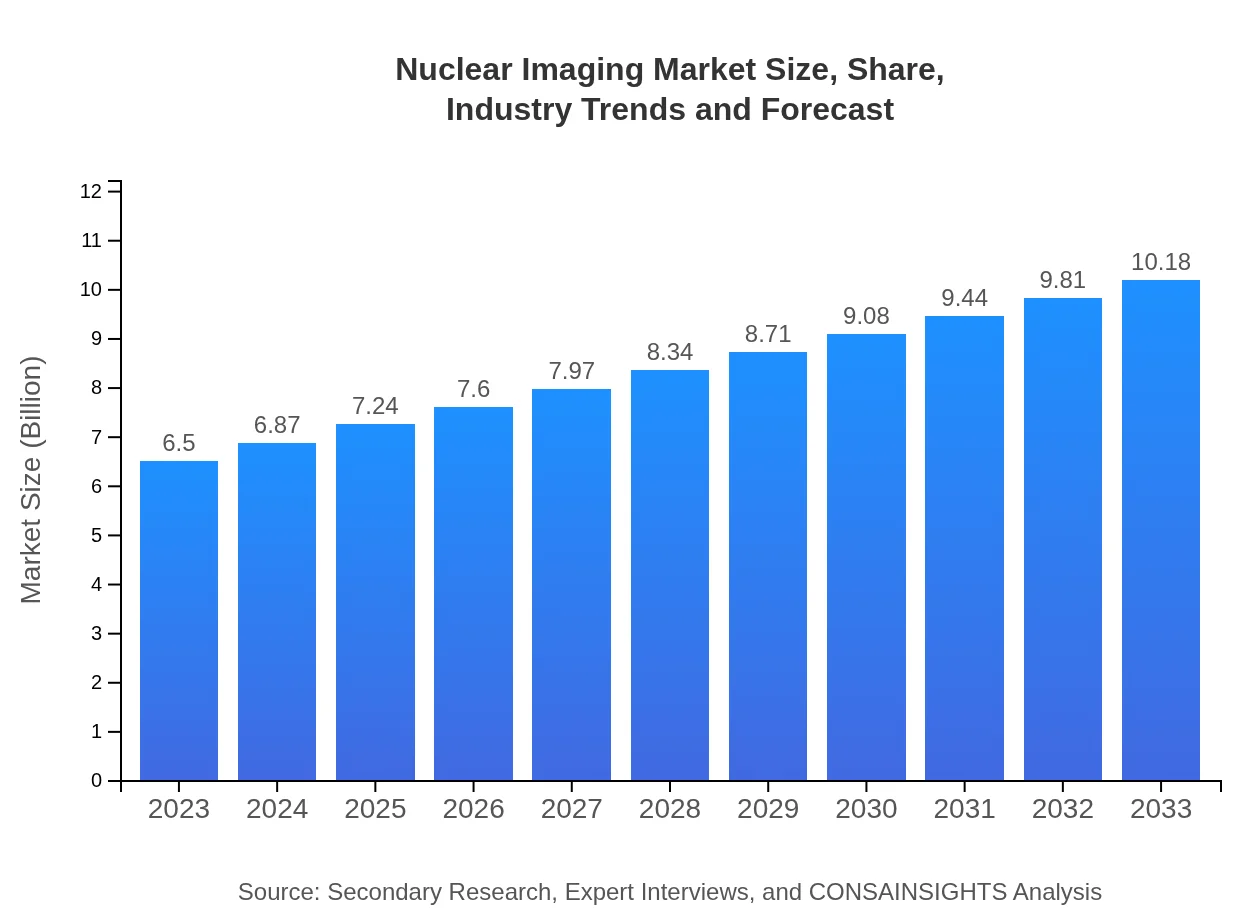
Nuclear Imaging Market — USD 6.5 billion in 2023, Growing to USD 10.18B by 2033 at 4.5% CAGR
This report provides a comprehensive analysis of the Nuclear Imaging market, including market dynamics, segmentation, regional insights, and future forecasts from 2023 to 2033. It aims to deliver detailed data and key trends shaping this industry over the forecast period.
Key Takeaways
- Global market grows from $6.50 Billion in 2023 to $10.18 Billion in 2033 with a 4.5% CAGR for 2023 to 2033.
- North America is largest regional market, while no single fastest-growing region is stated because regional CAGR differences remain within 0.15 percentage points.
- North America leads regionally, increasing from $2.17 Billion to $3.41 Billion between 2023 and 2033.
- Europe expands from $1.9 Billion to $2.98 Billion driven by clinical adoption and infrastructure investments.
- Asia Pacific rises from $1.4 Billion to $2.2 Billion as diagnostic capacity and access improve.
- Leading vendors include Siemens Healthineers, GE Healthcare, Philips Healthcare, Canon Medical Systems and Bracco Imaging.
Nuclear Imaging Market Report — Executive Summary
North America remains largest market by forecast-period value, while no single fastest-growing region is stated because top regional growth rates are separated by less than 0.15 percentage points. The nuclear imaging market is projected to expand notably from $6.50 Billion in 2023 to $10.18 Billion by 2033, reflecting a 4.5% CAGR for 2023 to 2033. Growth is anchored in rising demand for precise diagnostic modalities, increased procedure volumes in hospitals and diagnostic centers, and ongoing enhancements in imaging hardware and radiopharmaceuticals. Regional advances vary: North America remains the largest market, while Europe and Asia Pacific show meaningful gains as healthcare infrastructure and access improve. Key industry participants such as Siemens Healthineers, GE Healthcare, Philips Healthcare, Canon Medical Systems and Bracco Imaging are active in product innovation and partnerships. Regulatory pathways and reimbursement frameworks will continue to shape adoption, and evolving imaging technologies alongside expanding radiotracer options are expected to influence market structure and procurement decisions across hospitals, diagnostic centers and research institutions.
Key Growth Drivers
- Rising procedure volumes in hospitals and diagnostic centers increase demand for imaging equipment and radiopharmaceuticals.
- Technological improvements in PET, SPECT and hybrid systems enhance diagnostic accuracy and broaden clinical applications.
- Expansion of imaging infrastructure and access in emerging healthcare markets supports sustained market expansion.
- Development and commercialization of novel radiotracers drive use in oncology, cardiology and neurology.
- Strategic partnerships among device makers, pharmaceutical firms and healthcare providers accelerate product availability.
| Metric | Value |
|---|---|
| Study Period | 2023 - 2033 |
| 2023 Market Size | $6.50 Billion |
| CAGR (2023-2033) | 4.5% |
| 2033 Market Size | $10.18 Billion |
| Top Companies | Siemens Healthineers, GE Healthcare, Philips Healthcare, Canon Medical Systems, Bracco Imaging |
| Published Date | 16 October 2024 |
| Last Modified Date | 25 May 2026 |
Nuclear Imaging Market Overview
Customize Nuclear Imaging Market Report market research report
- ✔ Get in-depth analysis of Nuclear Imaging market size, growth, and forecasts.
- ✔ Understand Nuclear Imaging's regional dynamics and industry-specific trends.
- ✔ Identify potential applications, end-user demand, and growth segments in Nuclear Imaging
What is the Market Size & CAGR of Nuclear Imaging Market Report market in 2023?
Nuclear Imaging Industry Analysis
Nuclear Imaging Market Segmentation and Scope
Tell us your focus area and get a customized research report.
Nuclear Imaging Market Report Market Analysis Report by Region
Europe Nuclear Imaging Market Report:
Europe grows from $1.9 Billion in 2023 to $2.98 Billion in 2033. Adoption is fueled by investments in clinical imaging capacity, regional research into radiotracers, and healthcare systems emphasizing diagnostic precision for oncology and cardiology.Asia Pacific Nuclear Imaging Market Report:
Asia Pacific grows from $1.4 Billion in 2023 to $2.2 Billion in 2033. Expansion reflects rising access to diagnostic services, infrastructure build-out in hospitals and diagnostic centers, and growing utilization of nuclear imaging in emergent healthcare markets.North America Nuclear Imaging Market Report:
North America is largest regional market, rising from $2.17 Billion in 2023 to $3.41 Billion in 2033. Growth is supported by established imaging infrastructure, higher procedure volumes in hospitals and diagnostic centers, and active vendor presence driving equipment upgrades and tracer availability.South America Nuclear Imaging Market Report:
Latin America grows from $0.4 Billion in 2023 to $0.63 Billion in 2033. Market progress is linked to expanding diagnostic center networks, increased clinical awareness of nuclear imaging benefits, and gradual procurement of modern imaging systems.Middle East & Africa Nuclear Imaging Market Report:
Middle East and Africa grows from $0.62 Billion in 2023 to $0.97 Billion in 2033. Growth drivers include strengthening healthcare infrastructure, investments in diagnostic capabilities, and adoption of advanced imaging techniques in select urban centers.Tell us your focus area and get a customized research report.
Research Methodology
Nuclear Imaging Market Analysis By Product
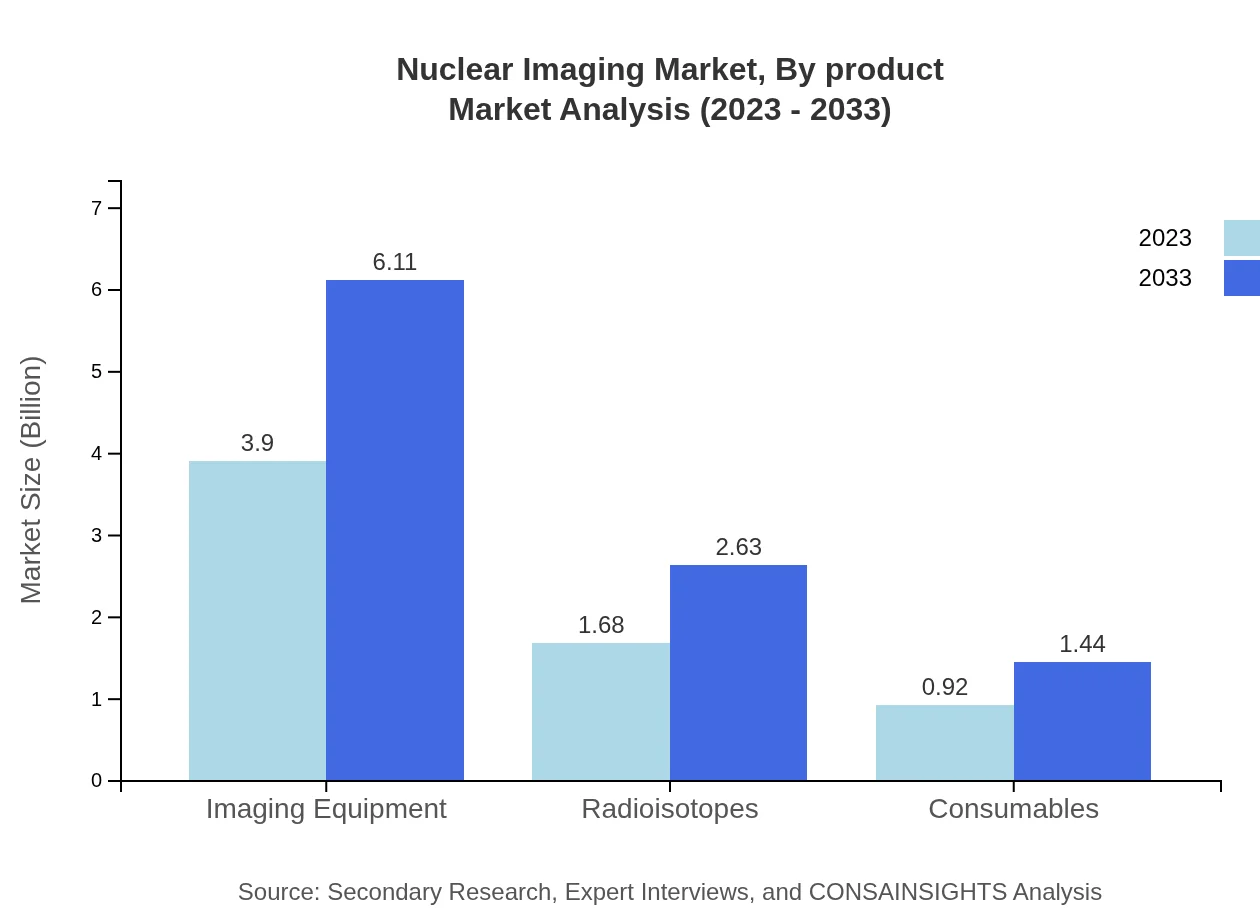
The Nuclear Imaging market, by product, includes segments such as imaging equipment, radioisotopes, and consumables. The imaging equipment segment leads with a market size of $3.90 billion in 2023, expected to grow to $6.11 billion by 2033, maintaining a market share of 60.01%. In parallel, the radioisotopes segment is valued at $1.68 billion in 2023 and is anticipated to reach $2.63 billion in 2033, holding a market share of 25.84%. Consumables, integral for radiopharmaceuticals delivery, will grow from $0.92 billion to $1.44 billion within the same period, maintaining a 14.15% market share.
Nuclear Imaging Market Analysis By Application
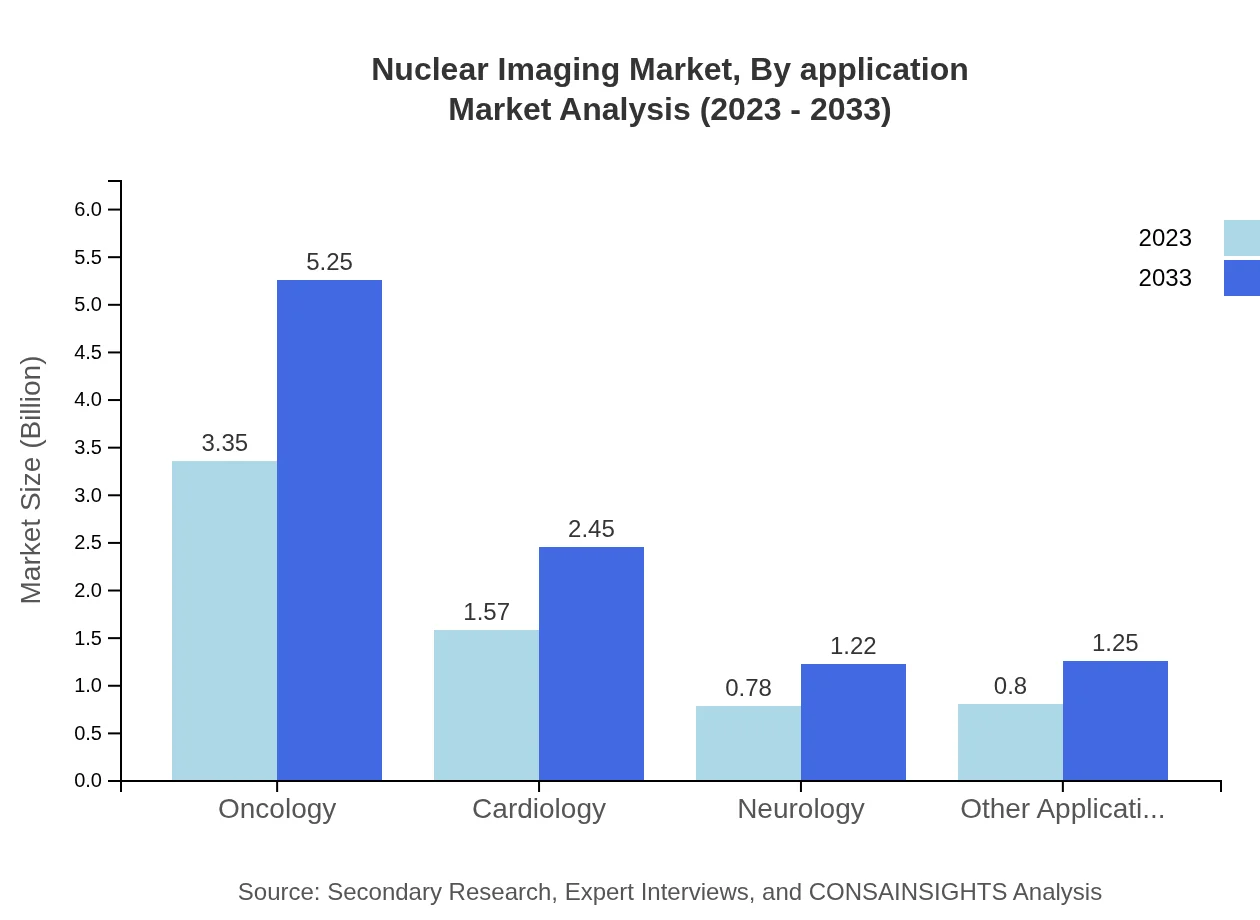
The applications of Nuclear Imaging include oncology, cardiology, neurology, and other applications. The oncology segment commands the largest share, with a market size of $3.35 billion in 2023, expectedto increase to $5.25 billion by 2033, representing 51.61% of the market. The cardiology segment is also significant, reflecting a market size of $1.57 billion in 2023 and anticipated growth to $2.45 billion by 2033, contributing 24.1% to the market. Neurology is growing as well, from $0.78 billion to $1.22 billion, making up 12.01% of the application market.
Nuclear Imaging Market Analysis By End User
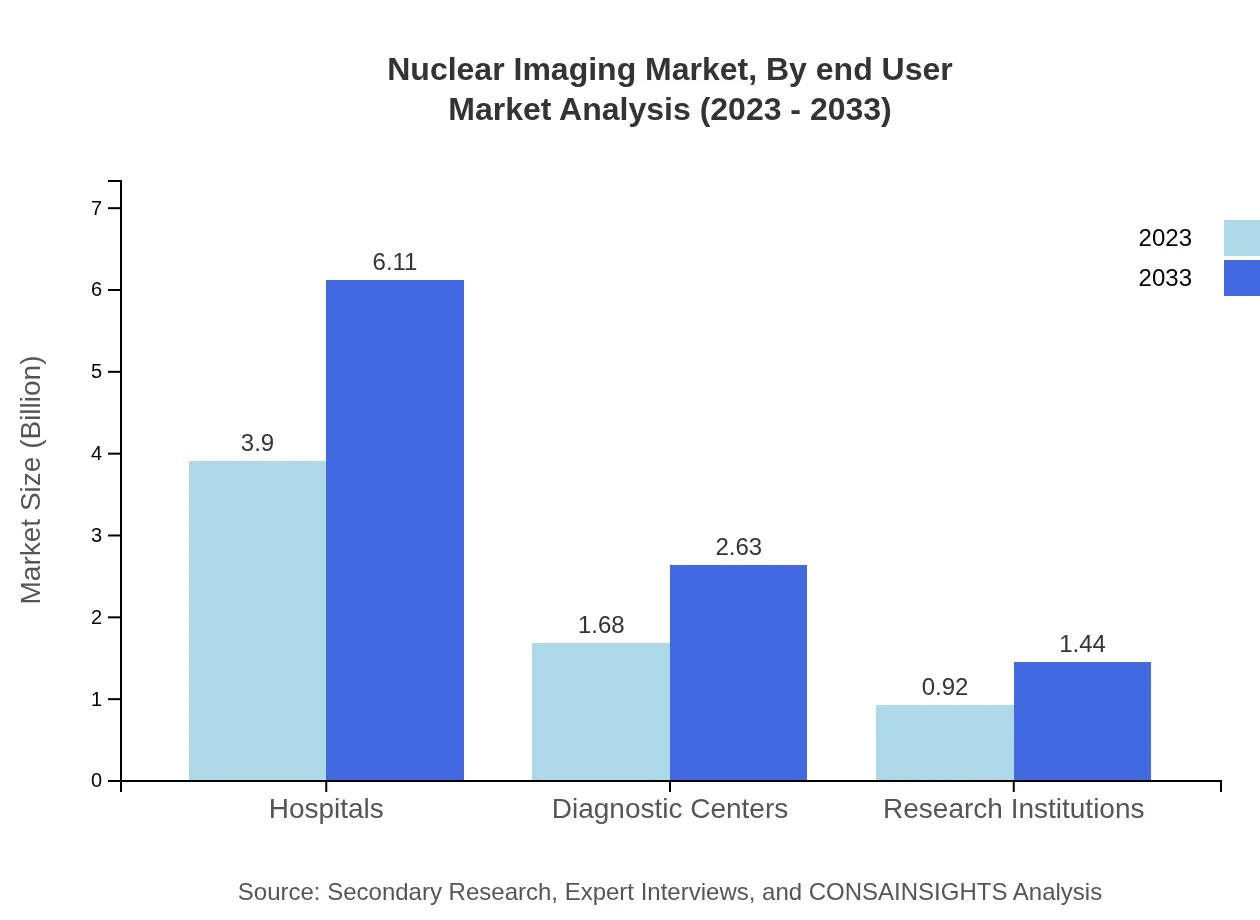
The Nuclear Imaging market by end-user consists primarily of hospitals, diagnostic centers, and research institutions. Hospitals dominate the sector with a size of $3.90 billion in 2023, projected to reach $6.11 billion by 2033, maintaining a 60.01% market share. Diagnostic centers are next, with market sizes growing from $1.68 billion to $2.63 billion, holding a share of 25.84%. Research institutions' market segment will grow from $0.92 billion to $1.44 billion, accounting for 14.15% of the total market.
Nuclear Imaging Market Analysis By Technology
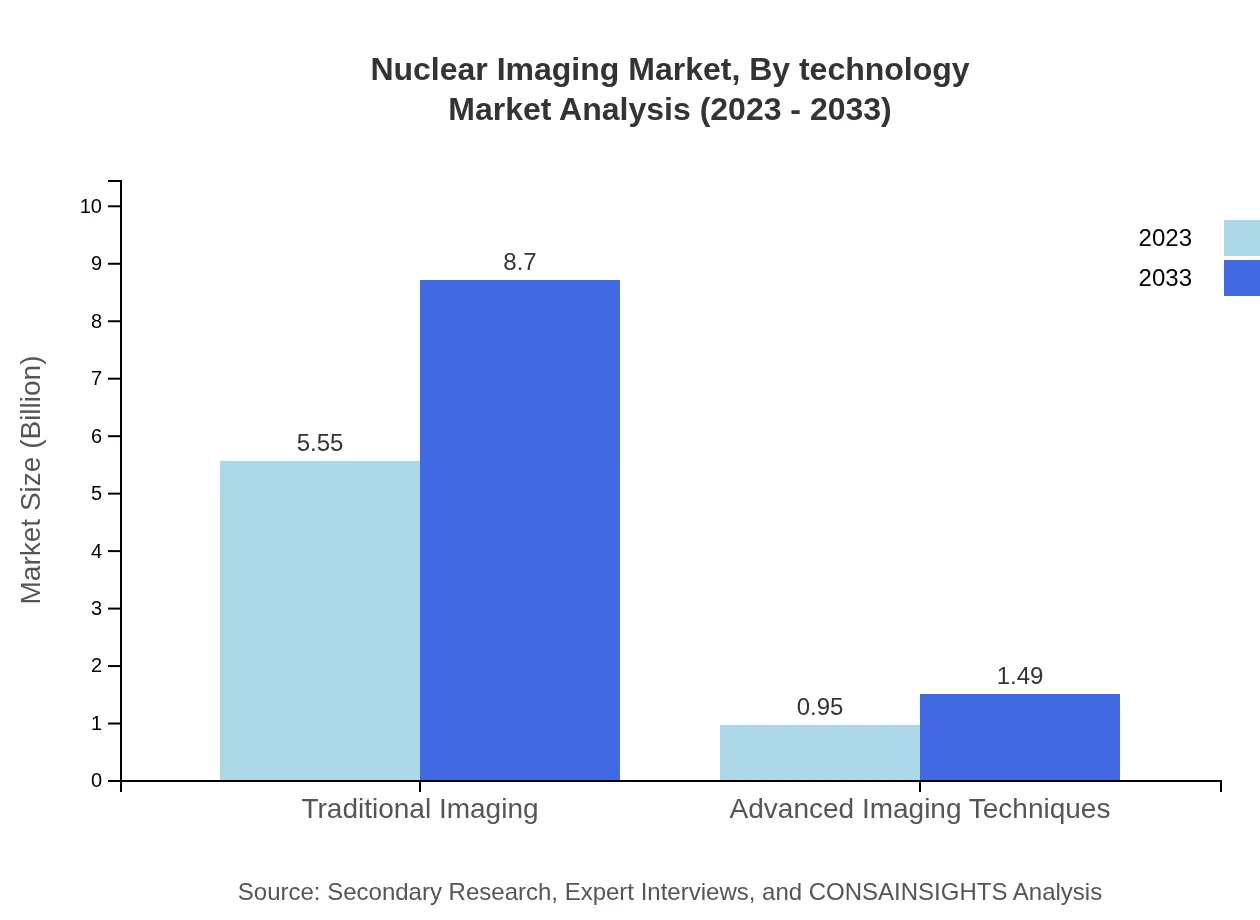
The Nuclear Imaging market is also segmented by technology into traditional imaging techniques and advanced imaging methods. Traditional imaging, comprising SPECT and PET systems, is valued at $5.55 billion in 2023, expected to reach $8.70 billion by 2033, dominating the market with an 85.41% share. Conversely, advanced imaging techniques, including hybrid imaging modalities, are anticipated to grow from $0.95 billion to $1.49 billion, comprising a 14.59% share of the market as technology continues to evolve.
Nuclear Imaging Market Trends and Future Forecast
Tell us your focus area and get a customized research report.
Global Market Leaders and Top Companies in Nuclear Imaging Industry
Siemens Healthineers:
A leading global medical technology company, Siemens Healthineers is known for its advanced imaging systems, contributing significantly to the Nuclear Imaging market with innovative PET and SPECT technologies.GE Healthcare:
As a pioneer in healthcare technologies, GE Healthcare specializes in high-quality imaging equipment, shaping nuclear imaging advancements across oncology and cardiology diagnoses.Philips Healthcare:
Philips is renowned for its innovation in imaging and diagnostic technologies, providing sophisticated nuclear imaging solutions that enhance patient outcomes and clinical efficacy.Canon Medical Systems:
Canon Medical Systems delivers cutting-edge nuclear imaging systems and is committed to providing innovative solutions that evolve with the healthcare landscape.Bracco Imaging:
A global leader in the development of imaging products, Bracco focuses on nuclear medicine radiopharmaceuticals that facilitate accurate diagnostic imaging in various applications.We're grateful to work with incredible clients.









FAQs
What is the market size of the nuclear imaging market in 2023?
The market size in 2023 is $6.50 Billion, reflecting current equipment, radiopharmaceutical and service demand across hospitals, diagnostic centers and research institutions.
What is the projected market size for 2033?
By 2033 the market is projected to reach $10.18 Billion, based on expanded adoption of imaging systems and increased utilization of radiotracers in clinical settings.
What is CAGR for the forecast period?
The compound annual growth rate for the forecast period 2023 to 2033 is 4.5%, representing steady expansion driven by technology and diagnostic demand.
Is there a single fastest Growing region in the Nuclear Imaging Market Report market?
No single fastest-growing region is stated for the Nuclear Imaging Market Report market because the top regional implied CAGR values are within 0.15 percentage points of each other, making the ranking too close to call reliably.
Why are radiopharmaceuticals important to market growth?
Radiopharmaceuticals enable functional imaging across oncology, cardiology and neurology, expanding clinical applications and supporting higher procedure volumes in imaging facilities.
Which companies lead the nuclear imaging market?
Top companies listed include Siemens Healthineers, GE Healthcare, Philips Healthcare, Canon Medical Systems and Bracco Imaging, active in systems and tracer development.
How big is the Europe market in 2023 and 2033?
Europe’s market value is $1.9 Billion in 2023 and increases to $2.98 Billion by 2033, supported by clinical adoption and infrastructure investments.
What drives adoption in Asia Pacific?
Asia Pacific expands from $1.4 Billion in 2023 to $2.2 Billion in 2033 as diagnostic capacity, equipment installations and access to radiotracers improve regionally.
Why are hospitals central to market development?
Hospitals account for substantial procedure volumes, capital acquisition of imaging equipment, and integration of nuclear imaging into multidisciplinary care pathways.
What is the role of research institutions in this market?
Research institutions support novel tracer development, clinical validation of imaging techniques and collaborative trials that enable broader clinical adoption.