

Orthopedic Biomaterials Market Report
First published: 21 October 2024 | Last updated: 25 May 2026 | Report Code: orthopedic-biomaterials
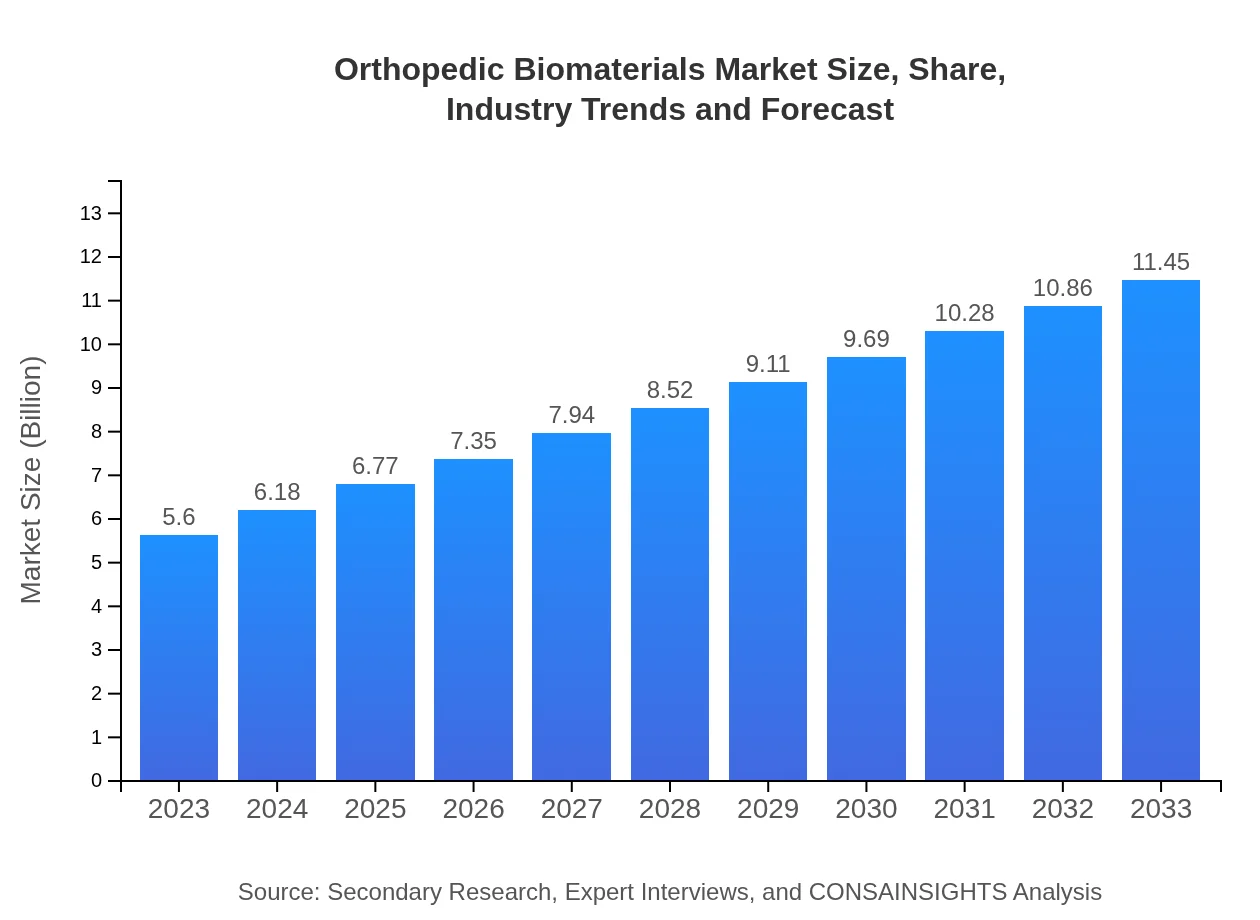
Orthopedic Biomaterials Market — USD 5.6 billion in 2023, Growing to USD 11.45B by 2033 at 7.2% CAGR
This report provides a comprehensive analysis of the Orthopedic Biomaterials market, covering insights on market trends, growth drivers, and forecasts from 2023 to 2033. It offers detailed segmentation and regional analyses to aid stakeholders in making informed decisions.
Key Takeaways
- Global market expands from $5.60 Billion in 2023 to $11.45 Billion in 2033 at a 7.2% CAGR.
- North America is largest regional market, while no single fastest-growing region is stated because regional CAGR differences remain within 0.15 percentage points.
- Material innovation across polymers, ceramics, and metals fuels application in joint reconstruction, spinal and trauma surgeries.
- Hospitals and orthopedic clinics remain primary end users while additive manufacturing and casting methods influence production.
- Leading companies include Zimmer Biomet, Smith & Nephew, Medtronic, Stryker Corporation, and DePuy Synthes.
Orthopedic Biomaterials Market Report — Executive Summary
North America remains largest market by forecast-period value, while no single fastest-growing region is stated because top regional growth rates are separated by less than 0.15 percentage points. The orthopedic biomaterials market is projected to expand significantly between 2023 and 2033, moving from $5.60 Billion to $11.45 Billion at a 7.2% CAGR. Growth is supported by increasing orthopedic procedures, advances in biomaterial properties, and adoption of modern manufacturing techniques. Hospitals and orthopedic clinics represent core end users, while research institutions continue to underpin innovation. Material categories such as polymeric, ceramic, and metallic biomaterials are central to applications in joint reconstruction, spinal surgery, and trauma care. Additive and subtractive manufacturing alongside casting are reshaping production approaches. Regulatory developments, investment in R&D, and collaboration among firms—including Zimmer Biomet, Smith & Nephew, Medtronic, Stryker Corporation, and DePuy Synthes—will influence competitive positioning and technology diffusion through the decade.
Key Growth Drivers
- Rising volume of orthopedic surgeries increases demand for advanced implantable materials and devices.
- Continuous material science improvements enhance biocompatibility and performance of polymeric, ceramic, and metallic biomaterials.
- Adoption of modern manufacturing methods, such as additive manufacturing, accelerates product customization and production efficiency.
- Expansion of hospital and specialty clinic capabilities supports higher utilization of orthopedic biomaterials across joint, spinal, and trauma procedures.
- Ongoing R&D and industry collaborations by leading firms stimulate new product introductions and clinical adoption.
| Metric | Value |
|---|---|
| Study Period | 2023 - 2033 |
| 2023 Market Size | $5.60 Billion |
| CAGR (2023-2033) | 7.2% |
| 2033 Market Size | $11.45 Billion |
| Top Companies | Zimmer Biomet, Smith & Nephew, Medtronic , Stryker Corporation, DePuy Synthes |
| Published Date | 21 October 2024 |
| Last Modified Date | 25 May 2026 |
Orthopedic Biomaterials Market Overview
Customize Orthopedic Biomaterials Market Report market research report
- ✔ Get in-depth analysis of Orthopedic Biomaterials market size, growth, and forecasts.
- ✔ Understand Orthopedic Biomaterials's regional dynamics and industry-specific trends.
- ✔ Identify potential applications, end-user demand, and growth segments in Orthopedic Biomaterials
What is the Market Size & CAGR of Orthopedic Biomaterials Market Report market in 2023?
Orthopedic Biomaterials Industry Analysis
Orthopedic Biomaterials Market Segmentation and Scope
Tell us your focus area and get a customized research report.
Orthopedic Biomaterials Market Report Market Analysis Report by Region
Europe Orthopedic Biomaterials Market Report:
Europe grows from $1.51 Billion in 2023 to $3.09 Billion in 2033. Regional expansion reflects demand for joint reconstruction and spinal procedures, investments in biomaterials research, and clinical adoption across hospital networks and specialty clinics.Asia Pacific Orthopedic Biomaterials Market Report:
Asia Pacific grows from $1.16 Billion in 2023 to $2.38 Billion in 2033. Market advancement is linked to rising surgical volumes, expanding hospital infrastructure, and growing interest in modern manufacturing approaches and implantable biomaterials.North America Orthopedic Biomaterials Market Report:
North America is largest regional market, rising from $1.92 Billion in 2023 to $3.93 Billion in 2033. Growth in the region is supported by high procedure volumes in hospitals and clinics, active R&D by leading firms, and rapid adoption of advanced manufacturing techniques.South America Orthopedic Biomaterials Market Report:
Latin America grows from $0.31 Billion in 2023 to $0.64 Billion in 2033. Growth is influenced by gradual expansion of orthopedics services, increased access to specialized care, and adoption of established biomaterial solutions in key medical centers.Middle East & Africa Orthopedic Biomaterials Market Report:
Middle East and Africa grows from $0.69 Billion in 2023 to $1.42 Billion in 2033. Regional drivers include development of healthcare facilities, growing procedural capacity in hospitals, and investments in clinical capabilities for orthopedic care.Tell us your focus area and get a customized research report.
Research Methodology
Orthopedic Biomaterials Market Analysis By Material Type
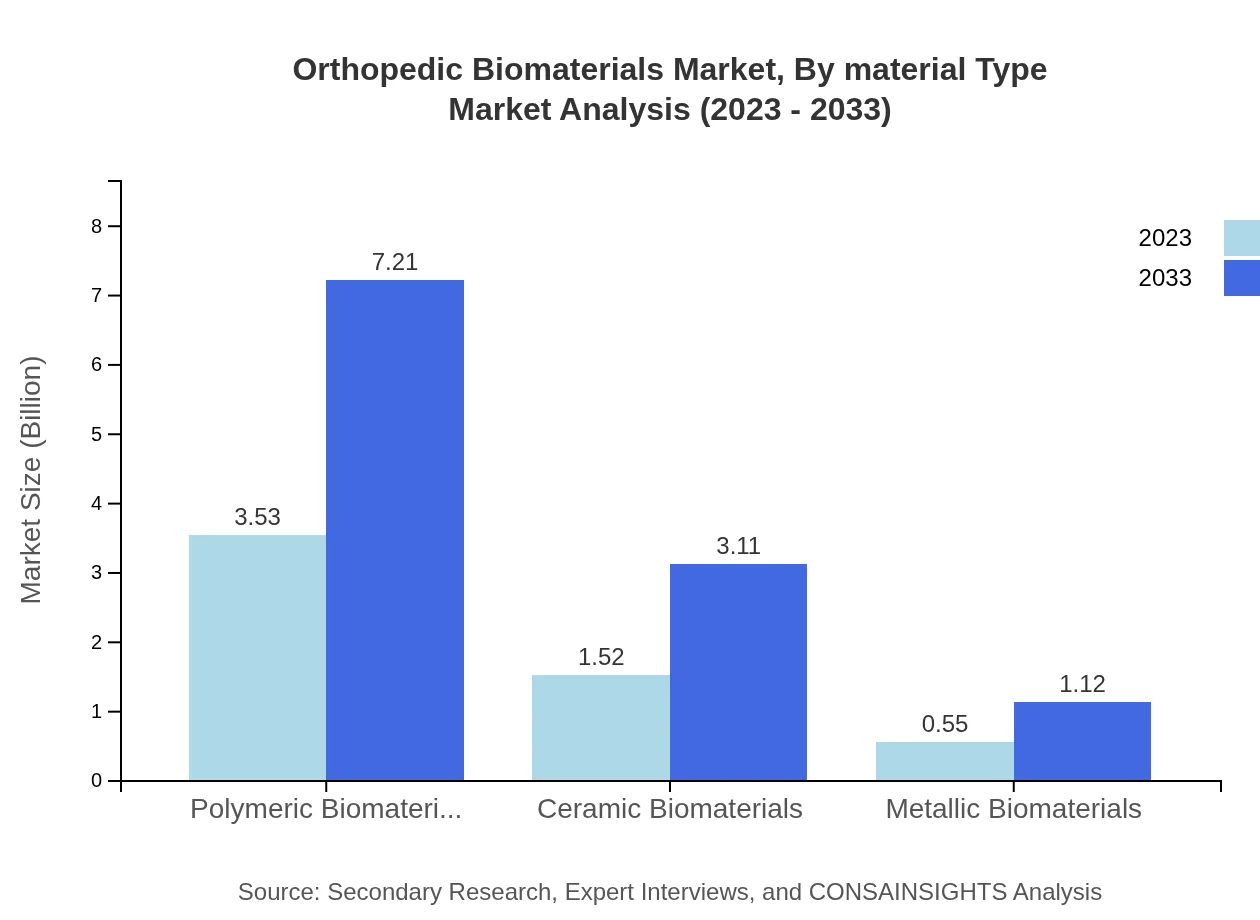
The market segments based on material type are as follows: Polymeric Biomaterials (USD 3.53 billion in 2023, projected to USD 7.21 billion by 2033, 63% share); Ceramic Biomaterials (USD 1.52 billion in 2023, expected to reach USD 3.11 billion by 2033, 27.2% share); and Metallic Biomaterials (USD 0.55 billion in 2023, increasing to USD 1.12 billion by 2033, 9.8% share). Polymeric materials dominate due to their flexibility and biocompatibility.
Orthopedic Biomaterials Market Analysis By Application
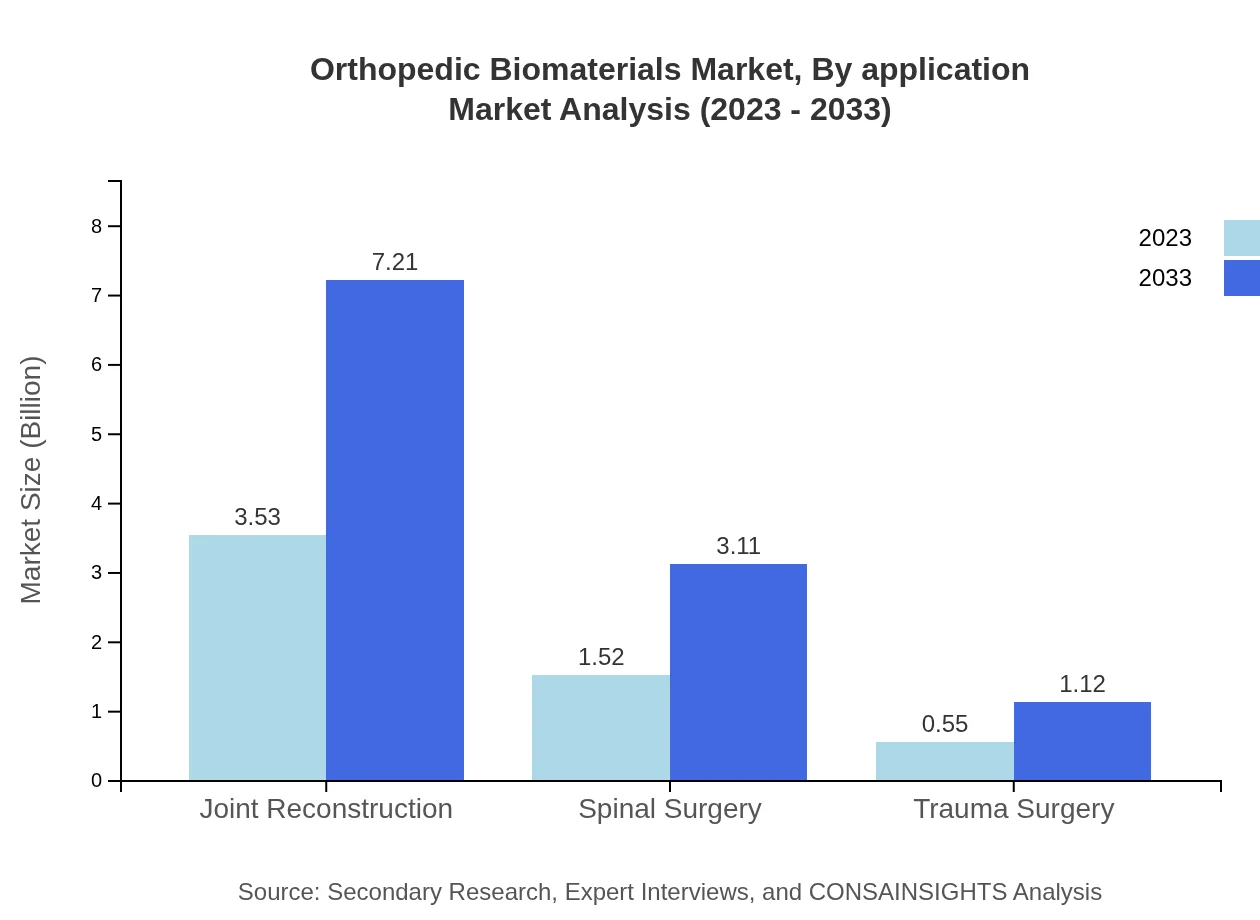
Key applications include Joint Reconstruction (USD 3.53 billion in 2023, aiming for USD 7.21 billion by 2033, 63% share), Spinal Surgery (USD 1.52 billion in 2023, projected to reach USD 3.11 billion by 2033, 27.2% share), and Trauma Surgery (USD 0.55 billion in 2023, anticipated to grow to USD 1.12 billion by 2033, 9.8% share). Joint Reconstruction remains the leading application due to high surgery rates globally.
Orthopedic Biomaterials Market Analysis By End User
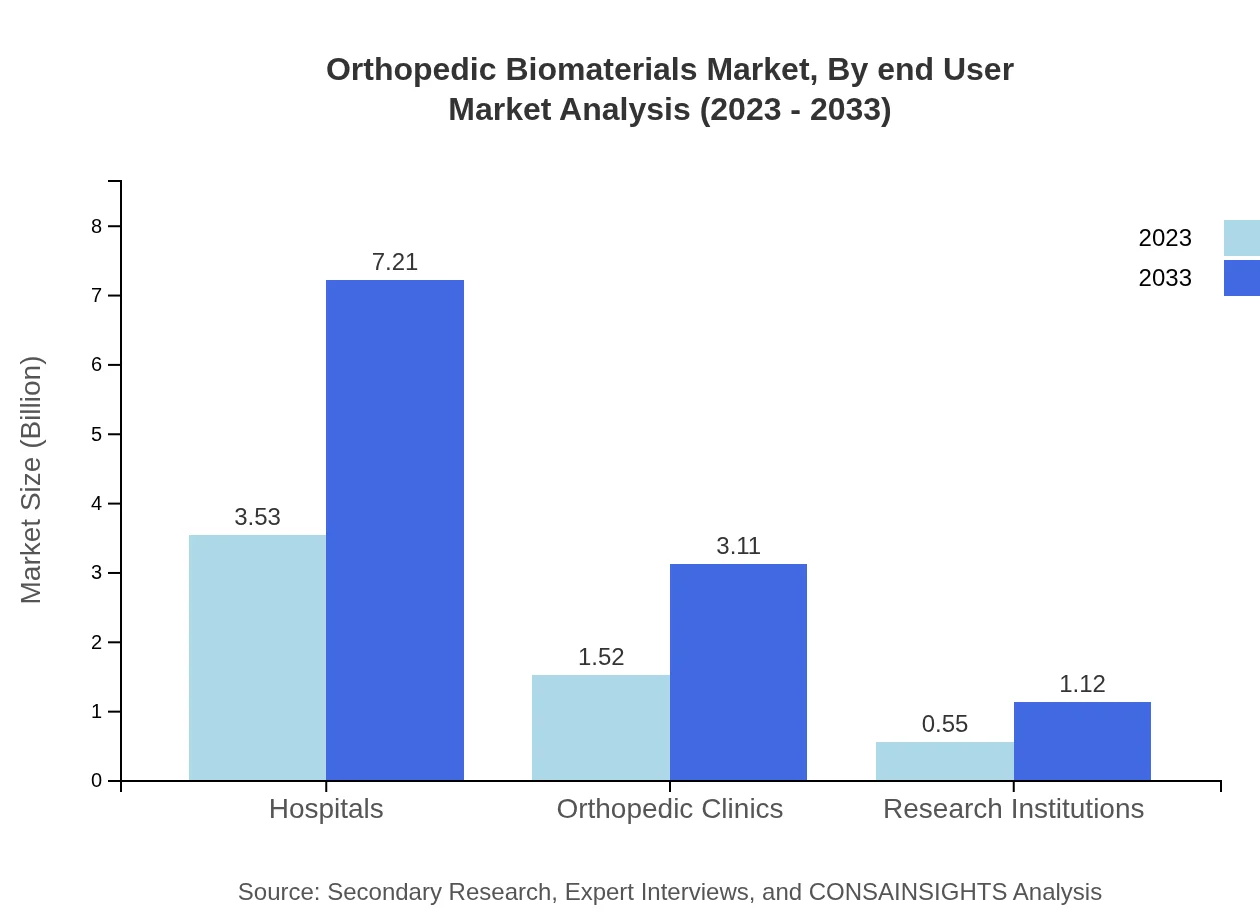
The market categories based on end-users include Hospitals (USD 3.53 billion in 2023, expected growth to USD 7.21 billion by 2033, maintaining a 63% share), Orthopedic Clinics (USD 1.52 billion in 2023, projected to reach USD 3.11 billion by 2033, with a 27.2% share), and Research Institutions (USD 0.55 billion in 2023, rising to USD 1.12 billion by 2033, 9.8% share). Hospitals dominate as primary settings for orthopedic procedures.
Orthopedic Biomaterials Market Analysis By Manufacturing Technique
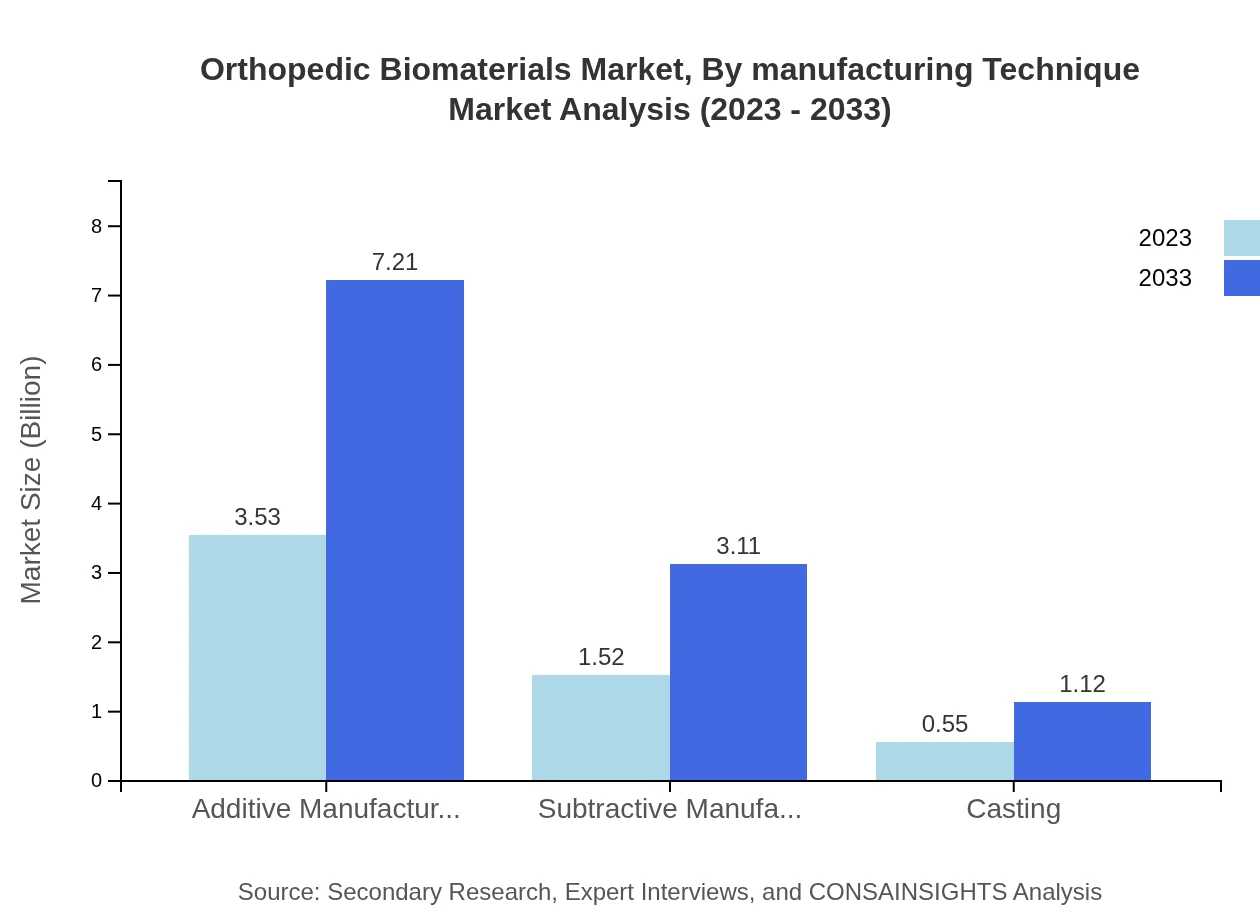
Manufacturing techniques comprise Additive Manufacturing (USD 3.53 billion in 2023, projected to grow to USD 7.21 billion by 2033, holding 63% share), Subtractive Manufacturing (USD 1.52 billion in 2023, expected to reach USD 3.11 billion by 2033, 27.2% share), and Casting (USD 0.55 billion in 2023, expected to grow to USD 1.12 billion by 2033, 9.8% share). Additive manufacturing is leading due to advancements in rapid prototyping and customization.
Orthopedic Biomaterials Market Trends and Future Forecast
Tell us your focus area and get a customized research report.
Global Market Leaders and Top Companies in Orthopedic Biomaterials Industry
Zimmer Biomet:
A leader in musculoskeletal healthcare, Zimmer Biomet develops innovative orthopedic biomaterials and implants focusing on enhancing patient outcomes.Smith & Nephew:
Smith & Nephew specializes in advanced wound management and minimally invasive surgery, providing cutting-edge orthopedic biomaterials.Medtronic :
Medtronic is instrumental in the spinal and orthopedic markets, offering innovative biomaterials that improve surgical efficacy.Stryker Corporation:
A prominent player in orthopedic technology, Stryker focuses on precision and quality across its range of biomaterials and orthopedic products.DePuy Synthes:
A subsidiary of Johnson & Johnson, DePuy Synthes leads in developing advanced orthopedic solutions including biomaterials for various applications.We're grateful to work with incredible clients.









FAQs
What is the market size of the orthopedic biomaterials market in 2023?
The market size in 2023 is $5.60 Billion, as reported for the orthopedic biomaterials sector, representing the base year for the 2023 to 2033 forecast period.
What is the projected market size of orthopedic biomaterials in 2033?
By 2033 the orthopedic biomaterials market is projected to reach $11.45 Billion according to the provided forecast figures covering 2023 to 2033.
What is CAGR for the orthopedic biomaterials market over the forecast period?
The reported compound annual growth rate (CAGR) for the orthopedic biomaterials market during 2023 to 2033 is 7.2%.
Is there a single fastest Growing region in the Orthopedic Biomaterials Market Report market?
No single fastest-growing region is stated for the Orthopedic Biomaterials Market Report market because the top regional implied CAGR values are within 0.15 percentage points of each other, making the ranking too close to call reliably.
What are the primary applications driving demand for biomaterials?
Primary applications include joint reconstruction, spinal surgery, and trauma surgery, which are principal areas of deployment for orthopedic biomaterials.
Who are the top companies operating in the orthopedic biomaterials market?
Top companies listed include Zimmer Biomet, Smith & Nephew, Medtronic, Stryker Corporation, and DePuy Synthes.
How are manufacturing techniques influencing the market?
Manufacturing techniques such as additive manufacturing, subtractive manufacturing, and casting are enabling customization and production efficiencies for biomaterial implants.
Why are hospitals significant end users for orthopedic biomaterials?
Hospitals are major end users due to procedure volume and infrastructure to perform joint, spinal, and trauma surgeries requiring biomaterial implants.