

Postpartum Hemorrhage Pph Devices Market Report
First published: 20 October 2024 | Last updated: 28 May 2026 | Report Code: postpartum-hemorrhage-pph-devices
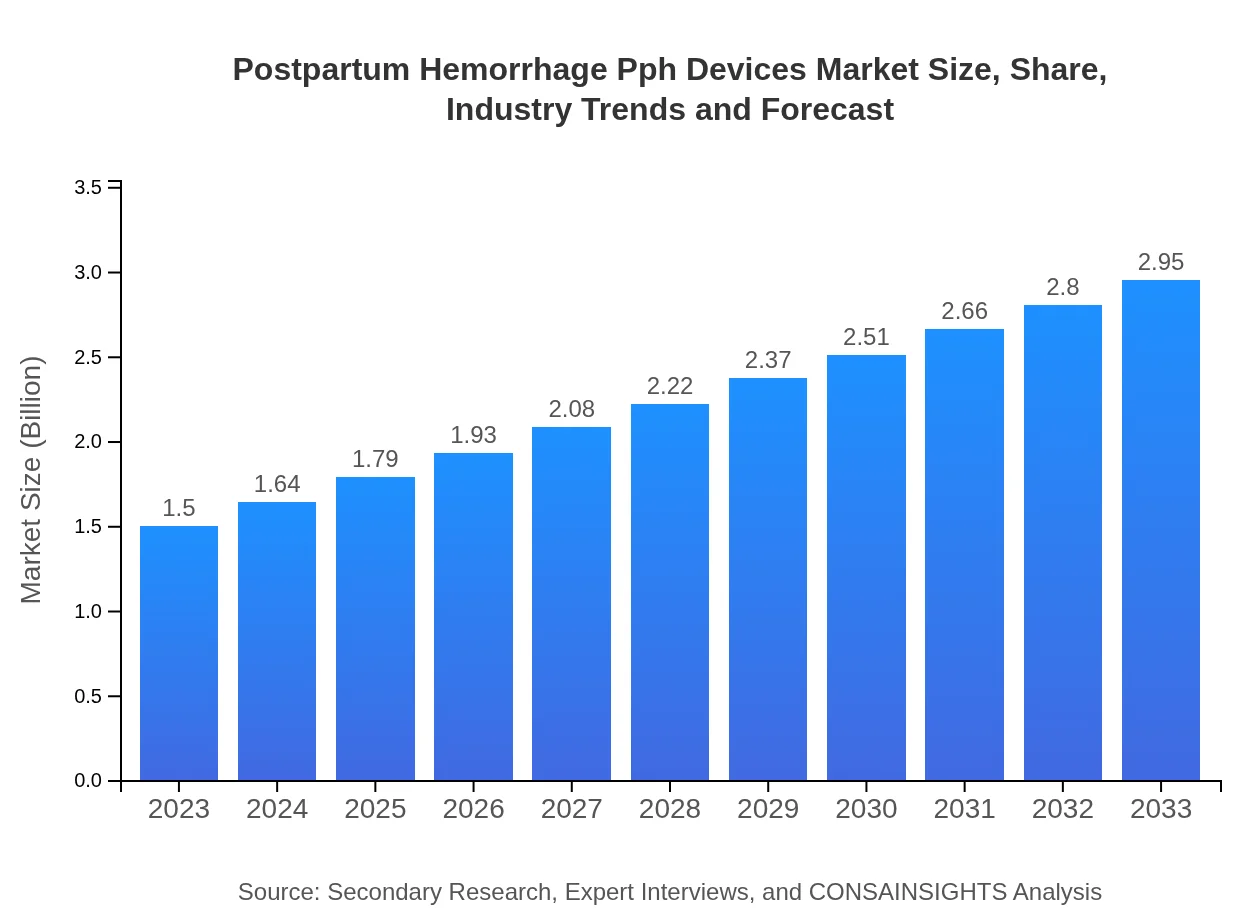
Postpartum Hemorrhage Pph Devices Market — USD 1.5 billion in 2023, Growing to USD 2.95B by 2033 at 6.8% CAGR
This report provides a comprehensive analysis of the Postpartum Hemorrhage (PPH) Devices market from 2023 to 2033, including market conditions, size, CAGR forecasts, regional insights, technological trends, and key market players.
Key Takeaways
- Global market grows from $1.50 Billion in 2023 to $2.95 Billion in 2033 at a 6.8% CAGR.
- North America is the largest region, increasing from $0.57 Billion in 2023 to $1.11 Billion in 2033.
- North America is largest regional market; Asia Pacific is regional market region based on implied CAGR across 2023 to 2033.
- European market expands from $0.45 Billion in 2023 to $0.88 Billion in 2033, reflecting steady regional demand.
- Key players include Baxter International, Medtronic, Johnson & Johnson, and Stryker Corporation, shaping product availability and adoption.
Postpartum Hemorrhage Pph Devices Market Report — Executive Summary
Regional analysis shows North America as largest market and Asia Pacific as fastest-growing region by implied CAGR. This report examines the market trajectory for postpartum hemorrhage devices over the 2023 to 2033 forecast period. The industry is expected to move from $1.50 Billion in 2023 to $2.95 Billion in 2033, supported by clinical emphasis on maternal safety, expanding access to care, and innovations across traditional, mechanical and pharmaceutical product categories. Regional dynamics show North America holding the largest market value and Asia Pacific demonstrating the highest implied growth rate. Market structure covers product types, applications including surgical and pharmacological management, and end users such as hospitals and clinics. Competitive activity—driven by companies like Baxter International, Medtronic, Johnson & Johnson, and Stryker Corporation—focuses on product development, regulatory alignment, and distribution partnerships. The analysis highlights adoption drivers, evolving clinical guidelines, and the role of training and awareness initiatives in shaping demand through 2033.
Key Growth Drivers
- Rising clinical prioritization of maternal health is expanding demand for effective PPH management tools.
- Advancements across traditional, mechanical and pharmaceutical device categories increase treatment options and clinician uptake.
- Expanded access to maternal care services and facility-based childbirth supports higher device utilization.
- Ongoing product innovation and manufacturer collaborations drive broader availability and improved device performance.
- Regulatory and reimbursement frameworks encouraging adoption where aligned with clinical guidelines.
| Metric | Value |
|---|---|
| Study Period | 2023 - 2033 |
| 2023 Market Size | $1.50 Billion |
| CAGR (2023-2033) | 6.8% |
| 2033 Market Size | $2.95 Billion |
| Top Companies | Baxter International, Medtronic , Johnson & Johnson, Stryker Corporation |
| Published Date | 20 October 2024 |
| Last Modified Date | 28 May 2026 |
Postpartum Hemorrhage Pph Devices Market Overview
Customize Postpartum Hemorrhage Pph Devices Market Report market research report
- ✔ Get in-depth analysis of Postpartum Hemorrhage Pph Devices market size, growth, and forecasts.
- ✔ Understand Postpartum Hemorrhage Pph Devices's regional dynamics and industry-specific trends.
- ✔ Identify potential applications, end-user demand, and growth segments in Postpartum Hemorrhage Pph Devices
What is the Market Size & CAGR of Postpartum Hemorrhage Pph Devices Market Report market in 2023?
Postpartum Hemorrhage Pph Devices Industry Analysis
Postpartum Hemorrhage Pph Devices Market Segmentation and Scope
Tell us your focus area and get a customized research report.
Postpartum Hemorrhage Pph Devices Market Report Market Analysis Report by Region
Europe Postpartum Hemorrhage Pph Devices Market Report:
Europe grows from $0.45 Billion in 2023 to $0.88 Billion in 2033. Regional expansion is tied to evolving clinical protocols, investments in maternal health services, and ongoing adoption of both traditional and newer device options within healthcare systems.Asia Pacific Postpartum Hemorrhage Pph Devices Market Report:
Asia Pacific is fastest-growing region by implied CAGR, increasing from $0.28 Billion in 2023 to $0.56 Billion in 2033. Drivers include rising access to facility-based childbirth, growing awareness of maternal care, and expanding availability of device options suited to diverse clinical settings.North America Postpartum Hemorrhage Pph Devices Market Report:
North America is largest regional market, rising from $0.57 Billion in 2023 to $1.11 Billion in 2033. This growth reflects established clinical infrastructure, higher adoption in hospitals and clinics, and active participation from major manufacturers in regional distribution and product support.South America Postpartum Hemorrhage Pph Devices Market Report:
Latin America grows from $0.1 Billion in 2023 to $0.19 Billion in 2033. Market movement is influenced by efforts to strengthen maternal health programs, gradual expansion of clinical services, and increased uptake of accessible PPH management products.Middle East & Africa Postpartum Hemorrhage Pph Devices Market Report:
Middle East and Africa grows from $0.11 Billion in 2023 to $0.21 Billion in 2033. Regional demand is shaped by initiatives to reduce maternal mortality, incremental improvements in healthcare infrastructure, and growing awareness of clinical protocols for postpartum hemorrhage management.Tell us your focus area and get a customized research report.
Research Methodology
Postpartum Hemorrhage Pph Devices Market Analysis By Product
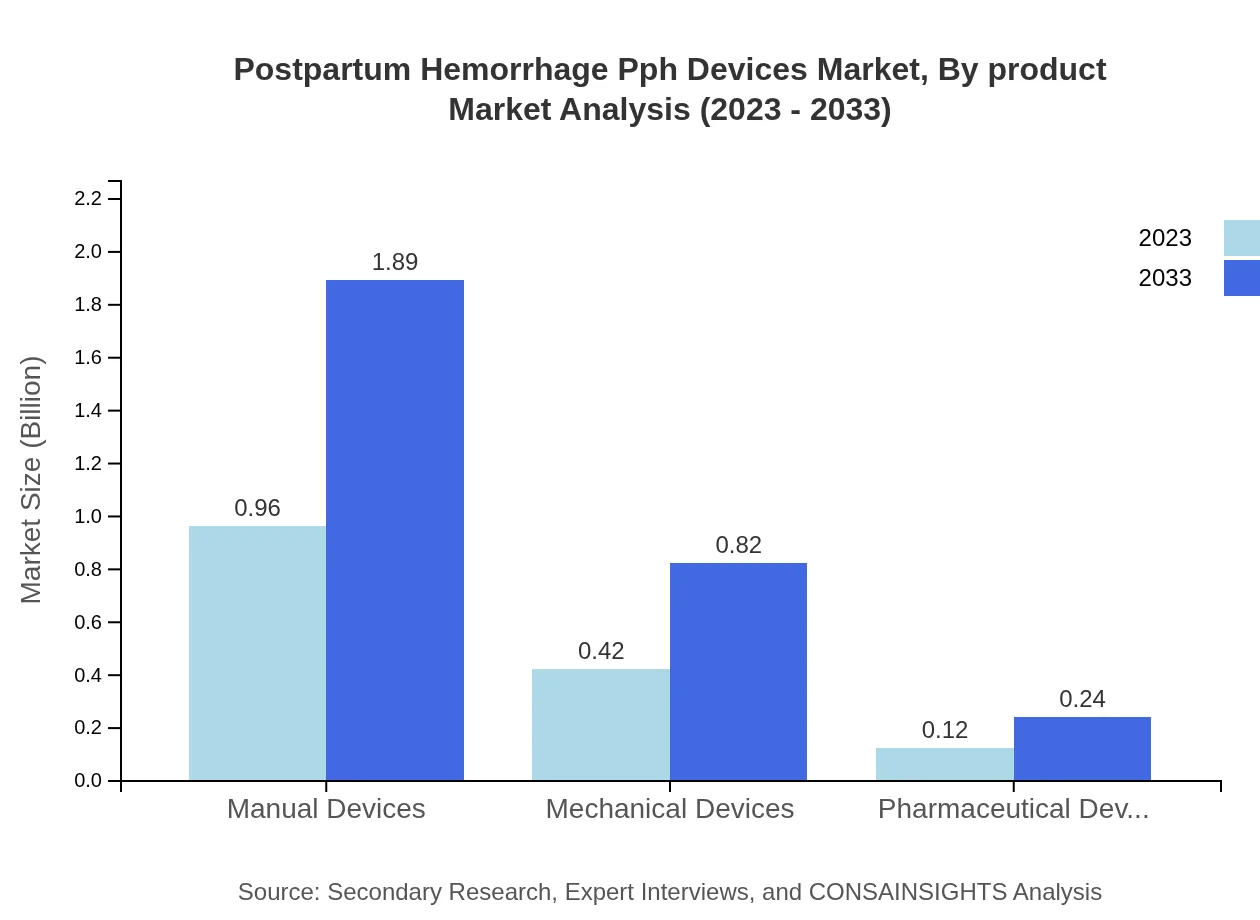
The product type analysis reveals that traditional devices dominate the market with a size of $1.28 billion in 2023 projected to reach $2.52 billion by 2033, holding a significant share of 85.53%. Innovative technologies, while smaller in value at $0.22 billion currently, are gaining a foothold with an estimated future size of $0.43 billion, representing a 14.47% market share. Manual devices represent another strong segment with a market size moving from $0.96 billion to $1.89 billion, and mechanical devices follow closely, projected to grow from $0.42 billion to $0.82 billion, indicating shifting preferences toward advanced solutions.
Postpartum Hemorrhage Pph Devices Market Analysis By Application
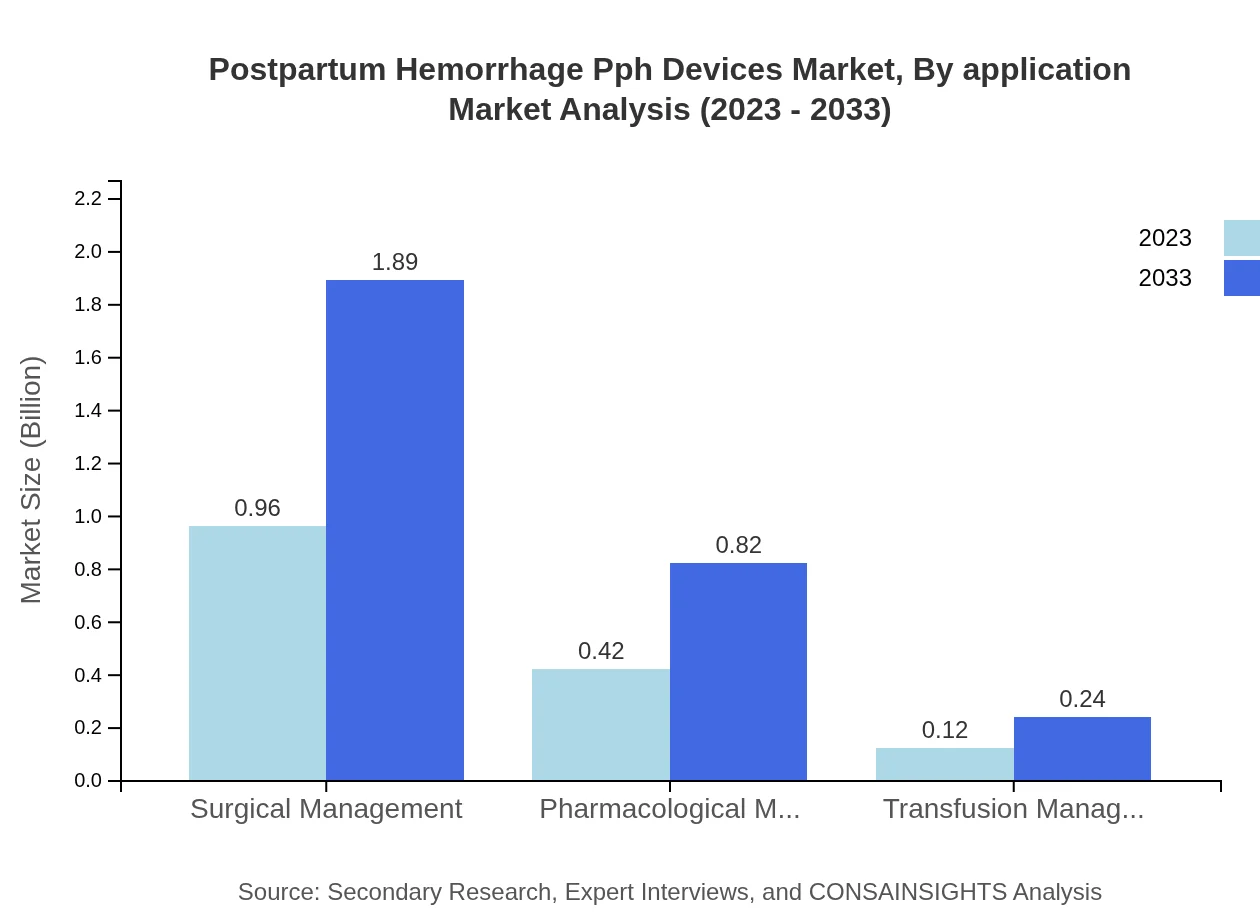
By application, surgical management takes the lead with a market size of $0.96 billion in 2023, expected to double to $1.89 billion by 2033, covering a substantial share of 64.13%. Pharmacological management is set to grow from $0.42 billion to $0.82 billion, marking a share of 27.75%, while transfusion management remains critical but represents a smaller segment with $0.12 billion in 2023, anticipated to reach $0.24 billion by 2033.
Postpartum Hemorrhage Pph Devices Market Analysis By End User
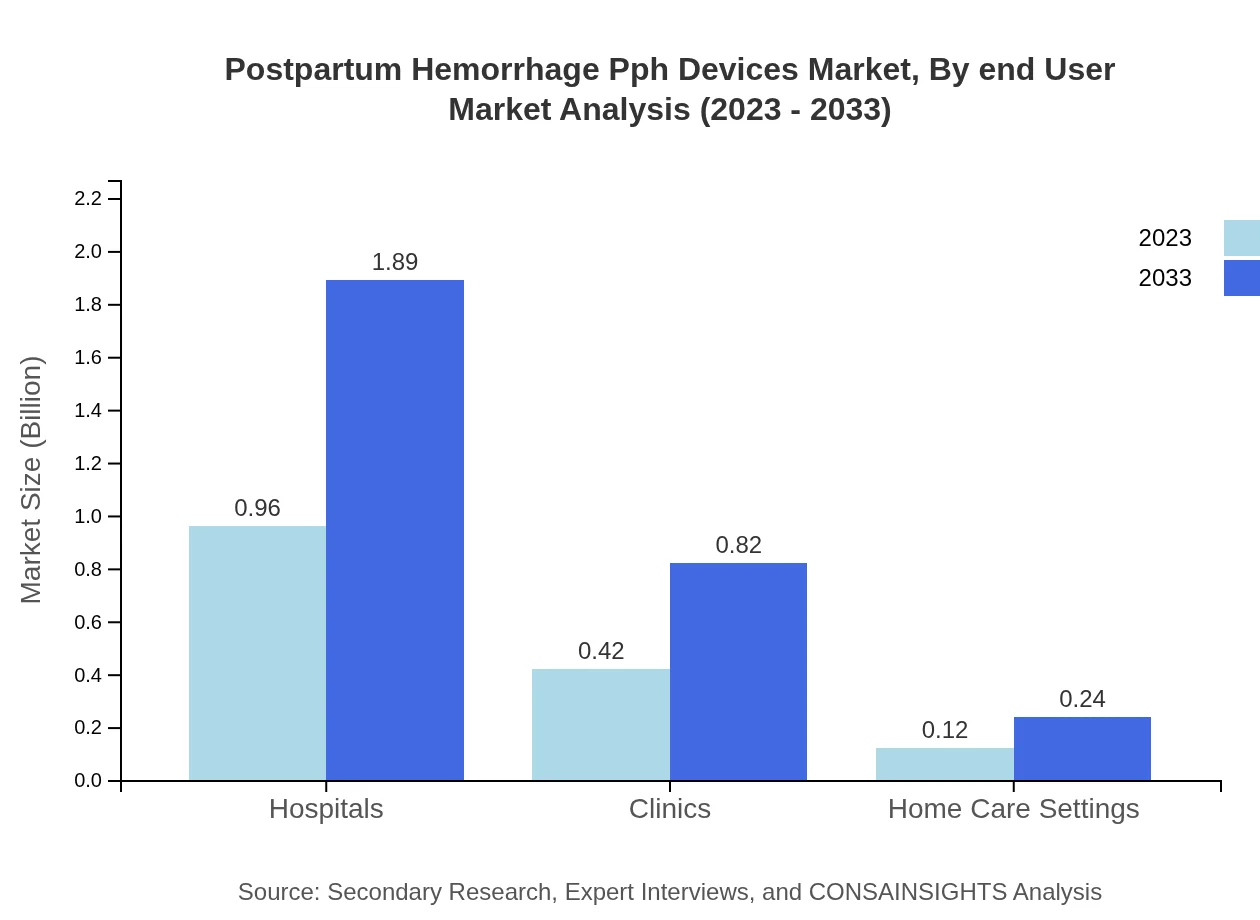
In terms of end-users, hospitals dominate utilization, with a market size of $0.96 billion in 2023 and an expected growth to $1.89 billion. Clinics also maintain a considerable market presence with $0.42 billion, depicting the need for PPH solutions in outpatient settings. Home care settings, while smaller at $0.12 billion, indicate a growing trend of at-home maternal care in developing regions.
Postpartum Hemorrhage Pph Devices Market Analysis By Tech
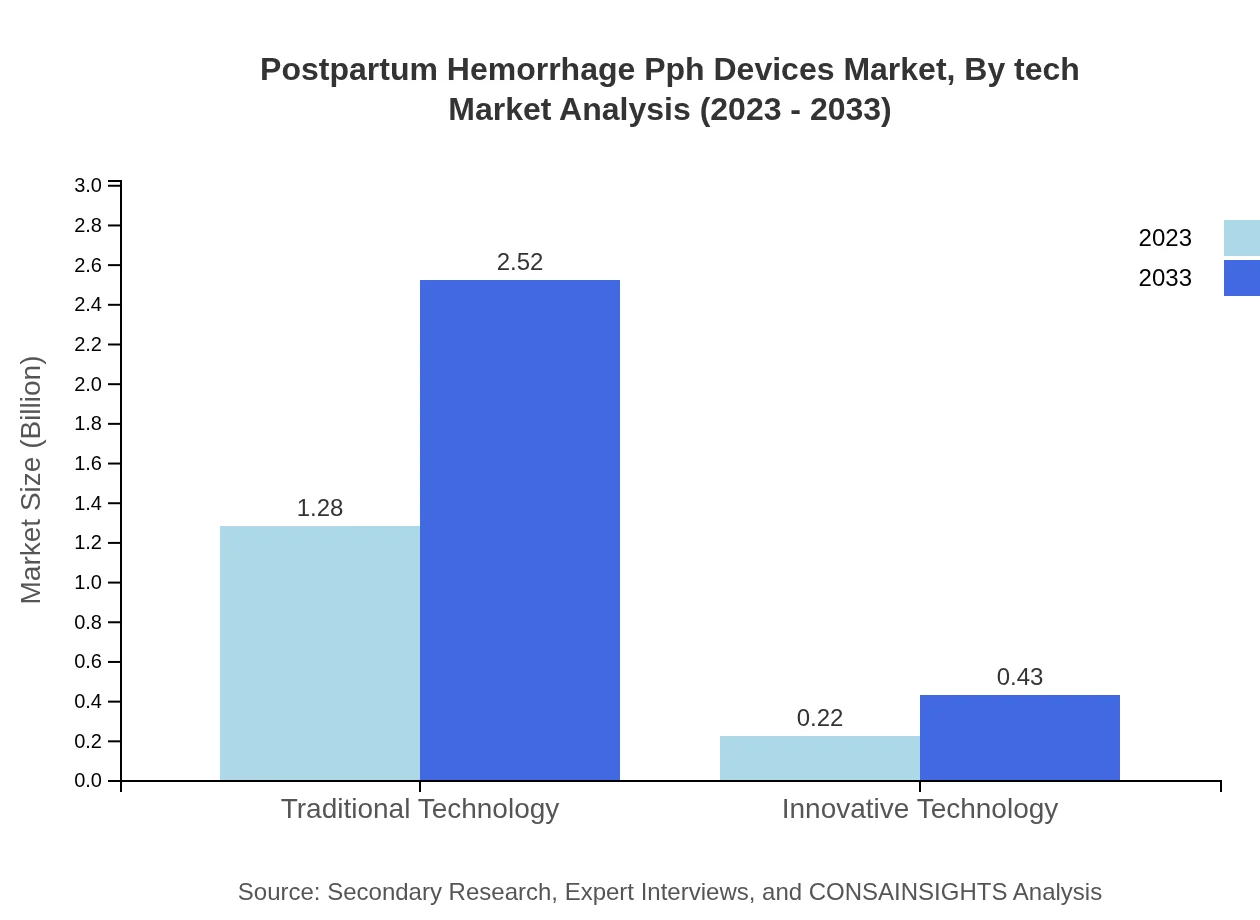
The technology segmentation highlights traditional methods leading with a size of $1.28 billion, emphasizing their relevance despite the rising interest in innovative approaches which are expected to grow moderately in market size from $0.22 billion to $0.43 billion. The steady performance of mechanical and manual devices reinforces their importance in existing healthcare facilities.
Postpartum Hemorrhage Pph Devices Market Trends and Future Forecast
Tell us your focus area and get a customized research report.
Global Market Leaders and Top Companies in Postpartum Hemorrhage Pph Devices Industry
Baxter International:
A leader in healthcare, Baxter offers innovative PPH solutions and therapies focusing on critical care and pain management.Medtronic :
Medtronic is renowned for its cutting-edge technologies and devices used in surgical management of PPH, contributing significantly to the industry's growth.Johnson & Johnson:
As a major player in the medical device market, Johnson & Johnson's extensive product lineup includes crucial solutions aimed at managing postpartum hemorrhage.Stryker Corporation:
Stryker specializes in surgical devices and technologies that enhance surgical procedures related to PPH management.We're grateful to work with incredible clients.









FAQs
What is the market size of Postpartum Hemorrhage Pph Devices Market Report in 2023?
The market size in 2023 is $1.50 Billion. This figure serves as the baseline for the 2023 to 2033 forecast and is drawn directly from market estimates provided in the report input.
How big will the market be in 2033?
The market is projected to reach $2.95 Billion in 2033, reflecting expected expansion across product types, regions, and end-user settings over the 2023 to 2033 forecast period.
What is CAGR for the forecast period?
The Compound Annual Growth Rate (CAGR) for the 2023 to 2033 forecast period is 6.8%, as specified in the report data.
Which region is the fastest Growing in the Postpartum Hemorrhage Pph Devices Market Report market?
Asia Pacific is the fastest-growing region, projected to expand from $0.28 Billion in 2023 to $0.56 Billion in 2033, reflecting an implied 7.18% CAGR over the forecast period.
Which region is the fastest Growing?
Asia Pacific is identified as the regional market region, increasing from $0.28 Billion in 2023 to $0.56 Billion in 2033 at an implied 7.18% CAGR, per the provided data.
Who are the leading companies in this market?
Top companies listed include Baxter International, Medtronic, Johnson & Johnson, and Stryker Corporation, which influence product development and market reach.
What product categories are included in the segmentation?
Product segmentation covers traditional technology, innovative technology, manual devices, mechanical devices, and pharmaceutical devices, as specified in the input sub-segment facts.
How are end users categorized in the report?
End-user categories include hospitals, clinics, and home care settings, each identified in the sub-segment data for target deployment and service delivery.