

Preclinical In Vivo Imaging Market Report
First published: 10 October 2024 | Last updated: 28 May 2026 | Report Code: preclinical-in-vivo-imaging
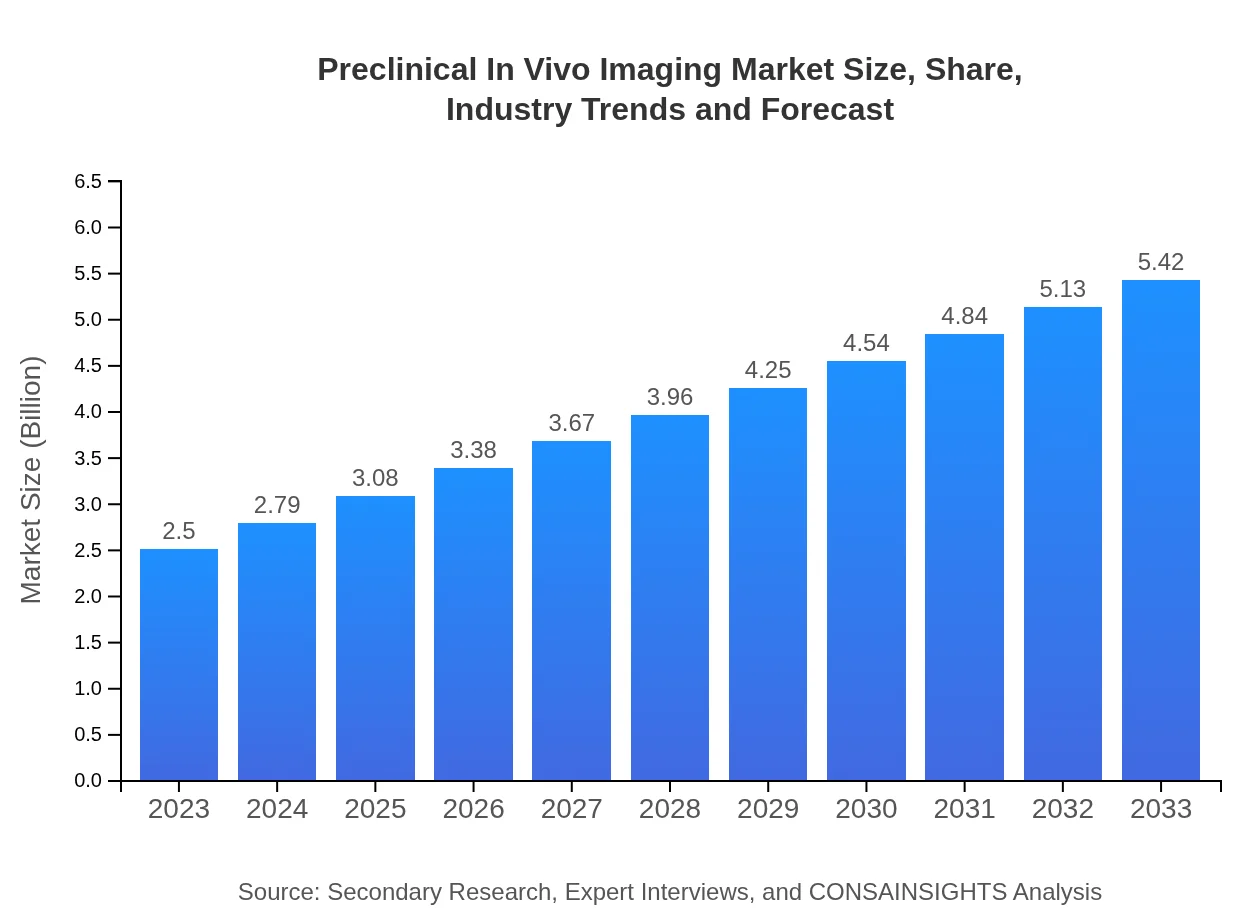
Preclinical In Vivo Imaging Market — USD 2.5 billion in 2023, Growing to USD 5.42B by 2033 at 7.8% CAGR
This report provides a comprehensive analysis of the Preclinical In Vivo Imaging market, exploring market size, growth forecasts, segmentation, and notable trends from 2023 to 2033.
Key Takeaways
- Market grows from $2.50 Billion in 2023 to $5.42 Billion in 2033 at a 7.8% CAGR.
- North America is largest regional market; Latin America is regional market region based on implied CAGR across 2023 to 2033.
- Latin America is the regional market region, rising from $0.23 Billion to $0.51 Billion (implied 8.29% CAGR).
- Regional expansion supported by demand for non-invasive imaging and increased pharmaceutical R&D investment.
- Leading companies include Bruker Corporation, PerkinElmer, Inc., MI Labs, and Topcon Corporation.
Preclinical In Vivo Imaging Market Report — Executive Summary
Regional analysis shows North America as largest market and Latin America as fastest-growing region by implied CAGR. This report outlines the Preclinical In Vivo Imaging market dynamics, highlighting a rise from $2.50 Billion in 2023 to $5.42 Billion in 2033 at a 7.8% CAGR. Growth is driven by higher investment in pharmaceutical research, demand for non-invasive imaging technologies, and advances in imaging modalities such as optical imaging, MRI, CT, and molecular imaging techniques. Market participants include Bruker Corporation, PerkinElmer, Inc., MI Labs, and Topcon Corporation. The industry structure spans instrumentation, techniques, and end users including pharmaceutical companies, CROs, academic institutions, research institutes, and government laboratories. Key trends cover integration of advanced analytics, improved imaging resolution, and hybrid systems. Regional patterns show North America as the largest market while Latin America exhibits the fastest implied growth. The report combines expert interviews and secondary sources to present validated insights for stakeholders considering investment, partnerships, or technology adoption.
Key Growth Drivers
- Rising pharmaceutical R&D expenditure generating demand for advanced preclinical imaging platforms.
- Preference for non-invasive methods fueling adoption of optical, MRI, and CT modalities in research workflows.
- Technological improvements, including higher-resolution instrumentation and hybrid imaging approaches.
- Wider use across end users such as CROs, academic institutions, and government laboratories expanding market uptake.
- Increased focus on molecular imaging and translational research supporting instrument and software demand.
| Metric | Value |
|---|---|
| Study Period | 2023 - 2033 |
| 2023 Market Size | $2.50 Billion |
| CAGR (2023-2033) | 7.8% |
| 2033 Market Size | $5.42 Billion |
| Top Companies | Bruker Corporation, PerkinElmer, Inc., MI Labs, Topcon Corporation |
| Published Date | 10 October 2024 |
| Last Modified Date | 28 May 2026 |
Preclinical In Vivo Imaging Market Overview
Customize Preclinical In Vivo Imaging Market Report market research report
- ✔ Get in-depth analysis of Preclinical In Vivo Imaging market size, growth, and forecasts.
- ✔ Understand Preclinical In Vivo Imaging's regional dynamics and industry-specific trends.
- ✔ Identify potential applications, end-user demand, and growth segments in Preclinical In Vivo Imaging
What is the Market Size & CAGR of Preclinical In Vivo Imaging Market Report market in 2023?
Preclinical In Vivo Imaging Industry Analysis
Preclinical In Vivo Imaging Market Segmentation and Scope
Tell us your focus area and get a customized research report.
Preclinical In Vivo Imaging Market Report Market Analysis Report by Region
Europe Preclinical In Vivo Imaging Market Report:
Europe grows from $0.84 Billion in 2023 to $1.82 Billion in 2033. Growth is supported by strong translational research programs, investments in molecular imaging, and collaborative initiatives between industry and academic institutions.Asia Pacific Preclinical In Vivo Imaging Market Report:
Asia Pacific grows from $0.39 Billion in 2023 to $0.85 Billion in 2033. Expansion is linked to rising research investments, expanding clinical and preclinical research capacity, and adoption of non-invasive imaging systems in regional laboratories.North America Preclinical In Vivo Imaging Market Report:
North America is largest regional market, rising from $0.9 Billion in 2023 to $1.95 Billion in 2033. Regional strength reflects concentrated pharmaceutical R&D spending, established research infrastructure, and widespread adoption of advanced imaging technologies among CROs and academic centers.South America Preclinical In Vivo Imaging Market Report:
Latin America is fastest-growing region by implied CAGR, increasing from $0.23 Billion in 2023 to $0.51 Billion in 2033. 23 Billion in 2023 to $0.51 Billion in 2033 and is identified as the regional growth market with an implied 8.29% CAGR. Growth drivers include expanding research activity and growing demand for preclinical tools across emerging research centers.Middle East & Africa Preclinical In Vivo Imaging Market Report:
Middle East and Africa grows from $0.13 Billion in 2023 to $0.28 Billion in 2033. The market is influenced by increasing investments in healthcare research infrastructure and gradual uptake of imaging technologies in academic and government labs.Tell us your focus area and get a customized research report.
Research Methodology
Preclinical In Vivo Imaging Market Analysis By Technique
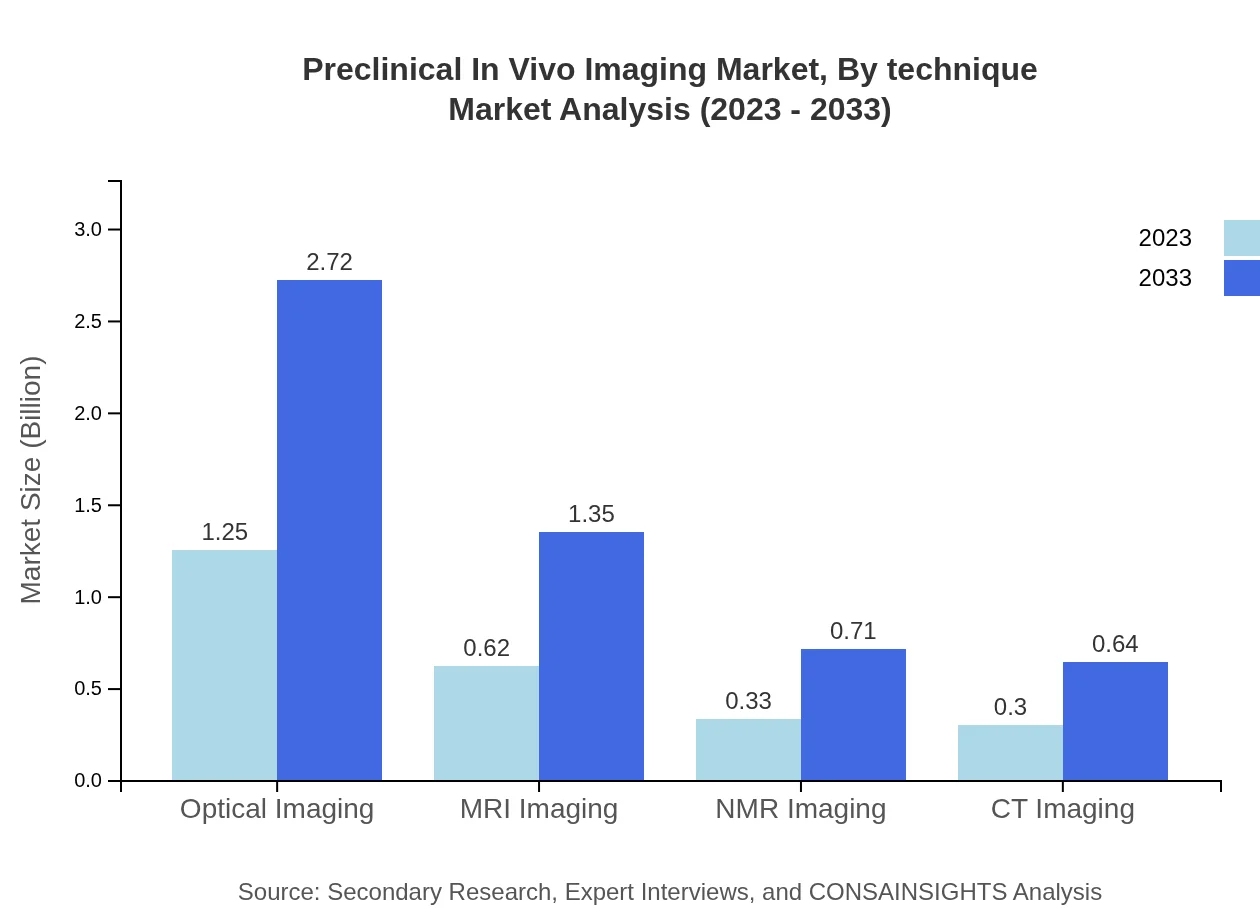
The technique segment is dominated by Optical Imaging, expected to maintain a market size of $1.25 billion in 2023 and reach $2.72 billion by 2033. Other notable techniques include MRI and NMR Imaging, capturing significant market shares due to their essential roles in diagnosis and research applications. Each imaging technique offers distinct advantages based on sensitivity, resolution, and specific applications in various biomedical fields.
Preclinical In Vivo Imaging Market Analysis By Application
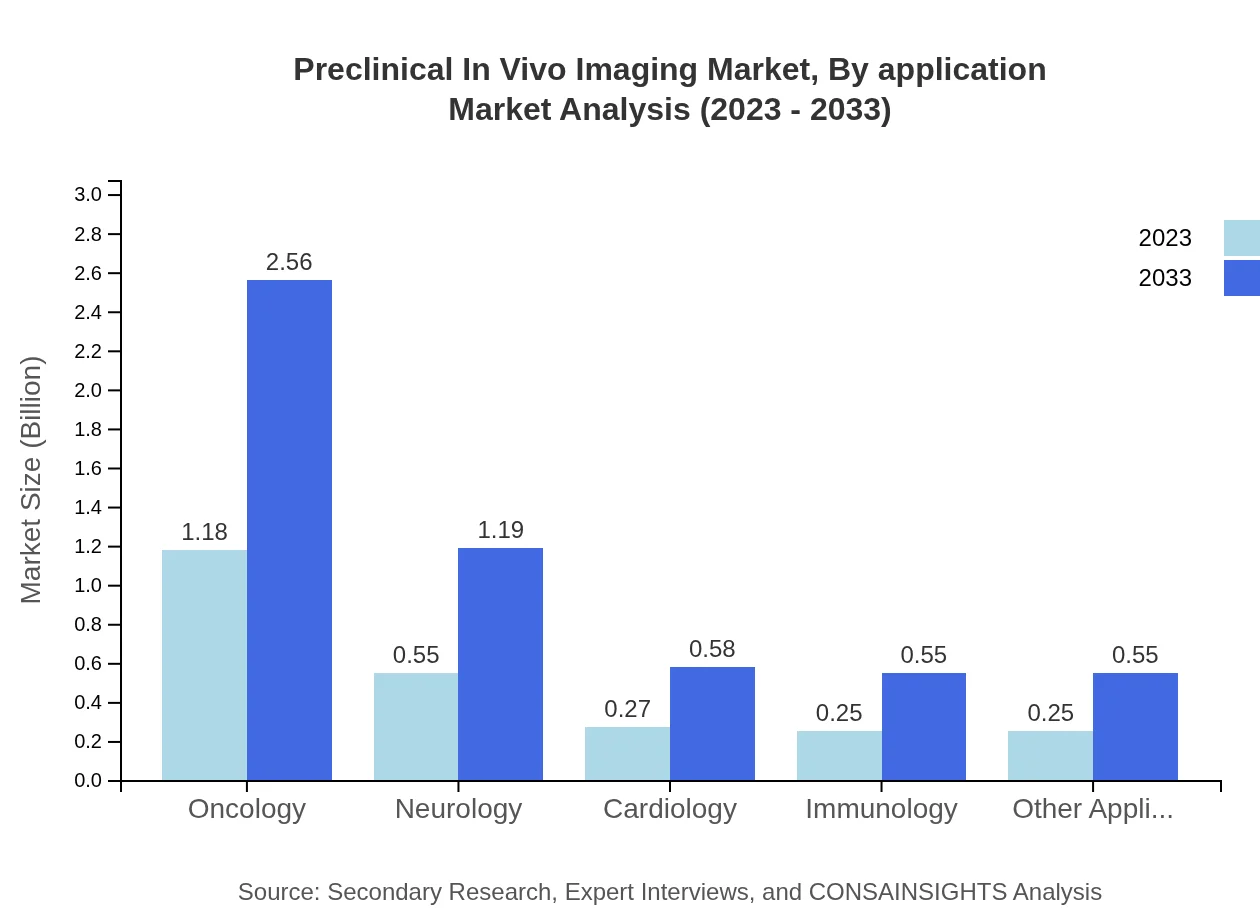
The application sector is leadingly occupied by Oncology, with a market size of $1.18 billion in 2023 and a projected growth to $2.56 billion by 2033. Neurology also represents a critical application area with significant growth potential. Enhanced imaging technologies drive advancements in these fields, supporting better detection, monitoring, and treatment assessments.
Preclinical In Vivo Imaging Market Analysis By Instrumentation
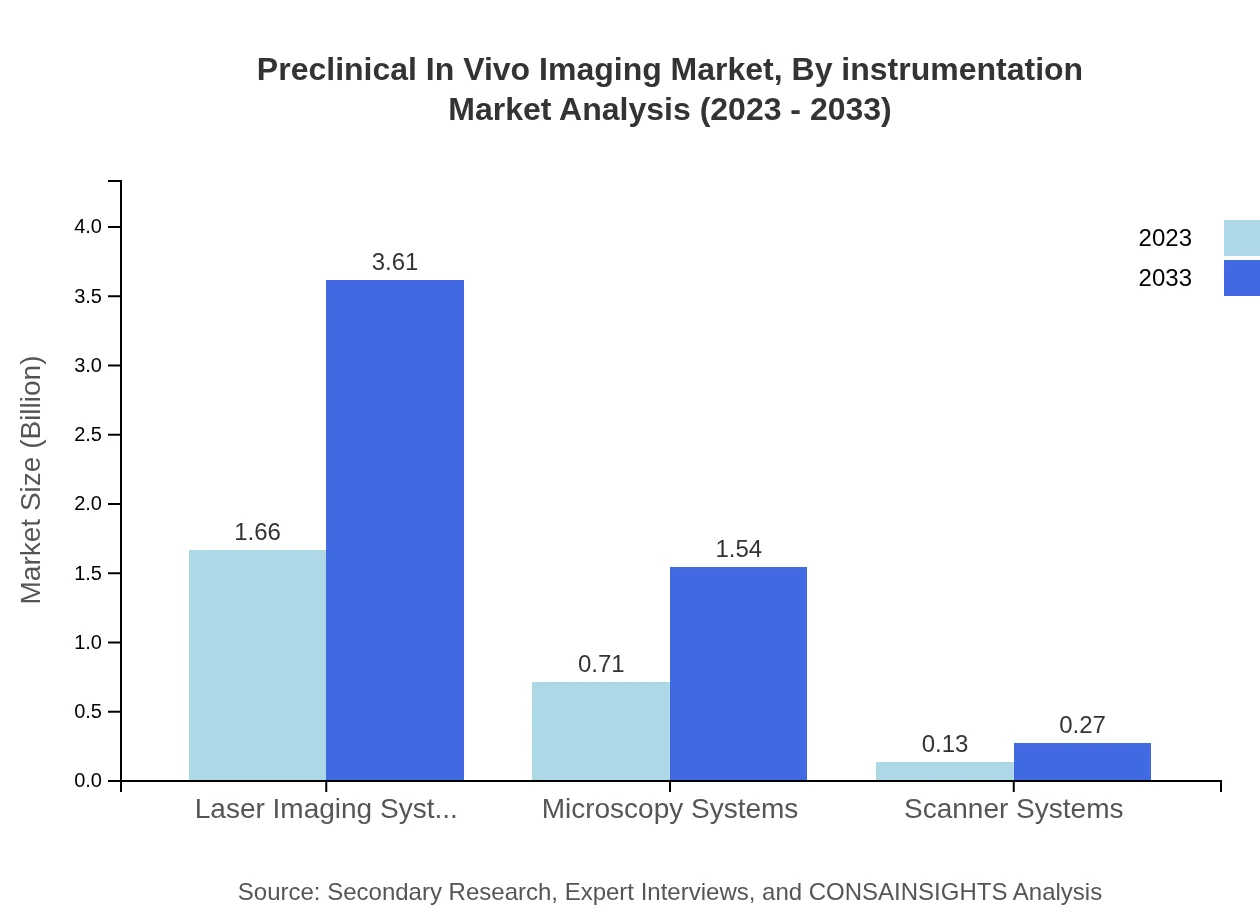
Laser Imaging Systems hold the largest market share in instrumentation, anticipated to grow from $1.66 billion in 2023 to $3.61 billion by 2033. The increasing preference for high-resolution imaging systems that permit real-time analysis underlines the importance of this instrumentation category in research and clinical settings.
Preclinical In Vivo Imaging Market Analysis By End User
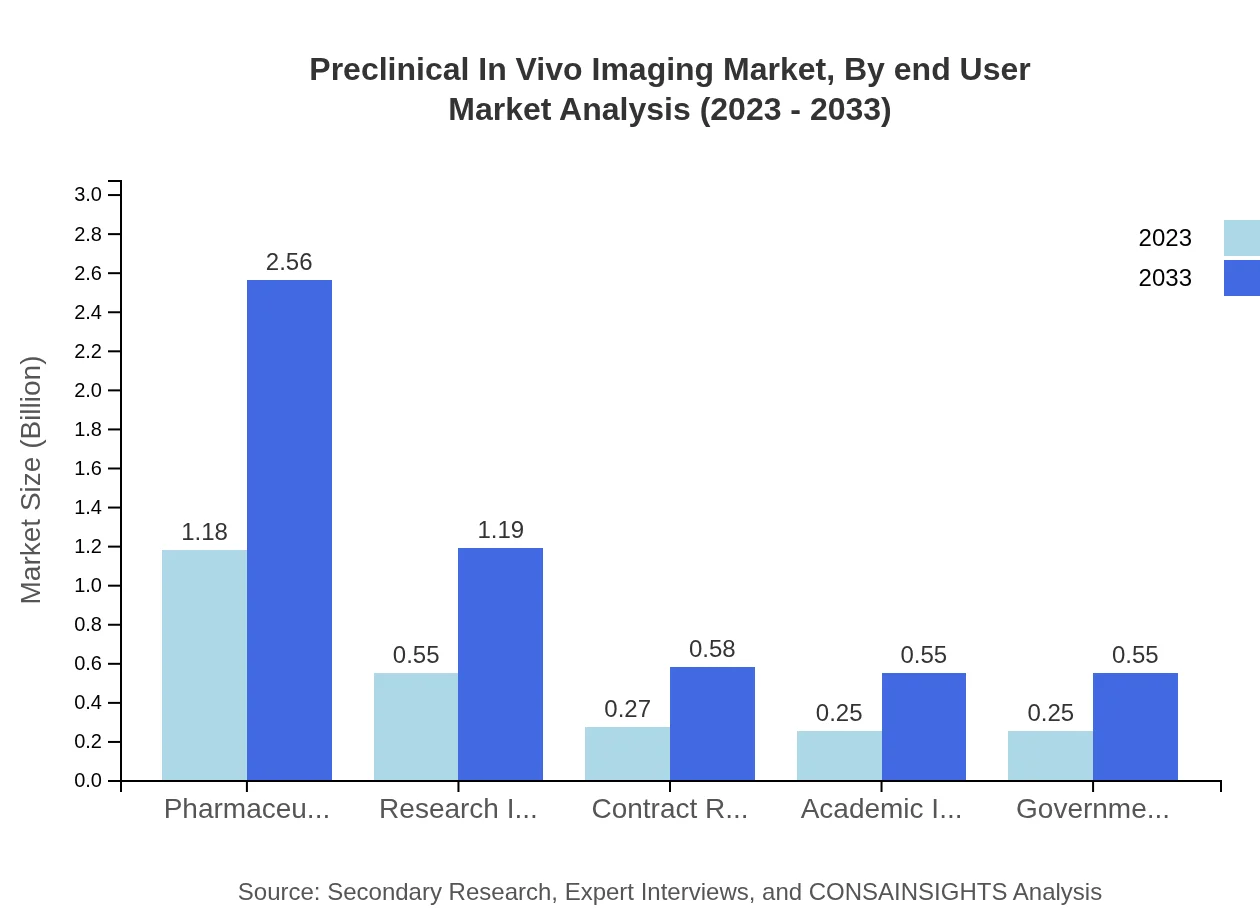
Pharmaceutical Companies lead the end-user segment, commanding a significant market size of $1.18 billion in 2023, expected to rise to $2.56 billion by 2033. Furthermore, Research Institutes contribute significantly, aided by increased focus on drug discovery and collaboration with pharmaceutical entities.
Preclinical In Vivo Imaging Market Trends and Future Forecast
Tell us your focus area and get a customized research report.
Global Market Leaders and Top Companies in Preclinical In Vivo Imaging Industry
Bruker Corporation:
A leading provider of preclinical imaging systems, Bruker combines advanced imaging modalities with a robust portfolio for bioimaging research.PerkinElmer, Inc.:
Specializing in imaging systems for diagnostic and preclinical applications, PerkinElmer develops innovative solutions that push boundaries in life sciences.MI Labs:
MI Labs offers an advanced suite of imaging technologies designed for in vivo studies, enabling high-resolution imaging crucial for academic and pharmaceutical research.Topcon Corporation:
Topcon is recognized for its optical imaging systems and innovative solutions that enhance research capabilities across multiple platforms.We're grateful to work with incredible clients.









FAQs
What is the market size of the Preclinical In Vivo Imaging market in 2023?
The market size for 2023 is $2.50 Billion according to the provided data, representing the baseline for the 2023 to 2033 forecast period.
How big will the market be in 2033?
The market is projected to reach $5.42 Billion by 2033 based on the stated forecast figures for the 2023 to 2033 period.
What is CAGR for the forecast period?
The forecast period 2023 to 2033 carries an exact CAGR of 7.8% as specified in the input data.
Which region is the fastest Growing in the Preclinical In Vivo Imaging Market Report market?
Latin America is the fastest-growing region, projected to expand from $0.23 Billion in 2023 to $0.51 Billion in 2033, reflecting an implied 8.29% CAGR over the forecast period.
Which region is the fastest Growing?
Latin America is described as the regional market region, rising from $0.23 Billion in 2023 to $0.51 Billion in 2033 with an implied 8.29% CAGR.
Who are the top companies in this market?
Top companies listed include Bruker Corporation, PerkinElmer, Inc., MI Labs, and Topcon Corporation as participants in the market landscape.
What end users drive demand for preclinical imaging?
Demand comes from pharmaceutical companies, CROs, research institutes, academic institutions, and government laboratories as primary end users.
Which techniques are prominent in the market?
Prominent techniques include optical imaging, MRI imaging, NMR imaging, and CT imaging as specified among the technology subsegments.
What instrumentation categories are listed?
Instrumentation subsegments include laser imaging systems, microscopy systems, and scanner systems as provided in the input data.
How does the market benefit drug discovery?
Preclinical imaging supports drug discovery by enabling non-invasive observation of biological processes, aiding candidate validation and therapeutic assessment.