

Pregnancy Products Market Report
First published: 20 October 2024 | Last updated: 25 May 2026 | Report Code: pregnancy-products
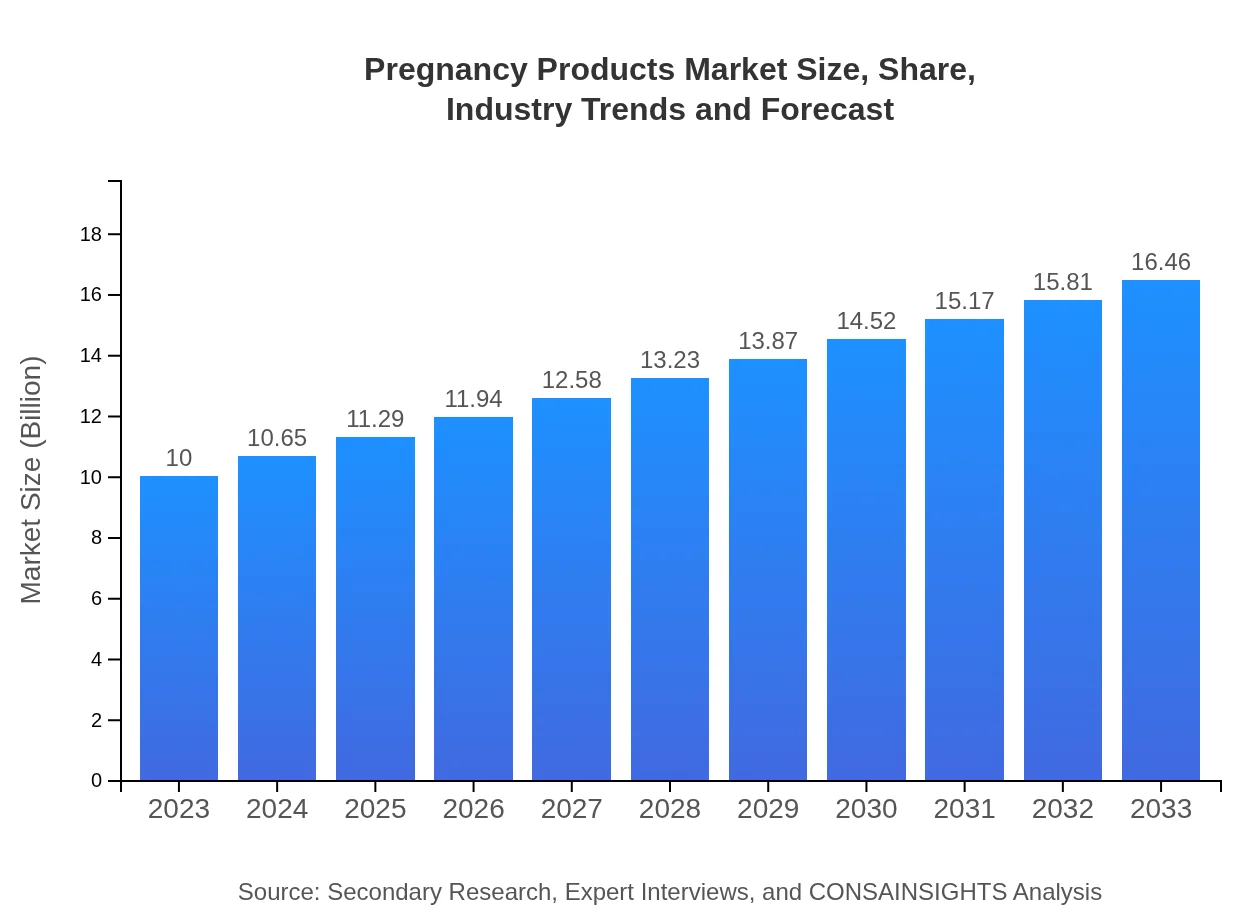
Pregnancy Products Market — USD 10 billion in 2023, Growing to USD 16.46B by 2033 at 5% CAGR
This report provides a comprehensive overview of the Pregnancy Products market, covering key trends, market size, segmentation, and forecasts from 2023 to 2033. Insights into regional dynamics and leading market players are also included for informed decision-making.
Key Takeaways
- Global market expands from $10.00 Billion in 2023 to $16.46 Billion in 2033 at a 5% CAGR.
- North America is largest regional market, while no single fastest-growing region is stated because regional CAGR differences remain within 0.15 percentage points.
- Europe, Asia Pacific, Latin America, and Middle East & Africa show notable growth reflecting rising maternal health awareness.
- Top companies named include Johnson & Johnson, Procter & Gamble, Burt's Bees, and Mothercare.
- E-commerce expansion and product innovation, including natural and personalized offerings, are core market catalysts.
Pregnancy Products Market Report — Executive Summary
North America remains largest market by forecast-period value, while no single fastest-growing region is stated because top regional growth rates are separated by less than 0.15 percentage points. The Pregnancy Products Market Report outlines steady expansion driven by rising attention to maternal health, product innovation, and broader e-commerce adoption. Market value is projected to climb from $10.00 Billion in 2023 to $16.46 Billion by 2033, reflecting a 5% CAGR over the 2023 to 2033 forecast period. Key product groups include prenatal vitamins, maternity apparel, baby gear, and personal care items, while consumer segments span expectant mothers, partners, and healthcare providers. Regional performance highlights North America as the largest market with values rising from $3.41 Billion in 2023 to $5.62 Billion in 2033. The report identifies regulatory considerations, demand for organic formulations, and channel shifts toward online sales as influential trends. regional growth market: Not specified. Major industry participants cited are Johnson & Johnson, Procter & Gamble, Burt's Bees, and Mothercare.
Key Growth Drivers
- Rising awareness of maternal and infant health leading to higher product uptake across prenatal and postpartum categories.
- Product innovation and demand for natural, personalized formulations increasing willingness to purchase premium offerings.
- Expansion of online retail channels improving availability and convenience for expectant consumers.
- Higher disposable incomes in several regions allowing greater spending on quality pregnancy-related products.
- Healthcare provider recommendations and stronger prenatal care frameworks supporting routine use of supplements and specialized goods.
| Metric | Value |
|---|---|
| Study Period | 2023 - 2033 |
| 2023 Market Size | $10.00 Billion |
| CAGR (2023-2033) | 5% |
| 2033 Market Size | $16.46 Billion |
| Top Companies | Johnson & Johnson, Procter & Gamble, Burt's Bees, Mothercare |
| Published Date | 20 October 2024 |
| Last Modified Date | 25 May 2026 |
Pregnancy Products Market Overview
Customize Pregnancy Products Market Report market research report
- ✔ Get in-depth analysis of Pregnancy Products market size, growth, and forecasts.
- ✔ Understand Pregnancy Products's regional dynamics and industry-specific trends.
- ✔ Identify potential applications, end-user demand, and growth segments in Pregnancy Products
What is the Market Size & CAGR of Pregnancy Products Market Report market in 2023?
Pregnancy Products Industry Analysis
Pregnancy Products Market Segmentation and Scope
Tell us your focus area and get a customized research report.
Pregnancy Products Market Report Market Analysis Report by Region
Europe Pregnancy Products Market Report:
Europe grows from $2.86 Billion in 2023 to $4.71 Billion in 2033. 86 Billion in 2023 to $4.71 Billion in 2033, driven by increased focus on maternal wellness, regulatory support for healthcare offerings, and consumer interest in organic and safety-tested pregnancy products across national markets.Asia Pacific Pregnancy Products Market Report:
Asia Pacific grows from $1.92 Billion in 2023 to $3.16 Billion in 2033. 92 Billion in 2023 to $3.16 Billion in 2033 as rising awareness of prenatal care, larger customer bases, and expanding e-commerce networks support wider access to prenatal vitamins, maternity apparel, and baby gear.North America Pregnancy Products Market Report:
North America is largest regional market, rising from $3.41 Billion in 2023 to $5.62 Billion in 2033. Regional growth reflects established retail infrastructures, high consumer spending on maternal health, and strong adoption of both premium and digital sales channels.South America Pregnancy Products Market Report:
Latin America grows from $0.83 Billion in 2023 to $1.37 Billion in 2033. 83 Billion in 2023 to $1.37 Billion in 2033, supported by improving prenatal care initiatives, growing disposable incomes, and increasing availability of both domestic and international pregnancy product brands.Middle East & Africa Pregnancy Products Market Report:
Middle East and Africa grows from $0.97 Billion in 2023 to $1.6 Billion in 2033. 97 Billion in 2023 to $1.6 Billion in 2033, with growth linked to expanding healthcare services, rising maternal health awareness, and gradual expansion of retail and online distribution for pregnancy-related goods.Tell us your focus area and get a customized research report.
Research Methodology
Pregnancy Products Market Analysis By Product Type
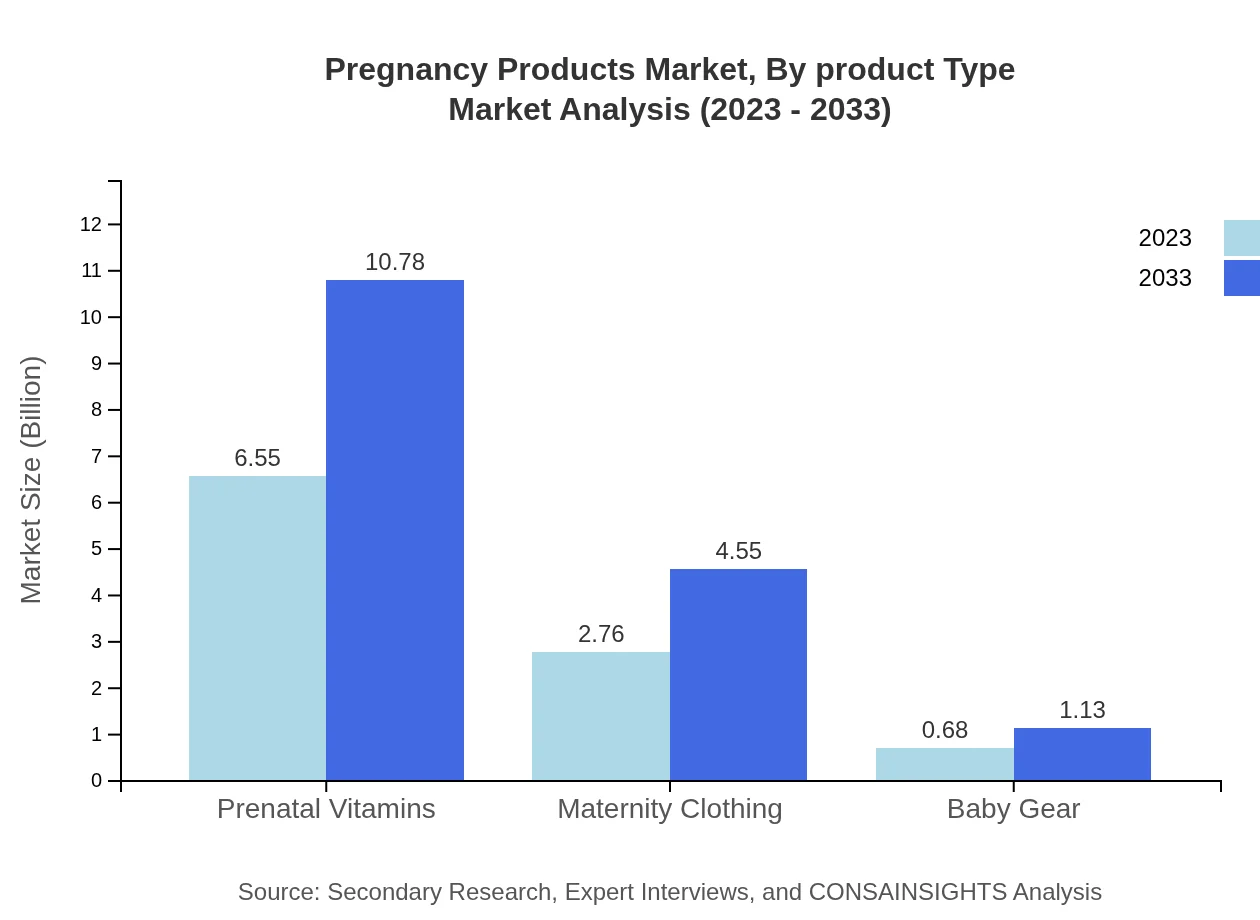
The Pregnancy Products market by product type is dominated by prenatal vitamins, which contribute significantly to market size and share. These vitamins are essential for fetal development and maternal health, constituting a market size of $6.55 billion in 2023, projected to rise to $10.78 billion by 2033. Other products such as maternity clothing and baby gear also play crucial roles, with maternity clothing generating $2.76 billion in 2023, expected to reach $4.55 billion by 2033, reflecting an increasing trend towards stylish and functional apparel for expectant mothers.
Pregnancy Products Market Analysis By Consumer
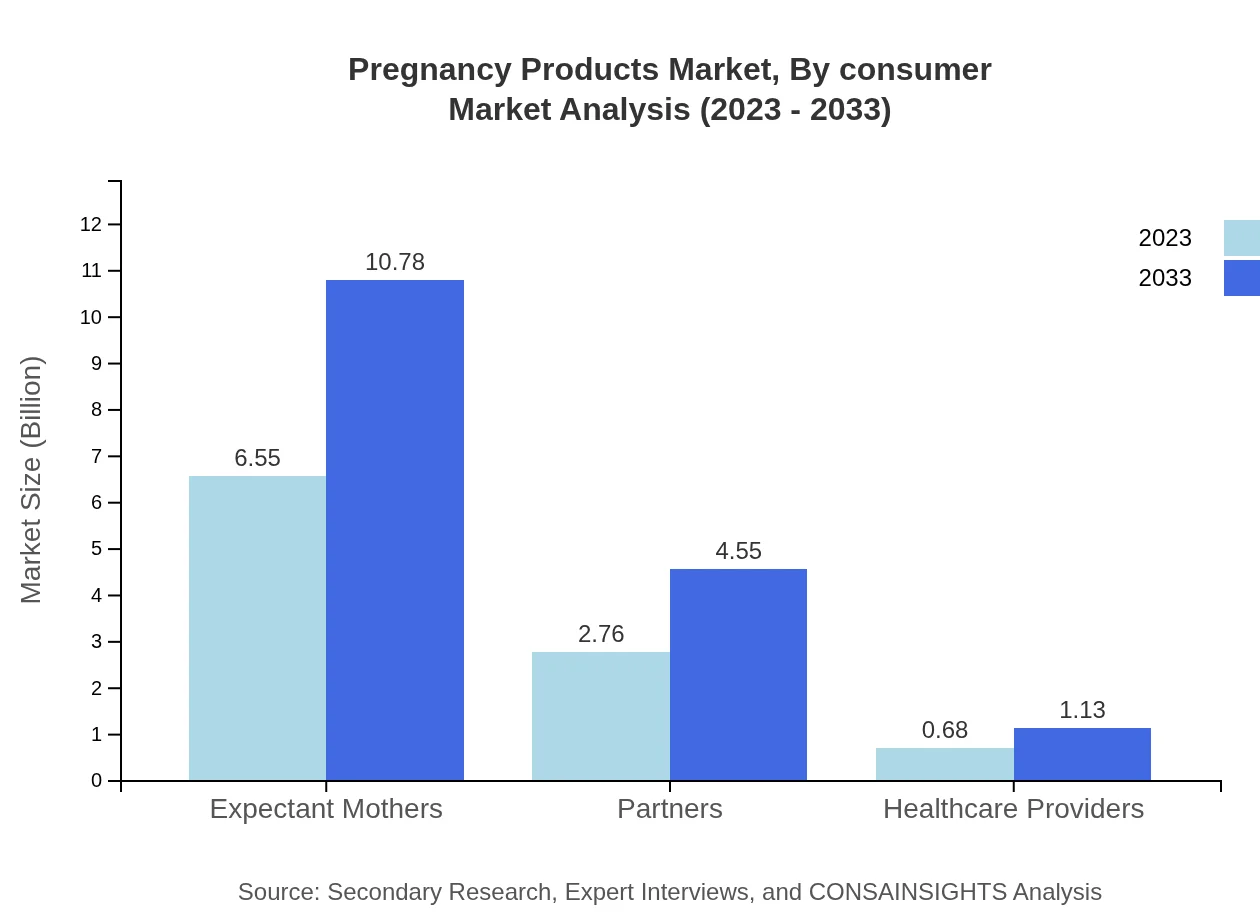
The consumer segment of the Pregnancy Products market is primarily made up of expectant mothers, who accounted for a market size of $6.55 billion in 2023, projected to grow to $10.78 billion by 2033. Partners of expectant mothers represent another significant consumer group, experiencing growth from $2.76 billion in 2023 to $4.55 billion by 2033. The growing awareness among healthcare providers is also influencing purchasing decisions, with their segment size anticipated to increase from $0.68 billion in 2023 to $1.13 billion by 2033.
Pregnancy Products Market Analysis By Product Category
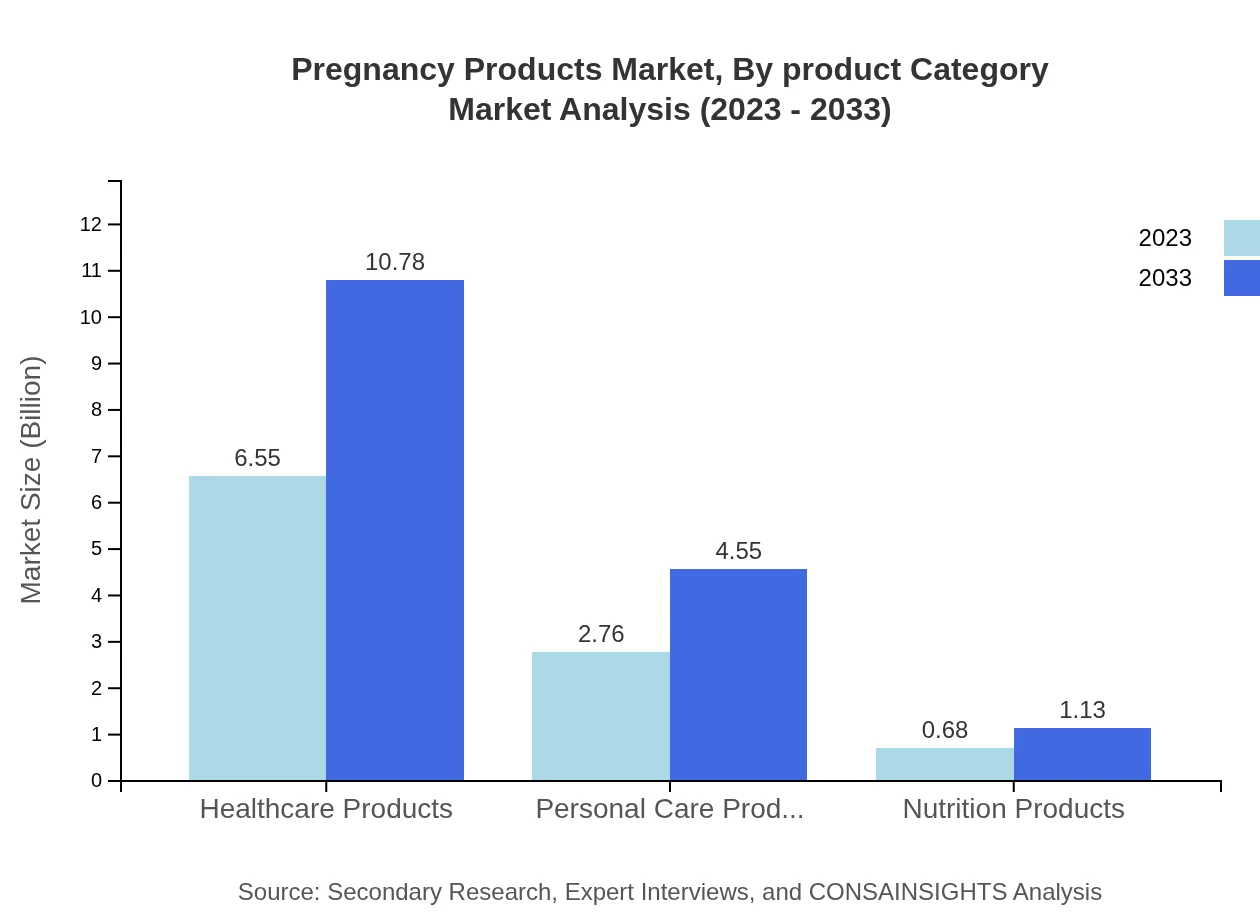
In terms of product category, healthcare products dominate with a market size of $6.55 billion in 2023, expected to rise to $10.78 billion by 2033. Personal care products follow, contributing notably to the market with a size of $2.76 billion in 2023, which will grow to $4.55 billion by 2033. The focus on nutrition products, while smaller, also reflects a notable growth trajectory, increasing from $0.68 billion in 2023 to $1.13 billion by 2033, as mothers become more health-conscious.
Pregnancy Products Market Analysis By Sales Channel
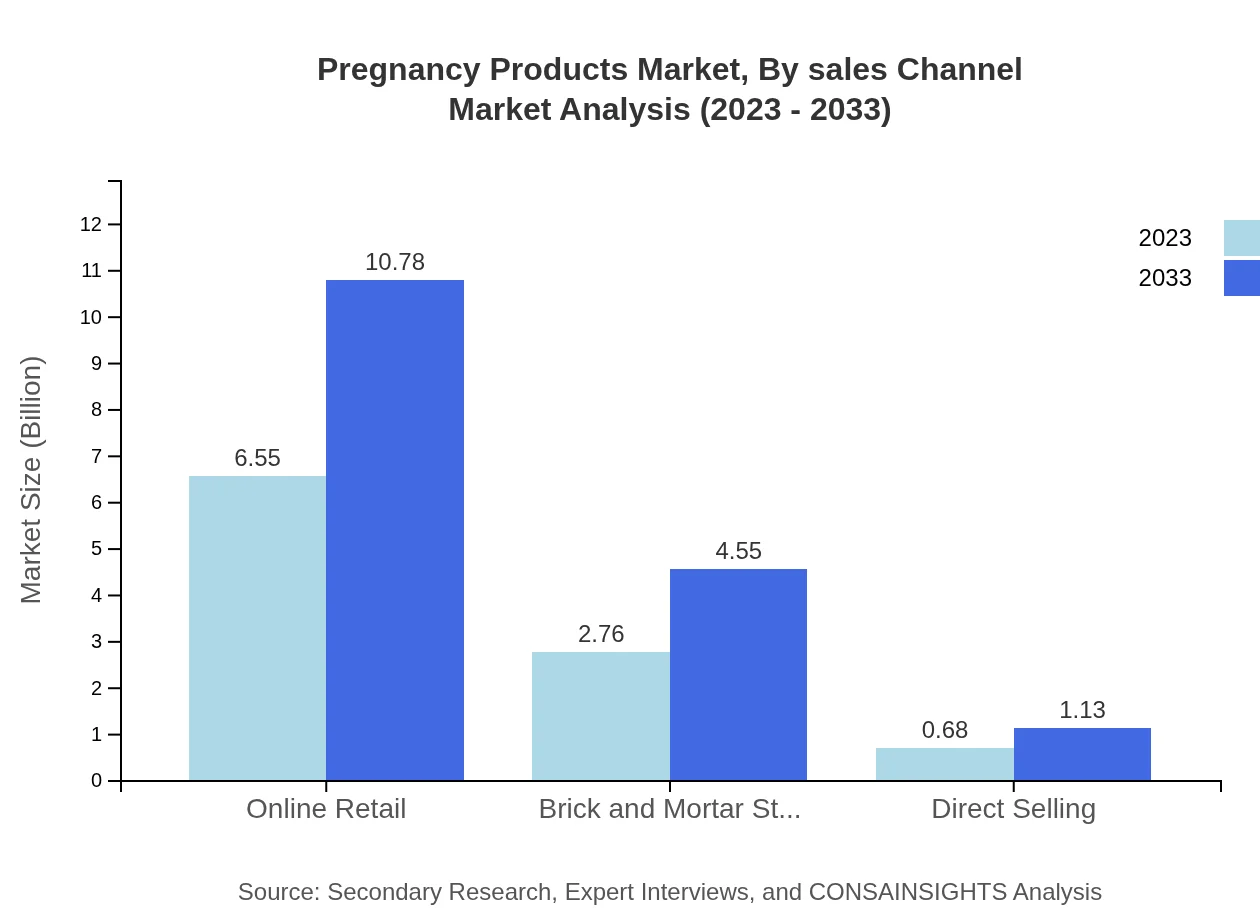
The sales channels for pregnancy products are diversifying, with online retail leading the way. The online sales channel is expected to grow from $6.55 billion in 2023 to $10.78 billion by 2033, reflecting consumer preference for convenience. Brick and mortar stores continue to play a significant role, growing from $2.76 billion in 2023 to $4.55 billion by 2033. Direct selling channels remain important yet smaller, anticipated to reach $1.13 billion by 2033.
Pregnancy Products Market Trends and Future Forecast
Tell us your focus area and get a customized research report.
Global Market Leaders and Top Companies in Pregnancy Products Industry
Johnson & Johnson:
A leader in healthcare products, Johnson & Johnson offers a wide range of prenatal vitamins and maternity-related items, emphasizing quality and innovation.Procter & Gamble:
Known for its wide array of consumer goods, Procter & Gamble has a strong presence in the maternity products segment, including baby care products and maternal health solutions.Burt's Bees:
Specializing in natural personal care products, Burt's Bees has a growing line of organic maternity and baby care products that cater to health-conscious consumers.Mothercare:
A well-established name in maternity and baby products, Mothercare offers a range of high-quality apparel and gear designed for mothers and their infants.We're grateful to work with incredible clients.








FAQs
What is the market size of the Pregnancy Products market in 2023?
The market size in 2023 is $10.00 Billion, as reported for the global pregnancy products sector during the 2023 base year.
How big will the Pregnancy Products market be in 2033?
By 2033 the market is projected to reach $16.46 Billion, reflecting the end-point valuation used in the report's 2023 to 2033 forecast.
What is CAGR for the forecast period?
The compound annual growth rate for the 2023 to 2033 forecast period is 5%, as stated for the global market projection.
Is there a single fastest Growing region in the Pregnancy Products Market Report market?
No single fastest-growing region is stated for the Pregnancy Products Market Report market because the top regional implied CAGR values are within 0.15 percentage points of each other, making the ranking too close to call reliably.
Which companies are listed as top players?
Top companies included in the report are Johnson & Johnson, Procter & Gamble, Burt's Bees, and Mothercare, reflecting notable industry participation.
What product categories are covered in the report?
The report covers product categories such as prenatal vitamins, maternity clothing, baby gear, healthcare products, personal care products, and nutrition products.
How are sales channels represented in the analysis?
Sales channels examined include online retail, brick and mortar stores, and direct selling, illustrating distribution diversity across the market.
What research methods were used to compile the report?
Research included primary interviews with industry experts, secondary company reports and publications, data triangulation, internal validation, and expert-led trend analysis.