

Radioactive Stents Market Report
First published: 08 October 2024 | Last updated: 28 May 2026 | Report Code: radioactive-stents
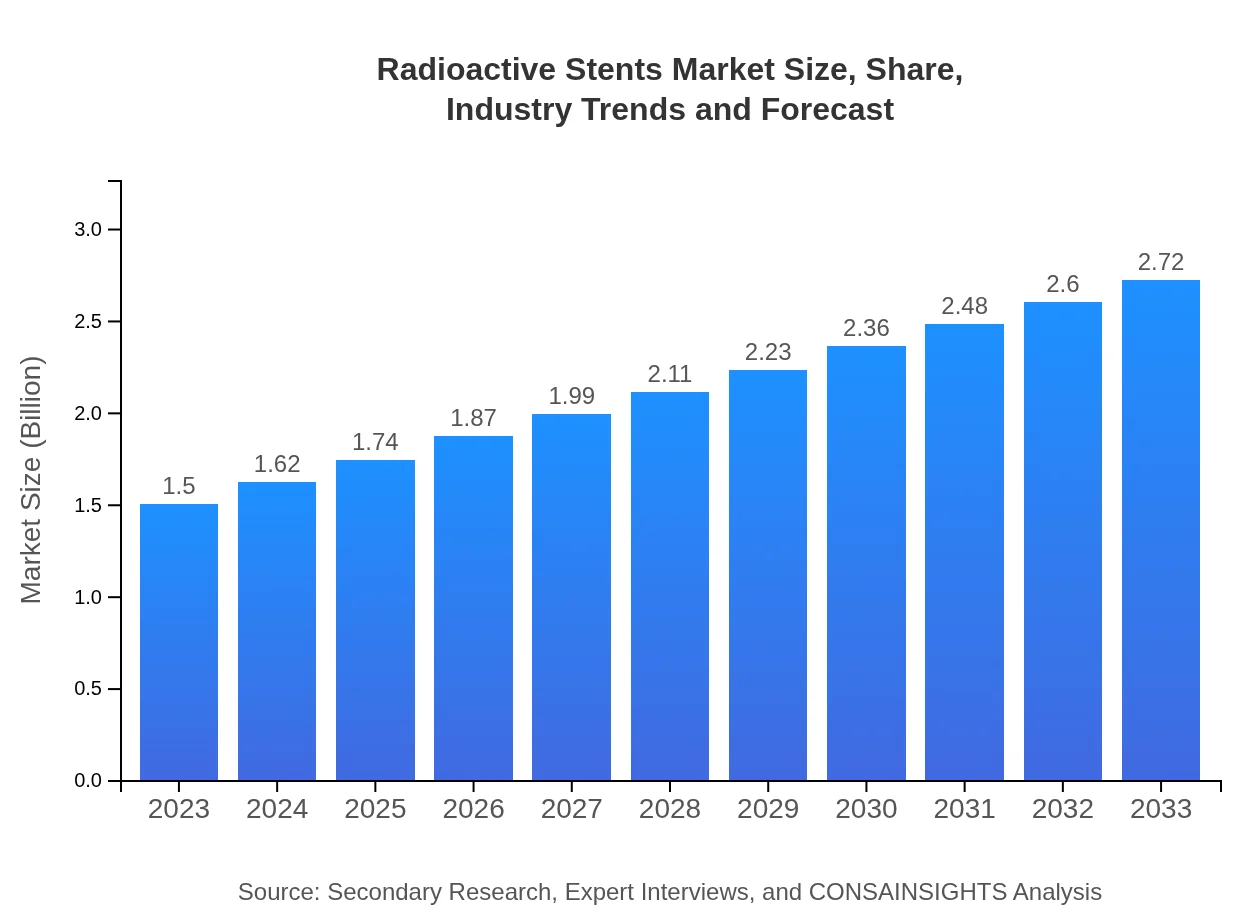
Radioactive Stents Market — USD $1.5 Billion in 2023, Growing to USD 2.72null by 2033 at 6.0% CAGR
This report provides a comprehensive analysis of the Radioactive Stents market, focusing on key insights, market dynamics, and forecasts for the period 2023 to 2033. It covers market size, segmentation, regional analysis, trends, and competitive landscape in detail.
Key Takeaways
- Global market expands from $1.50 Billion in 2023 to $2.72 Billion in 2033 at a 6% CAGR.
- North America is the largest region, rising from $0.55 Billion in 2023 to $0.99 Billion in 2033.
- North America is largest regional market; Latin America is regional market region based on implied CAGR across 2023 to 2033.
- Europe and Asia Pacific show steady increases: Europe from $0.44 Billion to $0.8 Billion, Asia Pacific from $0.29 Billion to $0.52 Billion.
- Leading companies include Boston Scientific Corporation, Abbott Laboratories, Medtronic, Bard Peripheral Vascular, and Stryker Corporation.
Radioactive Stents Market Report — Executive Summary
Regional analysis shows North America as largest market and Latin America as fastest-growing region by implied CAGR. Demand for radioactive stents is driven by the need to reduce restenosis in minimally invasive vascular and oncological procedures. The market is forecast to grow from $1.50 Billion in 2023 to $2.72 Billion by 2033 at a 6% CAGR over 2023 to 2033. Technological improvements in stent coatings, delivery systems, and manufacturing processes support product adoption. Regional dynamics vary: North America holds the largest share while Latin America is flagged as the regional market region. Key players such as Boston Scientific Corporation, Abbott Laboratories, Medtronic, Bard Peripheral Vascular, and Stryker Corporation are central to innovation and commercial activity. Ongoing collaboration between manufacturers and healthcare providers, along with regulatory and clinical evidence developments, will shape competitive positioning and market access through the forecast period.
Key Growth Drivers
- Rising use of minimally invasive interventions increases demand for advanced stent solutions that reduce restenosis risks.
- Advances in stent coatings and delivery technologies improve clinical outcomes and broaden application in cardiology and oncology.
- Expanded healthcare infrastructure and procedure adoption in multiple regions support market expansion during 2023 to 2033.
- Active product development by leading medical device companies accelerates availability of next-generation radioactive stents.
- Focus on improved biocompatibility and sterilization techniques enhances clinician confidence and patient safety.
| Metric | Value |
|---|---|
| Study Period | 2023 - 2033 |
| 2023 Market Size | $1.50 Billion |
| CAGR (2023-2033) | 6.0% |
| 2033 Market Size | $2.72 Billion |
| Top Companies | Boston Scientific Corporation, Abbott Laboratories, Medtronic , Bard Peripheral Vascular, Stryker Corporation |
| Published Date | 08 October 2024 |
| Last Modified Date | 28 May 2026 |
Radioactive Stents Market Overview
Customize Radioactive Stents Market Report market research report
- ✔ Get in-depth analysis of Radioactive Stents market size, growth, and forecasts.
- ✔ Understand Radioactive Stents's regional dynamics and industry-specific trends.
- ✔ Identify potential applications, end-user demand, and growth segments in Radioactive Stents
What is the Market Size & CAGR of Radioactive Stents Market Report market in 2023?
Radioactive Stents Industry Analysis
Radioactive Stents Market Segmentation and Scope
Tell us your focus area and get a customized research report.
Radioactive Stents Market Report Market Analysis Report by Region
Europe Radioactive Stents Market Report:
Europe grows from $0.44 Billion in 2023 to $0.8 Billion in 2033. Rising procedure volumes, advances in stent materials and coatings, and regulatory pathways that enable adoption are key regional drivers.Asia Pacific Radioactive Stents Market Report:
Asia Pacific grows from $0.29 Billion in 2023 to $0.52 Billion in 2033. Increasing healthcare access, broader adoption of interventional therapies, and investment in medical device innovation underpin regional market development.North America Radioactive Stents Market Report:
North America is largest regional market, rising from $0.55 Billion in 2023 to $0.99 Billion in 2033. Clinical demand for minimally invasive vascular procedures, established healthcare infrastructure, and active R&D from device manufacturers support market scale in this region.South America Radioactive Stents Market Report:
Latin America is fastest-growing region by implied CAGR, increasing from $0.14 Billion in 2023 to $0.26 Billion in 2033. Growing procedural adoption and improving healthcare infrastructure contribute to its designation as the regional growth market in the provided data.Middle East & Africa Radioactive Stents Market Report:
Middle East and Africa grows from $0.09 Billion in 2023 to $0.16 Billion in 2033. Expanding clinical capabilities, greater access to interventional treatments, and investments in healthcare systems drive regional market expansion.Tell us your focus area and get a customized research report.
Research Methodology
Radioactive Stents Market Analysis By Type
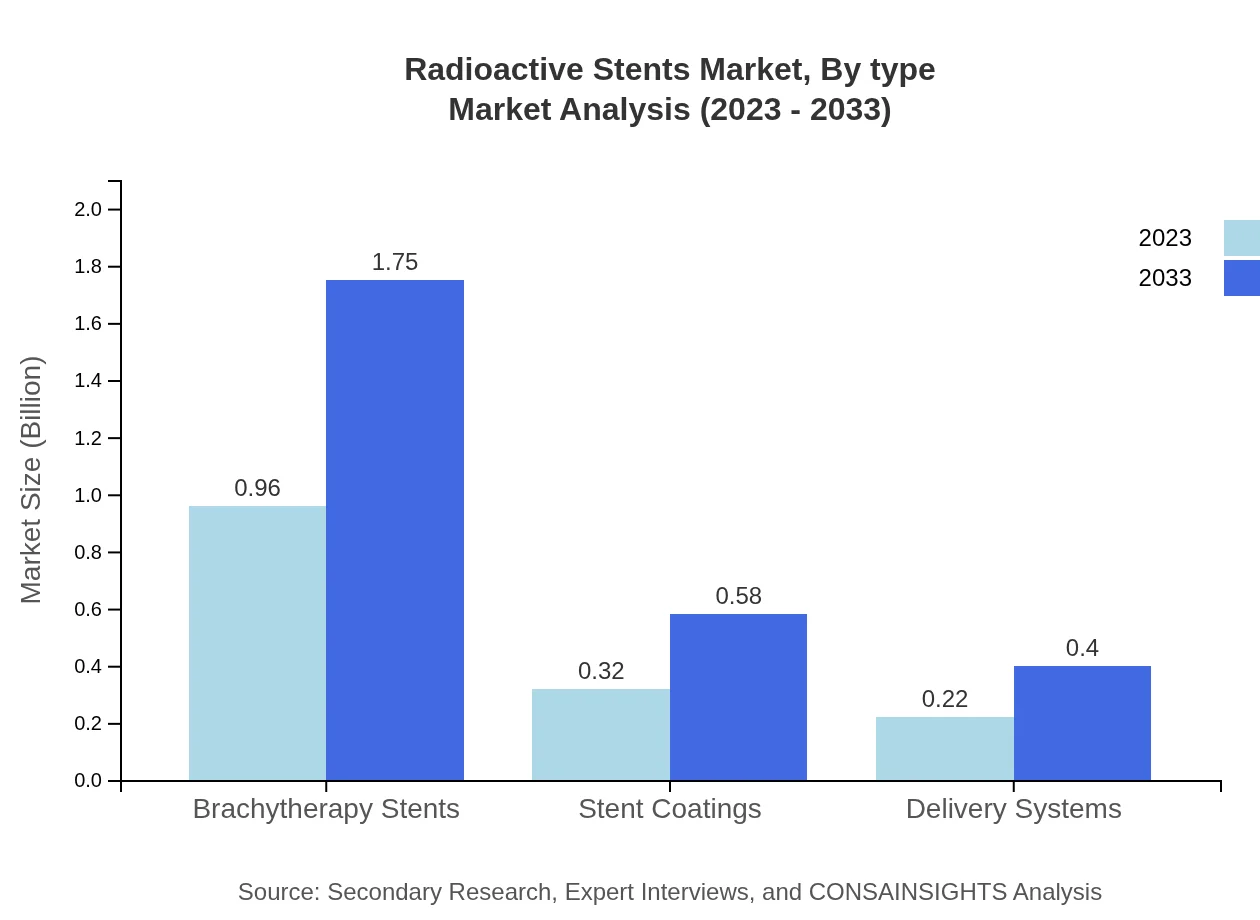
The market analysis by type reveals that Brachytherapy Stents dominate with a market size of USD 0.96 billion in 2023 and expected growth to USD 1.75 billion by 2033, capturing 64.19% market share. Stent coatings follow, holding a 21.11% share with market values moving from USD 0.32 billion to USD 0.58 billion over the same period. Delivery systems account for 14.7% of the market, increasing from USD 0.22 billion to USD 0.40 billion.
Radioactive Stents Market Analysis By Applications
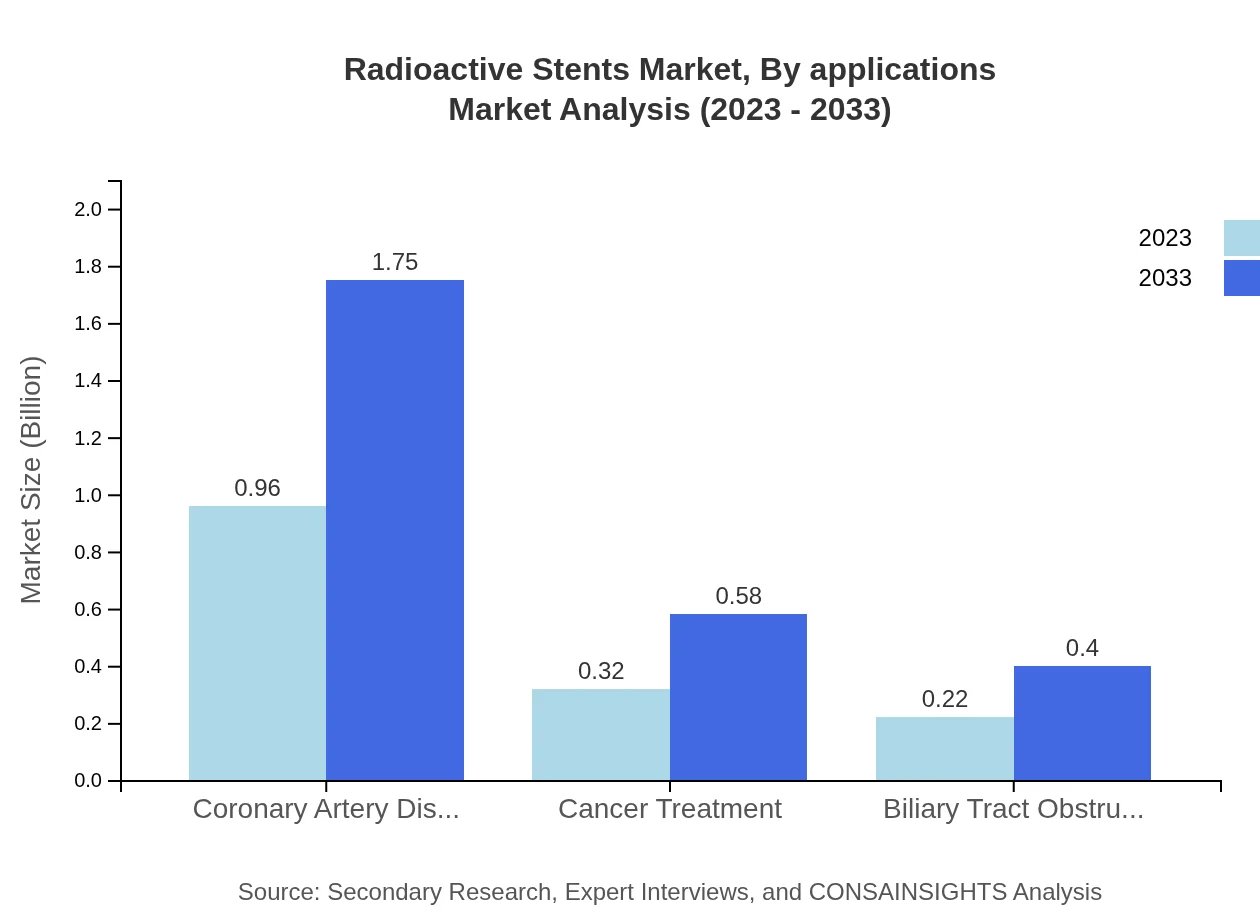
In terms of applications, the treatment of Coronary Artery Disease leads, with a market size of USD 0.96 billion in 2023 and estimated growth to USD 1.75 billion by 2033. This is followed by applications in Cancer Treatment, moving from USD 0.32 billion to USD 0.58 billion, representing 21.11% market share, and Biliary Tract Obstructions, scaling from USD 0.22 billion to USD 0.40 billion, capturing 14.7% of the market.
Radioactive Stents Market Analysis By End User
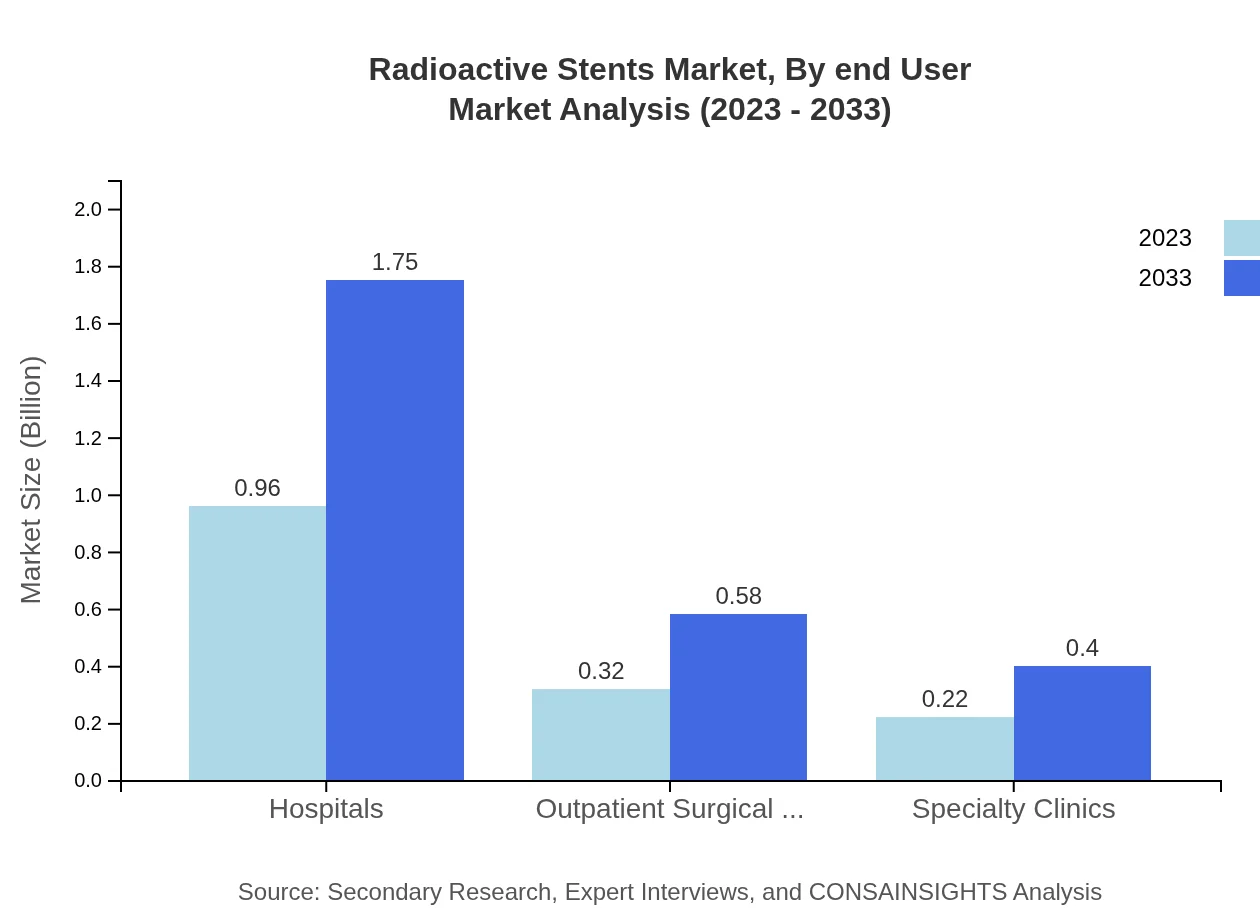
Hospitals lead the end-user market, with a size of USD 0.96 billion in 2023, growing to USD 1.75 billion by 2033, maintaining a steady share of 64.19%. Outpatient Surgical Centers cover 21.11% of the market and are projected to grow from USD 0.32 billion to USD 0.58 billion. Specialty Clinics contribute an additional 14.7%, growing from USD 0.22 billion to USD 0.40 billion.
Radioactive Stents Market Analysis By Region Applications
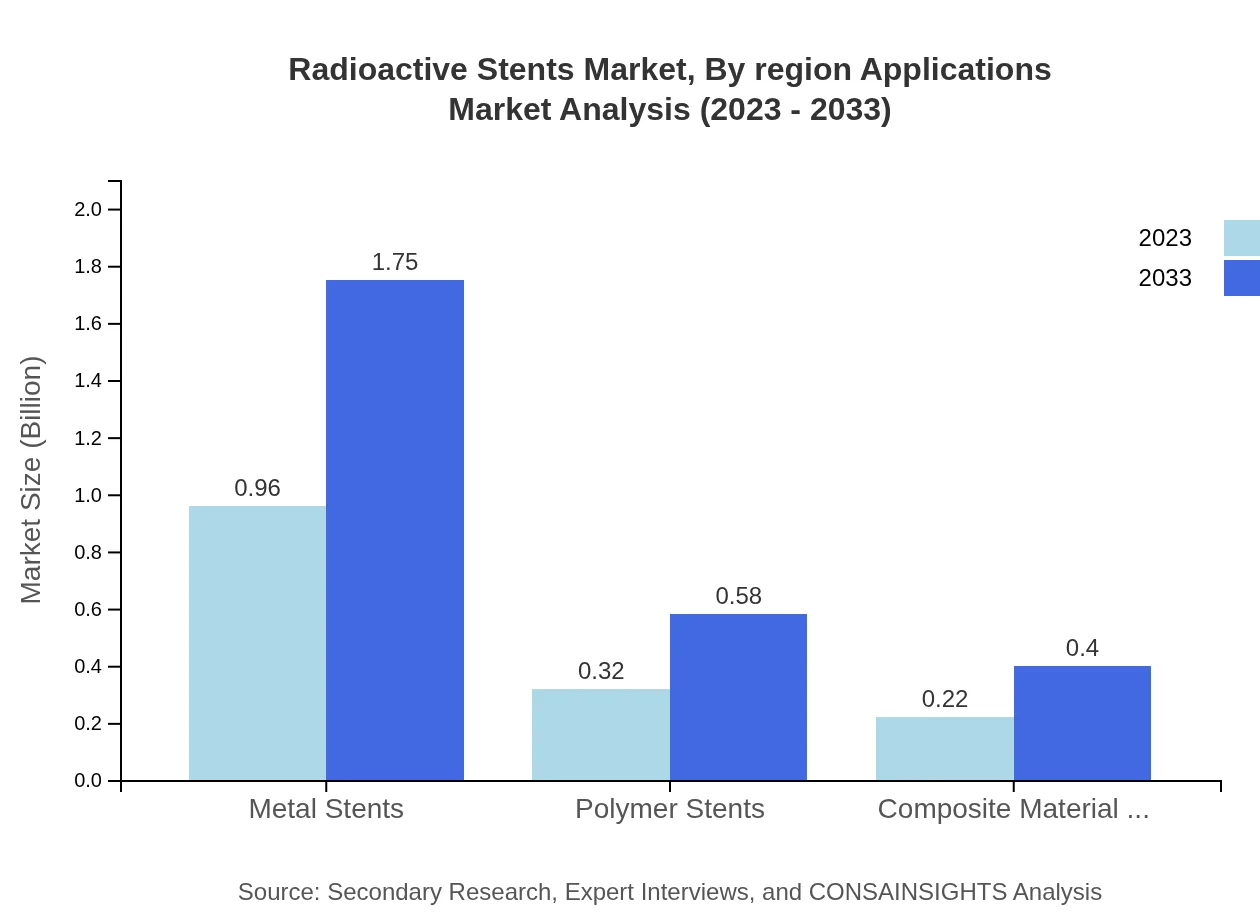
The composition of the Radioactive Stents market by material reveals that Metal Stents lead in performance, accounting for USD 0.96 billion in 2023 and expected to reach USD 1.75 billion by 2033 with 64.19% share. Polymer Stents represent 21.11% of the market, moving from USD 0.32 billion to USD 0.58 billion. Composite Material Stents cover 14.7% share, growing from USD 0.22 billion to USD 0.40 billion.
Radioactive Stents Market Analysis By Manufacturing Process
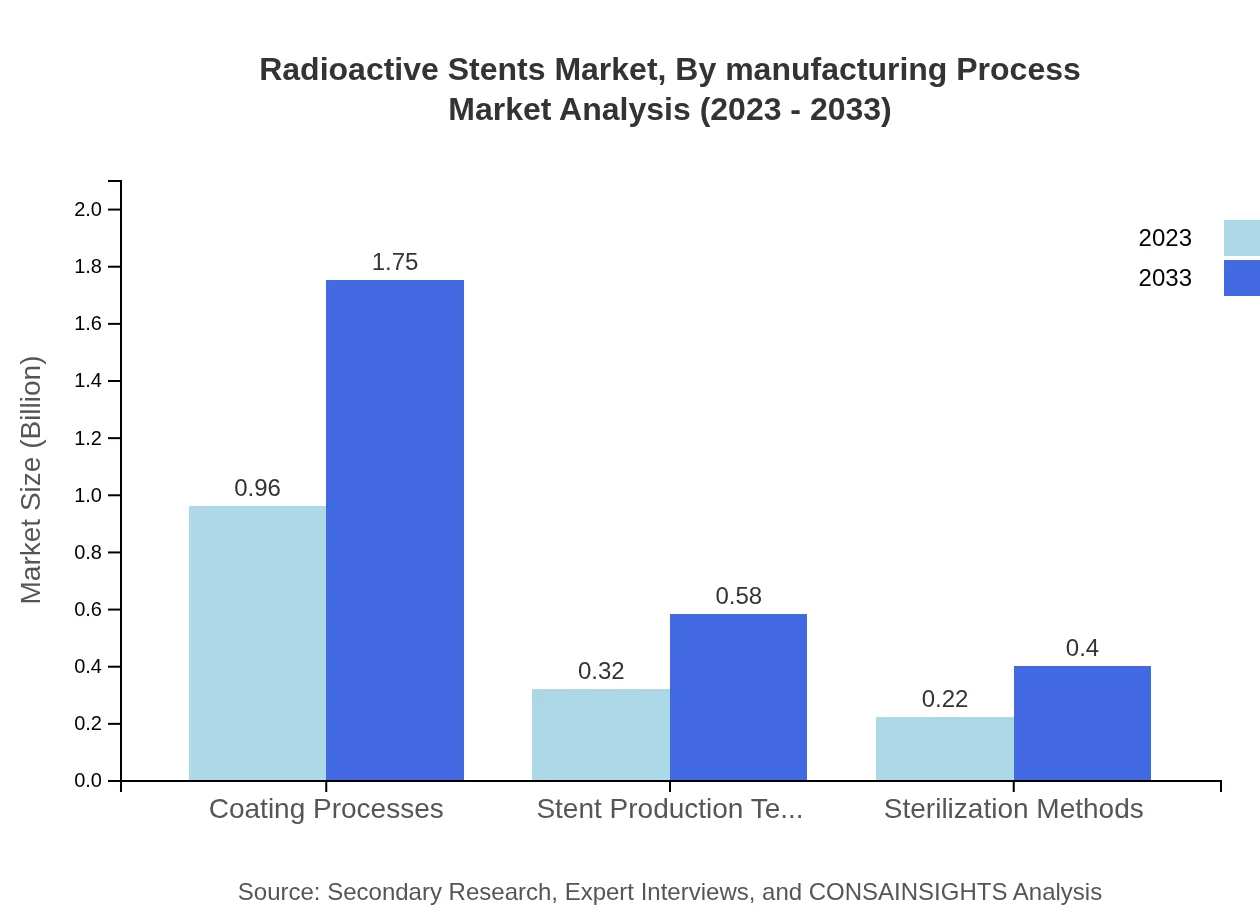
In manufacturing processes, Coating Processes lead with a market size of USD 0.96 billion in 2023, expected to grow to USD 1.75 billion by 2033, holding 64.19% share. Stent Production Techniques account for 21.11% and are projected to grow from USD 0.32 billion to USD 0.58 billion, while Sterilization Methods will capture 14.7% market share, increasing from USD 0.22 billion to USD 0.40 billion.
Radioactive Stents Market Trends and Future Forecast
Tell us your focus area and get a customized research report.
Global Market Leaders and Top Companies in Radioactive Stents Industry
Boston Scientific Corporation:
Boston Scientific is a global leader in the development of innovative medical devices, including advanced stents. Their significant research focus on radioactive stents aligns with advancements in cardiovascular therapies.Abbott Laboratories:
Abbott Laboratories is known for its comprehensive healthcare products, particularly in cardiovascular devices. Their contributions to medication-coated stents have influenced the development of radioactive stent technology.Medtronic :
Medtronic is a pioneer in the medical technology sector, particularly known for its cardiac devices. Their ongoing investments into R&D for stent technologies reflect their commitment to improving patient outcomes.Bard Peripheral Vascular:
Bard specializes in vascular medical devices, contributing significantly to advancements in stent technologies, including innovative radioactive stent applications for numerous therapeutic procedures.Stryker Corporation:
With a strong specialization in orthopedic and medical devices, Stryker's involvement in vascular interventions includes development and distribution of advanced stenting solutions.We're grateful to work with incredible clients.







FAQs
What is the market size in 2023?
The market size in 2023 is $1.50 Billion as stated in the report data for the global radioactive stents market.
What is the market size in 2033?
The projected market size for 2033 is $2.72 Billion according to the provided forecast figures.
What is CAGR?
The forecast CAGR for the period 2023 to 2033 is 6% as specified in the input market data.
Which region is the fastest Growing in the Radioactive Stents Market Report market?
Latin America is the fastest-growing region, projected to expand from $0.14 Billion in 2023 to $0.26 Billion in 2033, reflecting an implied 6.39% CAGR over the forecast period.
Which region is fastest Growing?
Latin America is noted as the regional market region with growth from $0.14 Billion in 2023 to $0.26 Billion in 2033.
Who are the top companies?
Top companies listed include Boston Scientific Corporation, Abbott Laboratories, Medtronic, Bard Peripheral Vascular, and Stryker Corporation.
How is the market segmented?
Segmentation covers type, end-user, application, material, and manufacturing process with subsegments such as Brachytherapy Stents, Hospitals, and Coronary Artery Disease.
Why are stent coatings important?
Coatings enhance biocompatibility, reduce thrombosis risk, and improve long-term patency, supporting wider clinical adoption of radioactive stents.
What drives regional growth differences?
Regional variations stem from differing healthcare infrastructure, procedure adoption rates, regulatory frameworks, and investment in interventional therapies.
How is data validated?
The research uses primary interviews, company reports, publications, data triangulation, and internal validation led by subject-matter experts.