

Rapid Diagnostics Market Report
First published: 07 October 2024 | Last updated: 25 May 2026 | Report Code: rapid-diagnostics
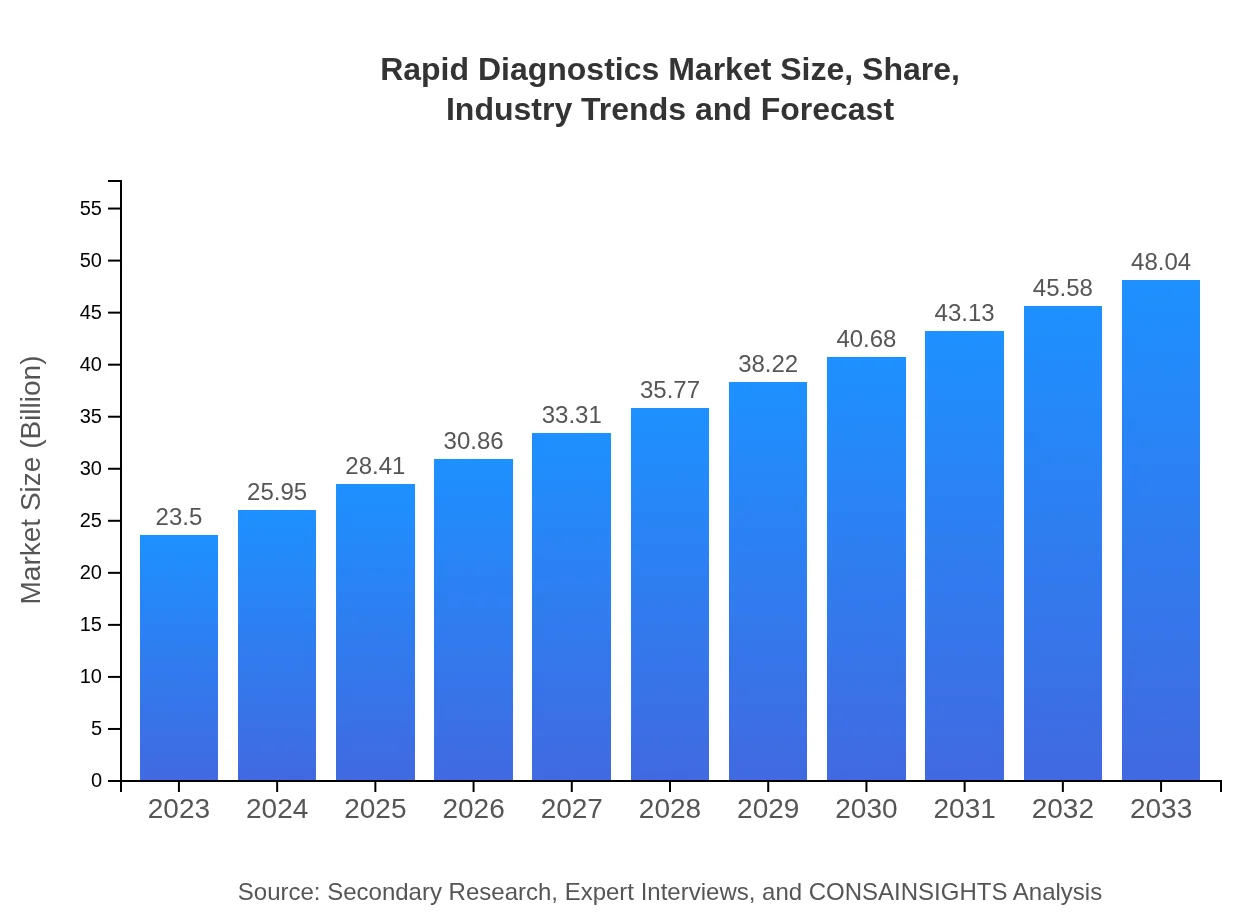
Rapid Diagnostics Market — USD 23.5 billion in 2023, Growing to USD 48.04B by 2033 at 7.2% CAGR
This report provides a comprehensive analysis of the Rapid Diagnostics market from 2023 to 2033. It covers market size, growth rates, industry insights, segmentations, regional performances, and forecasts, presenting valuable data for stakeholders to make informed decisions.
Key Takeaways
- Global market expands from $23.50 Billion (2023) to $48.04 Billion (2033) at a 7.2% CAGR.
- North America is largest regional market, while no single fastest-growing region is stated because regional CAGR differences remain within 0.15 percentage points.
- North America leads regional value, increasing from $8.99 Billion (2023) to $18.37 Billion (2033).
- Europe and Asia Pacific show notable increases to $12.48 Billion and $9.72 Billion respectively by 2033.
- Product segments include Molecular Diagnostics, Immunodiagnostics, and Point-of-Care Testing.
- Top companies listed include Abbott Laboratories, Roche Diagnostics, Thermo Fisher Scientific, and Becton, Dickinson and Company.
Rapid Diagnostics Market Report — Executive Summary
North America remains largest market by forecast-period value, while no single fastest-growing region is stated because top regional growth rates are separated by less than 0.15 percentage points. This report examines the Rapid Diagnostics market across global regions, product types, applications, and distribution channels. Market expansion from $23.50 Billion in 2023 to $48.04 Billion by 2033 at a 7.2% CAGR reflects rising demand for faster clinical decision-making and wider deployment of point-of-care and molecular platforms. Key trends include technological advancement in test formats, integration with digital health workflows, and increasing adoption across hospitals, laboratories, home care, pharmacies, and academic institutions. Regulatory approvals and strategic collaborations are shaping competitive positioning among major firms such as Abbott Laboratories, Roche Diagnostics, Thermo Fisher Scientific, and Becton, Dickinson and Company. The report’s segmentation covers product types, end users, applications, and channels, offering stakeholders targeted insight for investment, R&D, and go-to-market planning. Regional breakdowns quantify growth trajectories and highlight market structure changes that will influence supply chain and commercialization strategies over the forecast period.
Key Growth Drivers
- Rising need for rapid clinical results is increasing adoption across hospitals and laboratories.
- Advances in molecular and immunodiagnostic technologies enable quicker, more accurate point-of-care testing.
- Expanded home care and pharmacy testing channels are broadening patient access to diagnostics.
- Collaborations and regulatory clearances are accelerating commercialization of new rapid test formats.
- Increasing healthcare spending and emphasis on preventive care support sustained market expansion.
| Metric | Value |
|---|---|
| Study Period | 2023 - 2033 |
| 2023 Market Size | $23.50 Billion |
| CAGR (2023-2033) | 7.2% |
| 2033 Market Size | $48.04 Billion |
| Top Companies | Abbott Laboratories, Roche Diagnostics, Thermo Fisher Scientific, Becton, Dickinson and Company |
| Published Date | 07 October 2024 |
| Last Modified Date | 25 May 2026 |
Rapid Diagnostics Market Overview
Customize Rapid Diagnostics Market Report market research report
- ✔ Get in-depth analysis of Rapid Diagnostics market size, growth, and forecasts.
- ✔ Understand Rapid Diagnostics's regional dynamics and industry-specific trends.
- ✔ Identify potential applications, end-user demand, and growth segments in Rapid Diagnostics
What is the Market Size & CAGR of Rapid Diagnostics Market Report market in 2023?
Rapid Diagnostics Industry Analysis
Rapid Diagnostics Market Segmentation and Scope
Tell us your focus area and get a customized research report.
Rapid Diagnostics Market Report Market Analysis Report by Region
Europe Rapid Diagnostics Market Report:
Europe grows from $6.11 Billion in 2023 to $12.48 Billion in 2033. Regional expansion is supported by investments in diagnostic technologies, regulatory pathways enabling market entry, and broader use across hospitals, laboratories, and outpatient settings.Asia Pacific Rapid Diagnostics Market Report:
Asia Pacific grows from $4.76 Billion in 2023 to $9.72 Billion in 2033. Growth is linked to expanding healthcare access, increased diagnostic adoption in clinical and community settings, and rising demand for cost-effective, rapid test solutions.North America Rapid Diagnostics Market Report:
North America is largest regional market, rising from $8.99 Billion in 2023 to $18.37 Billion in 2033. 99 Billion in 2023 and grows to $18.37 Billion by 2033. The region’s value reflects widespread clinical infrastructure, rapid adoption of point-of-care and molecular testing, strong private and public healthcare investment, and activity by leading firms driving commercialization.South America Rapid Diagnostics Market Report:
Latin America grows from $1.92 Billion in 2023 to $3.93 Billion in 2033. Market gains reflect growing awareness of rapid testing benefits, expanded distribution channels, and increased uptake in public and private healthcare facilities.Middle East & Africa Rapid Diagnostics Market Report:
Middle East and Africa grows from $1.73 Billion in 2023 to $3.53 Billion in 2033. Drivers include expanding diagnostic infrastructure, rising healthcare expenditure, and adoption of point-of-care formats in diverse clinical environments.Tell us your focus area and get a customized research report.
Research Methodology
Rapid Diagnostics Market Analysis By Product Type
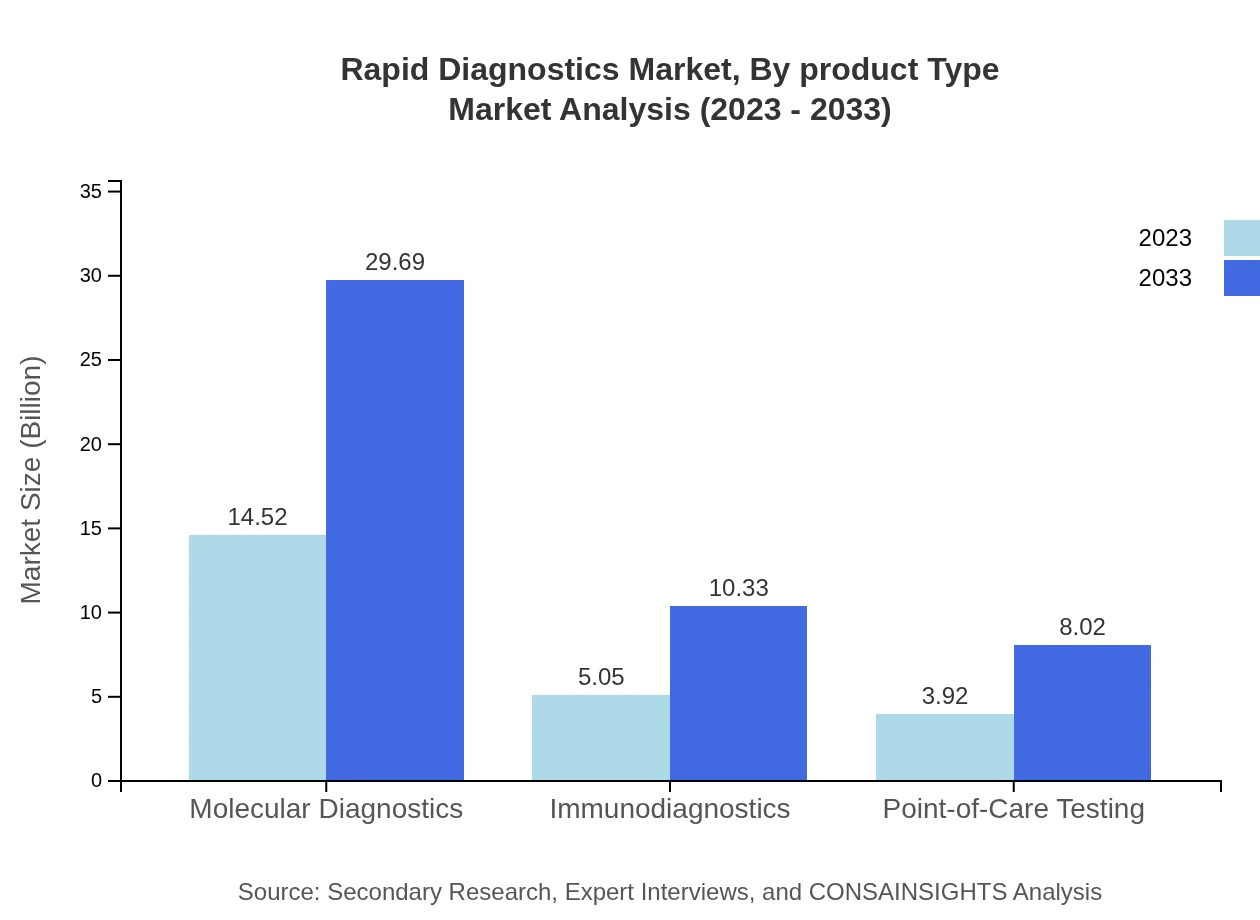
The Rapid Diagnostics market is dominated by various product segments. Molecular diagnostics, leading the market, accounted for $14.52 billion in 2023 and is expected to reach $29.69 billion by 2033, representing a 61.8% market share. Immunodiagnostics and Point-of-Care Testing follow, with significant shares of 21.51% and 16.69% respectively, indicating the diversified applications across numerous diseases.
Rapid Diagnostics Market Analysis By Application Area
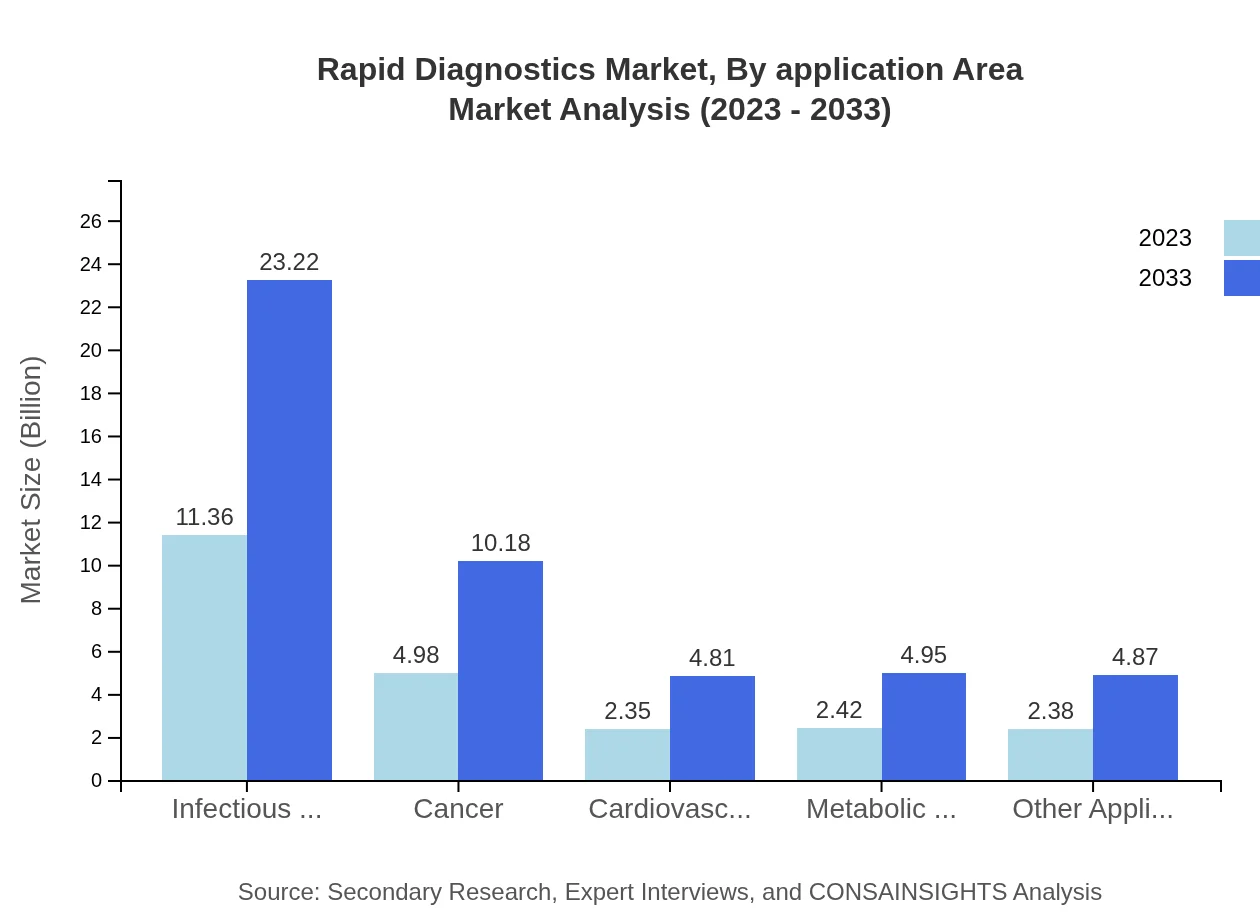
In the application area, Infectious Diseases holds the largest share, contributing $11.36 billion in 2023 and expected to reach $23.22 billion by 2033, maintaining a 48.34% market share. Other key areas include Cancer, Cardiovascular Diseases, and Metabolic Disorders, reflecting an evolving market addressing prevalent health issues.
Rapid Diagnostics Market Analysis By End User
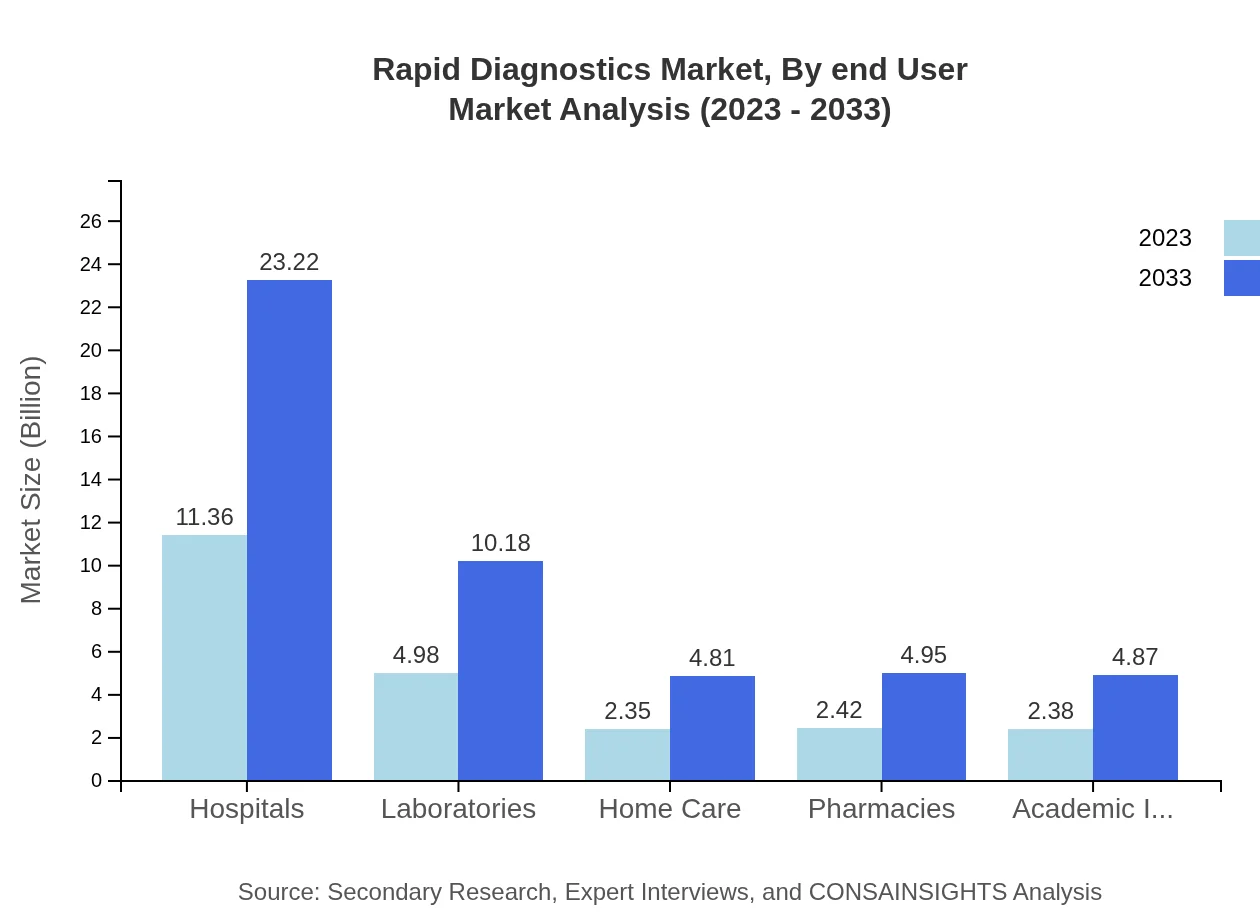
The end-user segment highlights Hospitals as the primary consumers at $11.36 billion in 2023, growing to $23.22 billion by 2033, representing 48.34% of the market. Laboratories and Home Care settings follow, each playing critical roles in improving diagnosis rates and treatment efficiency.
Rapid Diagnostics Market Trends and Future Forecast
Tell us your focus area and get a customized research report.
Global Market Leaders and Top Companies in Rapid Diagnostics Industry
Abbott Laboratories:
Abbott is a global leader in healthcare, specializing in diagnostics, device manufacturing, nutrition, and pharmaceuticals. Their innovative diagnostic solutions, including rapid tests for infectious diseases, are widely recognized.Roche Diagnostics:
Roche is renowned for its excellence in diagnostics and focuses on innovation in the medical field. The company offers a comprehensive range of rapid diagnostic tests.Thermo Fisher Scientific:
Thermo Fisher provides essential scientific solutions, including rapid diagnostics tools designed for various healthcare settings, focusing on quality and efficiency.Becton, Dickinson and Company:
BD is a leading global medical technology company, providing a diverse range of rapid diagnostics solutions, significantly contributing to public health and safety.We're grateful to work with incredible clients.








FAQs
What is the current market size of the Rapid Diagnostics market?
The market size was $23.50 Billion in 2023. This figure represents the global value of rapid diagnostic solutions across product types, channels, and end users for that year.
How big will the Rapid Diagnostics market be in 2033?
By 2033 the market is projected to reach $48.04 Billion, reflecting growth across molecular, immunodiagnostic and point-of-care segments over the forecast period.
What is CAGR of the market during the forecast period?
The compound annual growth rate (CAGR) for 2023 to 2033 is 7.2%, representing the average annual expansion rate applied to the market value across the decade.
Is there a single fastest Growing region in the Rapid Diagnostics Market Report market?
No single fastest-growing region is stated for the Rapid Diagnostics Market Report market because the top regional implied CAGR values are within 0.15 percentage points of each other, making the ranking too close to call reliably.
Why is the market growing at the reported CAGR?
Growth at 7.2% is driven by faster testing demand, technological upgrades in diagnostics, broader distribution channels, and increased emphasis on preventive and point-of-care healthcare.
Which companies are leading the Rapid Diagnostics market?
Top-listed companies include Abbott Laboratories, Roche Diagnostics, Thermo Fisher Scientific, and Becton, Dickinson and Company, noted for product development and market presence.
What end users adopt rapid diagnostic solutions?
Primary end users include hospitals, laboratories, home care settings, pharmacies, and academic institutions, reflecting diverse utilization across clinical and non-clinical environments.
How are distribution channels organized for these products?
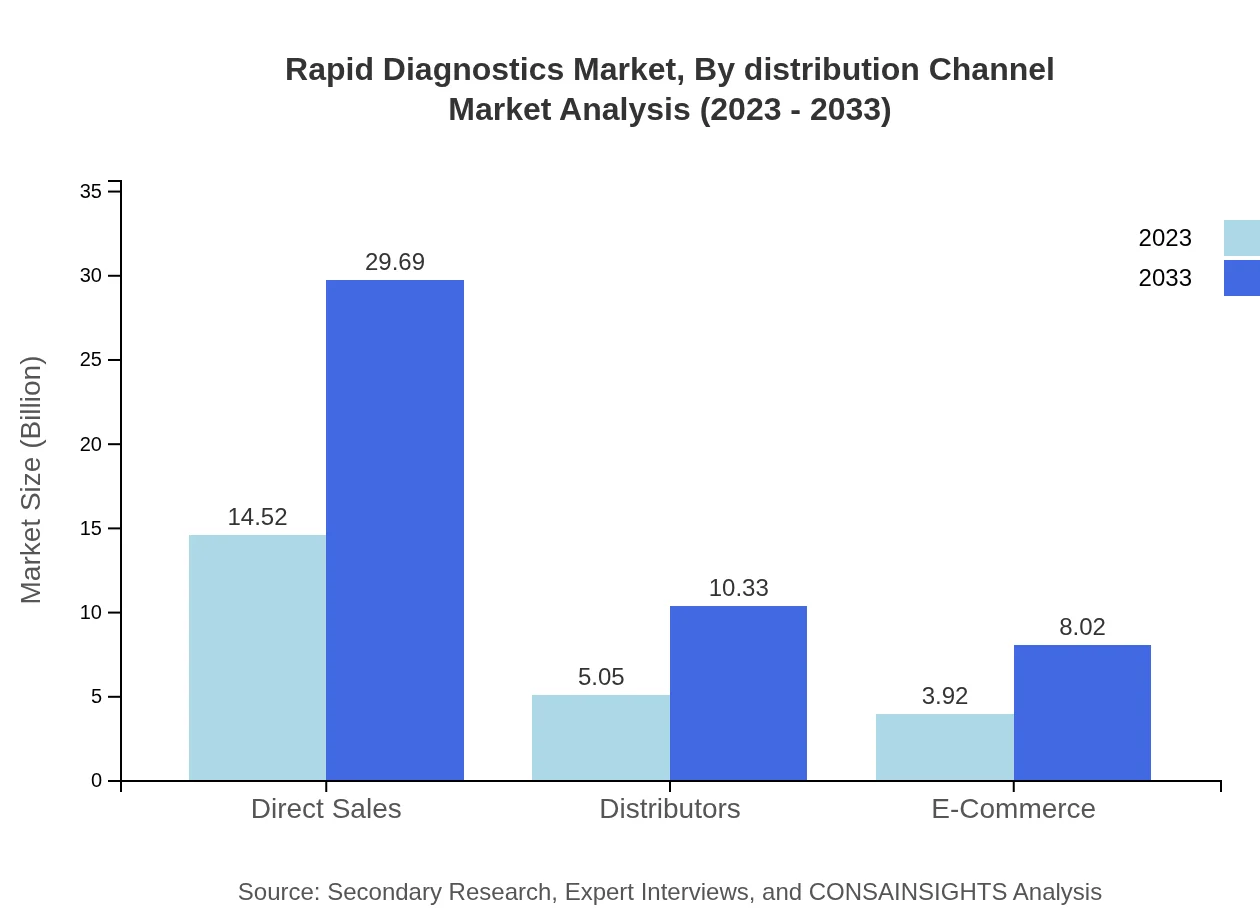
Distribution comprises direct sales, distributors, and e-commerce channels, enabling manufacturers and providers to reach clinical settings, retail outlets, and consumers.