
Reports >
Life Sciences
>
Rna Sequencing Market Report

Rna Sequencing Market Report
First published: 11 October 2024 | Last updated: 25 May 2026 | Report Code: rna-sequencing
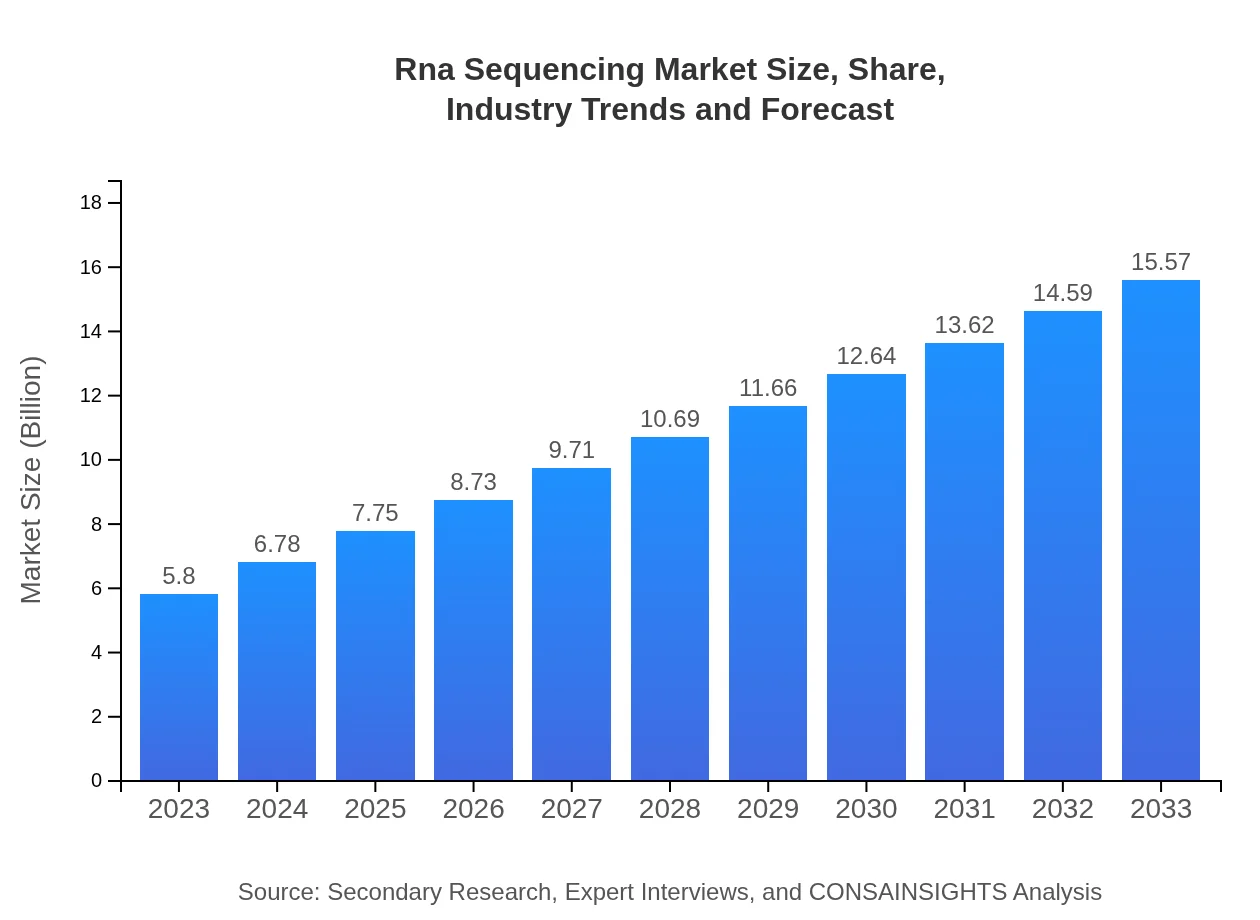
Rna Sequencing Market — USD 5.8 billion in 2023, Growing to USD 15.57B by 2033 at 10% CAGR
This report provides a comprehensive analysis of the RNA sequencing market, detailing market size, trends, segments, and forecasts from 2023 to 2033. Key insights into technological advancements, regional performances, and competitive landscapes are also included.
Key Takeaways
- Global market expands from $5.80 Billion in 2023 to $15.57 Billion by 2033 at a 10% CAGR.
- North America is largest regional market, while no single fastest-growing region is stated because regional CAGR differences remain within 0.15 percentage points.
- Europe grows from $1.54 Billion to $4.13 Billion between 2023 and 2033, reflecting clinical and research demand.
- Single-cell and high-throughput sequencing advances are central trends driving adoption across research and pharma.
- Top vendors include Illumina, Inc., Thermo Fisher Scientific, Inc., Bio-Rad Laboratories, Inc., and Roche Sequencing Solutions, Inc.
Rna Sequencing Market Report — Executive Summary
North America remains largest market by forecast-period value, while no single fastest-growing region is stated because top regional growth rates are separated by less than 0.15 percentage points. This report examines the Rna Sequencing Market Report across technologies, applications, and end-users, mapping expansion from $5.80 Billion in 2023 to $15.57 Billion in 2033 at a 10% CAGR. Growth is supported by technological advances such as next-generation and single-cell sequencing, rising use in drug discovery, clinical research, and agricultural genomics, and increased collaboration between research institutions and pharmaceutical companies. The market structure covers product categories including instruments, reagents, and consumables, as well as techniques like single-cell, bulk, and digital sequencing. Regional performance is detailed with North America identified as the largest market. Competitive analysis highlights established players such as Illumina, Inc., Thermo Fisher Scientific, Inc., Bio-Rad Laboratories, Inc., and Roche Sequencing Solutions, Inc. The report also outlines regulatory and infrastructure considerations that affect adoption and investment decisions.
Key Growth Drivers
- Advances in sequencing technologies, notably next-generation and single-cell methods, improving resolution and throughput.
- Wider application of RNA sequencing in drug discovery and clinical research increasing demand from pharmaceutical companies and diagnostic labs.
- Greater collaboration between academia and industry facilitating translational research and commercial development.
- Cost efficiencies and workflow improvements in sequencing platforms expanding availability in research institutions and applied sectors.
| Metric | Value |
|---|---|
| Study Period | 2023 - 2033 |
| 2023 Market Size | $5.80 Billion |
| CAGR (2023-2033) | 10% |
| 2033 Market Size | $15.57 Billion |
| Top Companies | Illumina, Inc., Thermo Fisher Scientific, Inc., Bio-Rad Laboratories, Inc., Roche Sequencing Solutions, Inc. |
| Published Date | 11 October 2024 |
| Last Modified Date | 25 May 2026 |
RNA Sequencing Market Overview
Customize Rna Sequencing Market Report market research report
- ✔ Get in-depth analysis of Rna Sequencing market size, growth, and forecasts.
- ✔ Understand Rna Sequencing's regional dynamics and industry-specific trends.
- ✔ Identify potential applications, end-user demand, and growth segments in Rna Sequencing
What is the Market Size & CAGR of Rna Sequencing Market Report market in 2023?
RNA Sequencing Industry Analysis
RNA Sequencing Market Segmentation and Scope
Tell us your focus area and get a customized research report.
Rna Sequencing Market Report Market Analysis Report by Region
Europe Rna Sequencing Market Report:
Europe grows from $1.54 Billion in 2023 to $4.13 Billion in 2033. 54 Billion in 2023 to $4.13 Billion in 2033, supported by expanding clinical diagnostics, public and private research initiatives, and uptake of next-generation sequencing in academic centers and biotech firms.Asia Pacific Rna Sequencing Market Report:
Asia Pacific grows from $1.2 Billion in 2023 to $3.22 Billion in 2033. 2 Billion in 2023 to $3.22 Billion in 2033 as research capacity expands, investment in genomics increases, and applications in agriculture and healthcare drive demand for sequencing services and platforms.North America Rna Sequencing Market Report:
North America is largest regional market, rising from $2.11 Billion in 2023 to $5.66 Billion in 2033. The region's scale reflects concentrated research funding, extensive clinical sequencing activity, and strong presence of major suppliers and research institutions.South America Rna Sequencing Market Report:
Latin America grows from $0.3 Billion in 2023 to $0.81 Billion in 2033. 3 Billion in 2023 to $0.81 Billion in 2033, reflecting growing research activities, emerging diagnostic adoption, and gradual investment in sequencing infrastructure across the region.Middle East & Africa Rna Sequencing Market Report:
Middle East and Africa grows from $0.65 Billion in 2023 to $1.75 Billion in 2033. 65 Billion in 2023 to $1.75 Billion in 2033, driven by targeted research programs, increasing clinical genomics initiatives, and partnerships that build local sequencing capabilities.Tell us your focus area and get a customized research report.
Research Methodology
Rna Sequencing Market Analysis By Technique
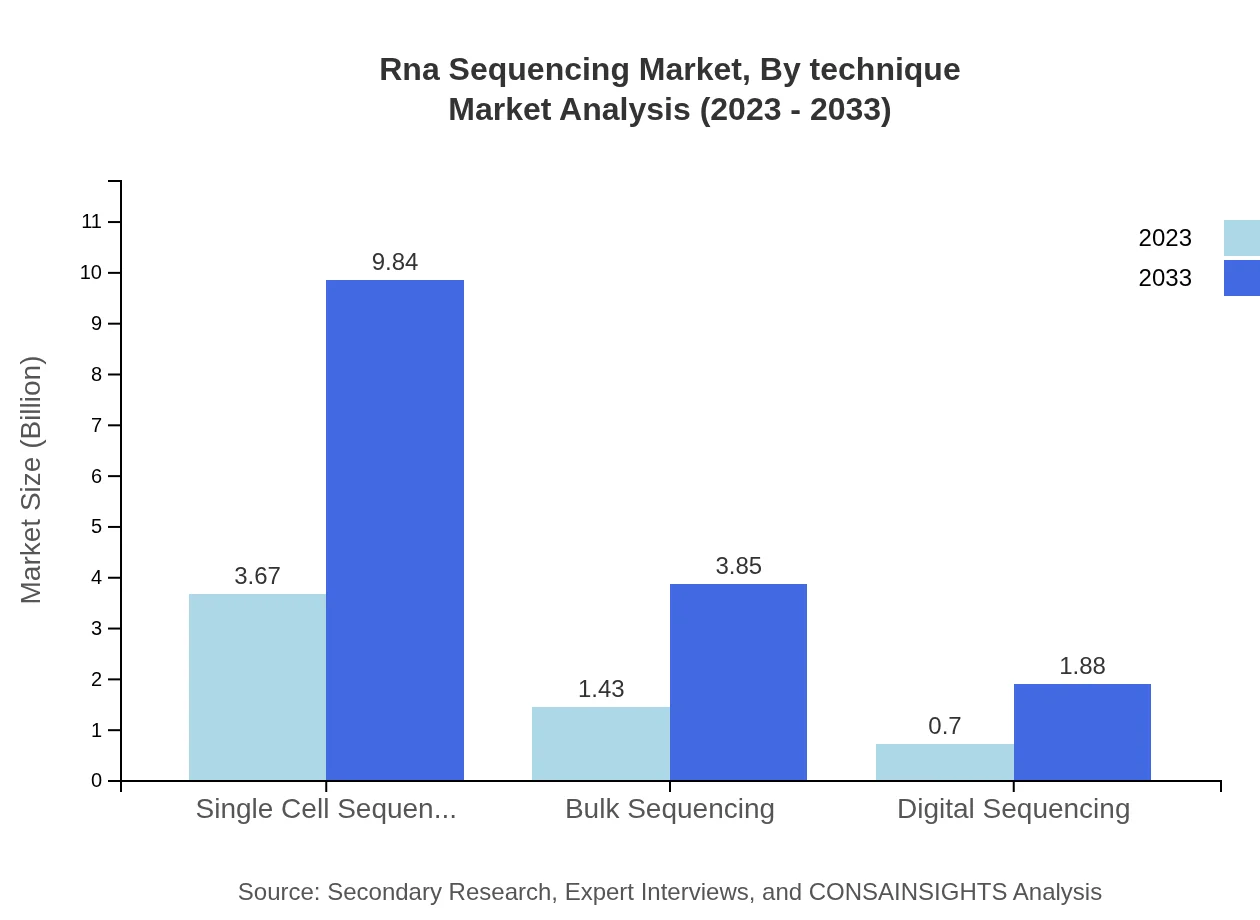
The RNA sequencing market, segmented by technique, is dominated by techniques such as single-cell sequencing, bulk sequencing, and digital sequencing. In 2023, the market for single-cell sequencing is estimated at approximately $3.67 billion, projected to reach $9.84 billion by 2033, accounting for a significant share of around 63.2% in both years. Bulk sequencing follows, currently valued at $1.43 billion and expected to grow to $3.85 billion by 2033, maintaining a market share of about 24.74%. Digital sequencing, valued at $0.70 billion in 2023, is expected to expand to $1.88 billion by 2033, holding about 12.06% of the market share.
Rna Sequencing Market Analysis By Product
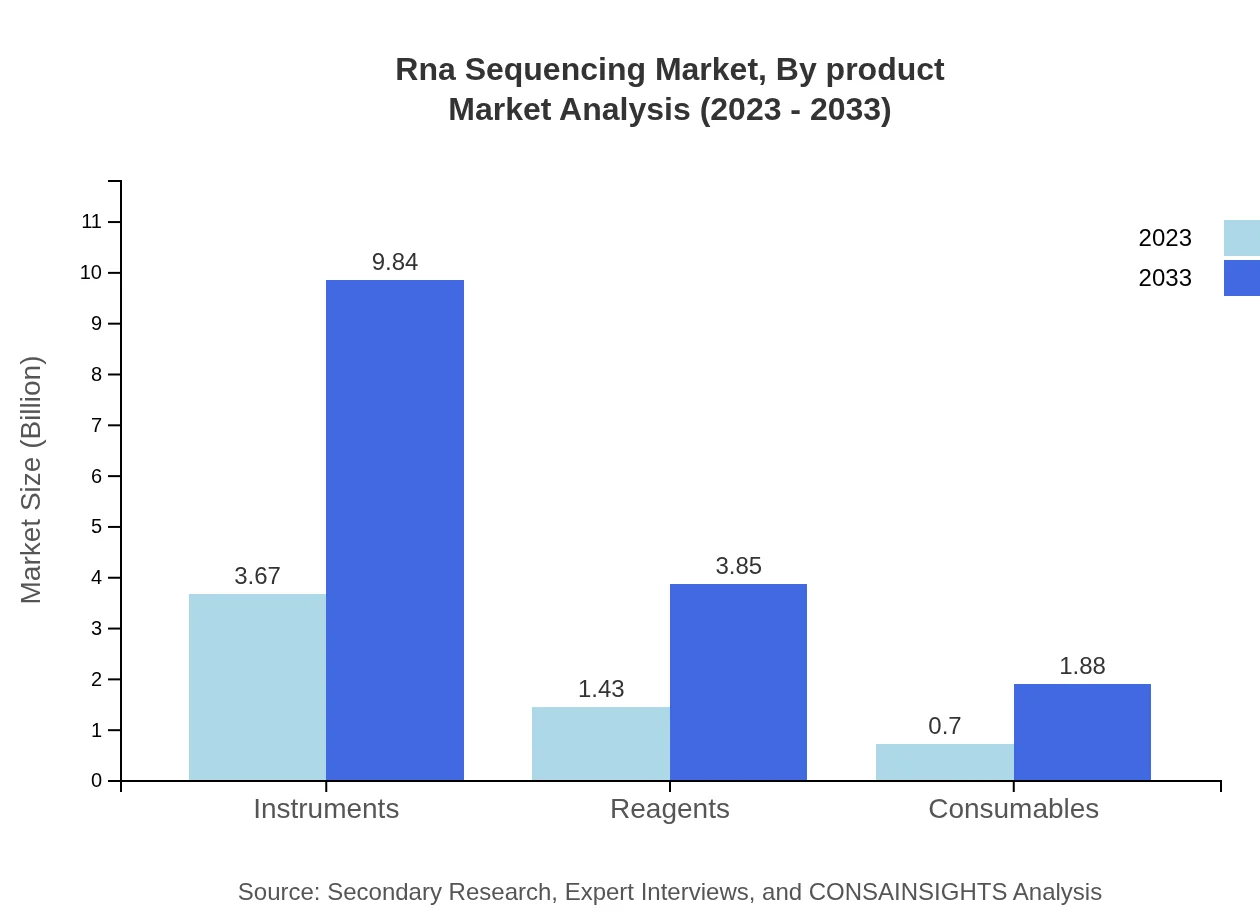
The RNA sequencing market is segmented by product into instruments, reagents, and consumables. Instruments dominate the market with a size of $3.67 billion in 2023, projected to grow to $9.84 billion by 2033, maintaining a share of 63.2%. Reagents are predicted to grow from $1.43 billion in 2023 to $3.85 billion by 2033, representing a significant share of 24.74%. Consumables, while smaller, are showing promising growth, from $0.70 billion in 2023 to $1.88 billion by 2033, holding a share of 12.06%.
Rna Sequencing Market Analysis By Application
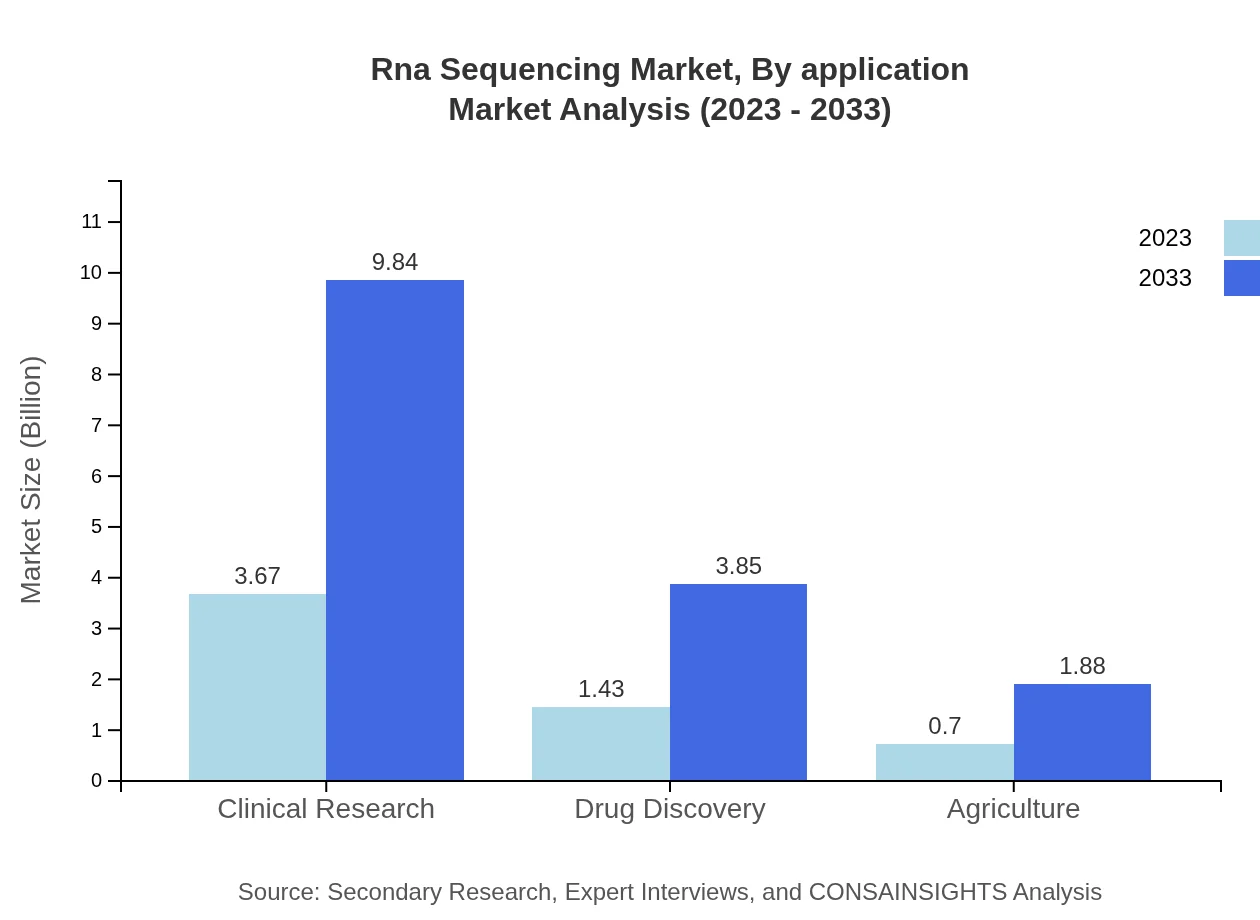
The market segmentation by application highlights significant demand in clinical research, drug discovery, and agriculture. Clinical research dominates the application segment with a size of $3.67 billion in 2023, expected to reach $9.84 billion by 2033, maintaining a market share of 63.2%. Drug discovery values at $1.43 billion currently is anticipated to grow to $3.85 billion by 2033, representing a share of 24.74%. Agriculture-related applications are expected to reach $1.88 billion by the same year, indicating a growing market focus.
Rna Sequencing Market Analysis By End User
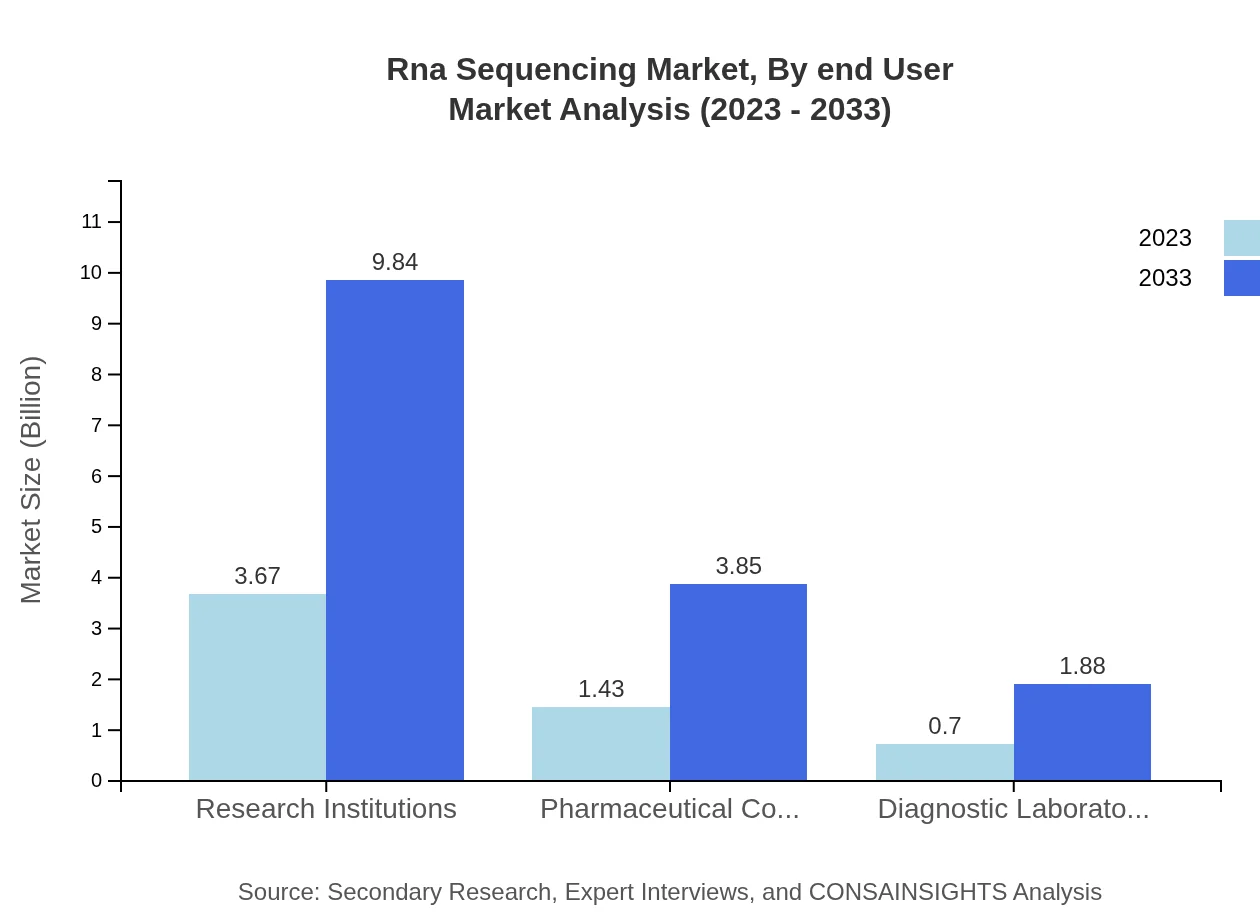
The RNA sequencing market's end-user segmentation reveals substantial contributions from research institutions, pharmaceutical companies, and diagnostic laboratories. Research institutions lead with $3.67 billion in 2023, projected to grow to $9.84 billion by 2033, sustaining a share of 63.2%. Pharmaceutical companies follow with $1.43 billion in 2023, anticipated to rise to $3.85 billion by 2033, capturing a market share of 24.74%. Diagnostic laboratories, while smaller, show consistent growth, projected to expand from $0.70 billion to $1.88 billion over the same period, holding a share of 12.06%.
RNA Sequencing Market Trends and Future Forecast
Tell us your focus area and get a customized research report.
Global Market Leaders and Top Companies in RNA Sequencing Industry
Illumina, Inc.:
Illumina is a leading company in the genetic analysis market and is recognized for its advanced sequencing technologies and systems. Their products, particularly the sequencing equipment, play a crucial role in facilitating high-throughput RNA sequencing.Thermo Fisher Scientific, Inc.:
Thermo Fisher is a major player in the RNA sequencing field, providing comprehensive solutions for research, including reagents, instruments, and technical support, enhancing the efficiency of RNA analysis in various applications.Bio-Rad Laboratories, Inc.:
Bio-Rad is well-known in the life sciences sector for its innovative tools and services, supporting RNA sequencing and genomics research, particularly through its offerings in molecular biology kits and reagents.Roche Sequencing Solutions, Inc.:
Roche Sequencing Solutions focuses on delivering innovative sequencing technologies that support accurate and efficient RNA sequencing, catering primarily to clinical and research markets.We're grateful to work with incredible clients.








FAQs
What is the market size of the RNA sequencing market in 2023?
The market size for the RNA sequencing sector in 2023 is $5.80 Billion, as stated in the report data for that year.
How big will the market be by 2033?
According to the provided figures, the market is projected to reach $15.57 Billion in 2033 during the stated forecast period.
What is CAGR for the forecast period?
The compound annual growth rate (CAGR) for the forecast period 2023 to 2033 is 10%, based on the input data supplied.
Is there a single fastest Growing region in the Rna Sequencing Market Report market?
No single fastest-growing region is stated for the Rna Sequencing Market Report market because the top regional implied CAGR values are within 0.15 percentage points of each other, making the ranking too close to call reliably.
Which companies are listed as top players?
Top companies named in the report include Illumina, Inc., Thermo Fisher Scientific, Inc., Bio-Rad Laboratories, Inc., and Roche Sequencing Solutions, Inc.
What are common end Users for RNA sequencing?
End-users highlighted include research institutions, pharmaceutical companies, and diagnostic laboratories, reflecting primary demand sources in the market.
What key techniques are covered in the market segmentation?
The segmentation includes single-cell sequencing, bulk sequencing, and digital sequencing as primary technique categories in the market breakdown.
How does the report derive its conclusions?
Findings are based on primary interviews with industry experts, secondary research from company reports and publications, and internal data triangulation and validation.