

Robotic Prosthetics Market Report
First published: 11 October 2024 | Last updated: 25 May 2026 | Report Code: robotic-prosthetics
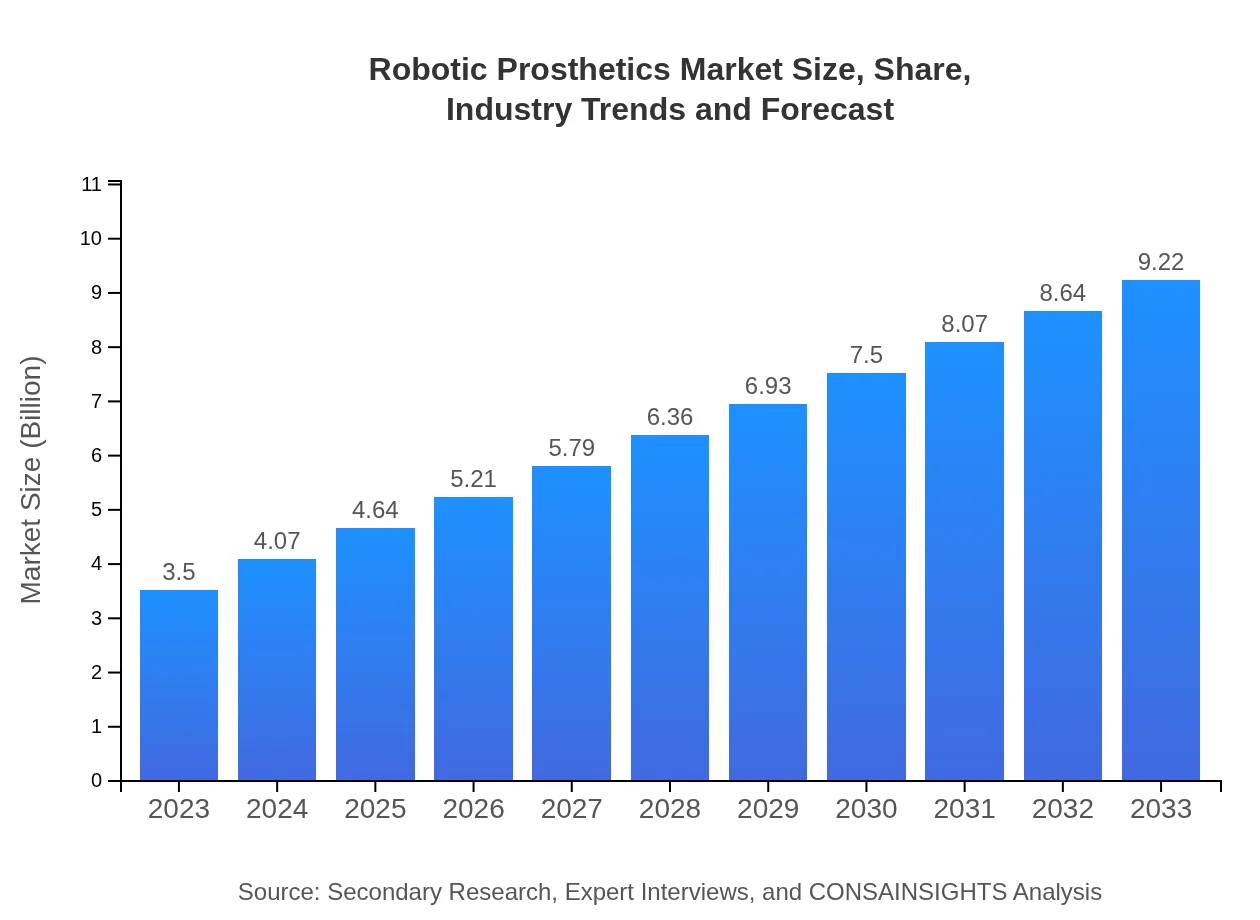
Robotic Prosthetics Market — USD 3.5 billion in 2023, Growing to USD 9.22B by 2033 at 9.8% CAGR
This report offers a comprehensive analysis of the Robotic Prosthetics market, covering current trends, future forecasts, key players, and regional insights for the period 2023 to 2033. Detailed segmentation and technology advancements are also discussed.
Key Takeaways
- Global market expands from $3.50 Billion in 2023 to $9.22 Billion by 2033, reflecting a 9.8% CAGR.
- North America is largest regional market, while no single fastest-growing region is stated because regional CAGR differences remain within 0.15 percentage points.
- Europe grows from $0.95 Billion to $2.5 Billion while Asia Pacific rises from $0.75 Billion to $1.99 Billion over the forecast.
- Technological advances in control systems and materials, plus rising clinical adoption, are primary growth catalysts.
- Key vendors identified include Össur, Ottobock, Alva Health, and Medtronic.
Robotic Prosthetics Market Report — Executive Summary
North America remains largest market by forecast-period value, while no single fastest-growing region is stated because top regional growth rates are separated by less than 0.15 percentage points. The report examines factors shaping the robotic prosthetics sector, where market size moves from $3.50 Billion in 2023 to $9.22 Billion in 2033 at a 9.8% CAGR for 2023 to 2033. Growth is driven by improvements in myoelectric and neural control, innovations in lightweight materials, and broader clinical acceptance. North America holds the largest share, supported by established healthcare infrastructure and device reimbursement pathways. The study dissects product types, end-users, materials, and technologies, and profiles leading firms such as Össur, Ottobock, Alva Health, and Medtronic. Strategic insights highlight adoption barriers, cost pressures, and opportunities for customized and research-focused solutions.
Key Growth Drivers
- Advances in control technologies, including myoelectric and neuroprosthetic systems, improving device functionality and user experience.
- Material innovations such as composites and lightweight metals enabling more comfortable and durable prosthetic solutions.
- Rising clinical adoption in hospitals and rehabilitation centers supported by growing evidence of functional benefits.
- Increased research activity from institutes and manufacturers accelerating product development and validation.
- Demand for personalized solutions and integration with assistive technologies expanding application across daily living and sports.
| Metric | Value |
|---|---|
| Study Period | 2023 - 2033 |
| 2023 Market Size | $3.50 Billion |
| CAGR (2023-2033) | 9.8% |
| 2033 Market Size | $9.22 Billion |
| Top Companies | Össur, Ottobock, Alva Health, Medtronic |
| Published Date | 11 October 2024 |
| Last Modified Date | 25 May 2026 |
Robotic Prosthetics Market Overview
Customize Robotic Prosthetics Market Report market research report
- ✔ Get in-depth analysis of Robotic Prosthetics market size, growth, and forecasts.
- ✔ Understand Robotic Prosthetics's regional dynamics and industry-specific trends.
- ✔ Identify potential applications, end-user demand, and growth segments in Robotic Prosthetics
What is the Market Size & CAGR of Robotic Prosthetics Market Report market in 2023?
Robotic Prosthetics Industry Analysis
Robotic Prosthetics Market Segmentation and Scope
Tell us your focus area and get a customized research report.
Robotic Prosthetics Market Report Market Analysis Report by Region
Europe Robotic Prosthetics Market Report:
Europe grows from $0.95 Billion in 2023 to $2.5 Billion in 2033. Regional momentum is driven by growing clinical integration in hospitals and rehabilitation services, alongside research initiatives and technology adoption across member countries.Asia Pacific Robotic Prosthetics Market Report:
Asia Pacific grows from $0.75 Billion in 2023 to $1.99 Billion in 2033. Growth is linked to rising healthcare investment, expanding rehabilitation services, and broader access to advanced prosthetic technologies in urban centers.North America Robotic Prosthetics Market Report:
North America is largest regional market, rising from $1.19 Billion in 2023 to $3.13 Billion in 2033. This expansion reflects established clinical infrastructure, favorable reimbursement practices, and active manufacturer presence supporting adoption and product refinement.South America Robotic Prosthetics Market Report:
Latin America grows from $0.25 Billion in 2023 to $0.67 Billion in 2033. Adoption is influenced by improving healthcare delivery, growing rehabilitation infrastructure, and expanding awareness of advanced prosthetic options.Middle East & Africa Robotic Prosthetics Market Report:
Middle East and Africa grows from $0.35 Billion in 2023 to $0.93 Billion in 2033. Progress is driven by increasing healthcare investments, emerging rehabilitation services, and targeted initiatives to enhance access to advanced prosthetic solutions.Tell us your focus area and get a customized research report.
Research Methodology
Robotic Prosthetics Market Analysis By Type
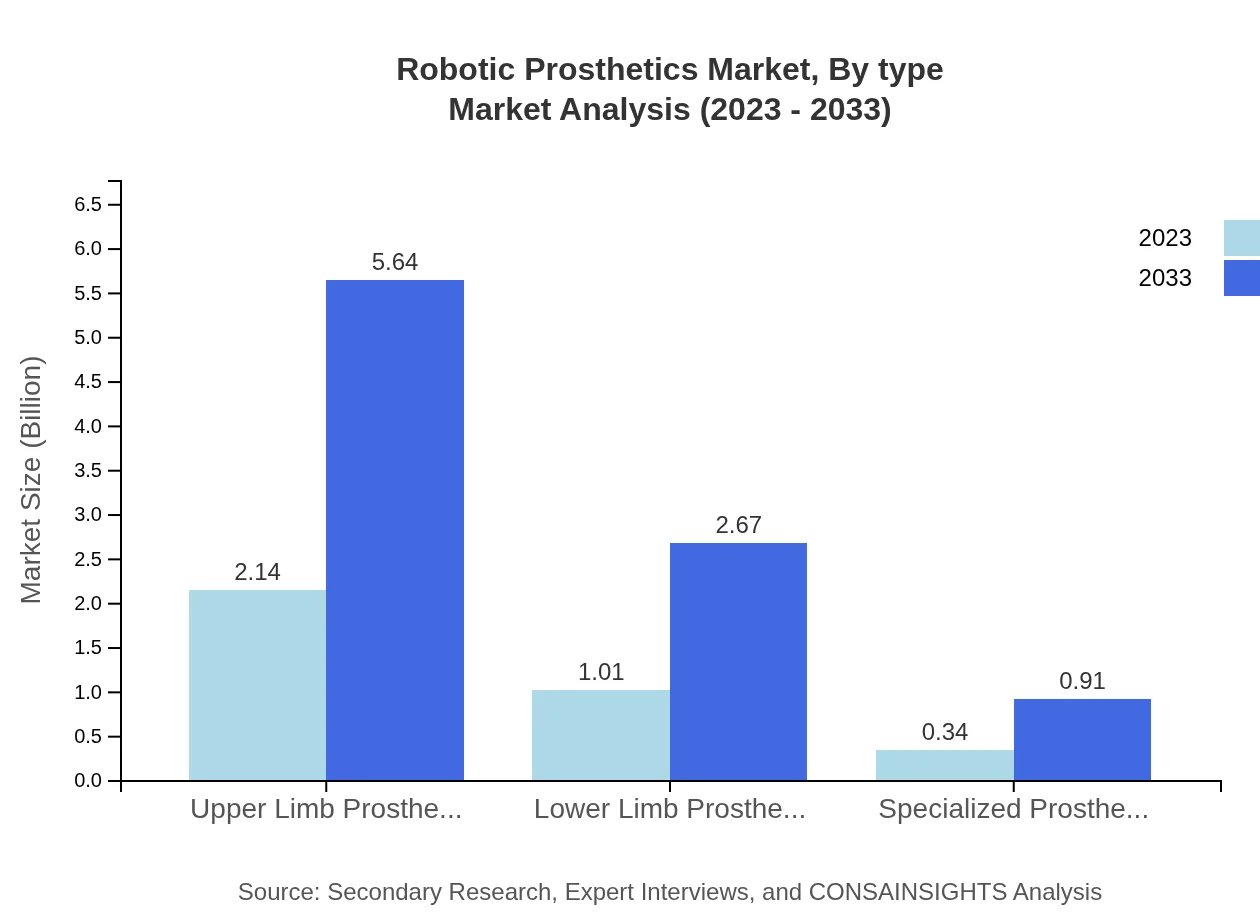
The market is bifurcated into Upper Limb Prosthetics, Lower Limb Prosthetics, and Specialized Prosthetics. As of 2023, Upper Limb Prosthetics have a market size of $2.14 billion (61.16% market share), while Lower Limb Prosthetics and Specialized Prosthetics contribute approximately $1.01 billion (28.99%) and $0.34 billion (9.85%), respectively. By 2033, Upper Limb Prosthetics are projected to reach $5.64 billion while Lower Limb Prosthetics and Specialized Prosthetics are expected to reach $2.67 billion and $0.91 billion respectively.
Robotic Prosthetics Market Analysis By Technology
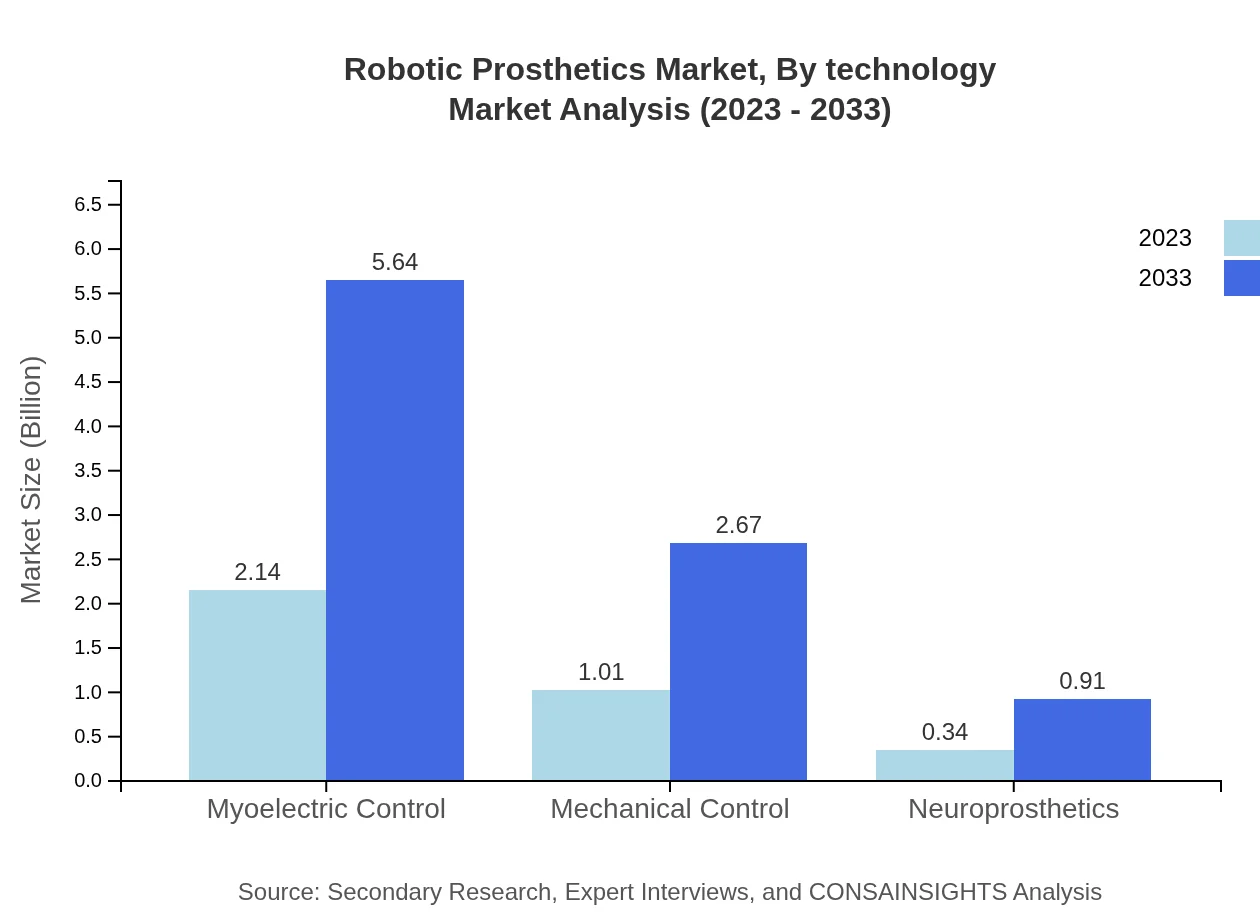
The technology in robotic prosthetics includes Myoelectric Control, Mechanical Control, and Neuroprosthetics. Myoelectric Control accounts for 61.16% of the market share in 2023, with a value of $2.14 billion, increasing to $5.64 billion by 2033. Mechanical Control holds 28.99% of the market share ($1.01 billion in 2023) and is expected to grow to $2.67 billion. Neuroprosthetics, although smaller, is making strides with $0.34 billion currently and an expected rise to $0.91 billion by 2033.
Robotic Prosthetics Market Analysis By Application
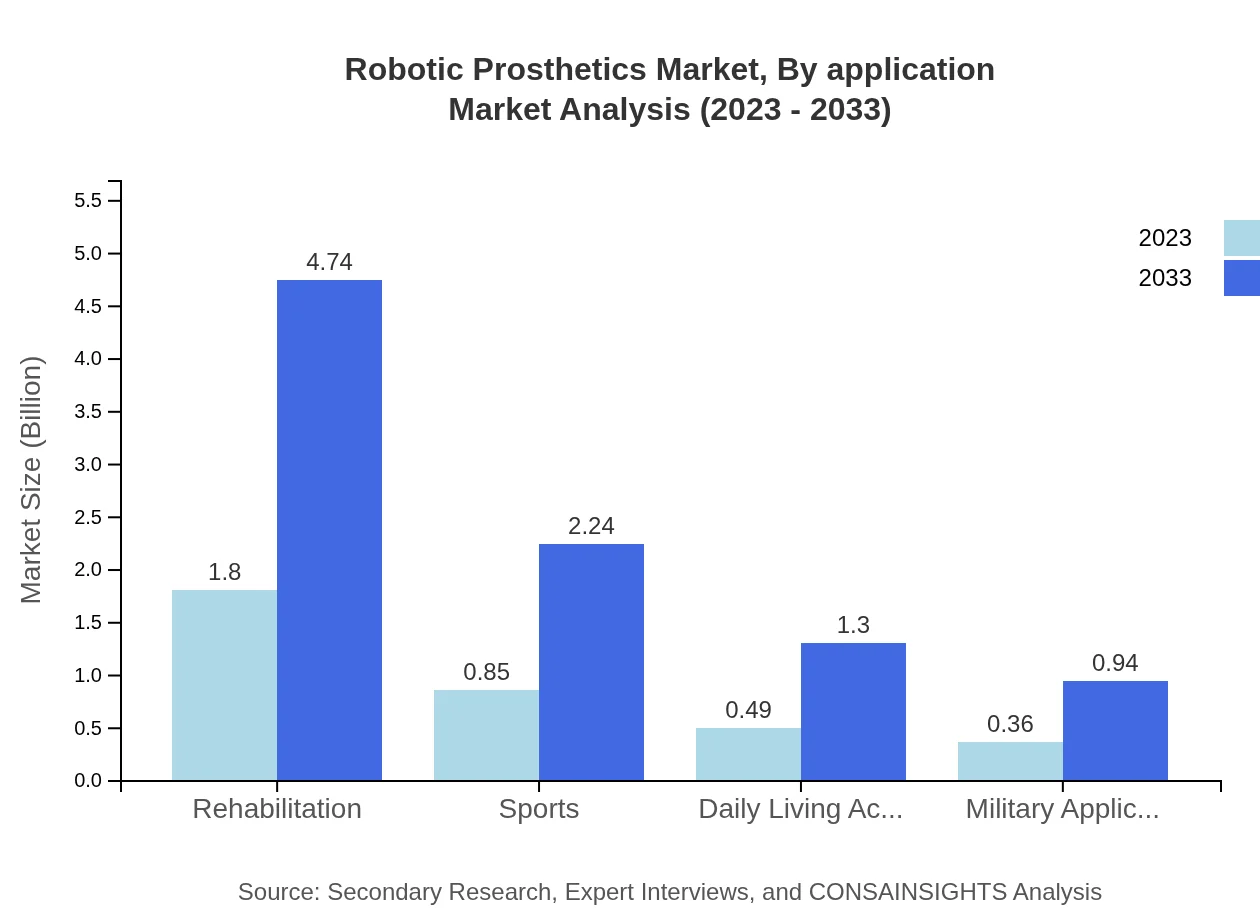
Applications of robotic prosthetics span various sectors, including Rehabilitation, Sports, Daily Living Activities, and Military Applications. Rehabilitation leads with a significant $1.80 billion share, accounting for 51.39% in 2023, projected to reach $4.74 billion by 2033. Sports applications follow closely with a current market size of $0.85 billion, expected to expand to $2.24 billion. The focus on military applications is also noteworthy, showing potential growth from $0.36 billion now to $0.94 billion in the future.
Robotic Prosthetics Market Analysis By Material
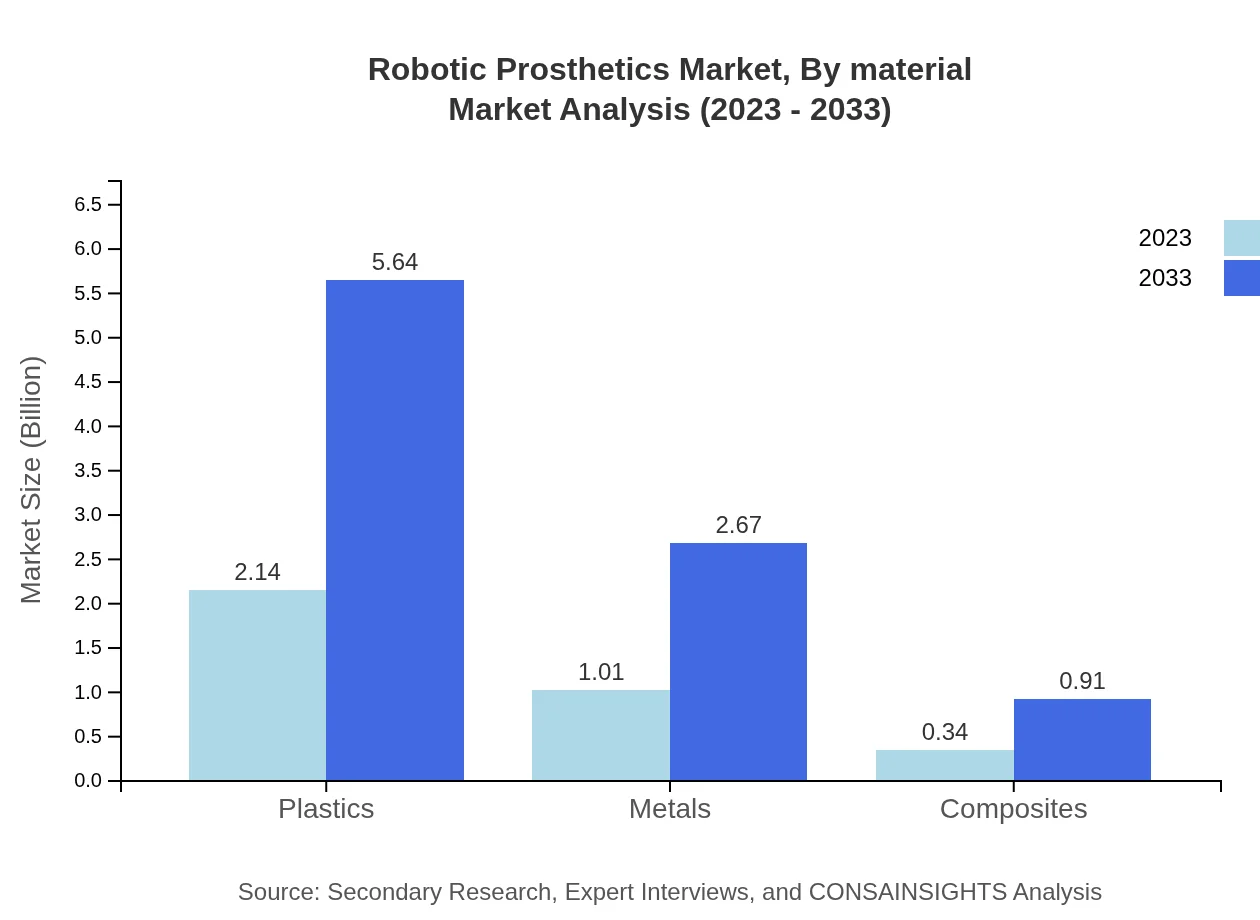
The market for robotic prosthetics can also be segmented based on materials such as Plastics, Metals, and Composites. Plastics dominate the market with a share of 61.16% in 2023, accounting for $2.14 billion, with expected growth to $5.64 billion. Metals hold a share equivalent to 28.99% ($1.01 billion), while Composites currently secure 9.85% of the market share ($0.34 billion) with projections for growth reflecting the trend towards lighter and more durable materials.
Robotic Prosthetics Market Analysis By End User
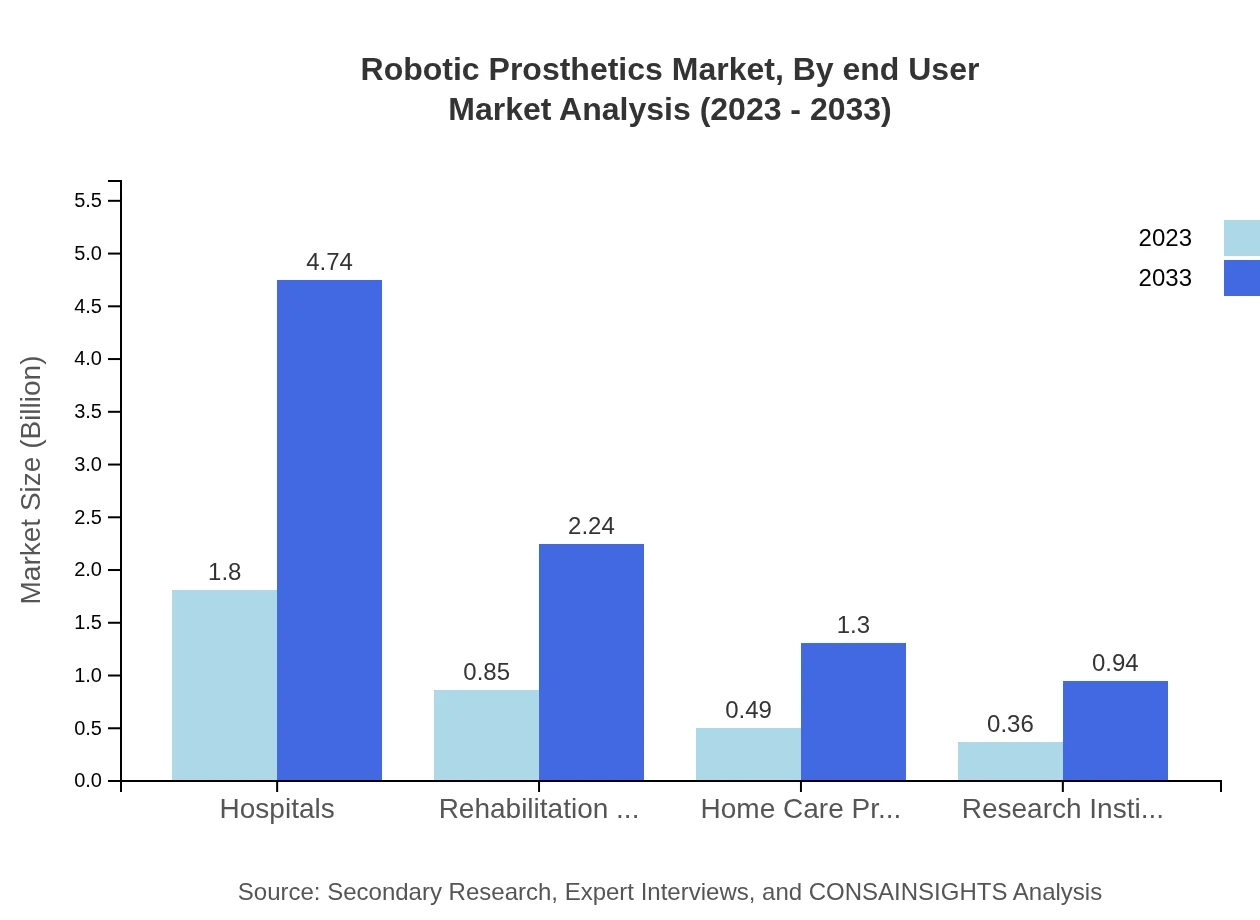
End-user segmentation includes Hospitals, Rehabilitation Centers, Home Care Providers, and Research Institutes. Hospitals lead the market with a size of $1.80 billion (51.39% market share) in 2023, projected to reach $4.74 billion by 2033. Rehabilitation Centers are also significant, currently valued at $0.85 billion, with expectations to grow to $2.24 billion. Home Care Providers make up a smaller segment but show growth potential from $0.49 billion to $1.30 billion by the end of the forecast period.
Robotic Prosthetics Market Trends and Future Forecast
Tell us your focus area and get a customized research report.
Global Market Leaders and Top Companies in Robotic Prosthetics Industry
Össur:
Össur is a leading global provider of non-invasive orthopedic solutions, specializing in prosthetics that integrate advanced technologies for enhanced mobility.Ottobock:
Ottobock is recognized for its innovative prosthesis designs and manufacturing practices, championing user-friendly products that focus on the specific needs of wearers.Alva Health:
Alva Health focuses on cutting-edge robotic solutions for prosthetics, aiming to improve user experience through customizability and adaptive technology.Medtronic :
Medtronic delivers a wide spectrum of healthcare solutions, including robotic prosthetics that leverage sensors and software for enhanced interaction and performance.We're grateful to work with incredible clients.









FAQs
What is the market size of the robotic prosthetics market in 2023?
The robotic prosthetics market size in 2023 is $3.50 Billion, as reported in the dataset provided for the 2023 to 2033 forecast period.
How big will the market be in 2033?
The market is projected to reach $9.22 Billion by 2033, based on the provided forecast covering 2023 to 2033 with an indicated CAGR of 9.8%.
What is CAGR of the market?
The compound annual growth rate (CAGR) for the robotic prosthetics market is 9.8% for the 2023 to 2033 forecast period, according to the input data.
Is there a single fastest Growing region in the Robotic Prosthetics Market Report market?
No single fastest-growing region is stated for the Robotic Prosthetics Market Report market because the top regional implied CAGR values are within 0.15 percentage points of each other, making the ranking too close to call reliably.
Which companies are leading the market?
Top companies listed in the report include Össur, Ottobock, Alva Health, and Medtronic, noted as key participants in product development and commercialization.
What are common end Users for robotic prosthetics?
End-users specified include hospitals, rehabilitation centers, home care providers, and research institutes, reflecting clinical and research-driven adoption environments.
How are technologies classified in the report?
Technologies are categorized to include myoelectric control, mechanical control, and neuroprosthetics, emphasizing different control and interface approaches.
What materials are commonly used in devices?
Materials reported comprise plastics, metals, and composites, each contributing to device weight, durability, and functional performance in prosthetic design.