
Reports >
Life Sciences
>
Scaffold Technology Market Report

Scaffold Technology Market Report
First published: 07 October 2024 | Last updated: 25 May 2026 | Report Code: scaffold-technology
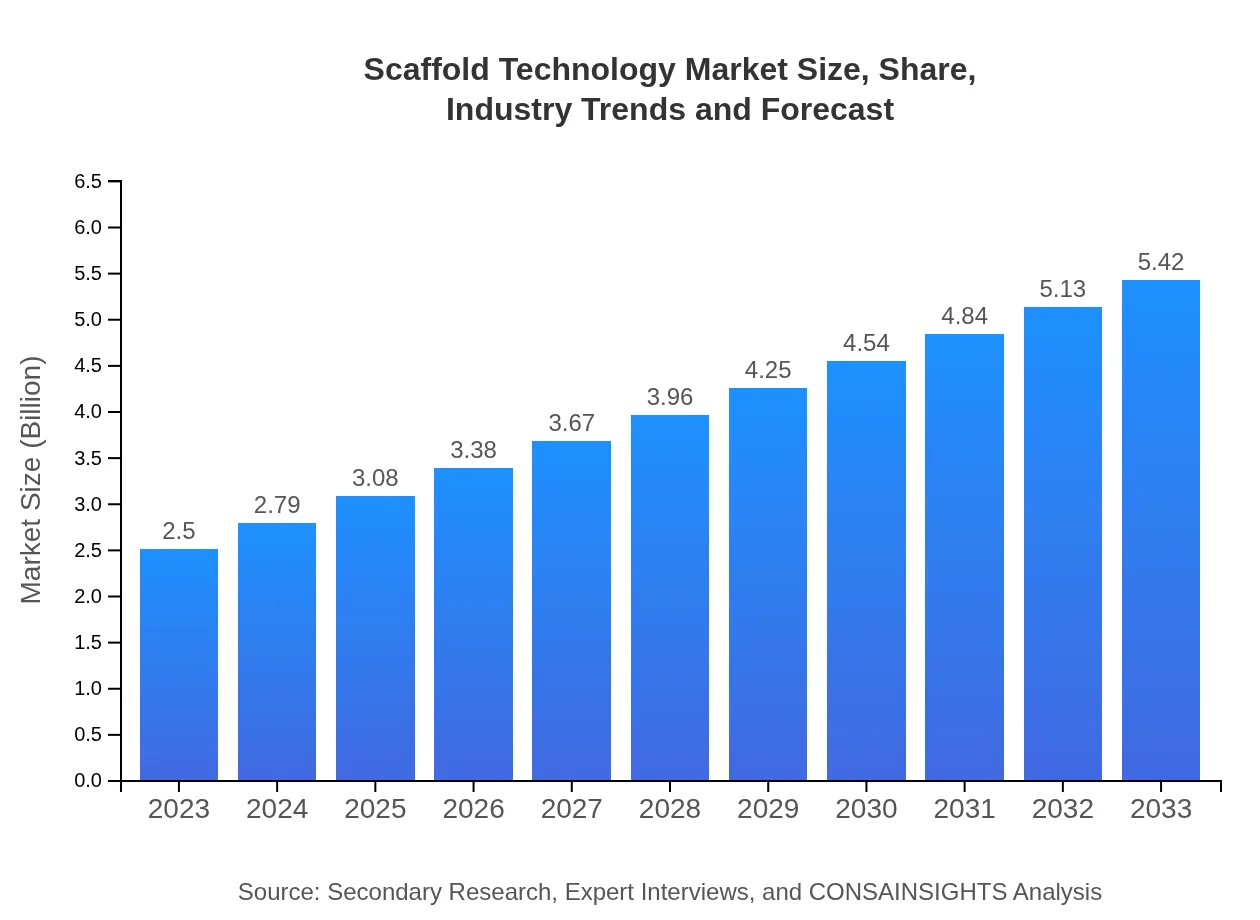
Scaffold Technology Market — USD 2.5 billion in 2023, Growing to USD 5.42B by 2033 at 7.8% CAGR
This report provides an in-depth analysis of the Scaffold Technology market, covering market size, trends, segmentation, regional insights, and forecasts from 2023 to 2033, along with key players and industry dynamics.
Key Takeaways
- Global market expansion from $2.50 Billion in 2023 to $5.42 Billion in 2033 at a 7.8% CAGR over 2023 to 2033.
- North America is largest regional market, while no single fastest-growing region is stated because regional CAGR differences remain within 0.15 percentage points.
- Material innovation and manufacturing advances such as 3D printing and electrospinning are central to market growth.
- Hospitals, research institutes and pharmaceutical companies are identified end‑users driving adoption and demand.
- Top companies active in the space include Tissue Regenix, Evonik Industries AG, Medtronic and 3M Company.
Scaffold Technology Market Report — Executive Summary
North America remains largest market by forecast-period value, while no single fastest-growing region is stated because top regional growth rates are separated by less than 0.15 percentage points. The Scaffold Technology Market Report highlights sustained expansion driven by rising clinical and research applications. Market size increases from $2.50 Billion in 2023 to $5.42 Billion in 2033, supported by investment in advanced materials and manufacturing techniques. Demand stems from hospitals, research institutes and pharmaceutical companies seeking improved biocompatible and biodegradable scaffold solutions. Key trends include adoption of electrospinning and 3D printing, a shift toward composite and biodegradable materials, and intensified R&D from established players such as Tissue Regenix, Evonik Industries AG, Medtronic and 3M Company. Regional dynamics show North America as the largest market. Competitive activity focuses on product innovation, regulatory alignment and partnerships to accelerate clinical translation and commercialization.
Key Growth Drivers
- Rising clinical and research applications in tissue engineering and regenerative medicine increasing demand for scaffold solutions.
- Adoption of advanced fabrication techniques like electrospinning and 3D printing enabling customizable scaffold architectures.
- Shift toward biodegradable and biocompatible materials driven by regulatory and environmental considerations.
- Increased investment from hospitals, research institutes and pharmaceutical companies to support scaffold development and commercialization.
- Ongoing R&D and collaboration among leading firms to improve scaffold performance and clinical outcomes.
| Metric | Value |
|---|---|
| Study Period | 2023 - 2033 |
| 2023 Market Size | $2.50 Billion |
| CAGR (2023-2033) | 7.8% |
| 2033 Market Size | $5.42 Billion |
| Top Companies | Tissue Regenix, Evonik Industries AG, Medtronic , 3M Company |
| Published Date | 07 October 2024 |
| Last Modified Date | 25 May 2026 |
Scaffold Technology Market Overview
Customize Scaffold Technology Market Report market research report
- ✔ Get in-depth analysis of Scaffold Technology market size, growth, and forecasts.
- ✔ Understand Scaffold Technology's regional dynamics and industry-specific trends.
- ✔ Identify potential applications, end-user demand, and growth segments in Scaffold Technology
What is the Market Size & CAGR of Scaffold Technology Market Report market in 2023?
Scaffold Technology Industry Analysis
Scaffold Technology Market Segmentation and Scope
Tell us your focus area and get a customized research report.
Scaffold Technology Market Report Market Analysis Report by Region
Europe Scaffold Technology Market Report:
Europe grows from $0.63 Billion in 2023 to $1.37 Billion in 2033. Regional progress reflects strong academic research, regulatory focus on biocompatible materials and increasing collaboration between industry and research institutes.Asia Pacific Scaffold Technology Market Report:
Asia Pacific grows from $0.49 Billion in 2023 to $1.07 Billion in 2033. Market drivers include rising healthcare demand, growing R&D capacity and adoption of scalable manufacturing techniques for tissue engineering and related applications.North America Scaffold Technology Market Report:
North America is largest regional market, rising from $0.87 Billion in 2023 to $1.89 Billion in 2033. Growth is underpinned by concentrated clinical research, significant healthcare investment and early adoption of advanced manufacturing technologies for scaffold production.South America Scaffold Technology Market Report:
Latin America grows from $0.21 Billion in 2023 to $0.46 Billion in 2033. Regional uptake is supported by expanding clinical research activity, growing healthcare infrastructure and increasing interest in regenerative medicine solutions.Middle East & Africa Scaffold Technology Market Report:
Middle East and Africa grows from $0.29 Billion in 2023 to $0.62 Billion in 2033. Growth factors include expanding healthcare investment, collaboration with global research partners and gradual adoption of advanced scaffold technologies.Tell us your focus area and get a customized research report.
Research Methodology
Scaffold Technology Market Analysis By Material
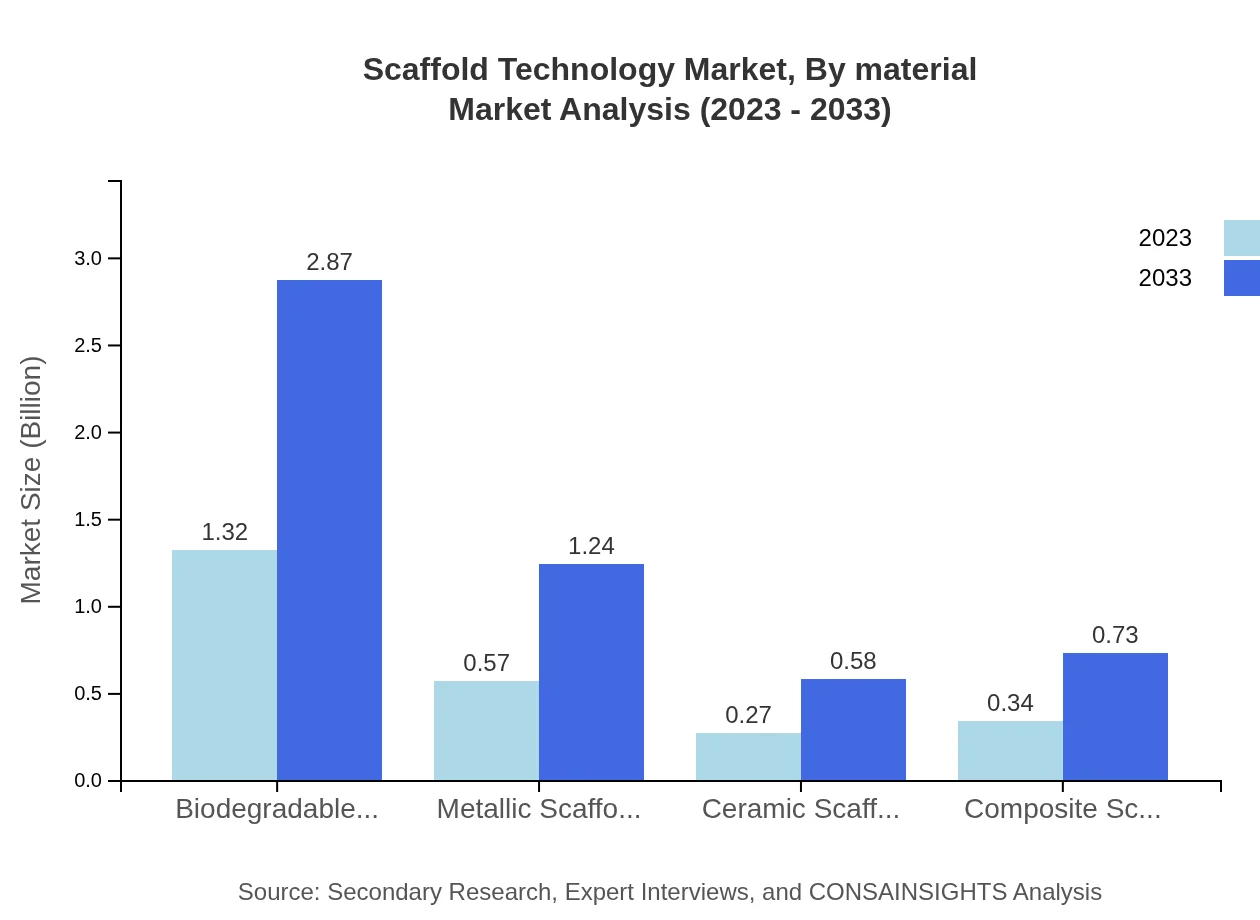
The Scaffold Technology market’s material segment includes biodegradable materials, metallic scaffolds, ceramic scaffolds, and composite scaffolds. Biodegradable materials accounted for the highest market share in 2023 with a value of $1.32 billion and are projected to grow to $2.87 billion by 2033, driven by their widespread use in tissue engineering. Metallic scaffolds, with a market value of $0.57 billion in 2023, are critical in orthopedic applications, expected to grow to $1.24 billion by 2033. Ceramic scaffolds are gaining traction for their biocompatibility, growing from $0.27 billion in 2023 to $0.58 billion by 2033. Composite scaffolds are emerging due to their advantageous properties, increasing from $0.34 billion in 2023 to $0.73 billion by 2033.
Scaffold Technology Market Analysis By Application
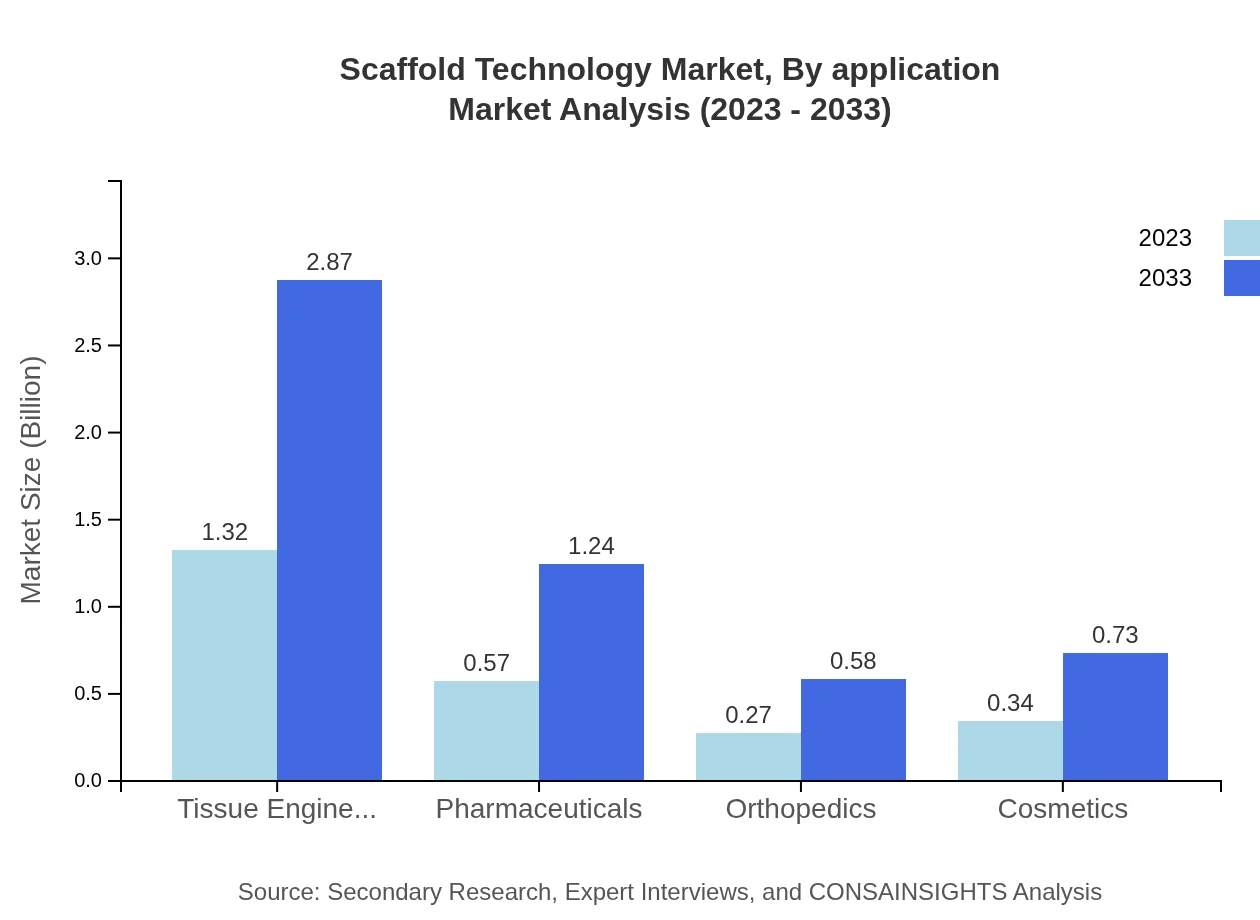
By application, the Scaffold Technology market is significantly influenced by tissue engineering, pharmaceuticals, orthopedics, and cosmetics. Tissue engineering dominates the market with a size of $1.32 billion in 2023, escalating to $2.87 billion by 2033, owing to the surging need for regenerative solutions. Pharmaceuticals also constitute a significant share, with a market size charting growth from $0.57 billion in 2023 to $1.24 billion in 2033. Orthopedic applications are projected to grow due to increasing implant surgeries, projected to rise from $0.27 billion to $0.58 billion during the forecast period.
Scaffold Technology Market Analysis By End User
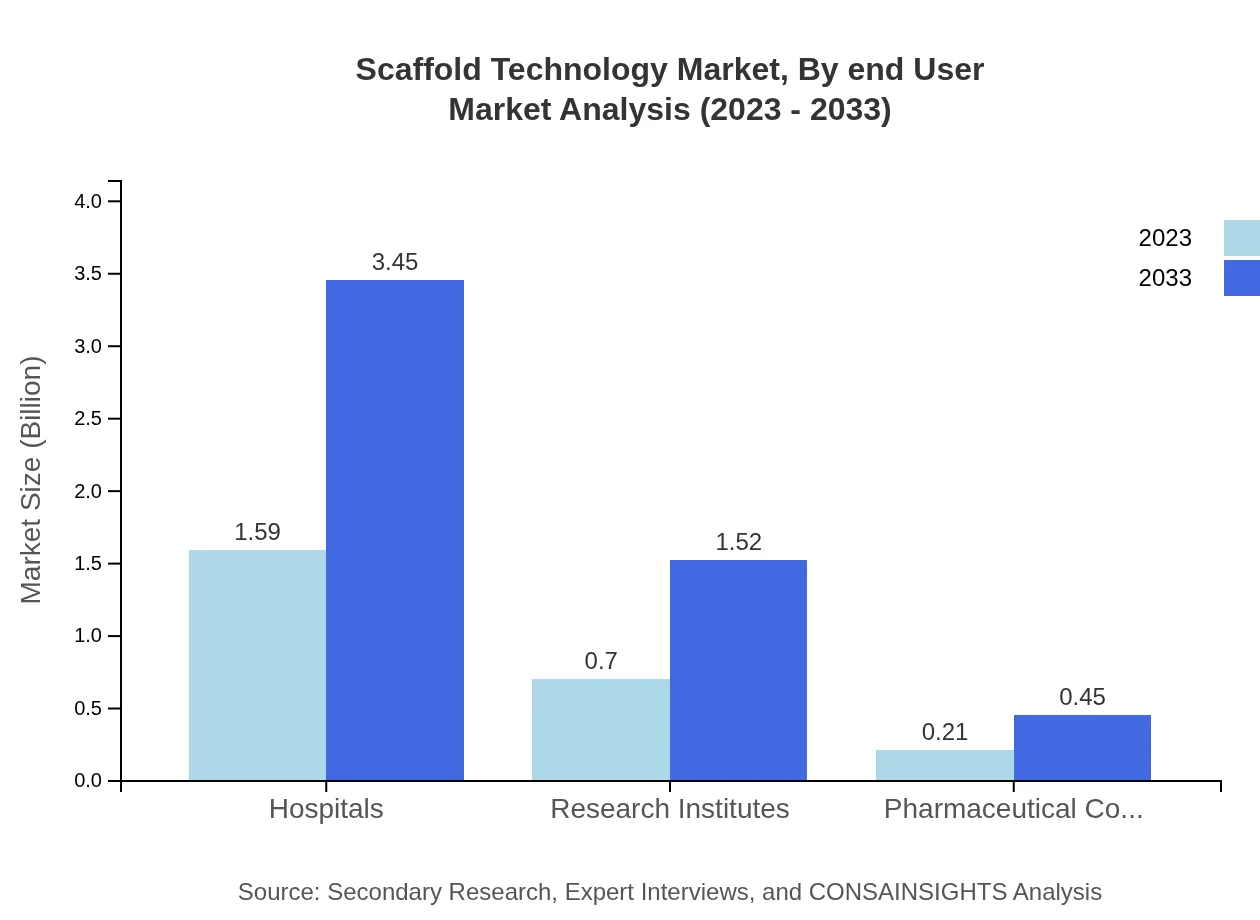
The Scaffold Technology market by end-user is segmented into hospitals, research institutes, and pharmaceutical companies. Hospitals hold the largest share, valued at $1.59 billion in 2023 and projected to reach $3.45 billion by 2033, driven by increased surgical procedures utilizing scaffolds. Research institutes follow, with a size rising from $0.70 billion in 2023 to $1.52 billion by 2033, propelled by heightened focus on biomedical research. Pharmaceutical companies, while smaller, are expected to grow from $0.21 billion to $0.45 billion in the same timeframe.
Scaffold Technology Market Analysis By Technique
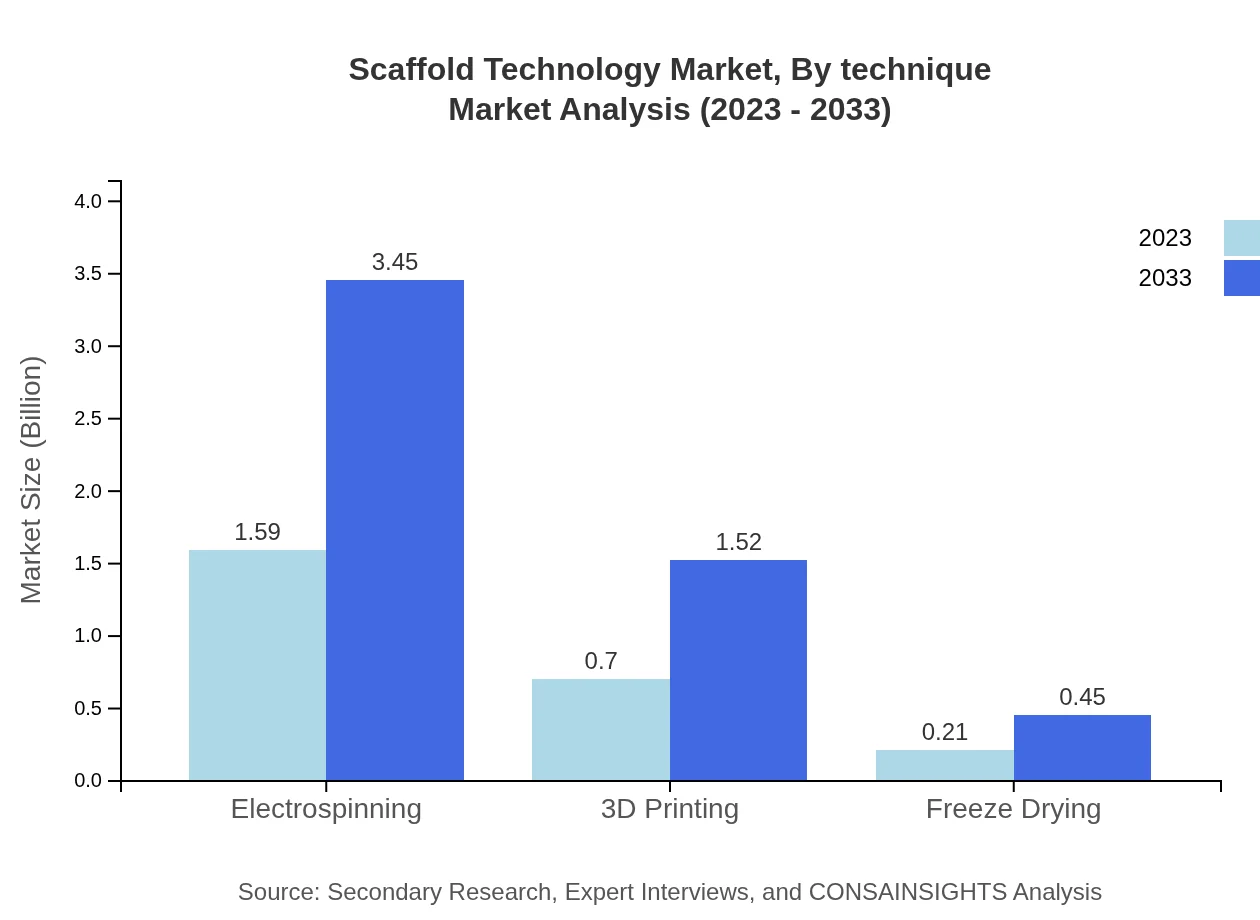
The Scaffold Technology market by technique encompasses methods such as electrospinning, 3D printing, and freeze drying. Electrospinning is a leader in this space, accounting for $1.59 billion in 2023 and expected to reach $3.45 billion by 2033 due to its efficient production of nanofibers. 3D printing shows promising growth, scaling from $0.70 billion to $1.52 billion in the next decade as customization becomes vital. Freeze drying, while smaller, is expected to grow from $0.21 billion to $0.45 billion, emphasizing its application in pharmaceuticals.
Scaffold Technology Market Trends and Future Forecast
Tell us your focus area and get a customized research report.
Global Market Leaders and Top Companies in Scaffold Technology Industry
Tissue Regenix:
A pioneer in regenerative medicine, Tissue Regenix specializes in the development of advanced scaffolding technologies that have critical applications in orthopedics and tissue engineering.Evonik Industries AG:
Evonik is a global leader in specialty chemicals, providing customized scaffold solutions and bioresorbable polymers for various healthcare applications.Medtronic :
As a leader in medical technology, Medtronic develops innovative scaffold solutions for various therapeutic areas, including cardiovascular care and surgical applications.3M Company:
3M leverages its diverse material science capabilities to create advanced scaffold technologies, targeting various medical and industrial applications.We're grateful to work with incredible clients.









FAQs
What is the market size of the Scaffold Technology Market Report in 2023?
The market size in 2023 is $2.50 Billion, as specified for the Scaffold Technology Market Report and used as the baseline for the 2023 to 2033 forecast period.
How big will the market be in 2033?
The 2033 market size is $5.42 Billion according to the provided forecast, reflecting the expected expansion over the 2023 to 2033 period based on current trends and drivers.
What is CAGR for the forecast period?
The compound annual growth rate for the 2023 to 2033 forecast period is 7.8%, applied to the market growth from $2.50 Billion to $5.42 Billion.
Is there a single fastest Growing region in the Scaffold Technology Market Report market?
No single fastest-growing region is stated for the Scaffold Technology Market Report market because the top regional implied CAGR values are within 0.15 percentage points of each other, making the ranking too close to call reliably.
Which companies are leading in this space?
Top companies listed include Tissue Regenix, Evonik Industries AG, Medtronic and 3M Company, which are active in innovation, material development and commercialization efforts.
What end‑users drive scaffold demand?
Hospitals, research institutes and pharmaceutical companies are the primary end‑users cited, driving adoption for clinical applications, preclinical research and therapeutic development needs.
What materials are prominent for scaffolds?
Prominent material categories include Biodegradable Materials, Metallic Scaffolds, Ceramic Scaffolds and Composite Scaffolds, reflecting diverse application requirements and performance characteristics.
What fabrication techniques are highlighted?
Key techniques identified are Electrospinning, 3D Printing and Freeze Drying, which enable different scaffold architectures and material compatibilities for research and clinical uses.
How does regulation influence the market?
Regulatory expectations encourage development of biocompatible and biodegradable scaffolds, prompting firms to invest in material safety testing and alignment with clinical validation requirements.
What applications drive scaffold adoption?
Applications include Tissue Engineering, Pharmaceuticals, Orthopedics and Cosmetics, where scaffolds support cellular growth, drug delivery and structural repair in clinical and commercial contexts.