
Reports >
Life Sciences
>
Stretch Marks Treatment Market Report

Stretch Marks Treatment Market Report
First published: 15 October 2024 | Last updated: 28 May 2026 | Report Code: stretch-marks-treatment
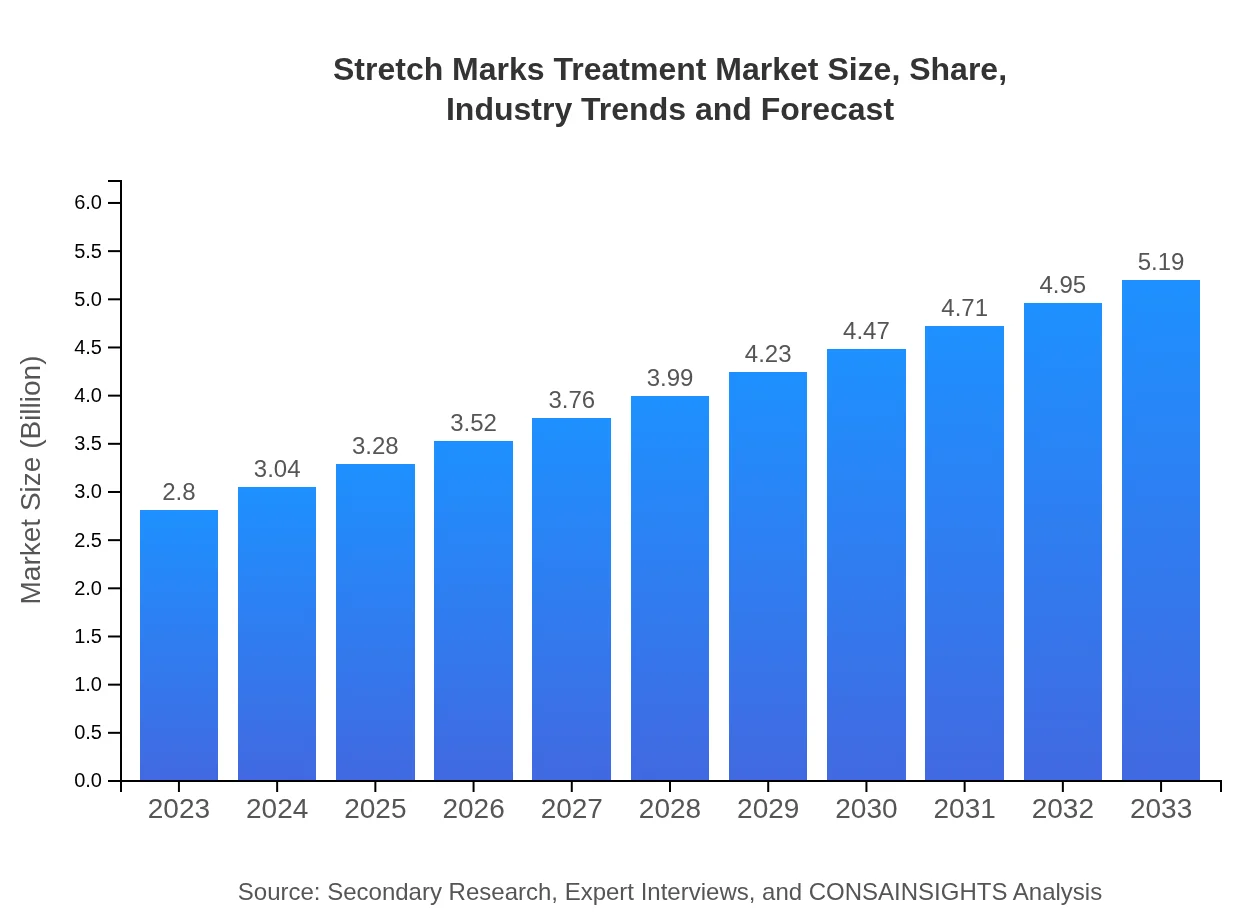
Stretch Marks Treatment Market — USD $2.8 Billion in 2023, Growing to USD 5.19null by 2033 at 6.2% CAGR
This report provides a comprehensive analysis of the Stretch Marks Treatment market from 2023 to 2033, focusing on market size, key trends, regional insights, and future forecasts. Detailed segmentation and competitive landscape analysis enrich the understanding of this evolving industry.
Key Takeaways
- Global market value increases from $2.80 Billion in 2023 to $5.19 Billion in 2033 with a 6.2% CAGR across the forecast period.
- North America is largest regional market, while no single fastest-growing region is stated because regional CAGR differences remain within 0.15 percentage points.
- North America leads regional value, rising from $1 Billion in 2023 to $1.85 Billion in 2033, reflecting strong clinical and consumer uptake.
- Europe grows from $0.95 Billion in 2023 to $1.75 Billion in 2033, supported by advanced dermatological services and product availability.
- Asia Pacific expands from $0.5 Billion in 2023 to $0.93 Billion in 2033, driven by rising awareness and broader retail access.
- Top companies include Hale and Hearty, LaserAway, Mederma, and StriVectin, positioned across topical, laser, and surgical solutions.
Stretch Marks Treatment Market Report — Executive Summary
North America remains largest market by forecast-period value, while no single fastest-growing region is stated because top regional growth rates are separated by less than 0.15 percentage points. This report examines the Stretch Marks Treatment market from 2023 to 2033, highlighting a rise from $2.80 Billion to $5.19 Billion and a 6.2% CAGR. Growth is propelled by technological advances in minimally invasive procedures, greater consumer focus on appearance, and expanding e-commerce distribution. Regional developments show North America with the largest end-market value. Product segmentation covers topical formulations, laser procedures and surgical options, while applications span men, women and teenagers. Competitive activity centers on product innovation and strategic partnerships among companies such as Hale and Hearty, LaserAway, Mederma and StriVectin. The report outlines market drivers, adoption barriers and future opportunities for clinics, hospitals and retail channels, with scenario-based insights for stakeholders planning entry or expansion strategies.
Key Growth Drivers
- Rising consumer emphasis on physical appearance and preventive skin care increases demand for treatment options.
- Advances in laser and minimally invasive techniques improve efficacy and broaden clinical adoption.
- Expanded online retail channels enhance product accessibility and drive direct-to-consumer sales.
- Broader availability of dermatology services in developed regions supports higher treatment volumes.
- Strategic collaborations among manufacturers and clinics accelerate product launches and service offerings.
| Metric | Value |
|---|---|
| Study Period | 2023 - 2033 |
| 2023 Market Size | $2.80 Billion |
| CAGR (2023-2033) | 6.2% |
| 2033 Market Size | $5.19 Billion |
| Top Companies | Hale and Hearty, LaserAway, Mederma, StriVectin |
| Published Date | 15 October 2024 |
| Last Modified Date | 28 May 2026 |
Stretch Marks Treatment Market Overview
Customize Stretch Marks Treatment Market Report market research report
- ✔ Get in-depth analysis of Stretch Marks Treatment market size, growth, and forecasts.
- ✔ Understand Stretch Marks Treatment's regional dynamics and industry-specific trends.
- ✔ Identify potential applications, end-user demand, and growth segments in Stretch Marks Treatment
What is the Market Size & CAGR of Stretch Marks Treatment Market Report market in 2023?
Stretch Marks Treatment Industry Analysis
Stretch Marks Treatment Market Segmentation and Scope
Tell us your focus area and get a customized research report.
Stretch Marks Treatment Market Report Market Analysis Report by Region
Europe Stretch Marks Treatment Market Report:
Europe grows from $0.95 Billion in 2023 to $1.75 Billion in 2033. This expansion aligns with advanced dermatological services, regulatory frameworks supporting clinical treatments, and robust retail availability for topical products.Asia Pacific Stretch Marks Treatment Market Report:
Asia Pacific grows from $0.5 Billion in 2023 to $0.93 Billion in 2033. Regional momentum is linked to rising beauty awareness, greater access to dermatology clinics, and expanding e-commerce channels that widen product reach.North America Stretch Marks Treatment Market Report:
North America is largest regional market, rising from $1 Billion in 2023 to $1.85 Billion in 2033. The region’s scale reflects established dermatology infrastructure, high clinical adoption rates for lasers and procedural treatments, and significant direct-to-consumer product penetration.South America Stretch Marks Treatment Market Report:
Latin America grows from $0.25 Billion in 2023 to $0.46 Billion in 2033. Growth is supported by increasing consumer interest in aesthetic treatments and improving availability of both topical and clinic-based solutions.Middle East & Africa Stretch Marks Treatment Market Report:
Middle East and Africa grows from $0.11 Billion in 2023 to $0.2 Billion in 2033. Market development is driven by growing demand for aesthetic procedures and improving access to specialized dermatology services.Tell us your focus area and get a customized research report.
Research Methodology
Stretch Marks Treatment Market Analysis By Product
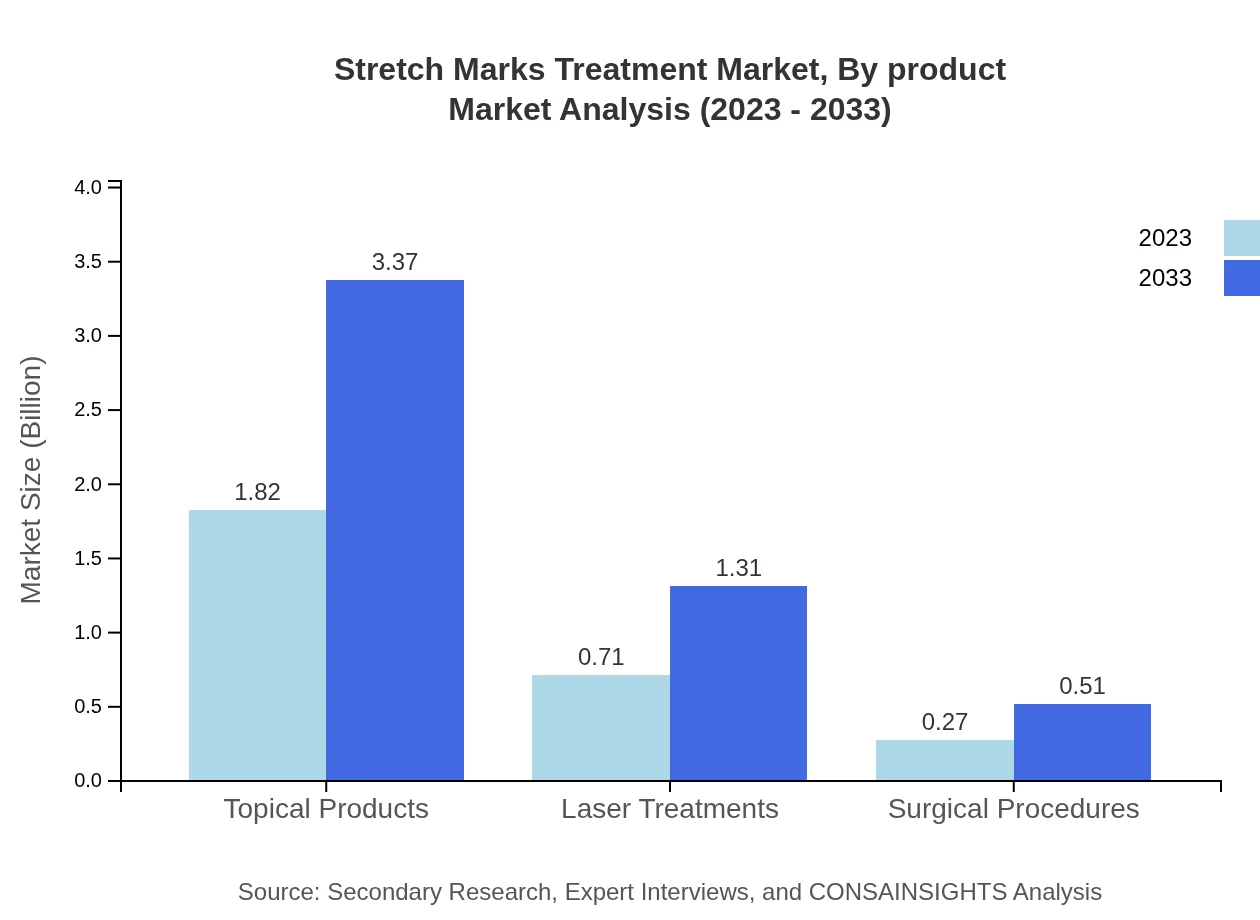
In the Stretch Marks Treatment market, topical products dominate with a market size of $1.82 billion in 2023, anticipated to rise to $3.37 billion by 2033. Laser treatments account for $0.71 billion, expected to grow to $1.31 billion. Surgical procedures, while representing a smaller market size of $0.27 billion, are also expected to double by 2033.
Stretch Marks Treatment Market Analysis By Application
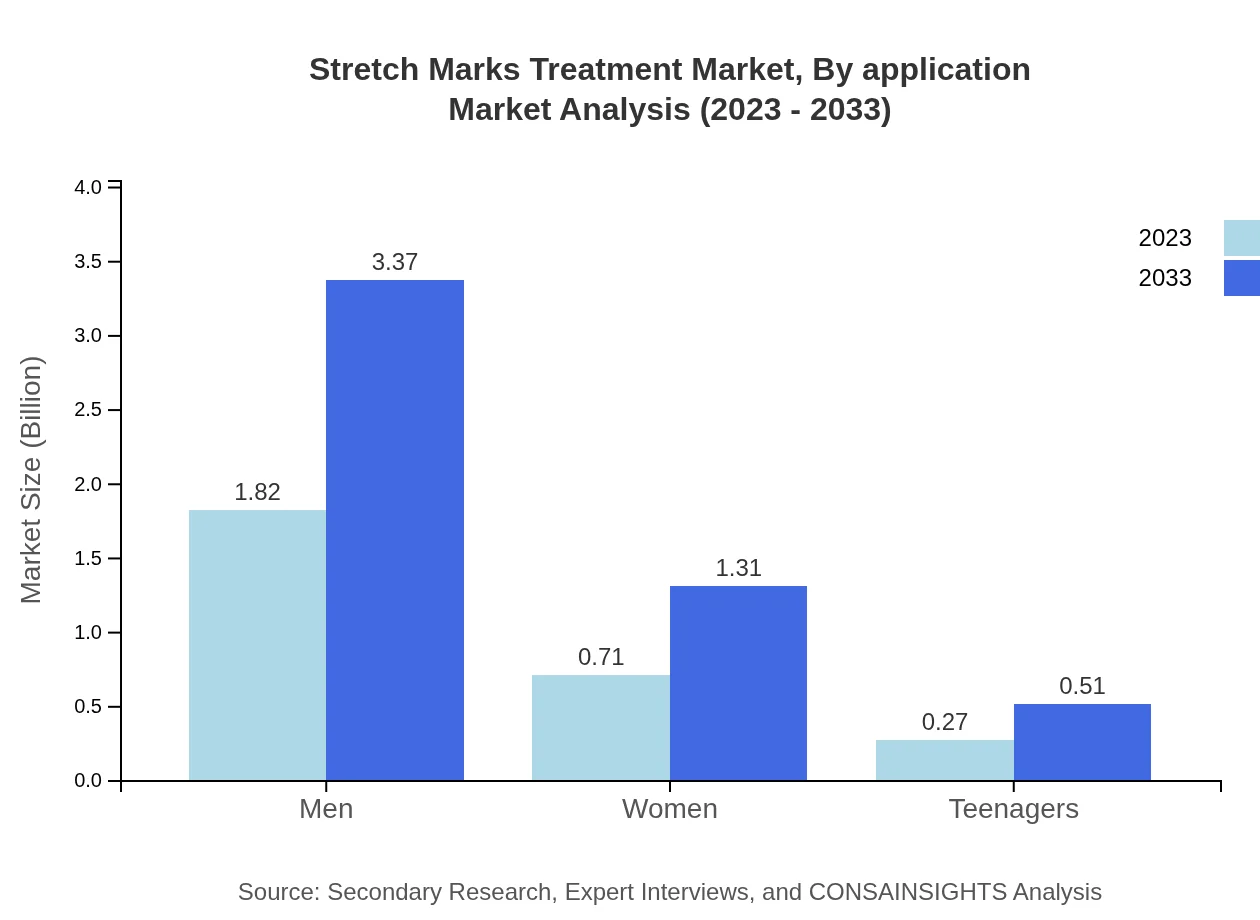
The segmentation by application indicates that individual consumers represent the largest market share of around 65.01% in 2023, anticipated to remain steady through 2033. Women specifically hold about 25.22% of the market, with teenagers contributing 9.77%, signaling a notable trend towards inclusivity in treatment options across demographics.
Stretch Marks Treatment Market Analysis By Distribution Channel
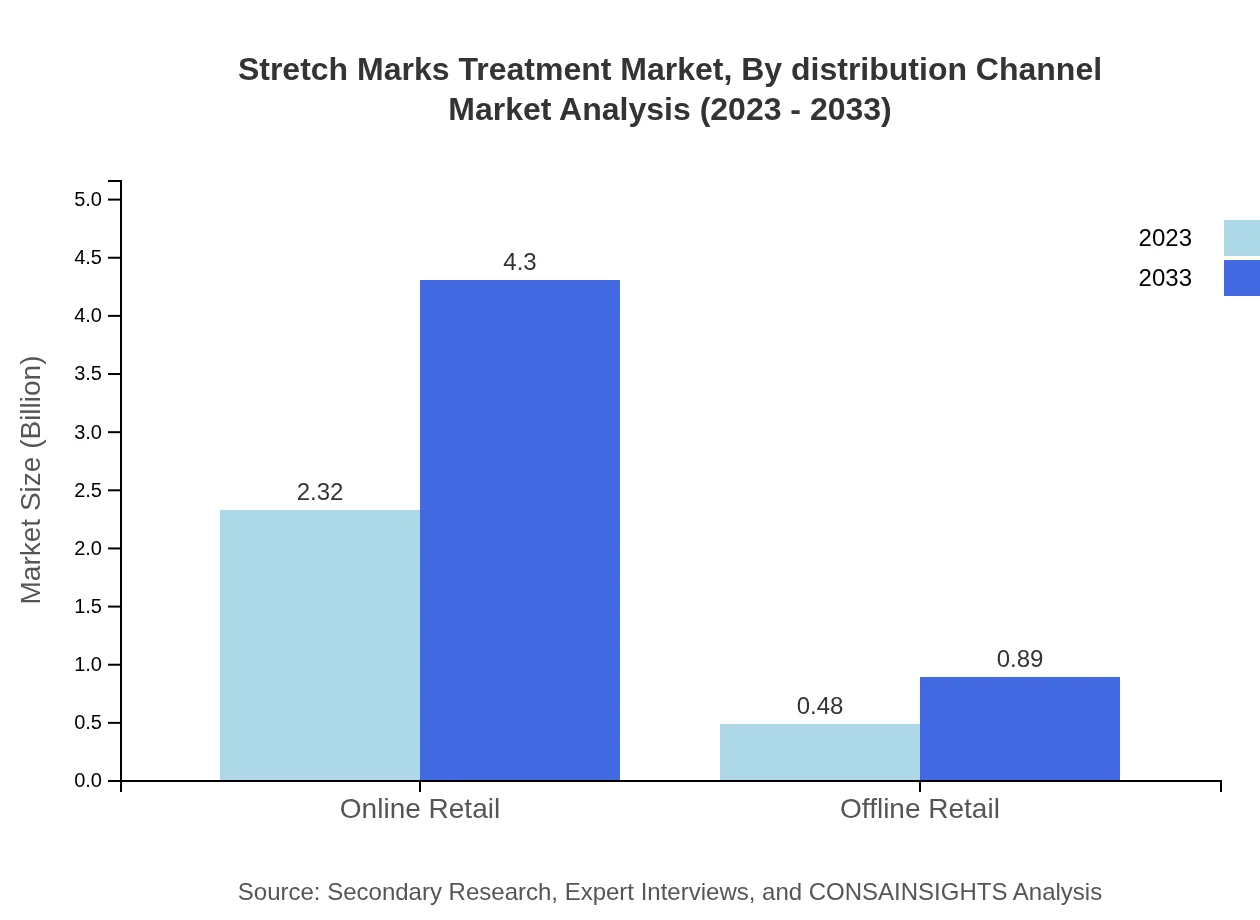
Online retail has emerged as the dominant distribution channel, constituting approximately 82.86% of market share in 2023. This trend is expected to strengthen, as e-commerce platforms provide ease of access and wider market reach. Offline retail, while smaller, complements this by maintaining about 17.14% of the market.
Stretch Marks Treatment Market Analysis By Region
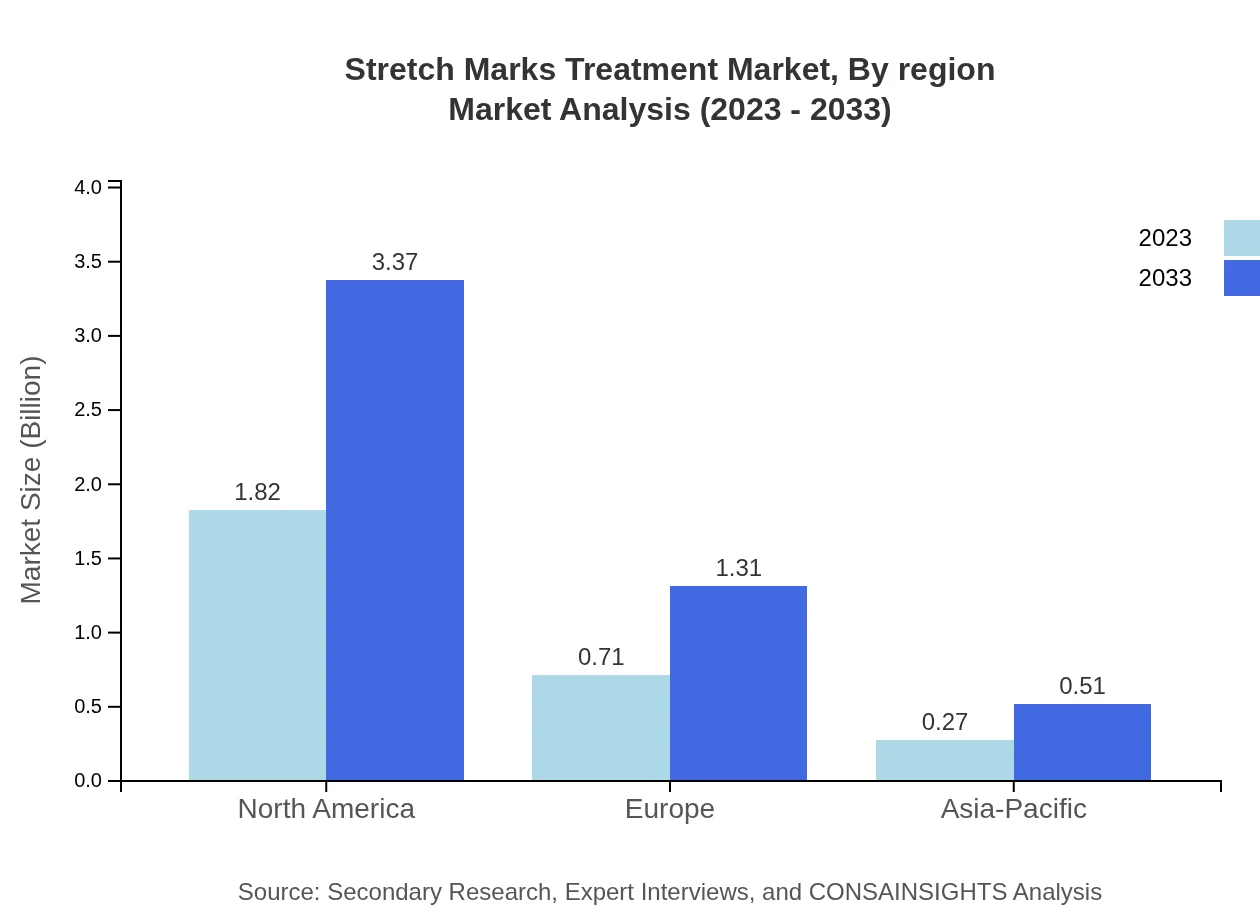
Geographically, North America commands the largest market share, driven by high consumer engagement and robust marketing strategies. Europe follows closely, influenced by strong health and beauty standards. The Asia Pacific is rapidly growing as an emerging market, while South America continues to evolve influenced by social trends.
Stretch Marks Treatment Market Analysis By Customer Segment
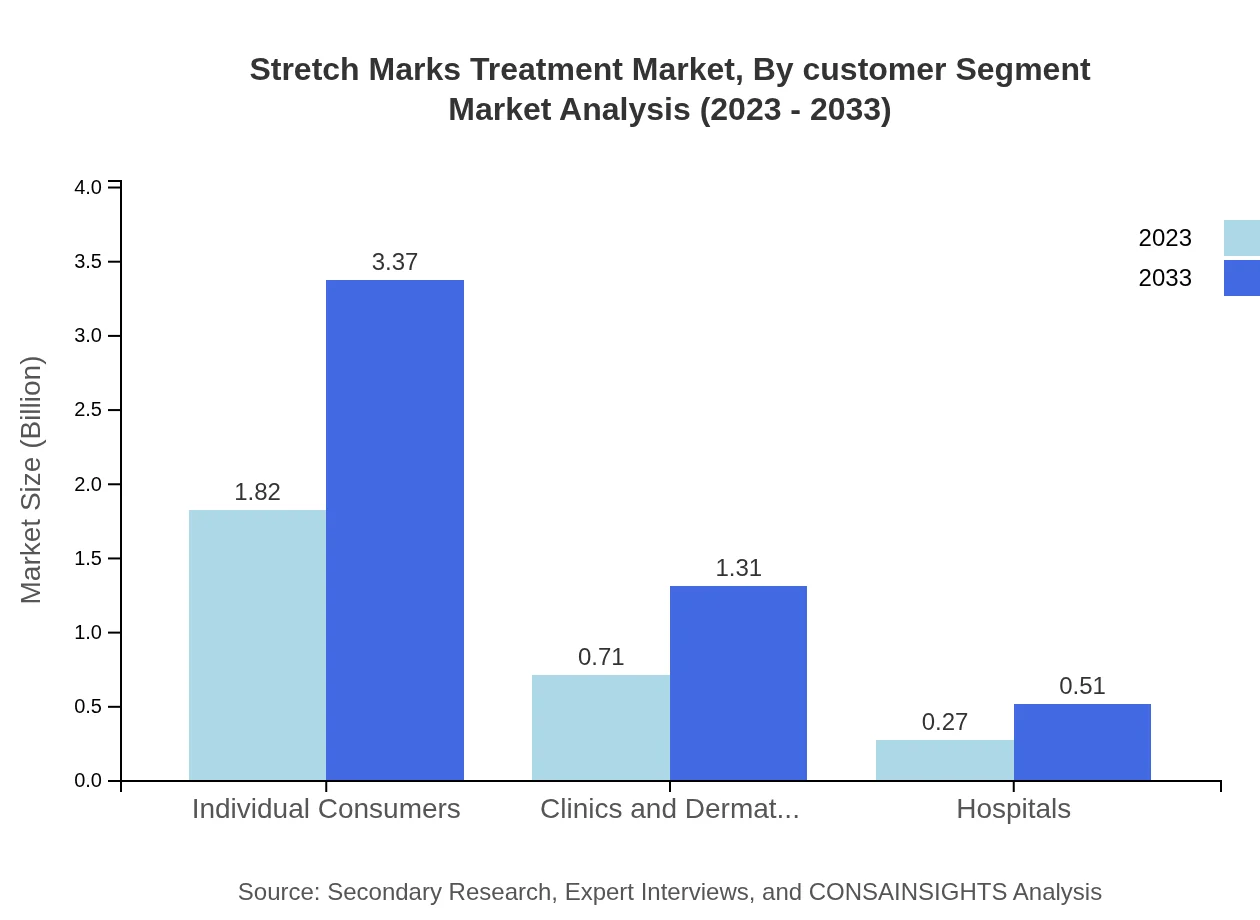
Customer segmentation reflects a dynamic array with men and individual consumers comprising significant shares in the market. Clinics and dermatology centers represent a notable part of the distribution landscape, further fostering growth through trusted treatment pathways.
Stretch Marks Treatment Market Trends and Future Forecast
Tell us your focus area and get a customized research report.
Global Market Leaders and Top Companies in Stretch Marks Treatment Industry
Hale and Hearty:
A leading provider of topical treatments specializing in organic formulations for stretch marks, Hale and Hearty focuses on sustainability and efficacy.LaserAway:
A prominent player in the laser treatment market, LaserAway offers a range of state-of-the-art laser therapies tailored to improve the appearance of stretch marks.Mederma:
Well-known for its effective topical gel products, Mederma leverages extensive marketing to educate consumers on minimizing scars and stretch marks.StriVectin:
Targeting stretch marks with clinically proven results, StriVectin combines advanced skincare formulations that attract a loyal consumer base.We're grateful to work with incredible clients.







FAQs
What is the market size of the Stretch Marks Treatment Market Report in 2023?
The market size in 2023 is $2.80 Billion as reported for the Stretch Marks Treatment market for the baseline year.
What is the market size of the Stretch Marks Treatment Market Report in 2033?
By 2033 the market is projected to reach $5.19 Billion, reflecting growth across products, regions, and distribution channels.
What is CAGR of the Stretch Marks Treatment Market Report?
The reported compound annual growth rate (CAGR) for 2023 to 2033 is 6.2%, covering the full forecast interval.
How big is the North America market in 2023 and 2033?
North America is reported at $1 Billion in 2023 and grows to $1.85 Billion in 2033, representing the largest regional value.
Which companies are named in the report?
The report lists Hale and Hearty, LaserAway, Mederma, and StriVectin as key companies featured in the competitive overview.
Why is Europe significant in regional growth?
Europe increases from $0.95 Billion in 2023 to $1.75 Billion in 2033, driven by mature dermatology services and product availability.
How big is the Asia Pacific market by 2033?
Asia Pacific is reported at $0.5 Billion in 2023 and expands to $0.93 Billion in 2033, reflecting rising awareness and retail expansion.
What are common distribution channels covered?
Distribution channels include Online Retail and Offline Retail, which together shape product reach and consumer access.
Who are the primary end users identified?
Primary customer segments comprise Individual Consumers, Clinics and Dermatology Centers, and Hospitals as focal end users.
Is there a single fastest Growing region in the Stretch Marks Treatment Market Report market?
No single fastest-growing region is stated for the Stretch Marks Treatment Market Report market because the top regional implied CAGR values are within 0.15 percentage points of each other, making the ranking too close to call reliably.