
Reports >
Life Sciences
>
Tumor Tracking Systems Market Report

Tumor Tracking Systems Market Report
First published: 14 October 2024 | Last updated: 28 May 2026 | Report Code: tumor-tracking-systems
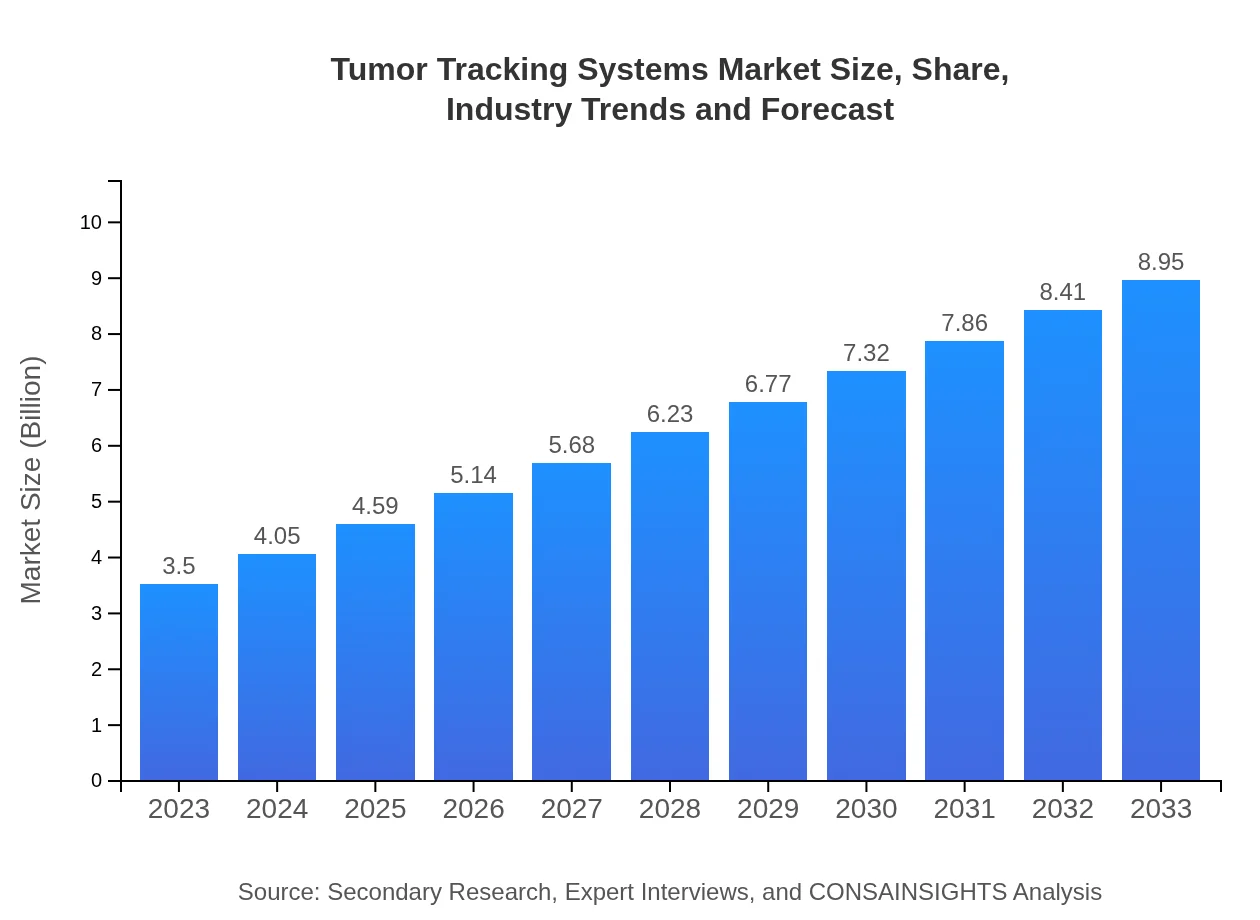
Tumor Tracking Systems Market — USD 3.5 billion in 2023, Growing to USD 8.95B by 2033 at 9.5% CAGR
This report analyzes the Tumor Tracking Systems market from 2023 to 2033, providing insights into market size, trends, and key player activities. It aims to equip stakeholders with essential data for strategic decision-making.
Key Takeaways
- Global market expands from $3.50 Billion (2023) to $8.95 Billion (2033) with a 9.5% CAGR over 2023 to 2033.
- North America is largest regional market, while no single fastest-growing region is stated because regional CAGR differences remain within 0.15 percentage points.
- North America is the largest region, increasing from $1.26 Billion in 2023 to $3.23 Billion in 2033.
- Regional markets such as Europe ($0.88B to $2.24B) and Asia Pacific ($0.68B to $1.74B) show significant growth during the forecast.
- Primary demand drivers include enhanced diagnostic accuracy, investments in healthcare infrastructure, and integration of advanced analytics.
- Key vendors named include Siemens Healthineers, GE Healthcare, IBM Watson Health, and Philips Healthcare.
Tumor Tracking Systems Market Report — Executive Summary
North America remains largest market by forecast-period value, while no single fastest-growing region is stated because top regional growth rates are separated by less than 0.15 percentage points. This report outlines the Tumor Tracking Systems market trajectory, with the global value rising from $3.50 Billion in 2023 to $8.95 Billion in 2033 at a 9.5% CAGR for 2023 to 2033. Growth is supported by improvements in imaging and data analytics, heightened focus on personalized treatment, and rising investments in clinical technology. Regulatory frameworks shape product development and market access, while hospitals, clinics, and research institutes remain primary end users. Major participants such as Siemens Healthineers, GE Healthcare, IBM Watson Health, and Philips Healthcare are active in product innovation and partnerships. The analysis covers product types, technology approaches, applications, deployment models, and regional trends, offering stakeholders actionable insight on adoption patterns and strategic priorities across the forecast period.
Key Growth Drivers
- Advances in imaging techniques and biomarkers improving detection and monitoring accuracy.
- Greater adoption of data analytics enabling longitudinal tumor tracking and treatment optimization.
- Increased healthcare infrastructure investments supporting deployment in hospitals and clinics.
- Regulatory standards guiding safety and efficacy, prompting product development and compliance.
- Demand from research institutes for tools that support clinical studies and personalized medicine.
| Metric | Value |
|---|---|
| Study Period | 2023 - 2033 |
| 2023 Market Size | $3.50 Billion |
| CAGR (2023-2033) | 9.5% |
| 2033 Market Size | $8.95 Billion |
| Top Companies | Siemens Healthineers, GE Healthcare, IBM Watson Health, Philips Healthcare |
| Published Date | 14 October 2024 |
| Last Modified Date | 28 May 2026 |
Tumor Tracking Systems Market Overview
Customize Tumor Tracking Systems Market Report market research report
- ✔ Get in-depth analysis of Tumor Tracking Systems market size, growth, and forecasts.
- ✔ Understand Tumor Tracking Systems's regional dynamics and industry-specific trends.
- ✔ Identify potential applications, end-user demand, and growth segments in Tumor Tracking Systems
What is the Market Size & CAGR of Tumor Tracking Systems Market Report market in 2023?
Tumor Tracking Systems Industry Analysis
Tumor Tracking Systems Market Segmentation and Scope
Tell us your focus area and get a customized research report.
Tumor Tracking Systems Market Report Market Analysis Report by Region
Europe Tumor Tracking Systems Market Report:
Europe grows from $0.88 Billion in 2023 to $2.24 Billion in 2033. Regional expansion is influenced by regulatory frameworks, increasing investment in diagnostic infrastructure, and demand from hospitals and research institutes for reliable tumor monitoring tools.Asia Pacific Tumor Tracking Systems Market Report:
Asia Pacific grows from $0.68 Billion in 2023 to $1.74 Billion in 2033. Growth drivers include rising healthcare spending, expanding clinical infrastructure, and adoption of imaging and analytics technologies across hospitals and clinics.North America Tumor Tracking Systems Market Report:
North America is largest regional market, rising from $1.26 Billion in 2023 to $3.23 Billion in 2033. Growth is linked to strong clinical adoption, concentrated vendor activity, investments in healthcare facilities, and uptake of advanced imaging and analytics solutions.South America Tumor Tracking Systems Market Report:
Latin America grows from $0.25 Billion in 2023 to $0.64 Billion in 2033. Expansion is supported by gradual healthcare investment, growing clinical services, and interest from research institutes in improved tumor tracking capabilities.Middle East & Africa Tumor Tracking Systems Market Report:
Middle East and Africa grows from $0.43 Billion in 2023 to $1.11 Billion in 2033. Regional uptake is driven by investments in medical technology, enhancements in diagnostic services, and increased emphasis on treatment monitoring in hospitals and clinics.Tell us your focus area and get a customized research report.
Research Methodology
Tumor Tracking Systems Market Analysis By Technology
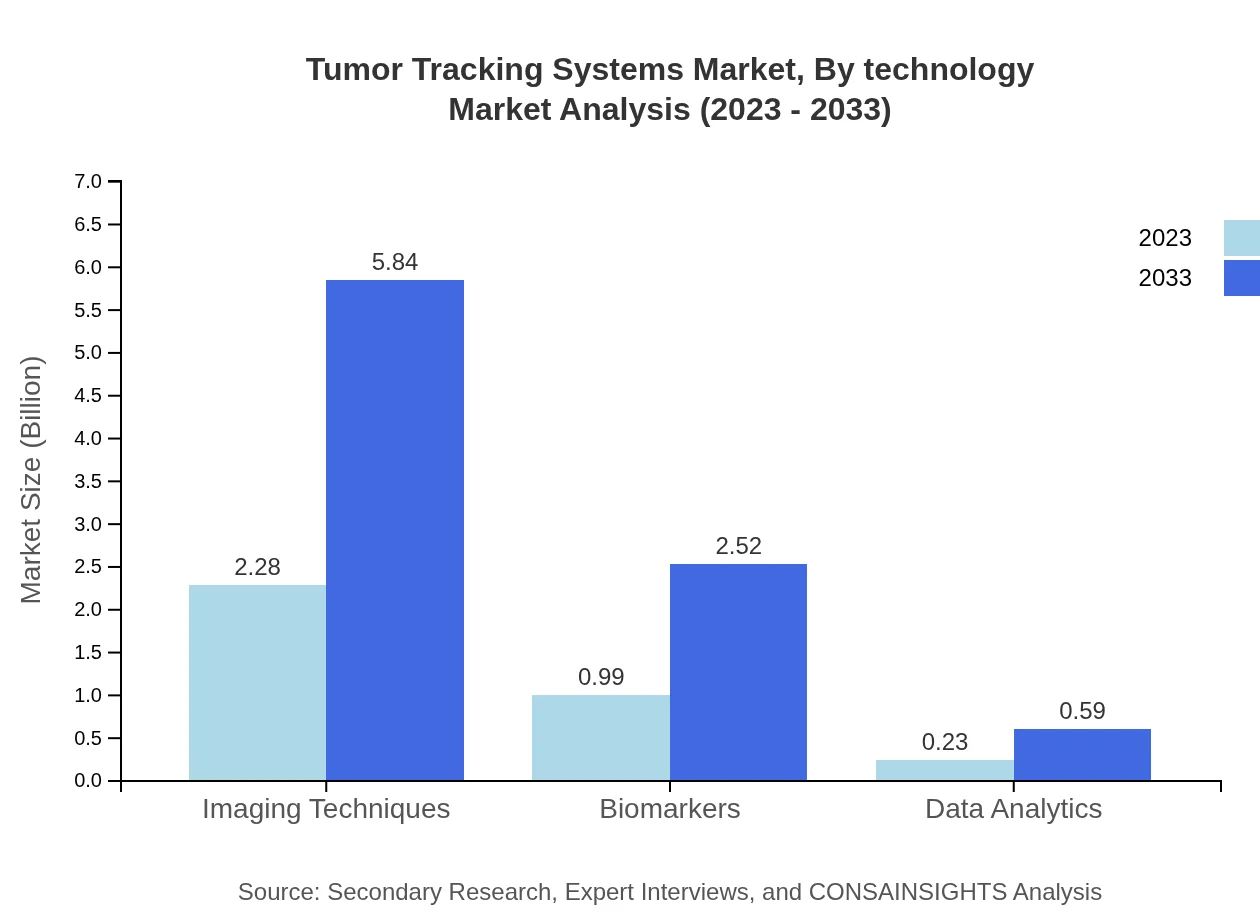
The Tumor Tracking Systems market is dominated by software solutions, accounting for 82.69% of the market share, with significant growth projected from $2.89 billion in 2023 to $7.40 billion by 2033. Hardware devices comprise the remaining market share, anticipated to expand from $0.61 billion to $1.55 billion during the same period. The integration of advanced technology such as AI and cloud computing is pivotal in enhancing system efficiency and efficacy.
Tumor Tracking Systems Market Analysis By Application
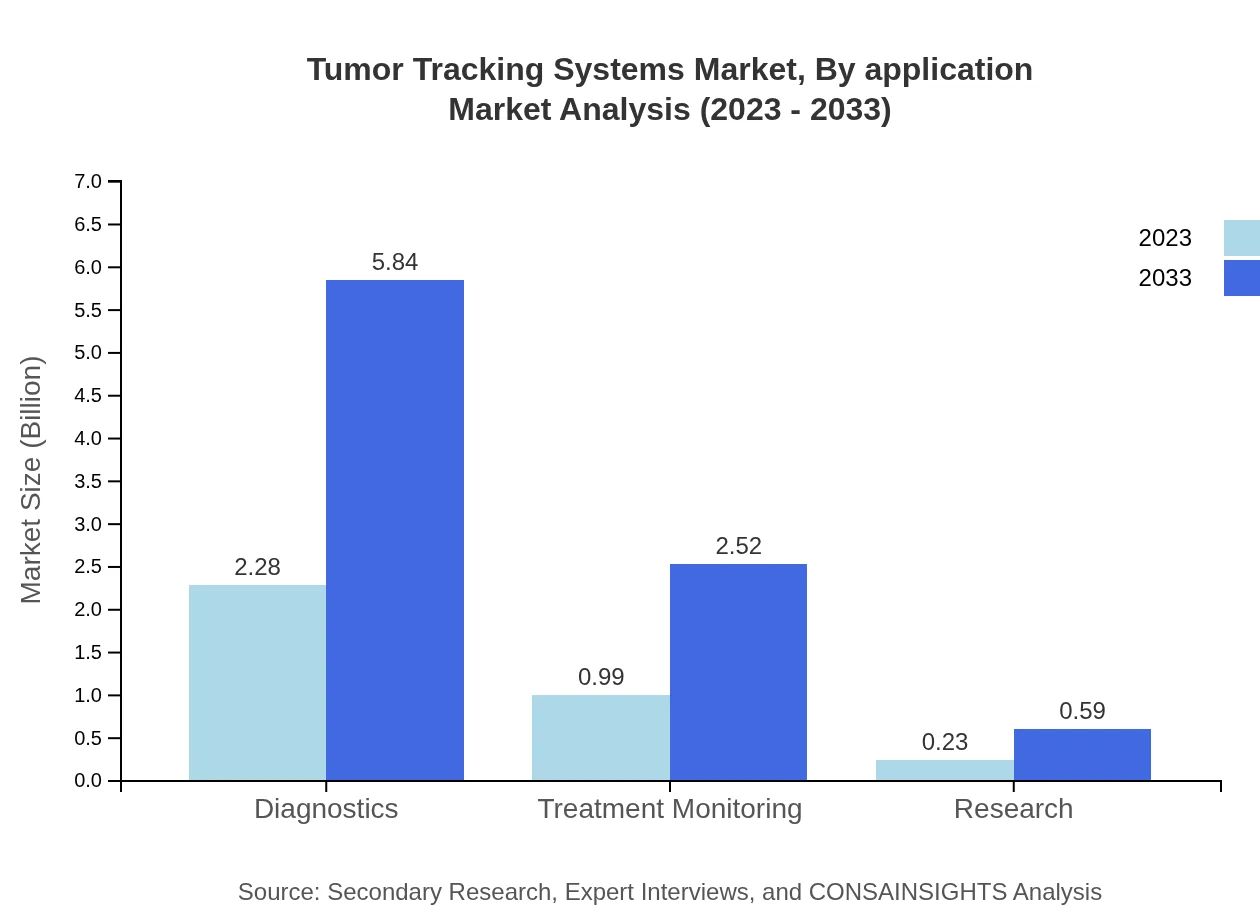
Applications for Tumor Tracking Systems are segmented into diagnostics, treatment monitoring, and research. Diagnostics lead with a significant share, reflecting 65.2% in 2023, while treatment monitoring is expected to grow from $0.99 billion to $2.52 billion. Research applications, though smaller, are integral for innovation within the sector.
Tumor Tracking Systems Market Analysis By End User
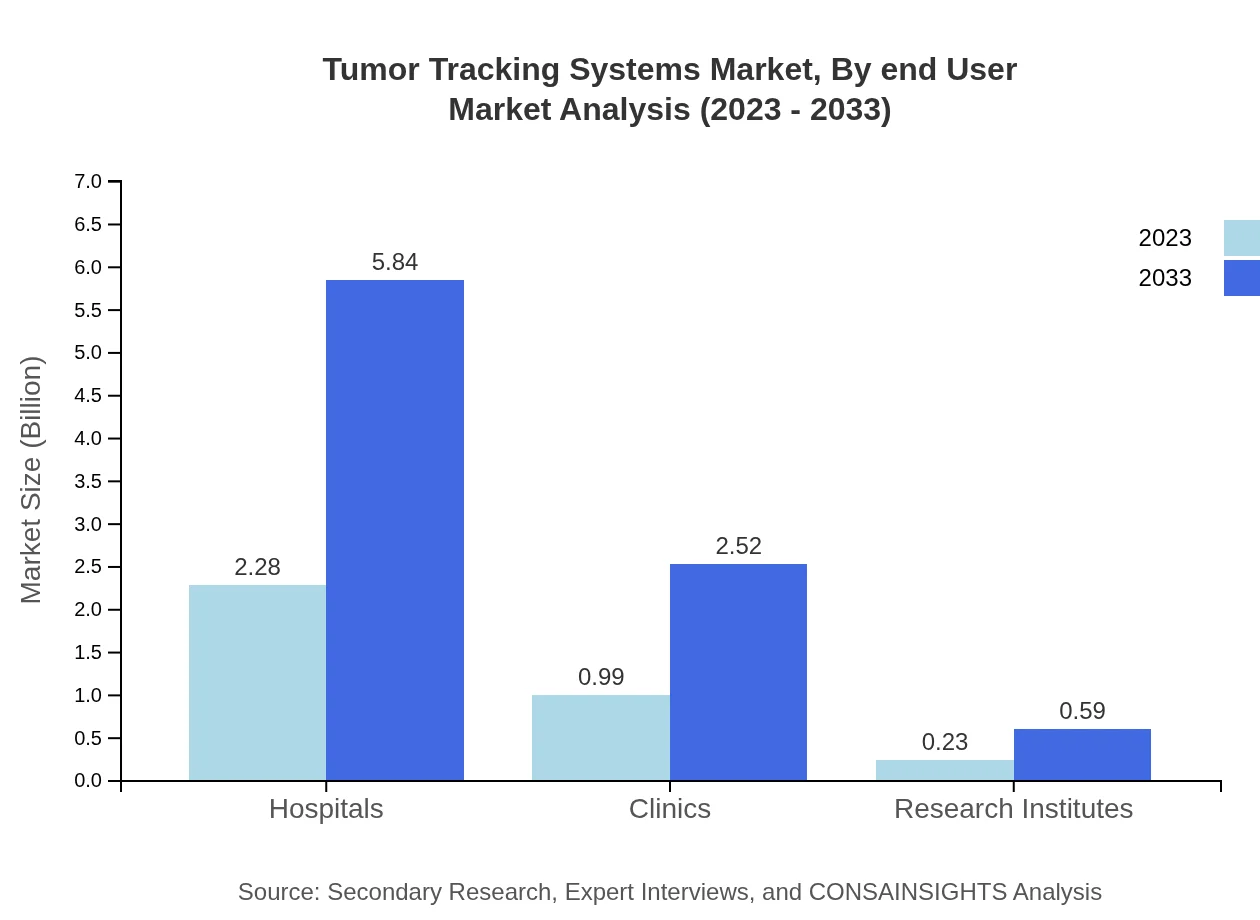
The market by end-user is primarily segmented into hospitals, clinics, and research institutes. Hospitals accounted for 65.2% of the market share, valued at $2.28 billion in 2023, expected to grow to $5.84 billion by 2033. Clinics follow, with 28.18% share, signaling a growing interest in advanced tracking systems beyond major institutions.
Tumor Tracking Systems Market Analysis By Product Type
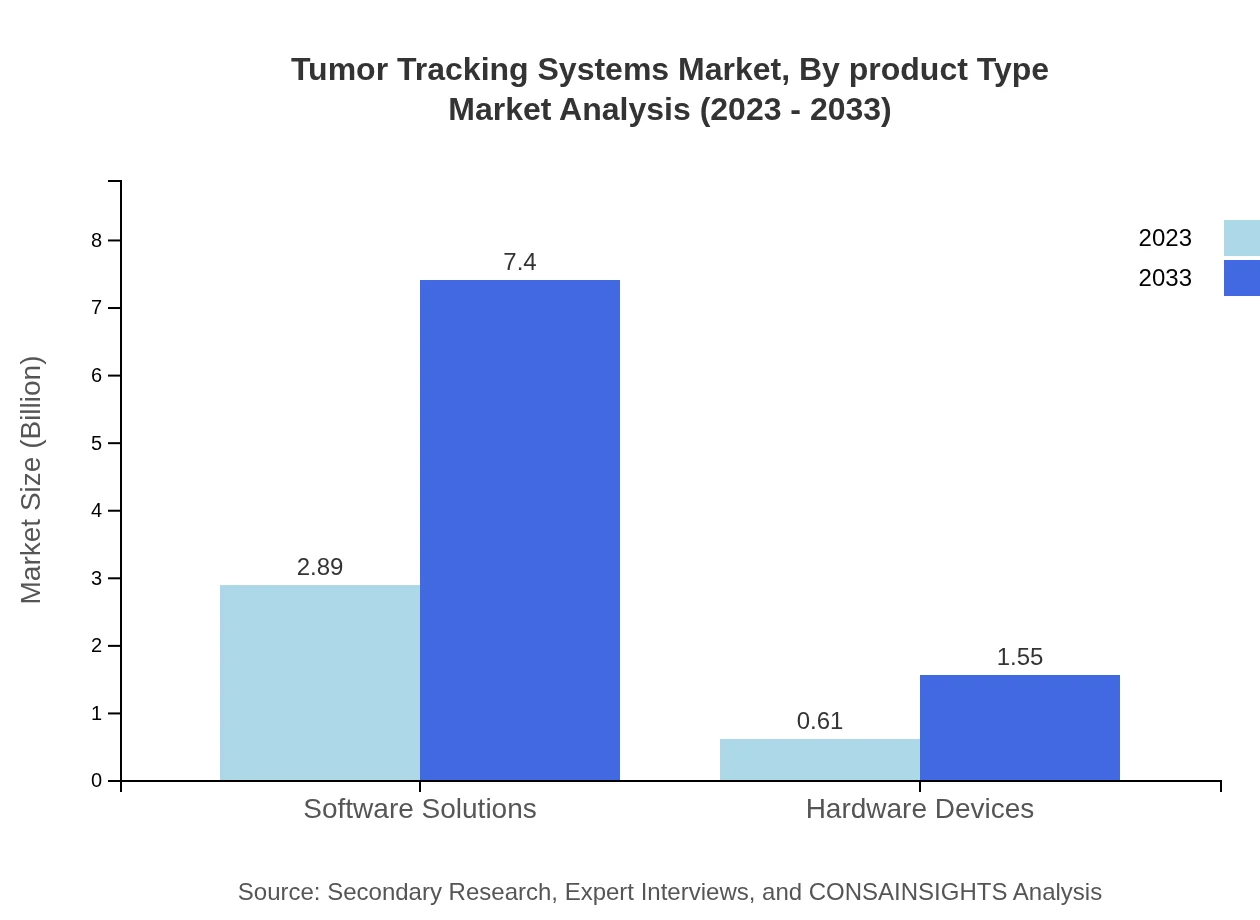
In terms of product types, software solutions dominate with a projected size growth from $2.89 billion to $7.40 billion by 2033. This segment is increasingly favored for its adaptability and integration capabilities with existing systems. Hardware devices complement this, expected to enhance significantly due to the demand for bundled software and hardware solutions.
Tumor Tracking Systems Market Analysis By Regulatory Framework
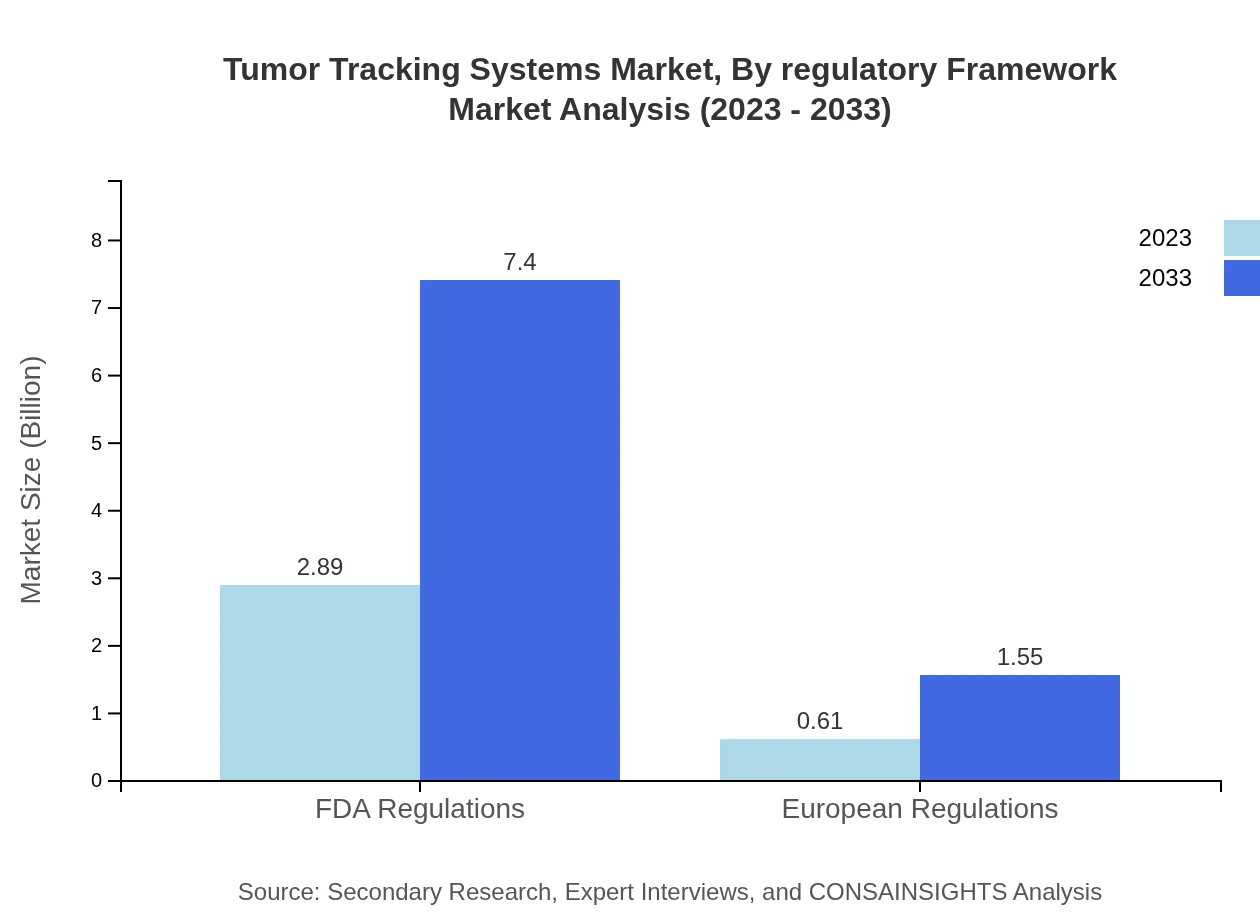
The market is significantly influenced by regulatory frameworks such as FDA and European regulations, which ensure the safety and efficacy of tumor tracking systems. Compliance with these standards is crucial for market players aiming to innovate and expand their market share.
Tumor Tracking Systems Market Trends and Future Forecast
Tell us your focus area and get a customized research report.
Global Market Leaders and Top Companies in Tumor Tracking Systems Industry
Siemens Healthineers:
Siemens Healthineers specializes in advanced imaging and digital solutions, providing a range of tumor tracking systems that integrate effortlessly with existing healthcare infrastructures.GE Healthcare:
GE Healthcare focuses on precision imaging technologies, offering sophisticated tumor tracking systems designed to enhance diagnostic accuracy and treatment monitoring.IBM Watson Health:
IBM Watson Health is at the forefront of leveraging AI and data analytics for tumor tracking solutions, enhancing decision-making processes in oncology.Philips Healthcare:
Philips Healthcare develops innovative imaging and monitoring solutions, aimed at improving patient outcomes through effective tumor management.We're grateful to work with incredible clients.









FAQs
What is the market size in 2023?
The market size in 2023 is $3.50 Billion, as stated in the report's baseline year for the 2023 to 2033 forecast period.
How big will the market be in 2033?
By 2033 the market reaches $8.95 Billion according to the report, reflecting projected adoption across clinical and research settings.
What is CAGR for the forecast period?
The reported compound annual growth rate for 2023 to 2033 is 9.5%, applied to the market progression from 2023 to 2033.
Is there a single fastest Growing region in the Tumor Tracking Systems Market Report market?
No single fastest-growing region is stated for the Tumor Tracking Systems Market Report market because the top regional implied CAGR values are within 0.15 percentage points of each other, making the ranking too close to call reliably.
Which end users are covered?
Primary end users specified include hospitals, clinics, and research institutes, reflecting clinical and investigational deployment scenarios.
Who are the top companies in the market?
Top companies listed are Siemens Healthineers, GE Healthcare, IBM Watson Health, and Philips Healthcare as key industry participants.
What technologies are included?
Technologies covered include imaging techniques, biomarkers, and data analytics, which support diagnostic and monitoring applications.
How is regulatory context treated?
Regulatory frameworks such as FDA and European regulations are included as factors that shape product development and market access.
What applications are emphasized?
Primary applications noted are diagnostics, treatment monitoring, and research, reflecting clinical and investigative use cases.
Why is data analytics important?
Data analytics enables longitudinal tumor assessment and supports treatment decisions, improving operational efficiency and clinical insight.