

Urothelial Cancer Drugs Market Report
First published: 14 October 2024 | Last updated: 28 May 2026 | Report Code: urothelial-cancer-drugs
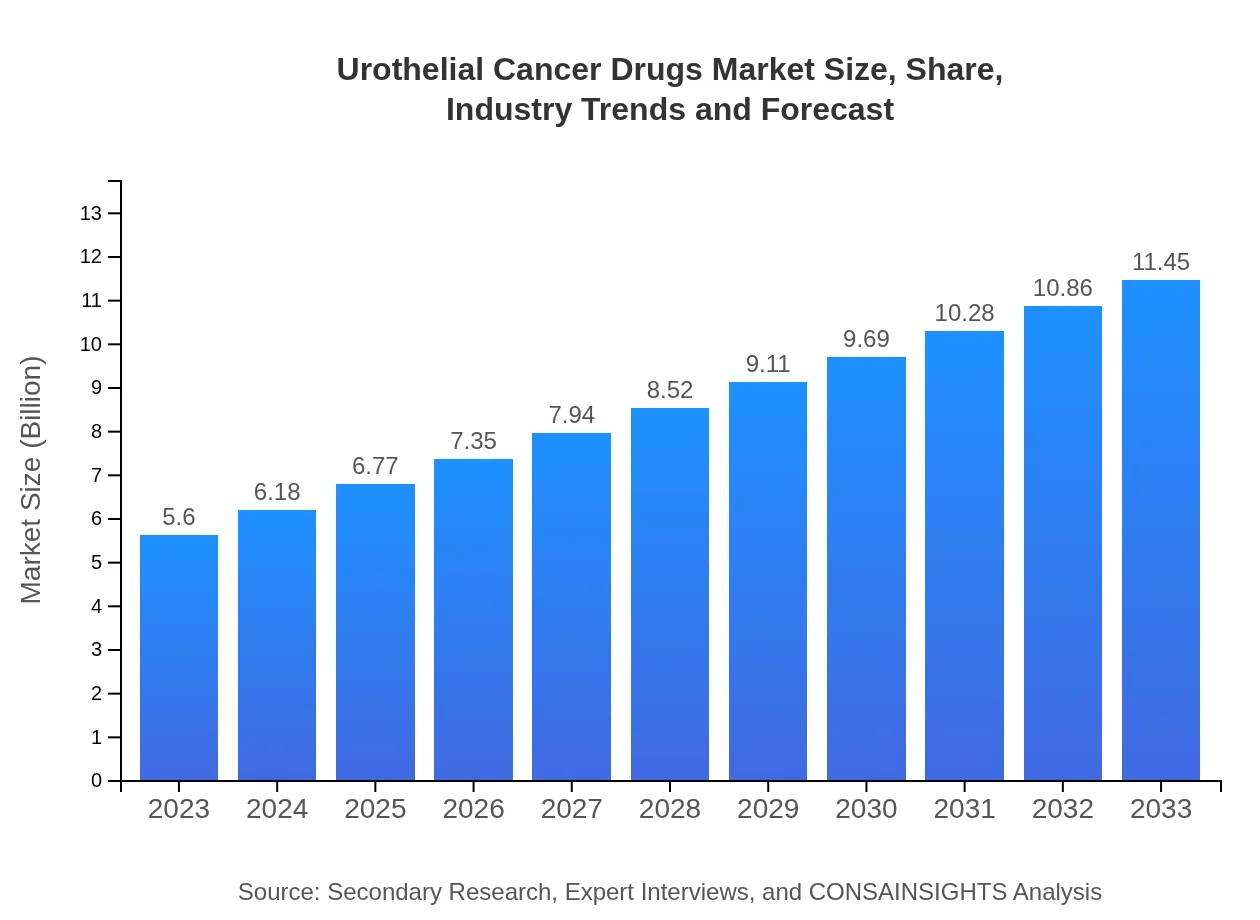
Urothelial Cancer Drugs Market — USD 5.6 billion in 2023, Growing to USD 11.45B by 2033 at 7.2% CAGR
This report analyzes the Urothelial Cancer Drugs market, providing insights into market dynamics, size, segmentation, and regional trends. The forecast period spans from 2023 to 2033, offering a comprehensive assessment for stakeholders in the oncology sector.
Key Takeaways
- Global market value rising from $5.60 Billion in 2023 to $11.45 Billion in 2033 at a 7.2% CAGR.
- North America is largest regional market, while no single fastest-growing region is stated because regional CAGR differences remain within 0.15 percentage points.
- European demand grows from $1.53 Billion to $3.13 Billion between 2023 and 2033, reflecting expanded treatment adoption.
- Therapeutic mix includes chemotherapy, immunotherapy, and targeted therapy alongside active R&D pipelines in Phase 1 to Phase 3.
- Hospitals, oncology clinics, and homecare settings are primary end-user channels shaping uptake and service delivery.
Urothelial Cancer Drugs Market Report — Executive Summary
North America remains largest market by forecast-period value, while no single fastest-growing region is stated because top regional growth rates are separated by less than 0.15 percentage points. This report evaluates drivers, patterns, and competitive dynamics shaping the urothelial cancer drugs landscape between 2023 and 2033. Market size moves from $5.60 Billion to $11.45 Billion, propelled by clinical innovation, heightened diagnostic activity, and investments in oncology research. Treatment options span established chemotherapy and newer immunotherapies and targeted agents, with several candidates progressing through Phase 1 to Phase 3 pipelines. Regional trajectories highlight North America as the largest market, supported by advanced clinical infrastructure and active private‑public collaborations. Key companies profiled include AstraZeneca, Roche, Merck & Co., and Bristol Myers Squibb. The analysis integrates primary interviews with industry experts, secondary literature, and internal validation to present actionable insights for stakeholders considering market entry, portfolio strategy, or partnership opportunities.
Key Growth Drivers
- Rising prevalence and diagnosis rates increasing demand for effective urothelial cancer treatments.
- Advances in immunotherapy and targeted therapy expanding therapeutic options beyond conventional chemotherapy.
- Sustained R&D investment and active clinical pipelines progressing compounds through Phase 1 to Phase 3.
- Improved patient management and adoption across hospitals, oncology clinics, and homecare settings supporting broader access.
- Regulatory pathways that enable expedited review and approval for clinically effective oncology agents.
| Metric | Value |
|---|---|
| Study Period | 2023 - 2033 |
| 2023 Market Size | $5.60 Billion |
| CAGR (2023-2033) | 7.2% |
| 2033 Market Size | $11.45 Billion |
| Top Companies | AstraZeneca, Roche, Merck & Co., Bristol Myers Squibb |
| Published Date | 14 October 2024 |
| Last Modified Date | 28 May 2026 |
Urothelial Cancer Drugs Market Overview
Customize Urothelial Cancer Drugs Market Report market research report
- ✔ Get in-depth analysis of Urothelial Cancer Drugs market size, growth, and forecasts.
- ✔ Understand Urothelial Cancer Drugs's regional dynamics and industry-specific trends.
- ✔ Identify potential applications, end-user demand, and growth segments in Urothelial Cancer Drugs
What is the Market Size & CAGR of Urothelial Cancer Drugs Market Report market in 2023?
Urothelial Cancer Drugs Industry Analysis
Urothelial Cancer Drugs Market Segmentation and Scope
Tell us your focus area and get a customized research report.
Urothelial Cancer Drugs Market Report Market Analysis Report by Region
Europe Urothelial Cancer Drugs Market Report:
Europe grows from $1.53 Billion in 2023 to $3.13 Billion in 2033. Regional uptake is influenced by expanding access to new therapies, collaborative research initiatives, and increasing emphasis on personalized oncology approaches within clinical practice.Asia Pacific Urothelial Cancer Drugs Market Report:
Asia Pacific grows from $1.09 Billion in 2023 to $2.23 Billion in 2033. Growth is supported by rising diagnosis rates, expanding healthcare capacity, and growing investment in clinical trials and adoption of advanced therapeutic options.North America Urothelial Cancer Drugs Market Report:
North America is largest regional market, rising from $2.14 Billion in 2023 to $4.37 Billion in 2033. The region’s scale is supported by advanced clinical infrastructure, significant oncology R&D spending, and established treatment networks across hospitals and specialist centers.South America Urothelial Cancer Drugs Market Report:
Latin America grows from $0.41 Billion in 2023 to $0.84 Billion in 2033. Market expansion reflects improving diagnostic services, greater availability of oncology treatments, and gradual enhancements in healthcare infrastructure for cancer care.Middle East & Africa Urothelial Cancer Drugs Market Report:
Middle East and Africa grows from $0.44 Billion in 2023 to $0.89 Billion in 2033. Drivers include strengthening oncology services, increased access to newer therapies, and growing local and regional clinical research activity.Tell us your focus area and get a customized research report.
Research Methodology
Urothelial Cancer Drugs Market Analysis By Drug Type
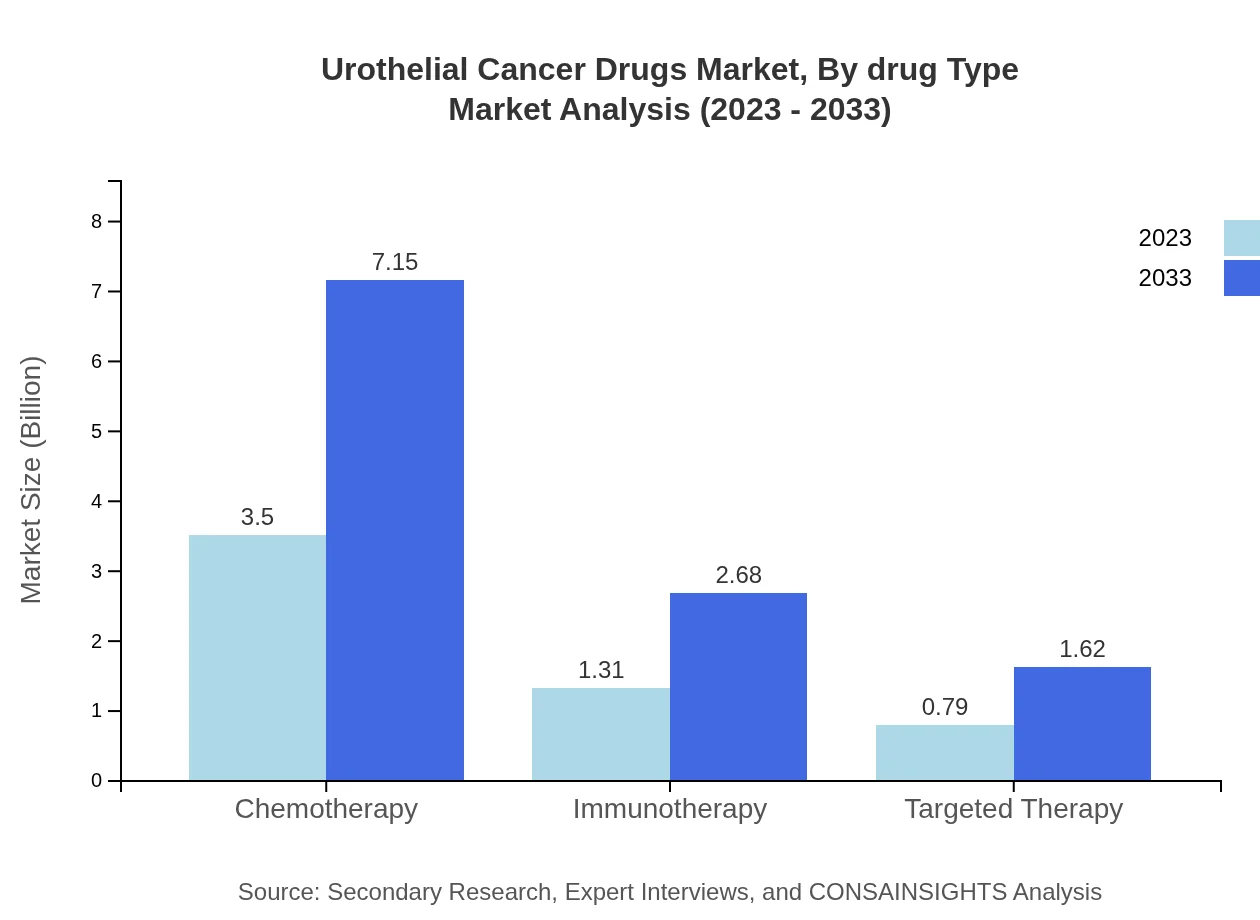
In 2023, chemotherapy accounts for a significant $3.50 billion and remains the leader with a market share of 62.47%. Immunotherapy follows with $1.31 billion (23.38%), while targeted therapy captures $0.79 billion (14.15%). By 2033, the values are projected to reach $7.15 billion, $2.68 billion, and $1.62 billion respectively, indicating a shift towards targeted and immunotherapeutic options.
Urothelial Cancer Drugs Market Analysis By Route Of Administration
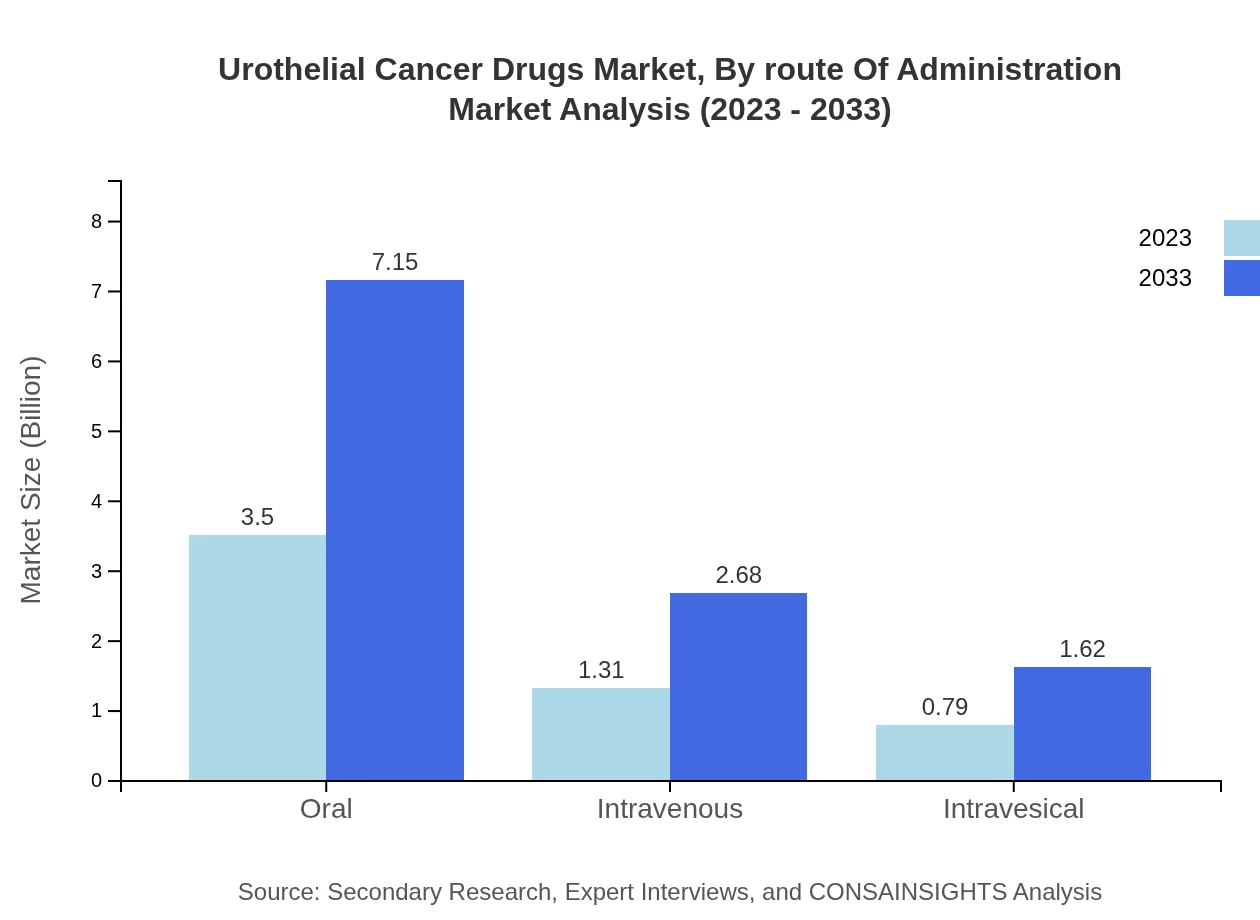
The oral administration route leads the segment in 2023 with a market size of $3.50 billion (62.47%) and is expected to double in value by 2033 to $7.15 billion. Intravenous routes account for $1.31 billion in 2023 with a market share of 23.38%, while intravesical delivery options represent $0.79 billion (14.15%). This trend reflects an increasing preference for oral therapies due to their ease of use.
Urothelial Cancer Drugs Market Analysis By Pipeline Drugs
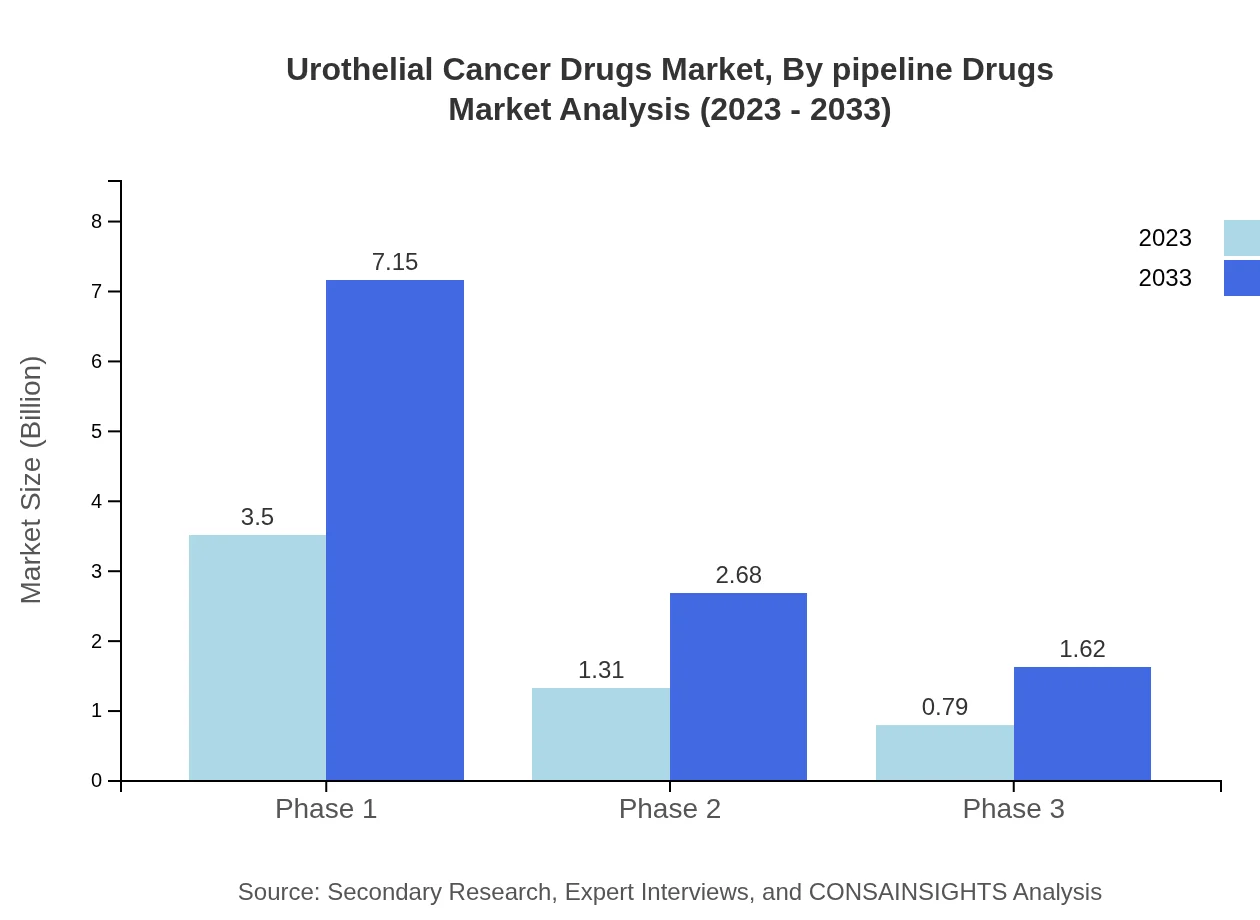
Pipeline drugs targeting novel mechanisms of action show promising potential. As of 2023, ongoing trials for Phase 1, Phase 2, and Phase 3 drugs are at market sizes of $3.50 billion (62.47%), $1.31 billion (23.38%), and $0.79 billion (14.15%) respectively. By 2033, these are forecasted to grow to $7.15 billion, $2.68 billion, and $1.62 billion, emphasizing the robust R&D efforts in developing next-generation therapies.
Urothelial Cancer Drugs Market Analysis By End User
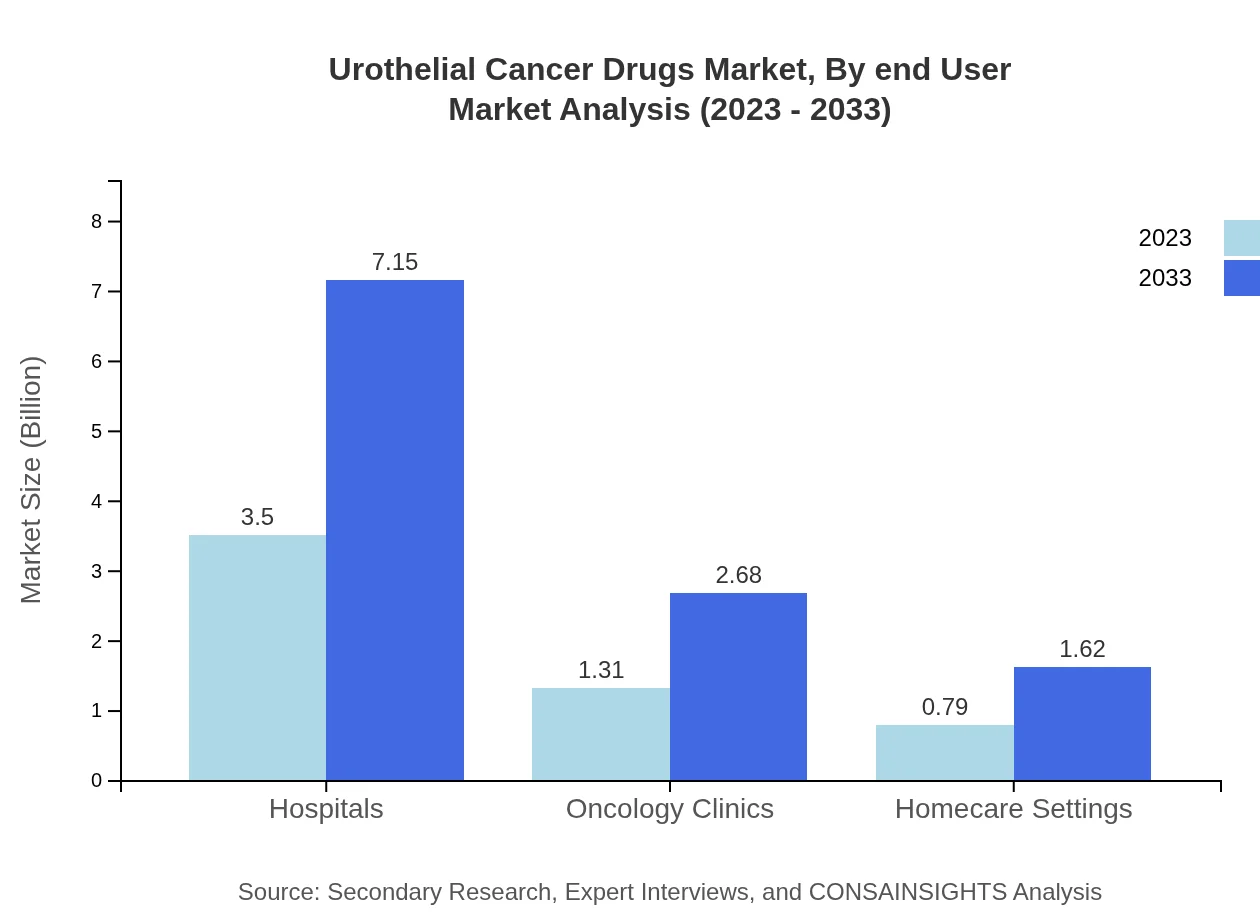
Hospitals dominate the end-user segment, accounting for $3.50 billion (62.47%) in 2023 and expected to grow to $7.15 billion by 2033. Oncology clinics follow with $1.31 billion (23.38%) and are projected to reach $2.68 billion. Homecare settings, currently at $0.79 billion (14.15%), are emerging as a significant channel reflecting patient preference for at-home treatment options.
Urothelial Cancer Drugs Market Trends and Future Forecast
Tell us your focus area and get a customized research report.
Global Market Leaders and Top Companies in Urothelial Cancer Drugs Industry
AstraZeneca:
AstraZeneca is a leading player in the Urothelial Cancer Drugs market, recognized for its groundbreaking immunotherapy, Atezolizumab, which has transformed treatment protocols for advanced bladder cancer.Roche:
Roche develops innovative treatments for bladder cancer, notably transitioning towards personalized medicine that tailors therapy based on genetic profiles of tumors.Merck & Co.:
Merck & Co. is notable for its comprehensive oncology portfolio, including therapies aimed at managing urothelial carcinoma and contributing significantly to clinical research.Bristol Myers Squibb:
Bristol Myers Squibb plays a vital role in the development of targeted therapies for urothelial cancer, focusing on enhancing patient outcomes through innovative solutions.We're grateful to work with incredible clients.









FAQs
What is the market size of the Urothelial Cancer Drugs Market Report in 2023?
The market size for 2023 is $5.60 Billion, reflecting the baseline value used for the 2023 to 2033 forecast period and comparative regional assessments.
How big will the market be in 2033?
By 2033 the market is projected to reach $11.45 Billion, based on the forecast covering 2023 to 2033 and the stated compound annual growth rate of 7.2%.
What is CAGR for the 2023 to 2033 period?
The compound annual growth rate for the 2023 to 2033 forecast period is 7.2%, applied to derive the market trajectory from 2023 to 2033.
Is there a single fastest Growing region in the Urothelial Cancer Drugs Market Report market?
No single fastest-growing region is stated for the Urothelial Cancer Drugs Market Report market because the top regional implied CAGR values are within 0.15 percentage points of each other, making the ranking too close to call reliably.
Which companies are profiled in the report?
Top companies included in the report are AstraZeneca, Roche, Merck & Co., and Bristol Myers Squibb, reflecting active participation in urothelial cancer drug development.
What end users are covered in segmentation?
End-user segments listed are hospitals, oncology clinics, and homecare settings, indicating the primary channels for therapy delivery and patient care.
How are drug types categorized in the report?
Drug-type segmentation includes chemotherapy, immunotherapy, and targeted therapy, highlighting the therapeutic classes evaluated across clinical and commercial stages.
What pipeline stages are examined?
Pipeline segmentation covers Phase 1, Phase 2, and Phase 3 candidates, providing visibility on early and late-stage development activity within the market.
What routes of administration are included?
Routes of administration in the analysis are oral, intravenous, and intravesical, reflecting common delivery methods for urothelial cancer treatments.
Who contributed to the research methodology?
Research incorporated primary interviews with industry experts and secondary sources such as company reports and publications, supplemented by internal validation and triangulation.