

Vaccine Market Report
First published: 21 October 2024 | Last updated: 28 May 2026 | Report Code: vaccine
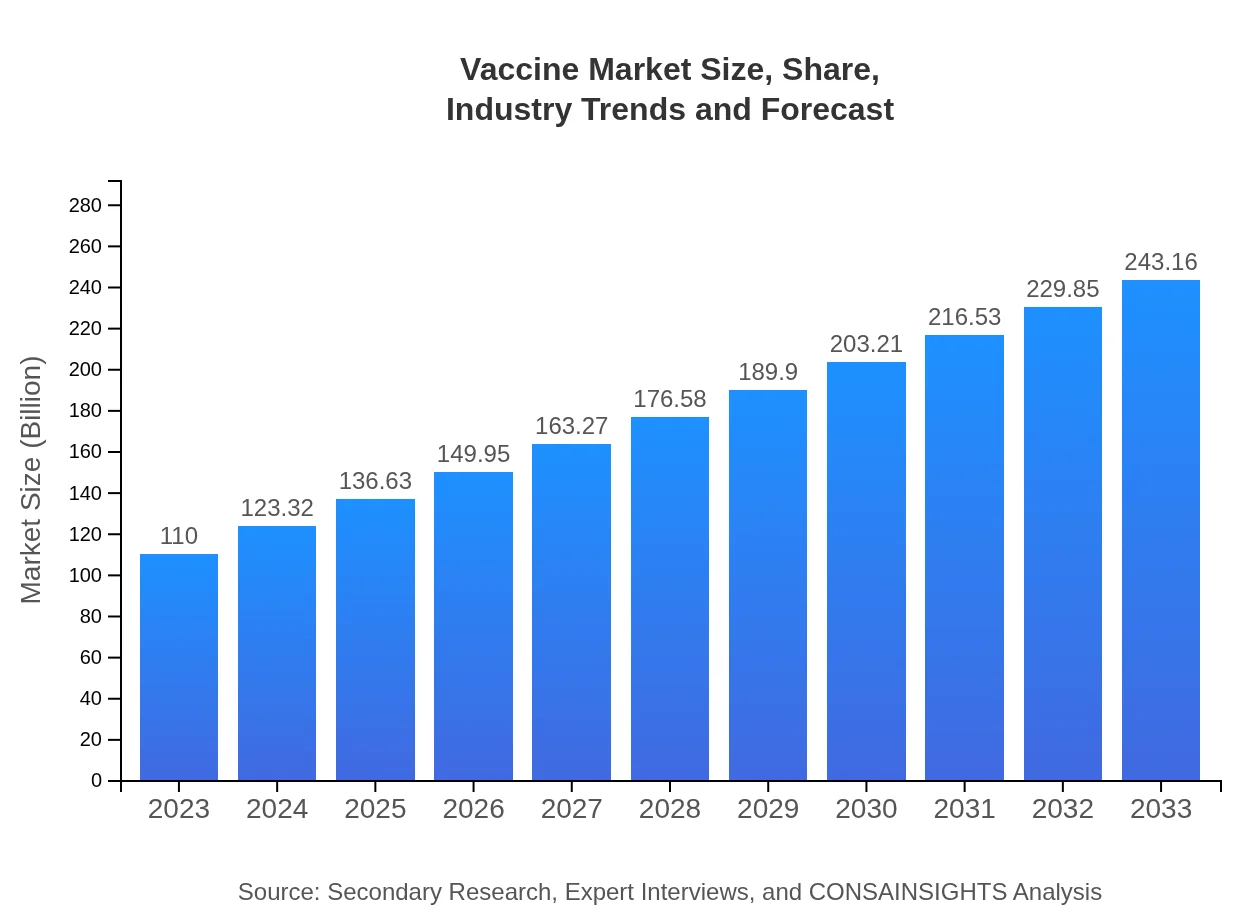
Vaccine Market — USD $110 Billion in 2023, Growing to USD 243.16null by 2033 at 8.0% CAGR
This report provides an in-depth analysis of the global vaccine market, showcasing current conditions, market size, and growth forecasts from 2023 to 2033. It covers various market segments, regional insights, technological advancements, and key players impacting the industry.
Key Takeaways
- Global market expands from $110.00 Billion in 2023 to $243.16 Billion in 2033 at an 8% CAGR.
- North America is largest regional market, while no single fastest-growing region is stated because regional CAGR differences remain within 0.15 percentage points.
- Europe and Asia Pacific show substantial increases: Europe from $31.43 Billion to $69.47 Billion; Asia Pacific from $23.74 Billion to $52.47 Billion.
- Manufacturing innovations such as mRNA and viral vector technologies are primary technological drivers cited in industry analysis.
- Top companies active in the market include Pfizer, Sanofi, Merck & Co., Johnson & Johnson, and AstraZeneca.
Vaccine Market Report — Executive Summary
North America remains largest market by forecast-period value, while no single fastest-growing region is stated because top regional growth rates are separated by less than 0.15 percentage points. The vaccine market is projected to more than double between 2023 and 2033, moving from $110.00 Billion to $243.16 Billion on an 8% CAGR. Growth is supported by sustained demand for infectious disease prevention, investments in biotechnology, and expanding immunization programs. Technological advances—mRNA, recombinant DNA and viral vector platforms—are reshaping product development and manufacturing. The market is structured across disease type, product type, administration route, and manufacturing technique, with established players like Pfizer, Sanofi, Merck & Co., Johnson & Johnson, and AstraZeneca driving R&D. Regional differences influence adoption and capacity expansion, and regulatory and distribution challenges remain key considerations for stakeholders.
Key Growth Drivers
- Rising demand for vaccines targeting infectious diseases and broader immunization campaigns.
- Advances in manufacturing platforms such as mRNA, recombinant DNA and viral vector technologies.
- Increased public and private investment in vaccine R&D and production capacity.
- Regulatory support and global initiatives that promote wider vaccine uptake and distribution.
- Expanded focus on both preventive and therapeutic vaccine development across multiple disease types.
| Metric | Value |
|---|---|
| Study Period | 2023 - 2033 |
| 2023 Market Size | $110.00 Billion |
| CAGR (2023-2033) | 8.0% |
| 2033 Market Size | $243.16 Billion |
| Top Companies | Pfizer , Sanofi, Merck & Co., Johnson & Johnson, AstraZeneca |
| Published Date | 21 October 2024 |
| Last Modified Date | 28 May 2026 |
Vaccine Market Overview
Customize Vaccine Market Report market research report
- ✔ Get in-depth analysis of Vaccine market size, growth, and forecasts.
- ✔ Understand Vaccine's regional dynamics and industry-specific trends.
- ✔ Identify potential applications, end-user demand, and growth segments in Vaccine
What is the Market Size & CAGR of Vaccine Market Report market in 2023?
Vaccine Industry Analysis
Vaccine Market Segmentation and Scope
Tell us your focus area and get a customized research report.
Vaccine Market Report Market Analysis Report by Region
Europe Vaccine Market Report:
Europe grows from $31.43 Billion in 2023 to $69.47 Billion in 2033. Regional expansion is supported by public immunization programs, research investments, and adoption of new manufacturing technologies.Asia Pacific Vaccine Market Report:
Asia Pacific grows from $23.74 Billion in 2023 to $52.47 Billion in 2033. Growth is fueled by rising vaccination coverage, capacity building, and increasing biotech investments across the region.North America Vaccine Market Report:
North America is largest regional market, rising from $36.86 Billion in 2023 to $81.48 Billion in 2033. 86 Billion in 2023 and grows to $81.48 Billion by 2033. As the largest regional market, growth reflects robust demand, manufacturing capacity expansion, and significant industry investment in advanced vaccine platforms.South America Vaccine Market Report:
Latin America grows from $2.72 Billion in 2023 to $6.01 Billion in 2033. 72 Billion in 2023 to $6.01 Billion by 2033. Regional drivers include expanding public health initiatives, improving distribution infrastructure, and broader access to vaccine technologies.Middle East & Africa Vaccine Market Report:
Middle East and Africa grows from $15.26 Billion in 2023 to $33.73 Billion in 2033. 26 Billion in 2023 and is expected to reach $33.73 Billion in 2033. Growth reflects increased immunization efforts, infrastructure development, and adoption of new vaccine modalities.Tell us your focus area and get a customized research report.
Research Methodology
Vaccine Market Analysis By Product Type
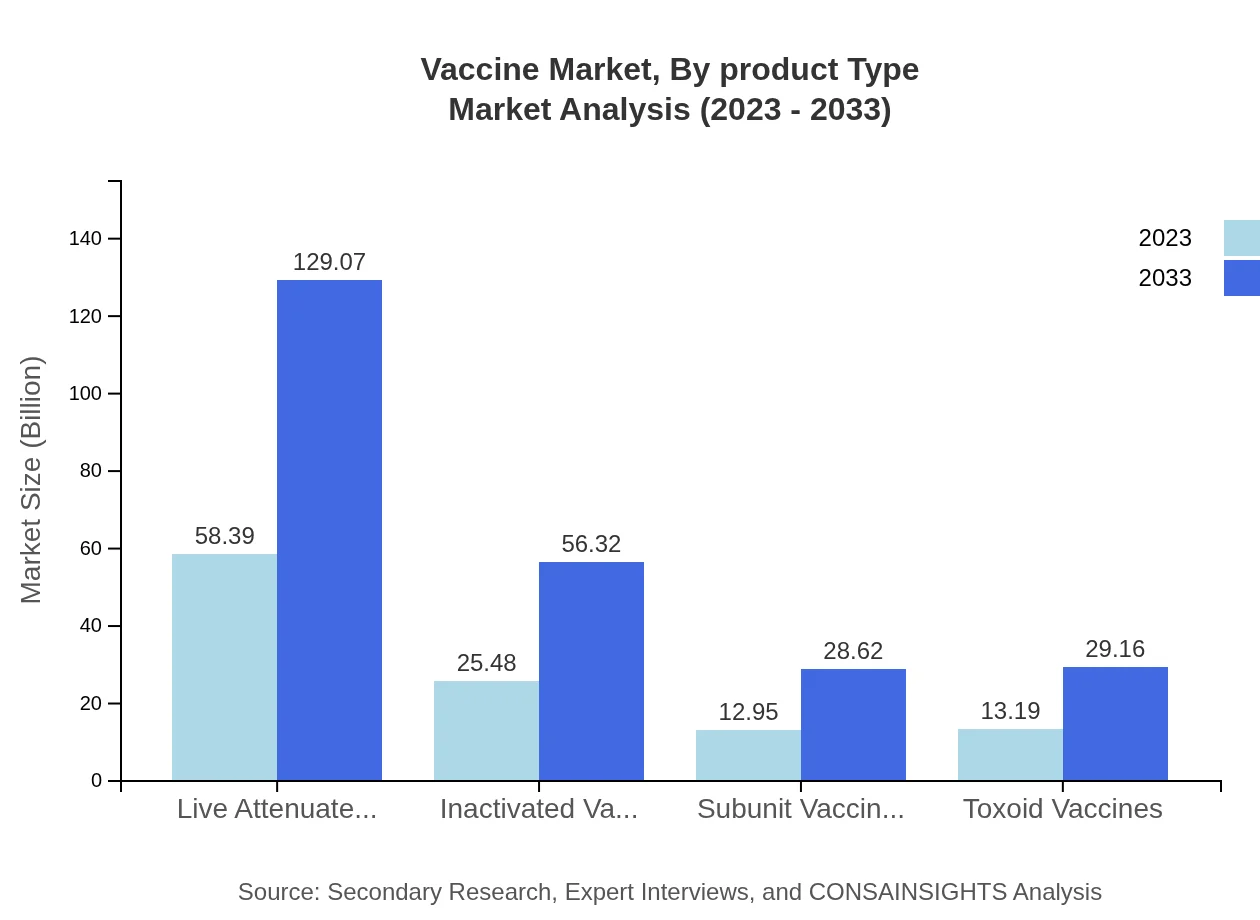
In 2023, the vaccine market by product type is dominated by live attenuated vaccines with a market size of USD 58.39 billion, expected to grow to USD 129.07 billion by 2033, holding a 53.08% market share. Other significant segments include inactivated vaccines at USD 25.48 billion and subunit vaccines at USD 12.95 billion, reflecting the diverse needs for various immunization strategies.
Vaccine Market Analysis By Disease
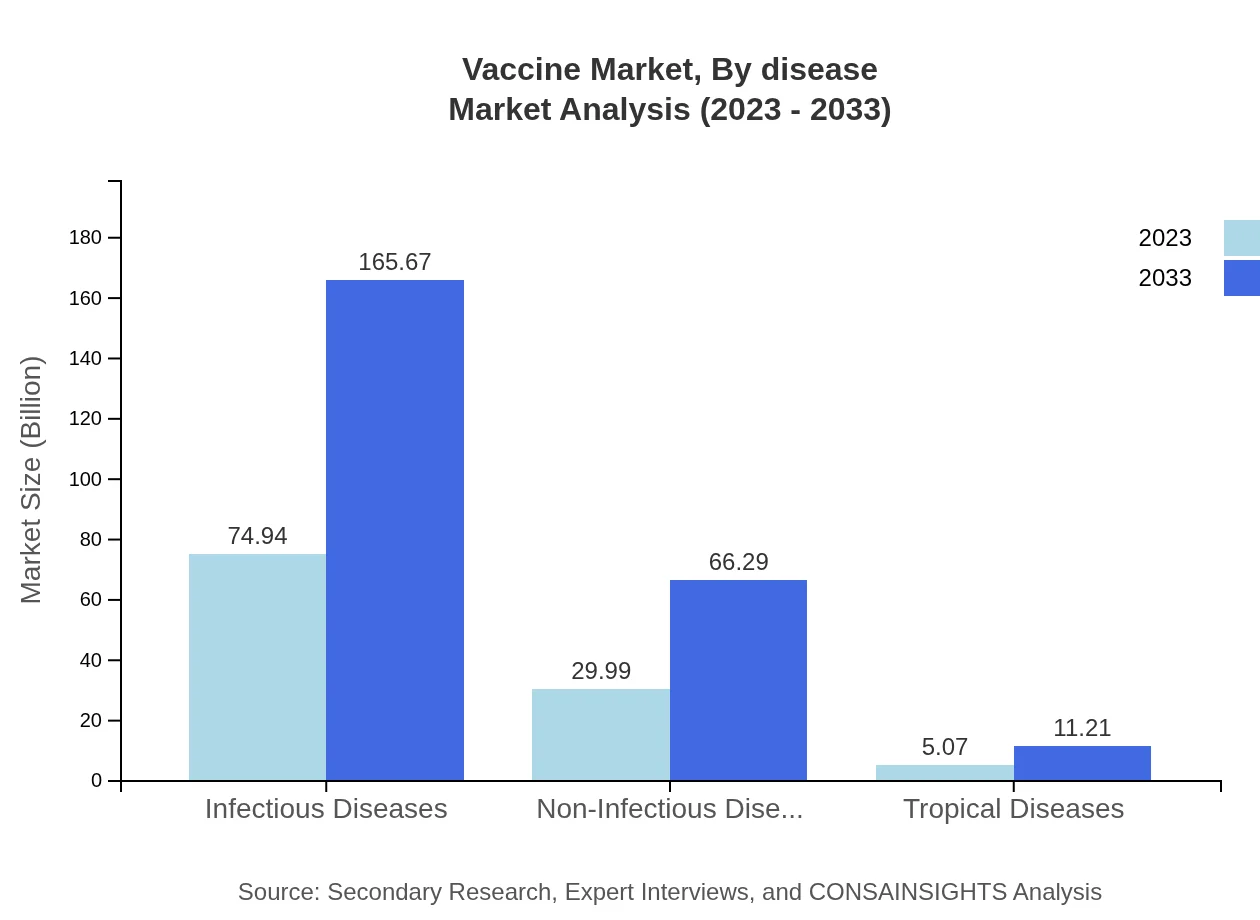
Focusing on infectious diseases, this segment is projected to expand from USD 74.94 billion in 2023 to USD 165.67 billion by 2033, capturing 68.13% of the market share. Conversely, non-infectious diseases, while currently smaller at USD 29.99 billion in 2023, are forecasted to grow significantly to USD 66.29 billion, highlighting the emerging focus on preventing chronic illnesses through vaccination.
Vaccine Market Analysis By Administration Route
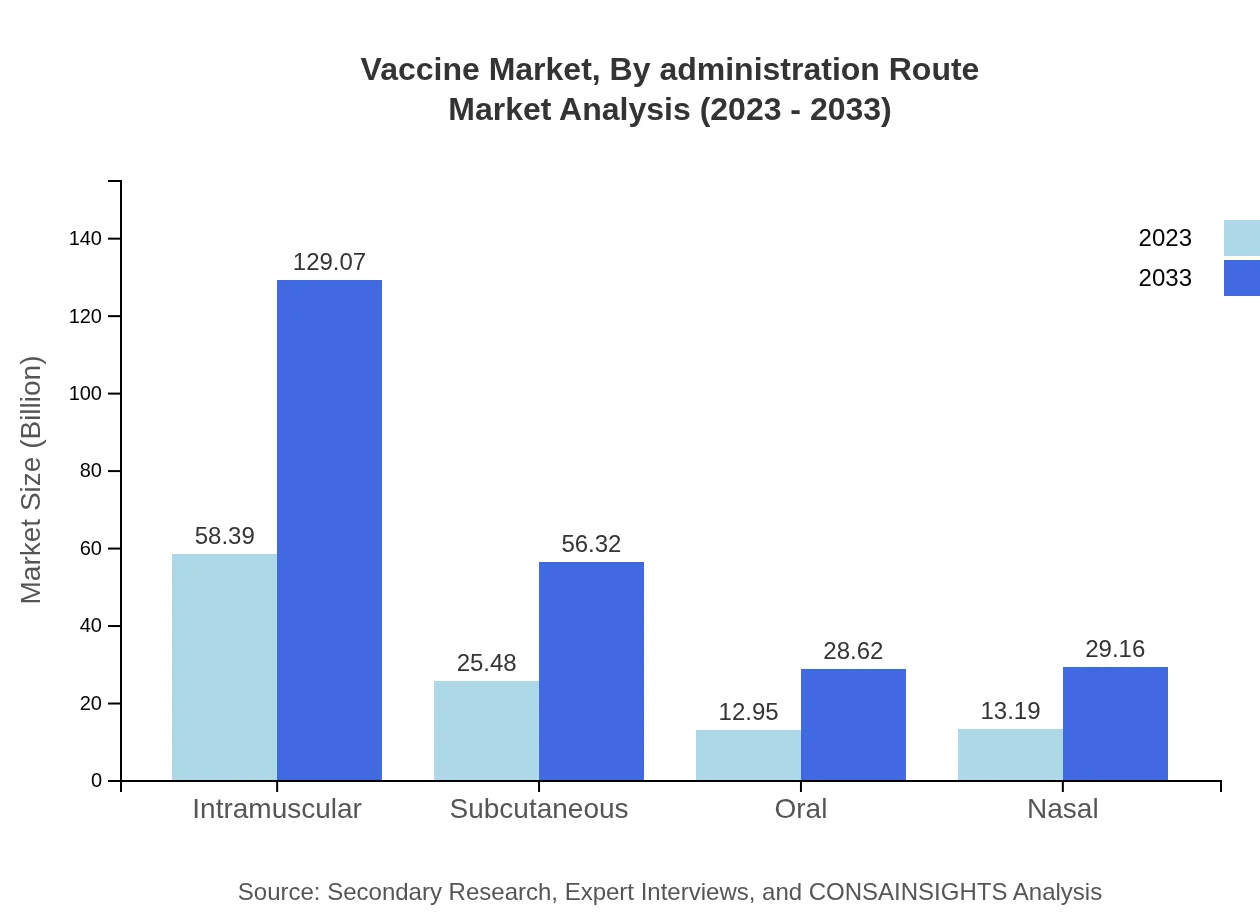
The vaccine administration route analysis reveals intramuscular injections commanding a significant share with USD 58.39 billion in 2023, likely reaching USD 129.07 billion by 2033. Subcutaneous and oral administration routes are also critical segments, reflecting varied preferences and delivery methods for vaccine administration.
Vaccine Market Analysis By Manufacturing Technique
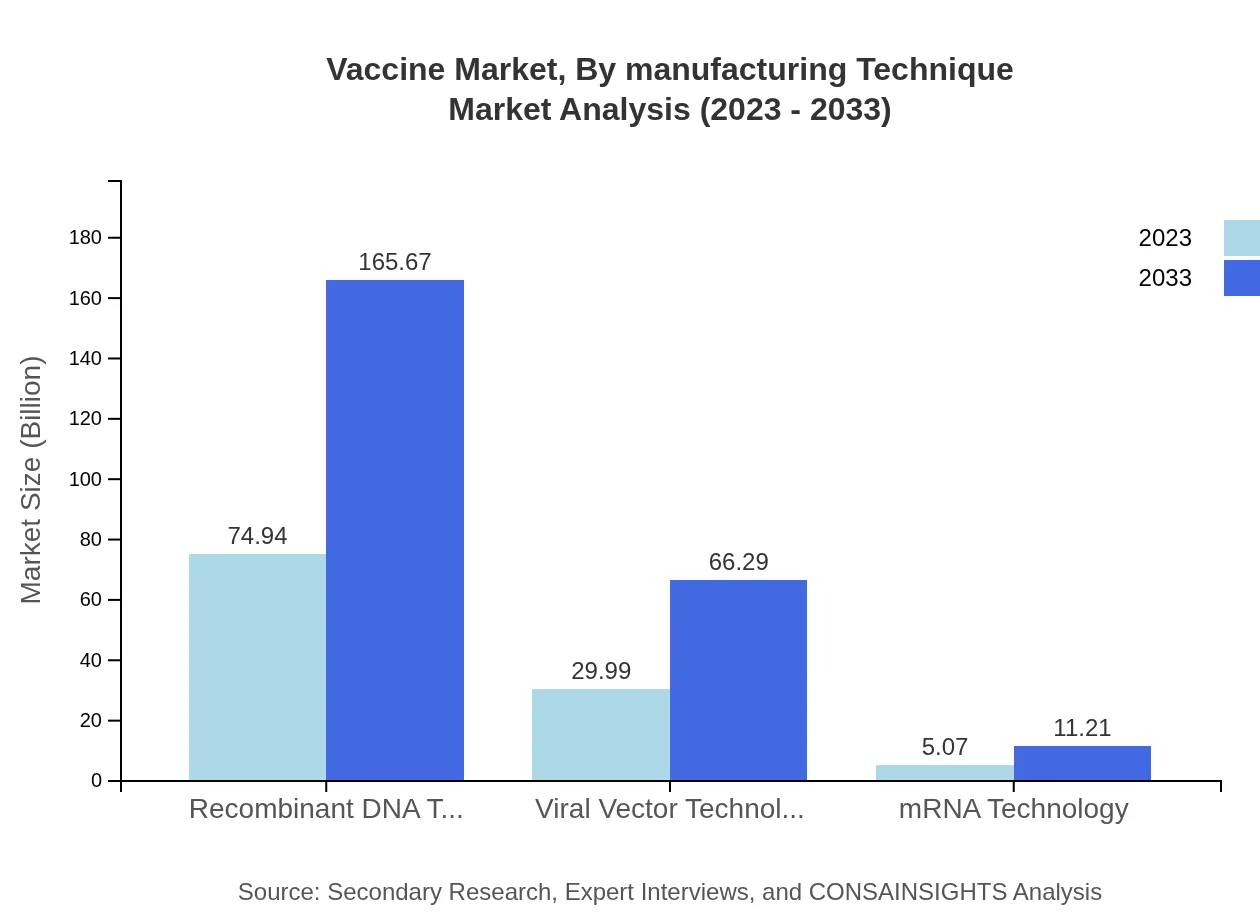
Advancements in manufacturing techniques have led to noteworthy segments in the vaccine market. The recombinant DNA technology segment, as of 2023, is valued at USD 74.94 billion and is expected to double by 2033. Viral vector technology is also seeing significant growth, increasing from USD 29.99 billion to USD 66.29 billion over the same period, emphasizing the innovation driving this industry forward.
Vaccine Market Trends and Future Forecast
Tell us your focus area and get a customized research report.
Global Market Leaders and Top Companies in Vaccine Industry
Pfizer :
Pfizer is a leading biopharmaceutical company engaged in the development and manufacturing of a broad range of vaccines, including its widely-known COVID-19 vaccine. They invest heavily in R&D to sustain their market leadership and innovate for future health challenges.Sanofi:
Sanofi, a global healthcare leader, has a strong foothold in the vaccine sector, particularly in pediatric vaccines. Their commitment to public health and continuous innovation plays a crucial role in maintaining their market position.Merck & Co.:
Merck & Co. is recognized for its comprehensive portfolio of vaccines and commitment to infectious disease prevention. They focus on innovative technologies to enhance vaccine efficacy and broaden their market presence.Johnson & Johnson:
Johnson & Johnson is known for its terrestrial vaccine production, including the development of vaccines targeting viral diseases. Their diversified healthcare strategies facilitate their strong position in the global vaccine market.AstraZeneca:
AstraZeneca has emerged as a vital contributor to the global vaccination effort, particularly in response to the COVID-19 pandemic, with its vaccine becoming a leading option in many countries.We're grateful to work with incredible clients.









FAQs
What is the current market size of the vaccine market?
The market size for 2023 is $110.00 Billion, as reported. This figure represents the global market baseline used for the 2023 to 2033 forecast period.
How big will the vaccine market be by 2033?
By 2033 the market is projected to reach $243.16 Billion, reflecting anticipated growth over the 2023 to 2033 forecast period based on provided market projections.
What is CAGR of the vaccine market over the forecast period?
The compound annual growth rate reported for the 2023 to 2033 period is 8%, which underpins the expansion from $110.00 Billion to $243.16 Billion.
Is there a single fastest Growing region in the Vaccine Market Report market?
No single fastest-growing region is stated for the Vaccine Market Report market because the top regional implied CAGR values are within 0.15 percentage points of each other, making the ranking too close to call reliably.
Which companies lead the vaccine market?
Top companies listed for the market include Pfizer, Sanofi, Merck & Co., Johnson & Johnson, and AstraZeneca as key industry participants.
What are major technological trends shaping the market?
Noted technologies driving change include mRNA, recombinant DNA and viral vector techniques, which influence product pipelines and manufacturing approaches.
How big is the Europe vaccine market in 2023 and 2033?
Europe is reported at $31.43 Billion in 2023 and is expected to reach $69.47 Billion by 2033, indicating regional expansion over the forecast period.
What is the role of manufacturing innovation in growth?
Manufacturing innovations increase production efficiency and support new vaccine modalities, helping to scale supply to meet demand and accelerate development timelines.
Which regions are covered in the regional analysis?
The analysis includes North America, Europe, Asia Pacific, Latin America, and Middle East and Africa with specific start and end values provided for each region.
Why is a fastest Growing region not named?
A regional growth market is not specified because top regional growth rates are within 0.15 percentage points, preventing designation of a single fastest-growing area.