

Acute Ischemic Stroke Diagnosis Market Report
First published: 20 October 2024 | Last updated: 25 May 2026 | Report Code: acute-ischemic-stroke-diagnosis
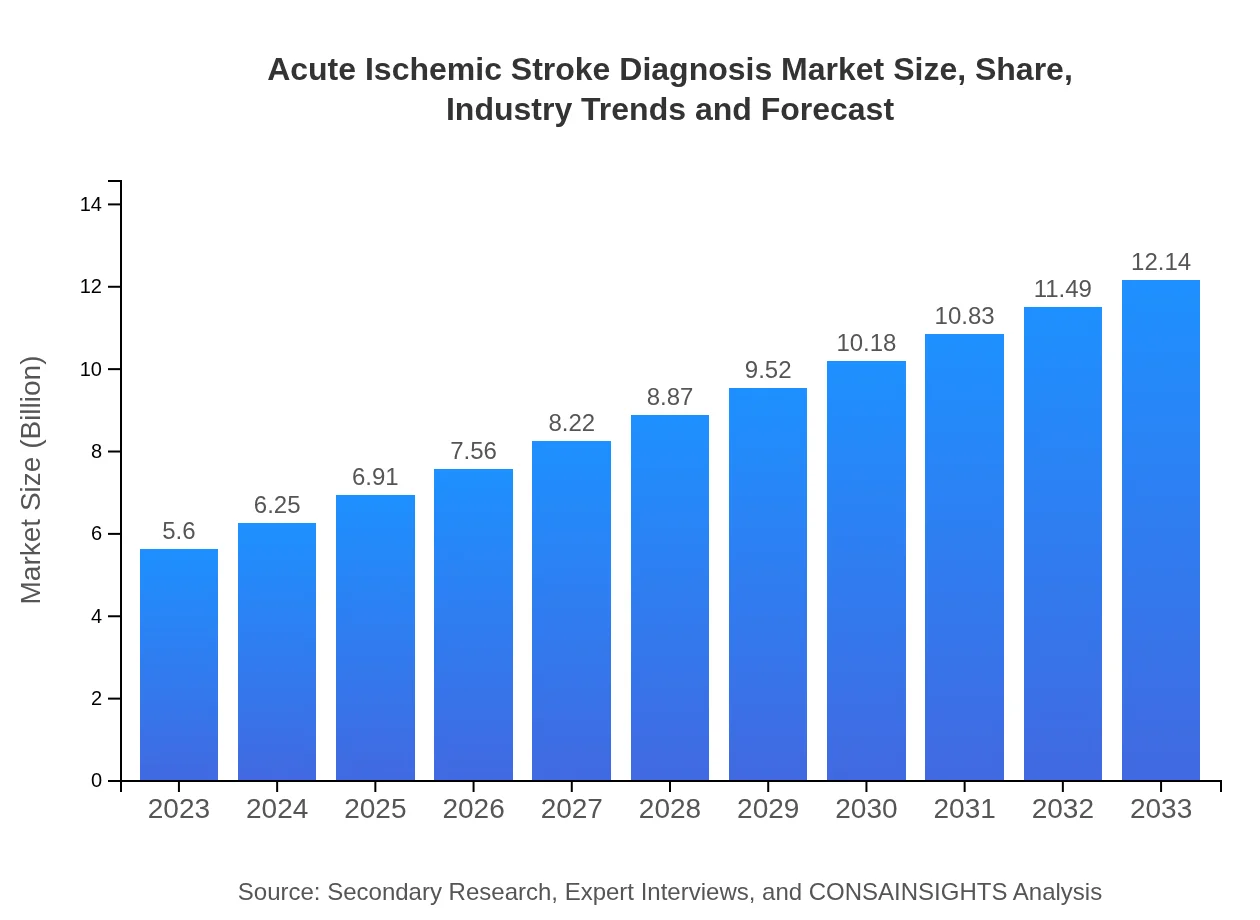
Acute Ischemic Stroke Diagnosis Market — USD 5.6 billion in 2023, Growing to USD 12.14B by 2033 at 7.8% CAGR
This report offers a comprehensive analysis of the Acute Ischemic Stroke Diagnosis market, including current market trends, segmentation, insights across various regions, technology advancements, and a forward-looking forecast for the years 2023 to 2033.
Key Takeaways
- Global market expands from $5.60 Billion in 2023 to $12.14 Billion by 2033, reflecting a 7.8% CAGR for 2023 to 2033.
- North America is largest regional market, while no single fastest-growing region is stated because regional CAGR differences remain within 0.15 percentage points.
- Europe grows from $1.51 Billion in 2023 to $3.28 Billion in 2033; Asia Pacific increases from $1.13 Billion to $2.45 Billion.
- Top companies shaping the sector include GE Healthcare, Siemens Healthineers, Philips Healthcare, Abbott Laboratories, and Roche Diagnostics.
- Segment breadth spans advanced imaging, point-of-care testing, hospitals, diagnostic centers, research institutes, and patient types across adults and pediatrics.
Acute Ischemic Stroke Diagnosis Market Report — Executive Summary
North America remains largest market by forecast-period value, while no single fastest-growing region is stated because top regional growth rates are separated by less than 0.15 percentage points. The Acute Ischemic Stroke Diagnosis market is positioned for meaningful expansion, moving from $5.60 Billion in 2023 to $12.14 Billion in 2033 at a 7.8% CAGR for 2023 to 2033. Growth is driven by improved imaging capabilities, emphasis on early detection, and higher investments in diagnostic R&D. The landscape includes neuroimaging, laboratory testing, clinical evaluation and point-of-care modalities, with hospitals, diagnostic centers and research institutes as principal end users. Regional dynamics show North America as the largest market, supported by advanced infrastructure and strong adoption of imaging technologies. Europe, Asia Pacific, Latin America and Middle East & Africa each record notable increases using the same diagnostic mix. Major suppliers such as GE Healthcare, Siemens Healthineers, Philips Healthcare, Abbott Laboratories and Roche Diagnostics are central to product development and commercialization. The report highlights market structure, technology segmentation and provider strategies, offering stakeholders a grounded view of market drivers, adoption patterns, and competitive positioning through the forecast period.
Key Growth Drivers
- Advances in imaging technologies, including CT and MRI modalities, increasing diagnostic accuracy and speed.
- Rising investment in diagnostic research and development by major medical device and diagnostics companies.
- Growing emphasis on early intervention and rapid triage to improve patient outcomes after acute ischemic stroke.
- Expansion of point-of-care testing and laboratory diagnostics that accelerate decision-making in hospitals and emergency settings.
- Demographic shifts and rising incidence of stroke prompting broader screening and diagnostic demand globally.
| Metric | Value |
|---|---|
| Study Period | 2023 - 2033 |
| 2023 Market Size | $5.60 Billion |
| CAGR (2023-2033) | 7.8% |
| 2033 Market Size | $12.14 Billion |
| Top Companies | GE Healthcare, Siemens Healthineers, Philips Healthcare, Abbott Laboratories, Roche Diagnostics |
| Published Date | 20 October 2024 |
| Last Modified Date | 25 May 2026 |
Acute Ischemic Stroke Diagnosis Market Overview
Customize Acute Ischemic Stroke Diagnosis Market Report market research report
- ✔ Get in-depth analysis of Acute Ischemic Stroke Diagnosis market size, growth, and forecasts.
- ✔ Understand Acute Ischemic Stroke Diagnosis's regional dynamics and industry-specific trends.
- ✔ Identify potential applications, end-user demand, and growth segments in Acute Ischemic Stroke Diagnosis
What is the Market Size & CAGR of Acute Ischemic Stroke Diagnosis Market Report market in 2023?
Acute Ischemic Stroke Diagnosis Industry Analysis
Acute Ischemic Stroke Diagnosis Market Segmentation and Scope
Tell us your focus area and get a customized research report.
Acute Ischemic Stroke Diagnosis Market Report Market Analysis Report by Region
Europe Acute Ischemic Stroke Diagnosis Market Report:
Europe grows from $1.51 Billion in 2023 to $3.28 Billion in 2033. Expansion is supported by widespread adoption of neuroimaging, increasing investment in stroke diagnosis, and clinical protocols emphasizing early detection and treatment.Asia Pacific Acute Ischemic Stroke Diagnosis Market Report:
Asia Pacific grows from $1.13 Billion in 2023 to $2.45 Billion in 2033. Regional gains are linked to expanding healthcare access, rising diagnostic capacity, and growing deployment of imaging and point-of-care solutions in hospitals and clinics.North America Acute Ischemic Stroke Diagnosis Market Report:
North America is largest regional market, rising from $2.08 Billion in 2023 to $4.5 Billion in 2033. 08 Billion in 2023 and rises to $4.5 Billion in 2033. The region’s scale reflects robust imaging infrastructure, strong hospital adoption of advanced diagnostic systems, and substantial vendor presence driving technology uptake.South America Acute Ischemic Stroke Diagnosis Market Report:
Latin America grows from $0.46 Billion in 2023 to $1 Billion in 2033. 46 Billion in 2023 and grows to $1 Billion in 2033. Market enlargement is driven by increasing healthcare investment, broader availability of diagnostic services, and gradual adoption of advanced imaging modalities.Middle East & Africa Acute Ischemic Stroke Diagnosis Market Report:
Middle East and Africa grows from $0.42 Billion in 2023 to $0.91 Billion in 2033. Growth factors include improving diagnostic infrastructure, targeted healthcare funding, and gradual uptake of laboratory and imaging technologies.Tell us your focus area and get a customized research report.
Research Methodology
Acute Ischemic Stroke Diagnosis Market Analysis By Diagnosis Method
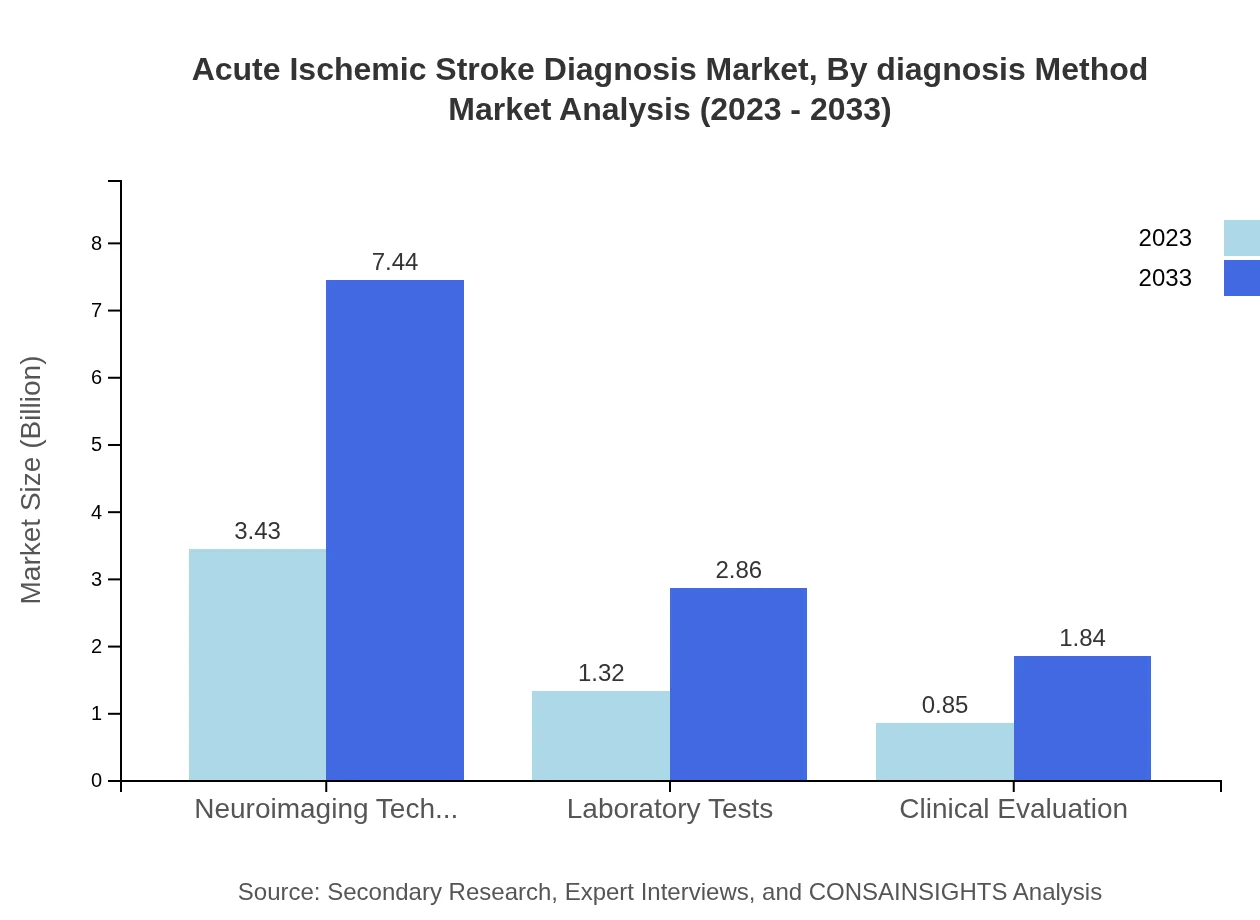
Neuroimaging techniques, including advanced CT and MRI scans, dominate the market with a substantial share estimated at 61.25% in 2023, set to maintain this level through 2033. Laboratory tests and clinical evaluations also contribute significantly but at relatively lower shares. The emphasis on advanced imaging technologies is indicative of the market's direction towards precision medicine.
Acute Ischemic Stroke Diagnosis Market Analysis By Technology
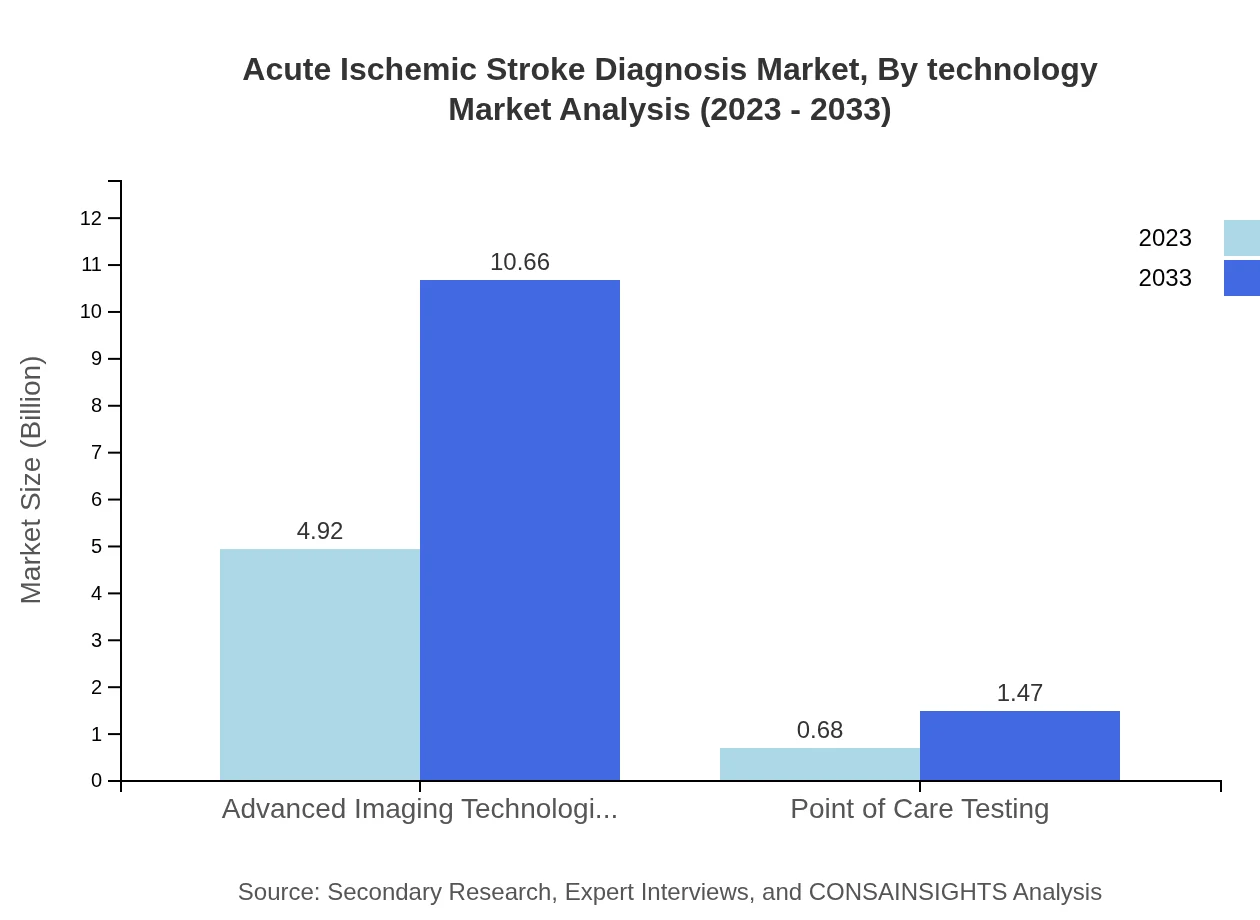
Advanced imaging technologies are anticipated to hold an 87.85% market share in 2023, with growth expected as new modalities are developed. Point of care testing, although smaller in scale, is crucial for immediate care settings, projected to grow from 0.68 billion to 1.47 billion through 2033, reflecting advances in rapid diagnostic protocols.
Acute Ischemic Stroke Diagnosis Market Analysis By End User
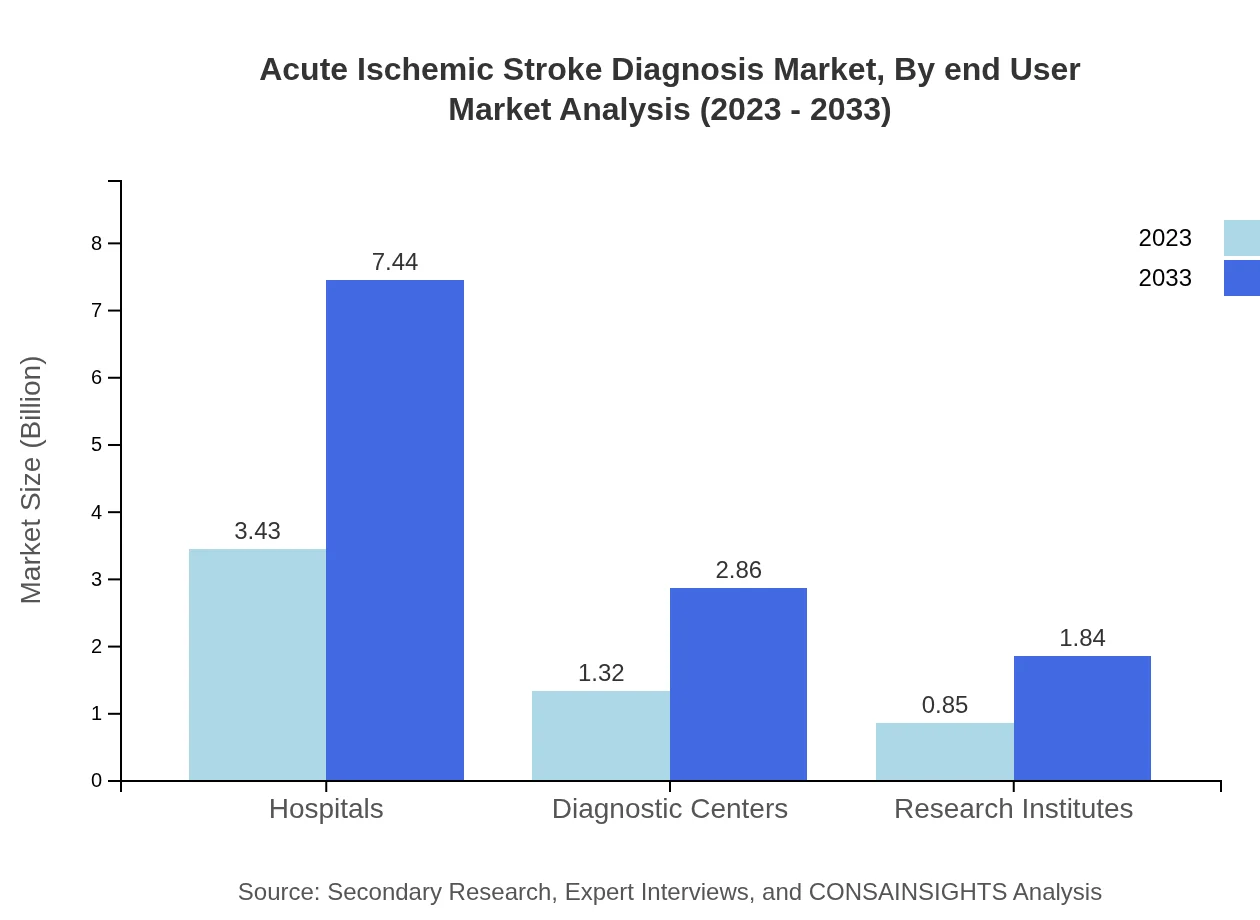
Hospitals comprise the largest segment in the Acute Ischemic Stroke Diagnosis market, accounting for 61.25% of the market share in 2023, projected to grow to 61.25% by 2033. Diagnostic centers and research institutions are crucial as they focus on developing new diagnostic methodologies, sharing 23.58% and 15.17% of the market respectively.
Acute Ischemic Stroke Diagnosis Market Analysis By Patient Type
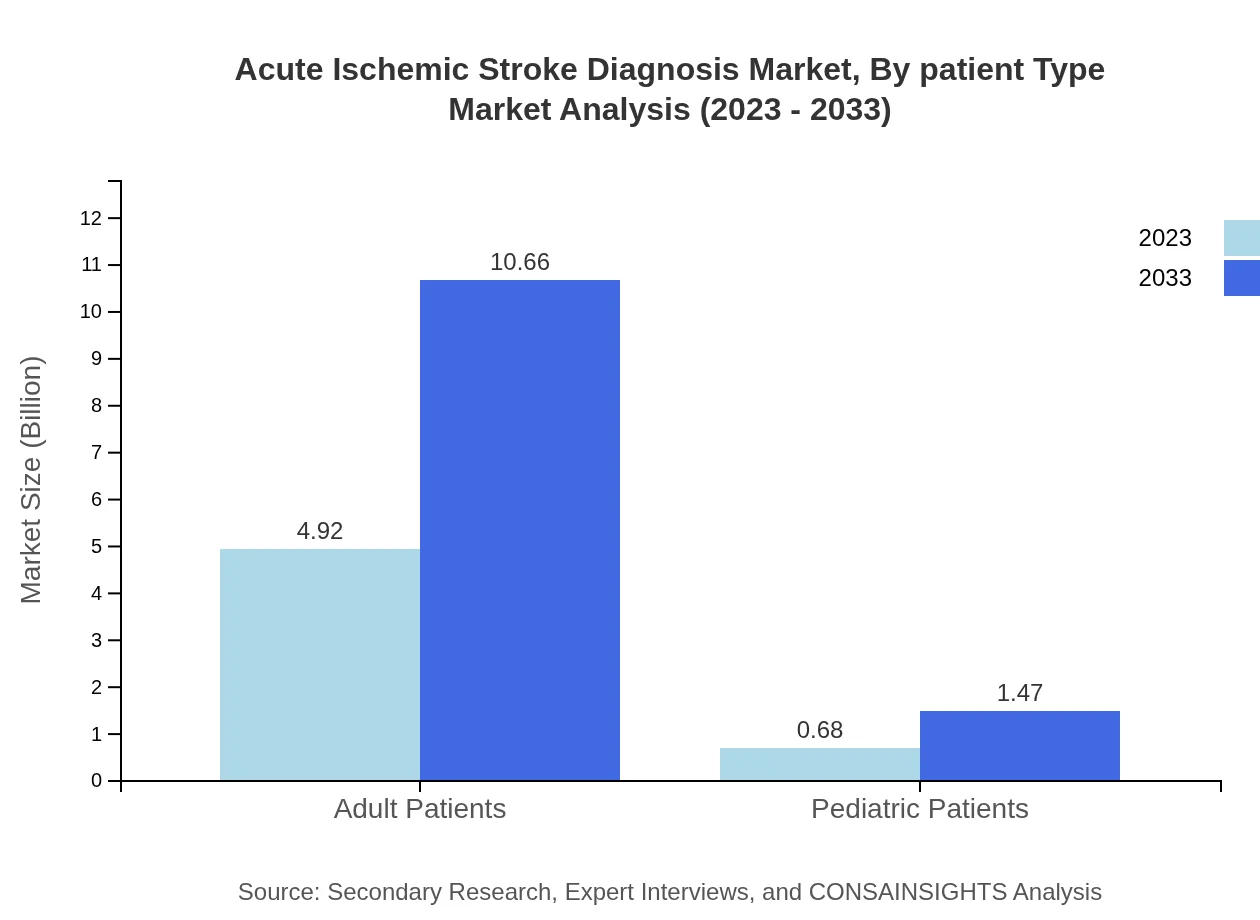
Adult patients represent the majority share in the market at 87.85% in 2023, projected to remain stable through 2033. Pediatric patients, while smaller at 12.15%, show significant growth potential as awareness improves among caregivers and healthcare providers.
Acute Ischemic Stroke Diagnosis Market Trends and Future Forecast
Tell us your focus area and get a customized research report.
Global Market Leaders and Top Companies in Acute Ischemic Stroke Diagnosis Industry
GE Healthcare:
GE Healthcare is a leading innovator in medical imaging technologies and healthcare solutions. Their advancements have significantly impacted stroke diagnostics and treatment.Siemens Healthineers:
Siemens Healthineers is renowned for developing cutting-edge tools for radiology and medical imaging, contributing to faster and more accurate stroke diagnoses.Philips Healthcare:
Philips Healthcare provides advanced diagnostic imaging solutions and has been pivotal in enhancing stroke management through innovative technologies.Abbott Laboratories:
Abbott Laboratories is focused on developing efficient diagnostic tests that provide quick results, which are critical in stroke settings.Roche Diagnostics:
Roche Diagnostics specializes in diagnostic tests and is instrumental in developing new biomarkers for stroke detection, driving innovation in the field.We're grateful to work with incredible clients.








FAQs
What is the market size of the Acute Ischemic Stroke Diagnosis market in 2023?
The market size for 2023 is $5.60 Billion, as stated for the base year in the report and used as the starting reference for the 2023 to 2033 forecast period.
What is the projected market value in 2033?
The market is projected to reach $12.14 Billion by 2033, reflecting the end-point valuation provided for the 2023 to 2033 forecast horizon.
What is CAGR for the forecast period?
The reported compound annual growth rate (CAGR) for the market across 2023 to 2033 is 7.8%, as specified for the forecast interval.
Is there a single fastest Growing region in the Acute Ischemic Stroke Diagnosis Market Report market?
No single fastest-growing region is stated for the Acute Ischemic Stroke Diagnosis Market Report market because the top regional implied CAGR values are within 0.15 percentage points of each other, making the ranking too close to call reliably.
Which companies are named as key players?
The report lists GE Healthcare, Siemens Healthineers, Philips Healthcare, Abbott Laboratories and Roche Diagnostics as leading companies active in this market.
Why is early detection emphasized for acute ischemic stroke?
Early detection improves treatment window and outcomes; faster diagnostics enable timely interventions, which is a primary rationale for investment in imaging and point-of-care testing.
What are the main diagnostic modalities covered?
The market encompasses neuroimaging techniques, laboratory tests and clinical evaluation methods, alongside point-of-care testing and advanced imaging technologies.
Who are the primary end users of diagnostic solutions?
Primary end users include hospitals, diagnostic centers and research institutes, which drive demand for imaging systems, lab assays and clinical decision tools.
How big is the Europe market in 2023 and 2033?
Europe is reported at $1.51 Billion in 2023 and grows to $3.28 Billion in 2033, reflecting regional expansion of diagnostic adoption.
What is the market size for Asia Pacific in 2023 and 2033?
Asia Pacific is listed at $1.13 Billion in 2023 and is projected to reach $2.45 Billion in 2033 per the regional facts provided.