
Reports >
Life Sciences
>
Ai In Pharmaceutical Industry

Ai In Pharmaceutical Industry
First published: 20 May 2025 | Last updated: 25 May 2026 | Report Code: ai-in-pharmaceutical-industry
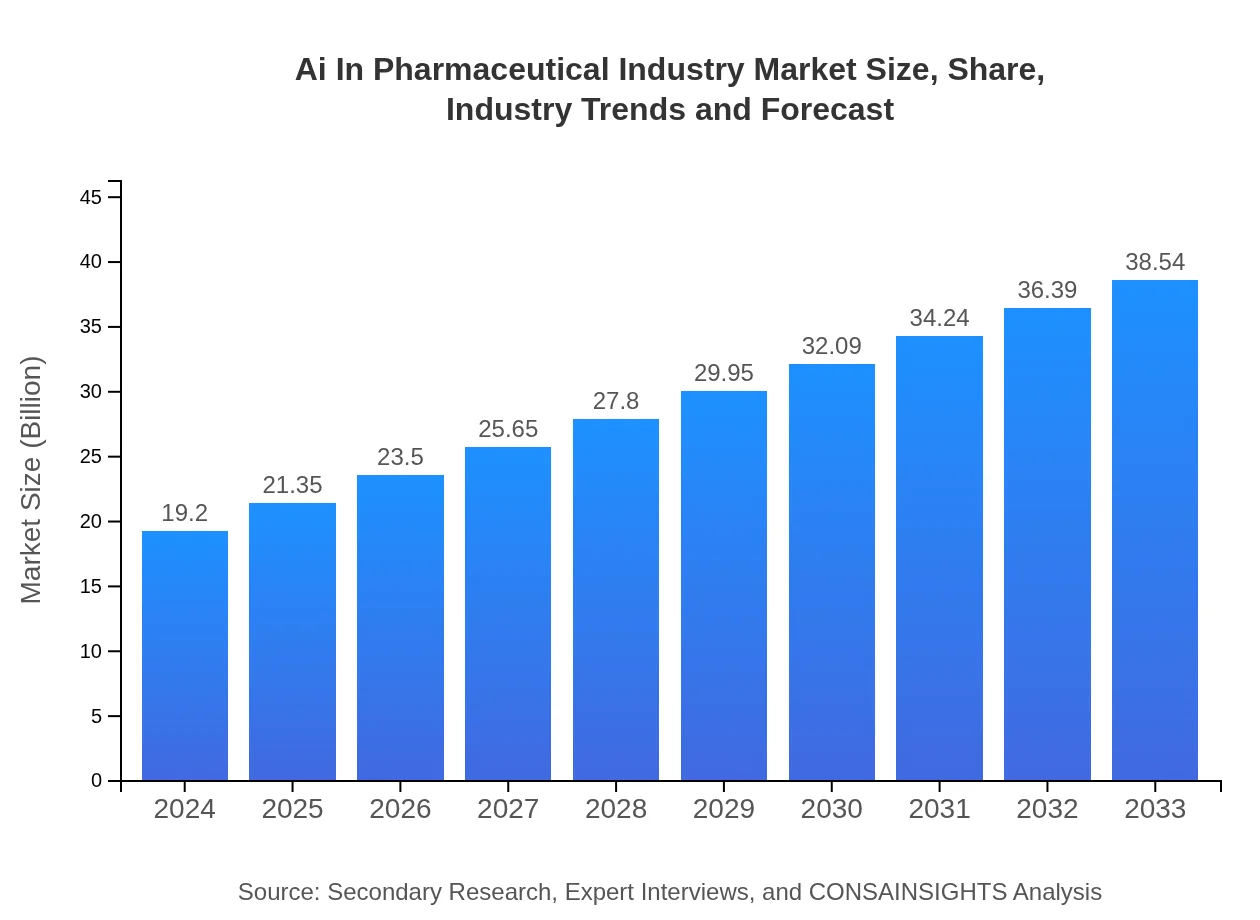
Ai In Pharmaceutical Industry Market — USD $19.2 Billion in 2024, Growing to USD 38.54null by 2033 at 7.8% CAGR
This comprehensive report provides an in-depth analysis of the Ai in Pharmaceutical Industry market over the forecast period 2024 to 2033. It covers critical insights on market size, regional performance, segmentation across applications, and technology trends. The analysis includes competitive dynamics and future growth challenges, offering stakeholders a clear perspective on upcoming market developments.
Key Takeaways
- Global market value is $19.20 Billion in 2024 and is expected to reach $38.54 Billion by 2033.
- North America is largest regional market, while no single fastest-growing region is stated because regional CAGR differences remain within 0.15 percentage points.
- Projected CAGR for the forecast period 2024 to 2033 is 7.8%, reflecting steady expansion across applications.
- North America is identified as the largest region, rising from $6.69 Billion in 2024 to $13.44 Billion in 2033.
- Regional growth is broad-based with Europe moving from $6.02 Billion to $12.08 Billion and Asia Pacific from $3.63 Billion to $7.3 Billion.
- Key participants include Pfizer and Novartis, with adoption across pharmaceutical companies, biotech firms, CROs, and regulatory agencies.
Ai In Pharmaceutical Industry — Executive Summary
North America remains largest market by forecast-period value, while no single fastest-growing region is stated because top regional growth rates are separated by less than 0.15 percentage points. The Ai In Pharmaceutical Industry market is advancing as organizations adopt data-driven tools across drug discovery, clinical trials, manufacturing, and supply chain operations. Market size increases from $19.20 Billion in 2024 to $38.54 Billion in 2033 at a 7.8% CAGR for 2024 to 2033. Growth is supported by higher R&D investment, improved data processing, and expanded pilot programs that validate predictive analytics and personalized treatment algorithms. North America is the largest regional market, while regional growth is notable across Europe, Asia Pacific, Latin America, and Middle East and Africa. Adoption spans pharmaceutical companies, biotech firms, contract research organizations, and regulatory agencies. Leading companies such as Pfizer and Novartis are active in deploying AI solutions, and trends include enhanced collaboration between stakeholders, greater focus on regulatory alignment, and concentration on operational efficiency gains. This report synthesizes primary interviews, secondary sources, and expert analyses to map opportunities and adoption pathways.
Key Growth Drivers
- Increasing R&D investment enabling AI-supported drug discovery and candidate screening.
- Expanded use of predictive analytics to streamline clinical trials and reduce time-to-market.
- Adoption of AI in manufacturing and supply chain management to improve efficiency and traceability.
- Stronger collaboration among pharmaceutical companies, biotech firms, CROs, and regulatory agencies.
- Improved data-processing capabilities and algorithmic personalization supporting treatment development.
| Metric | Value |
|---|---|
| Study Period | 2024 - 2033 |
| 2024 Market Size | $19.20 Billion |
| CAGR (2024-2033) | 7.8% |
| 2033 Market Size | $38.54 Billion |
| Top Companies | Pfizer, Novartis |
| Published Date | 20 May 2025 |
| Last Modified Date | 25 May 2026 |
Ai In Pharmaceutical Industry Market Overview
Customize Ai In Pharmaceutical Industry market research report
- ✔ Get in-depth analysis of Ai In Pharmaceutical Industry market size, growth, and forecasts.
- ✔ Understand Ai In Pharmaceutical Industry's regional dynamics and industry-specific trends.
- ✔ Identify potential applications, end-user demand, and growth segments in Ai In Pharmaceutical Industry
What is the Market Size & CAGR of Ai In Pharmaceutical Industry market in 2024?
Ai In Pharmaceutical Industry Industry Analysis
Ai In Pharmaceutical Industry Market Segmentation and Scope
Tell us your focus area and get a customized research report.
Ai In Pharmaceutical Industry Market Analysis Report by Region
Europe Ai In Pharmaceutical Industry:
Europe grows from $6.02 Billion in 2024 to $12.08 Billion in 2033. Growth is supported by collaborative research networks, regulatory initiatives enabling pilot programs, and investments in AI-enabled clinical and manufacturing applications.Asia Pacific Ai In Pharmaceutical Industry:
Asia Pacific grows from $3.63 Billion in 2024 to $7.3 Billion in 2033. Expansion reflects rising R&D activity, increased digital infrastructure investments, and growing adoption of AI for clinical development and supply chain optimization.North America Ai In Pharmaceutical Industry:
North America is largest regional market, rising from $6.69 Billion in 2024 to $13.44 Billion in 2033. Regional adoption is propelled by concentrated R&D investment, established biotech clusters, and early deployment of AI-driven drug discovery and clinical trial platforms.South America Ai In Pharmaceutical Industry:
Latin America grows from $0.24 Billion in 2024 to $0.47 Billion in 2033. Market progress is tied to targeted deployments of AI in pharmaceutical operations, growing interest from multinational firms, and pilot projects in clinical research.Middle East & Africa Ai In Pharmaceutical Industry:
Middle East and Africa grows from $2.62 Billion in 2024 to $5.26 Billion in 2033. Drivers include investment in healthcare digitization, adoption of analytics for patient monitoring, and initiatives to modernize manufacturing and supply chain practices.Tell us your focus area and get a customized research report.
Research Methodology
Ai In Pharmaceutical Industry Market Analysis By Application
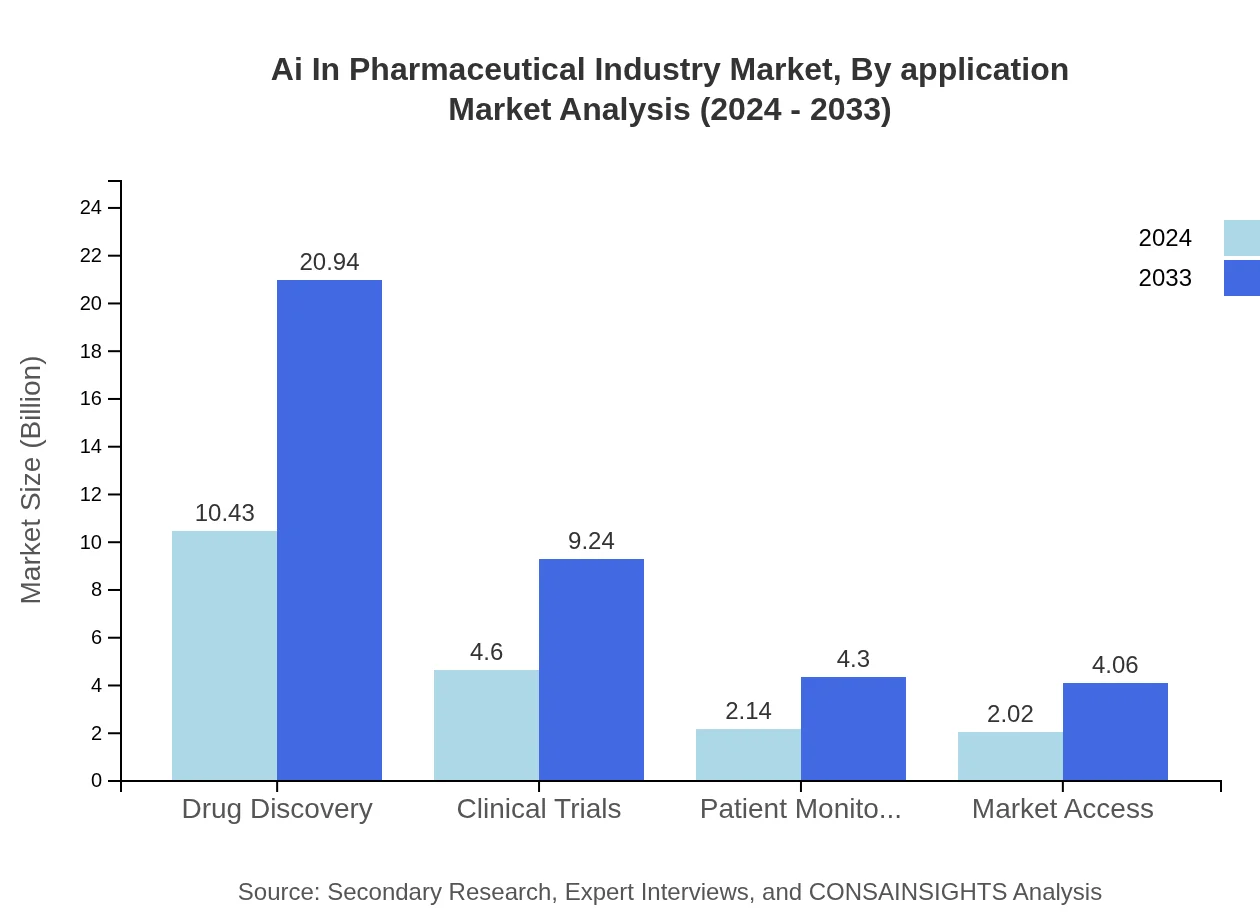
The by-application segment in the pharmaceutical industry captures the diverse applications where AI is being implemented. It amalgamates areas such as Research and Development, Manufacturing, Sales and Marketing, and Supply Chain Management. For instance, the Research and Development segment has shown significant promise, with market sizes reflecting a substantial growth from USD 10.43 billion in 2024 to USD 20.94 billion in 2033, and holding a stable market share of 54.34%. Similarly, the Manufacturing segment’s performance, growing from USD 4.60 billion to USD 9.24 billion, indicates a robust integration of AI-driven robotics and analytics. Sales and Marketing, supported by digital campaign optimizations and customer behavior analytics, and Supply Chain Management, boosted by logistics and inventory management AI tools, further drive the overall market potential. This segmentation underscores the versatility and application-specific impact that AI brings to the pharmaceutical industry, facilitating enhanced operational efficiency and more precise clinical outcomes.
Ai In Pharmaceutical Industry Market Analysis By Technology
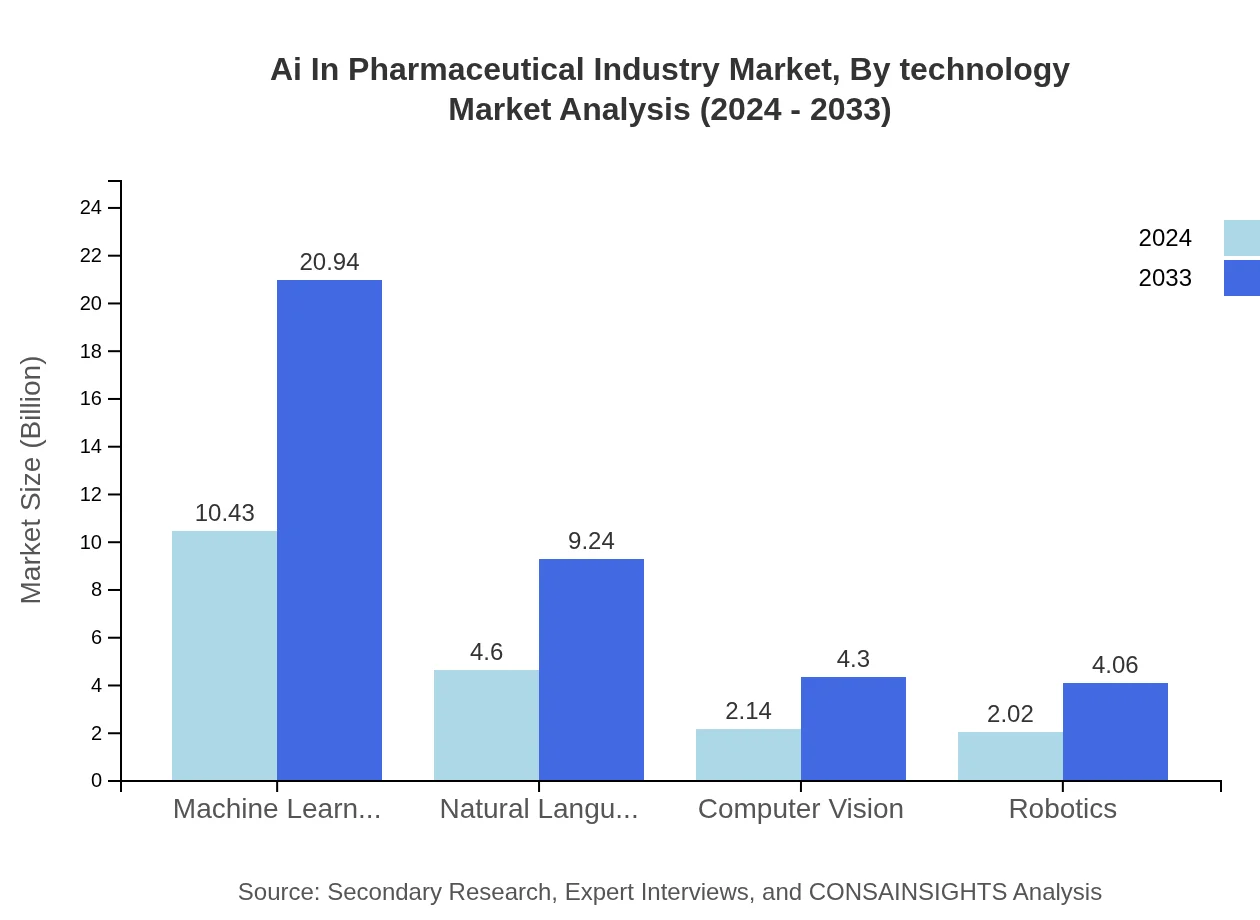
The by-technology segmentation emphasizes the different AI technologies that are revolutionizing the pharmaceutical sector. Key technological players include Machine Learning, Natural Language Processing, Computer Vision, and Robotics. Each technology segment is contributing significantly to the industrial advancements seen in drug discovery, patient care, and operational management. For example, the Machine Learning segment has demonstrated substantial growth, with forecasts suggesting a near doubling of its market size from USD 10.43 billion to USD 20.94 billion between 2024 and 2033. Similarly, Natural Language Processing and Computer Vision are being utilized to extract actionable insights from large datasets and assist in imaging diagnostics, respectively. Robotics, on the other hand, enhances manufacturing precision and safety. Together, these technologies are creating a multi-pronged approach to digital transformation in pharmaceuticals, thereby driving efficiency, reducing time-to-market, and ensuring high-quality patient outcomes.
Ai In Pharmaceutical Industry Market Analysis By Usage
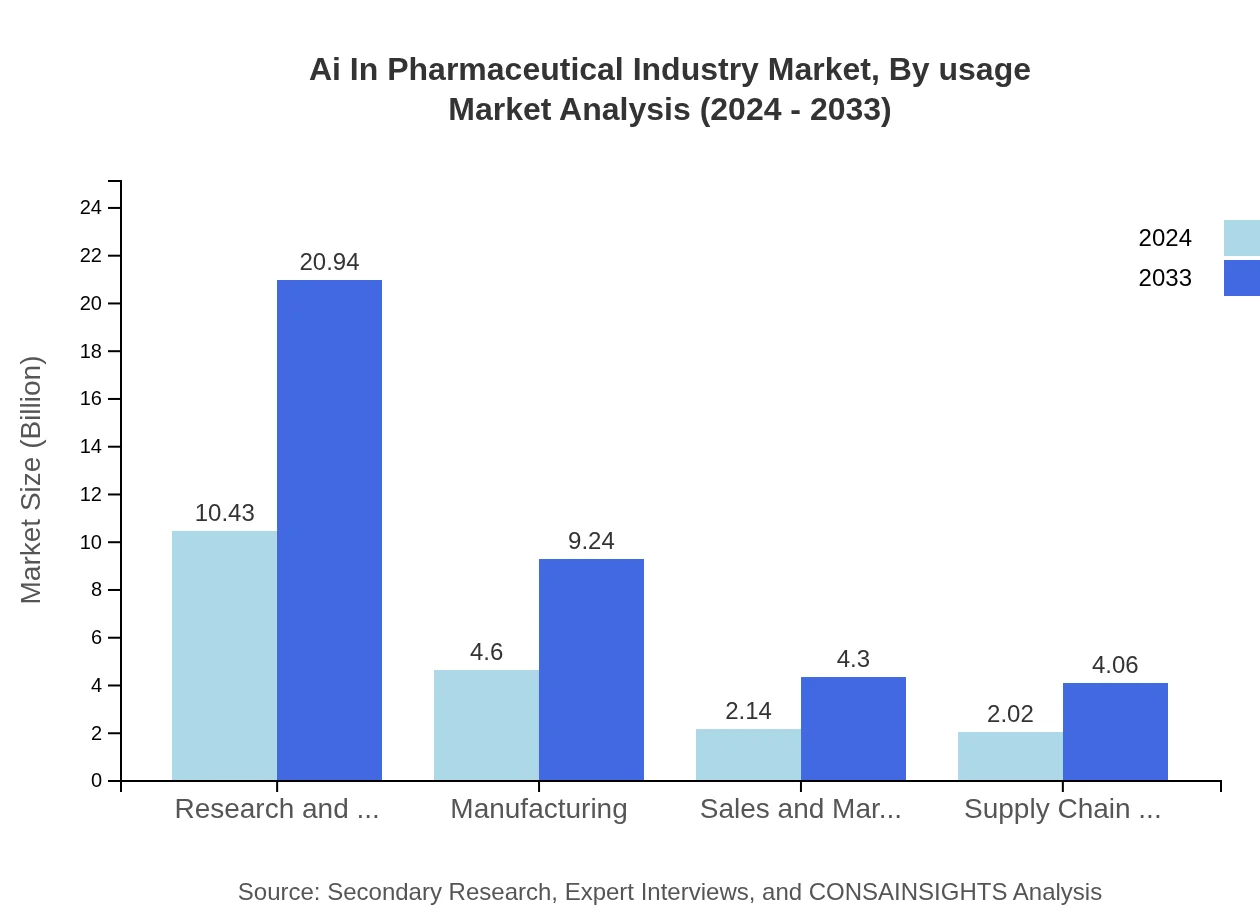
Within the by-usage segmentation, the focus is on how AI is deployed across various operational and clinical processes. This segment groups applications such as Drug Discovery, Clinical Trials, Patient Monitoring, and Market Access. The Drug Discovery segment, for example, is highlighted by its impressive market figures, with projections showing a growth from USD 10.43 billion to USD 20.94 billion between 2024 and 2033, while Clinical Trials, Patient Monitoring, and Market Access show parallel trends that underline the increasing reliance on predictive analytics and automated systems. These applications not only improve the efficiency of developing and testing new treatments but also contribute to optimizing resource allocation and reducing operational delays. Ultimately, the by-usage analysis demonstrates how AI-driven solutions are transforming traditional healthcare paradigms through enhanced accuracy, reduced costs, and faster clinical validation cycles.
Ai In Pharmaceutical Industry Market Analysis By End Users
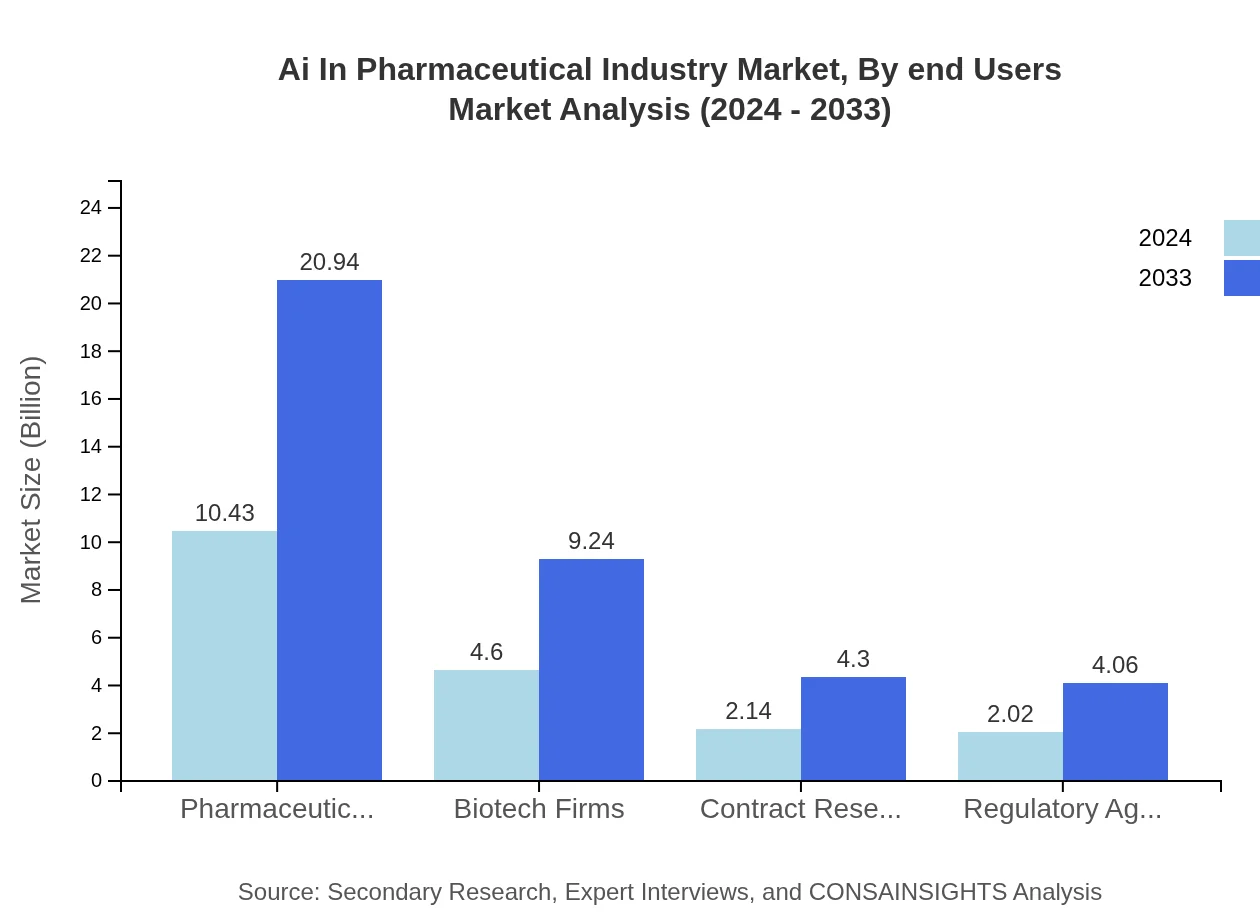
The by-end-users segmentation categorizes the market based on key participants who are adopting AI technologies. This includes Pharmaceutical Companies, Biotech Firms, Contract Research Organizations (CROs), and Regulatory Agencies. Among these, Pharmaceutical Companies and Biotech Firms lead the transition by implementing AI to support both innovation and compliance, with market sizes for these segments mirroring the strong performance observed in Research and Development. CROs are increasingly leveraging AI to optimize trial management and accelerate regulatory approvals, while Regulatory Agencies benefit from more efficient monitoring and predictive compliance checks. This segmentation reflects the collaborative ecosystem where each stakeholder plays a critical role in advancing AI adoption, ultimately leading to improved drug development processes and enhanced patient safety.
Ai In Pharmaceutical Industry Market Trends and Future Forecast
Tell us your focus area and get a customized research report.
Global Market Leaders and Top Companies in Ai In Pharmaceutical Industry Industry
Pfizer:
Pfizer has been at the forefront of integrating advanced AI technologies in its research and development processes. The company leverages cutting-edge data analytics and machine learning algorithms to streamline drug discovery and clinical trials, ensuring faster and more efficient market entry for novel treatments.Novartis:
Novartis has embraced AI to transform its operational frameworks, particularly in personalized medicine and patient monitoring. By incorporating sophisticated AI systems, Novartis enhances its ability to predict treatment outcomes and optimize supply chain management, thereby reinforcing its position as a global leader in pharmaceutical innovation.We're grateful to work with incredible clients.







FAQs
What is the current market size of the Ai In Pharmaceutical Industry?
The market size for the Ai In Pharmaceutical Industry was $19.20 Billion in 2024, as stated for the base year in the provided data.
How big will the market be by 2033?
The Ai In Pharmaceutical Industry market is projected to reach $38.54 Billion by 2033 according to the input data for the forecast horizon.
What is CAGR for the forecast period?
The reported compound annual growth rate for the forecast period 2024 to 2033 is 7.8% based on the provided figures.
Is there a single fastest Growing region in the Ai In Pharmaceutical Industry market?
No single fastest-growing region is stated for the Ai In Pharmaceutical Industry market because the top regional implied CAGR values are within 0.15 percentage points of each other, making the ranking too close to call reliably.
Why are pharmaceutical companies adopting AI?
Pharmaceutical companies adopt AI to accelerate drug discovery, enhance clinical trial efficiency, optimize manufacturing, and strengthen supply chain decision-making.
Who are notable companies in this market?
Top companies listed in the provided data include Pfizer and Novartis as participants deploying AI solutions in pharmaceutical contexts.
What end Users are addressed by AI in this sector?
End-users include pharmaceutical companies, biotech firms, contract research organizations (CROs), and regulatory agencies according to the input segmentation.
Which technology types are prominent in this market?
Prominent technologies named in the data are Machine Learning, Natural Language Processing, Computer Vision, and Robotics.
How big is the market in Europe in 2024 and 2033?
Europe is reported to grow from $6.02 Billion in 2024 to $12.08 Billion in 2033 as per the regional facts provided.
What drives adoption in clinical trials and patient monitoring?
Adoption in clinical trials and patient monitoring is driven by AI capabilities to analyze complex datasets, enable predictive insights, and support remote and real-time monitoring.