

Ambulatory Cardiac Monitoring Market Report
First published: 15 October 2024 | Last updated: 25 May 2026 | Report Code: ambulatory-cardiac-monitoring
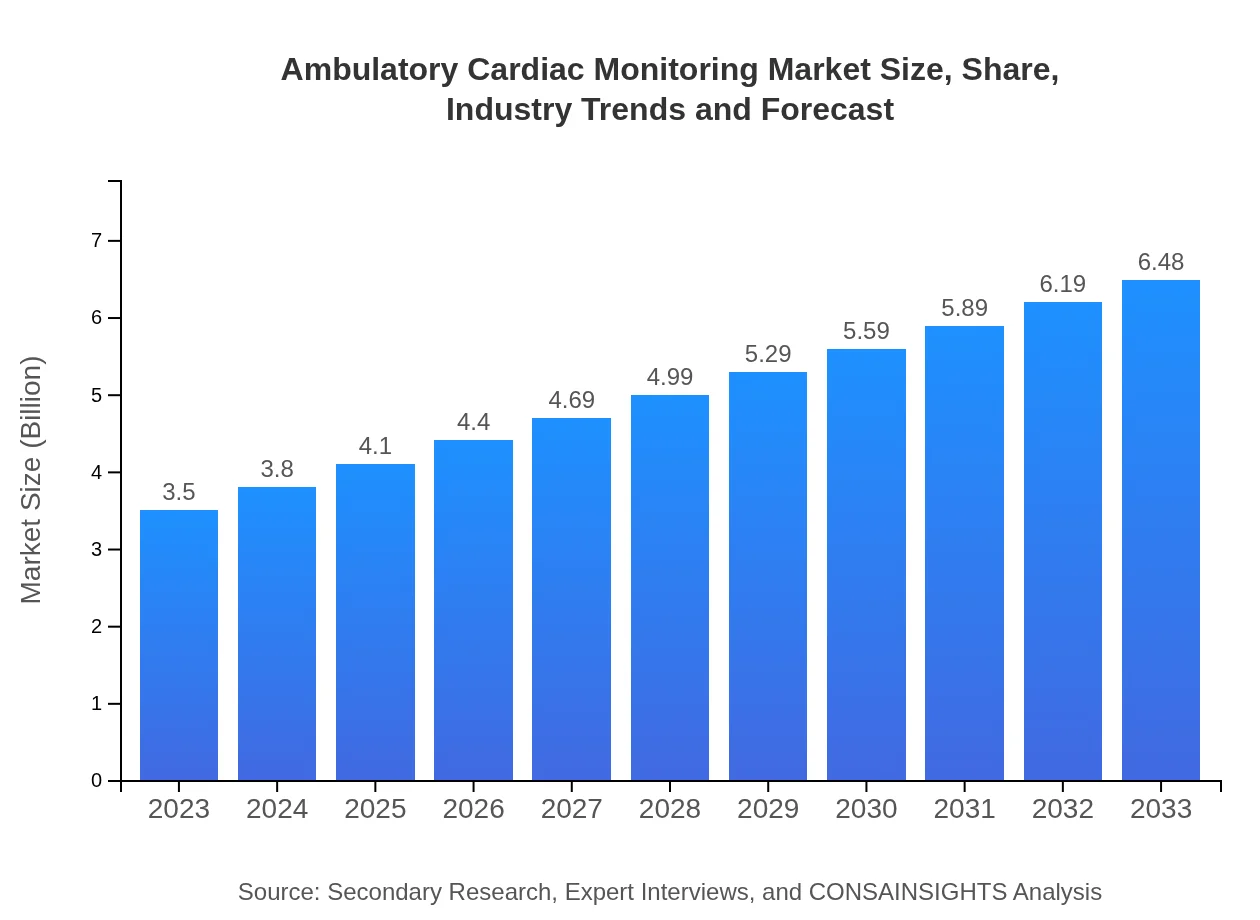
Ambulatory Cardiac Monitoring Market — USD 3.5 billion in 2023, Growing to USD 6.48B by 2033 at 6.2% CAGR
This report provides an in-depth analysis of the Ambulatory Cardiac Monitoring market, including market size, growth trends, regional insights, and forecasts from 2023 to 2033. It aims to equip stakeholders with actionable insights for strategic decision-making.
Key Takeaways
- Global market expands from $3.50 Billion in 2023 to $6.48 Billion in 2033 at a 6.2% CAGR.
- North America is largest regional market, while no single fastest-growing region is stated because regional CAGR differences remain within 0.15 percentage points.
- North America holds the largest regional value, rising from $1.19 Billion in 2023 to $2.21 Billion in 2033.
- Europe is a significant regional contributor, increasing from $1.15 Billion in 2023 to $2.14 Billion in 2033.
- Asia Pacific shows growth from $0.66 Billion in 2023 to $1.23 Billion in 2033, reflecting rising adoption of monitoring solutions.
- Prominent vendors include Medtronic, Philips Healthcare, Abbott Laboratories and GE Healthcare, shaping product innovation and distribution.
Ambulatory Cardiac Monitoring Market Report — Executive Summary
North America remains largest market by forecast-period value, while no single fastest-growing region is stated because top regional growth rates are separated by less than 0.15 percentage points. This report examines the Ambulatory Cardiac Monitoring market’s expansion between 2023 and 2033. The market size grows from $3.50 Billion to $6.48 Billion, reflecting a 6.2% CAGR across the forecast period. Drivers include greater prevalence of cardiovascular conditions, rising adoption of remote and home-based monitoring, and advances in wearable and implantable technologies. The market landscape is supported by established suppliers such as Medtronic, Philips Healthcare, Abbott Laboratories and GE Healthcare, and distribution channels ranging from direct sales to online platforms. Regional dynamics vary: North America leads in absolute value while Europe and Asia Pacific make notable contributions. The report presents segmentation by end user, technology, application and distribution, and synthesizes findings from expert interviews, company documentation, and data validation to provide a concise, actionable view for stakeholders.
Key Growth Drivers
- Increasing prevalence of heart disease driving demand for continuous outpatient monitoring.
- Technological progress in wearable and implantable devices enabling longer-term data capture.
- Greater acceptance of home-based care and remote patient monitoring workflows among providers.
- Investment by major medical-device companies boosting product availability and clinical support.
- Expanded digital connectivity and integration with mobile health platforms facilitating data transmission.
| Metric | Value |
|---|---|
| Study Period | 2023 - 2033 |
| 2023 Market Size | $3.50 Billion |
| CAGR (2023-2033) | 6.2% |
| 2033 Market Size | $6.48 Billion |
| Top Companies | Medtronic , Philips Healthcare, Abbott Laboratories, GE Healthcare |
| Published Date | 15 October 2024 |
| Last Modified Date | 25 May 2026 |
Ambulatory Cardiac Monitoring Market Overview
Customize Ambulatory Cardiac Monitoring Market Report market research report
- ✔ Get in-depth analysis of Ambulatory Cardiac Monitoring market size, growth, and forecasts.
- ✔ Understand Ambulatory Cardiac Monitoring's regional dynamics and industry-specific trends.
- ✔ Identify potential applications, end-user demand, and growth segments in Ambulatory Cardiac Monitoring
What is the Market Size & CAGR of Ambulatory Cardiac Monitoring Market Report market in 2023?
Ambulatory Cardiac Monitoring Industry Analysis
Ambulatory Cardiac Monitoring Market Segmentation and Scope
Tell us your focus area and get a customized research report.
Ambulatory Cardiac Monitoring Market Report Market Analysis Report by Region
Europe Ambulatory Cardiac Monitoring Market Report:
Europe grows from $1.15 Billion in 2023 to $2.14 Billion in 2033. Regional momentum is underpinned by increasing uptake of remote monitoring, regulatory support for digital health, and investments in ambulatory care pathways.Asia Pacific Ambulatory Cardiac Monitoring Market Report:
Asia Pacific grows from $0.66 Billion in 2023 to $1.23 Billion in 2033. Expansion is driven by increasing healthcare access, growing awareness of cardiovascular disease management, and adoption of wearable monitoring technologies.North America Ambulatory Cardiac Monitoring Market Report:
North America is largest regional market, rising from $1.19 Billion in 2023 to $2.21 Billion in 2033. This region’s scale reflects established clinical adoption, reimbursement frameworks, and strong presence of major device manufacturers supporting outpatient monitoring solutions.South America Ambulatory Cardiac Monitoring Market Report:
Latin America grows from $0.3 Billion in 2023 to $0.55 Billion in 2033. Growth factors include expanding healthcare infrastructure and rising demand for remote diagnostic and monitoring capabilities across outpatient settings.Middle East & Africa Ambulatory Cardiac Monitoring Market Report:
Middle East and Africa grows from $0.2 Billion in 2023 to $0.36 Billion in 2033. Market development is linked to broader digitization of healthcare services and gradual deployment of ambulatory monitoring solutions.Tell us your focus area and get a customized research report.
Research Methodology
Ambulatory Cardiac Monitoring Market Analysis By Technology
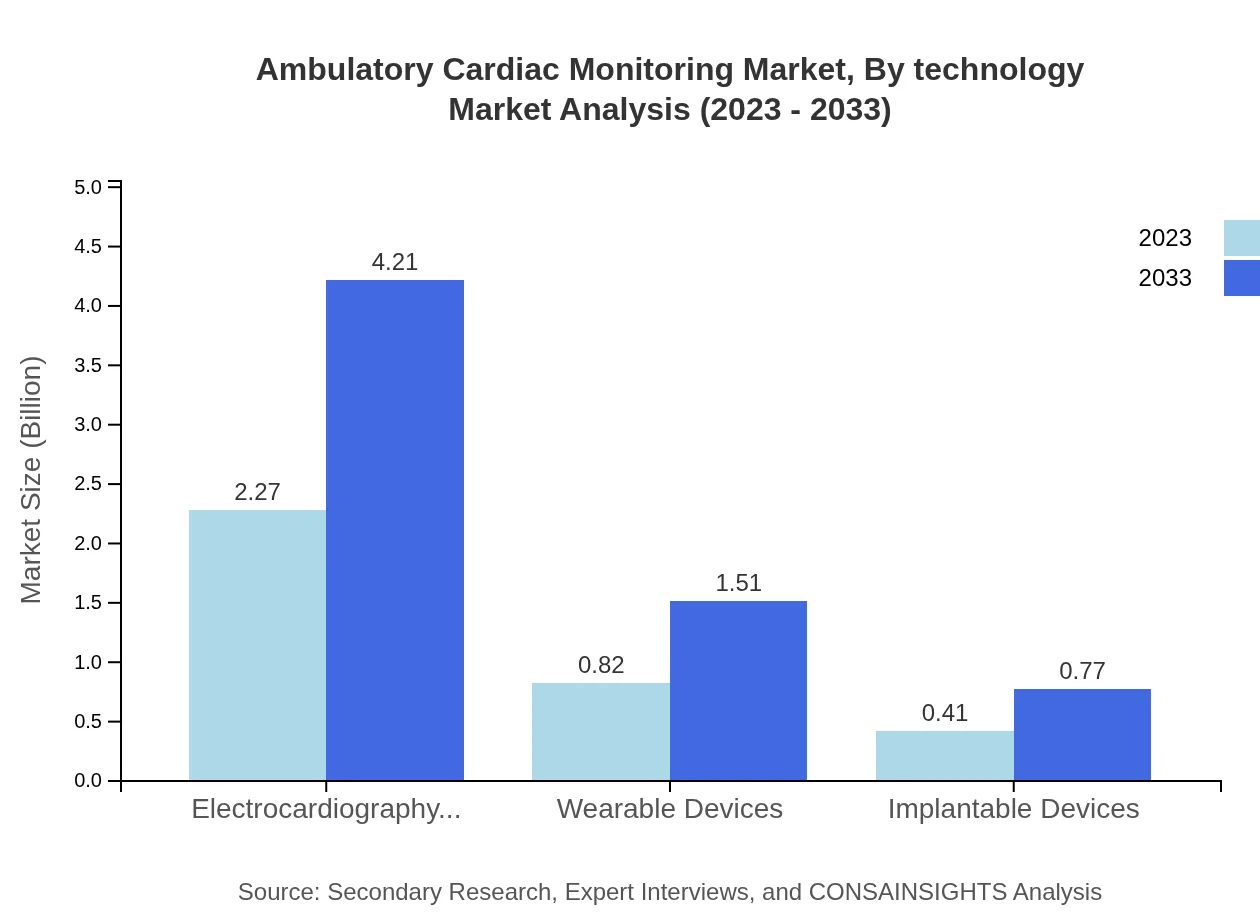
The technology segment includes various monitoring techniques such as Electrocardiography (ECG), Holter monitors, and remote telemetry. In 2023, the ECG market is valued at $2.27 billion, expected to grow to $4.21 billion by 2033, holding a market share of 64.85%. Holter monitors and remote telemetry solutions are also witnessing increased adoption due to their effectiveness in long-term monitoring.
Ambulatory Cardiac Monitoring Market Analysis By Application
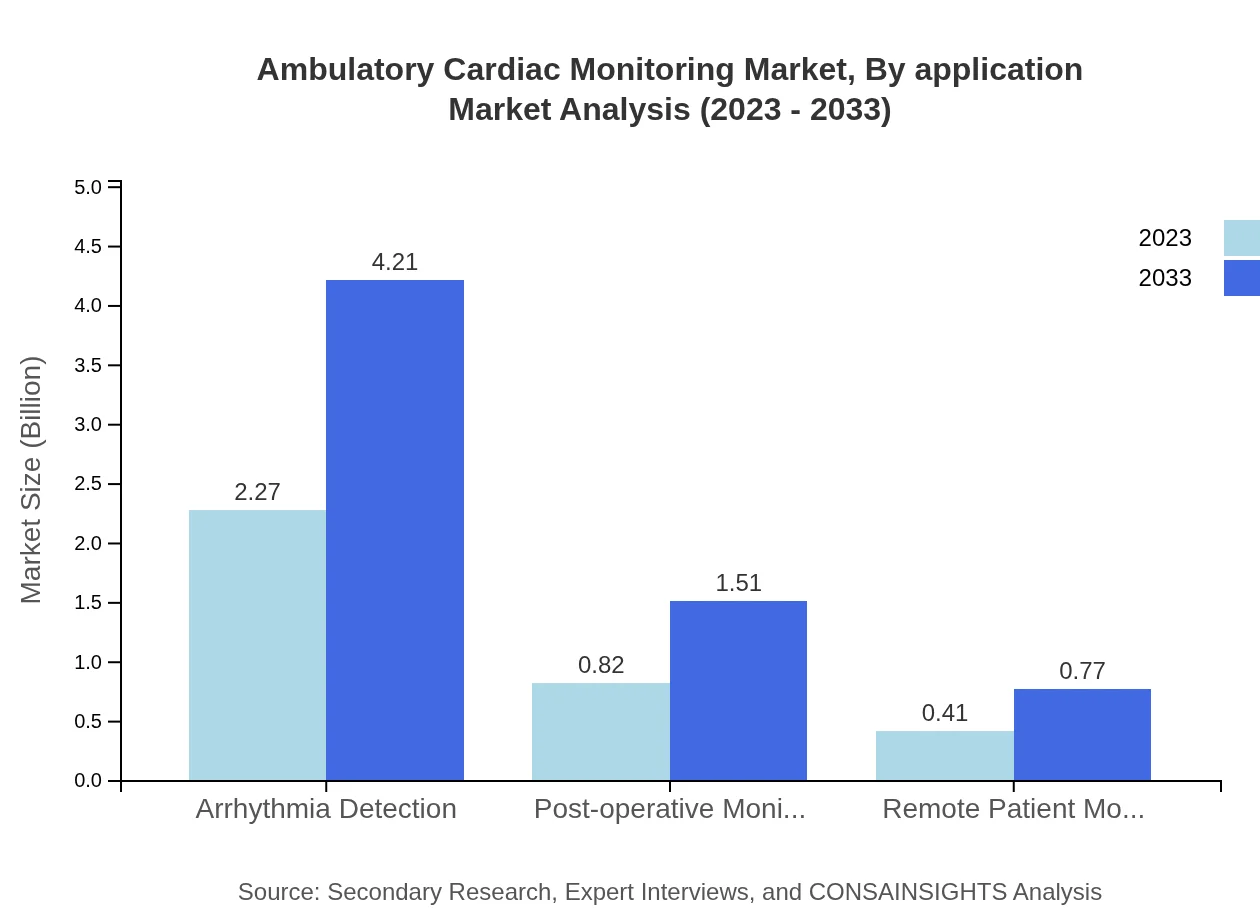
Segmentation by application includes arrhythmia detection, post-operative monitoring, and remote patient monitoring. The arrhythmia detection segment alone contributes significantly, projected to grow from $2.27 billion in 2023 to $4.21 billion by 2033, maintaining a share of 64.85%. This reflects a growing emphasis on continuous rhythm monitoring, which is critical for timely intervention.
Ambulatory Cardiac Monitoring Market Analysis By End User
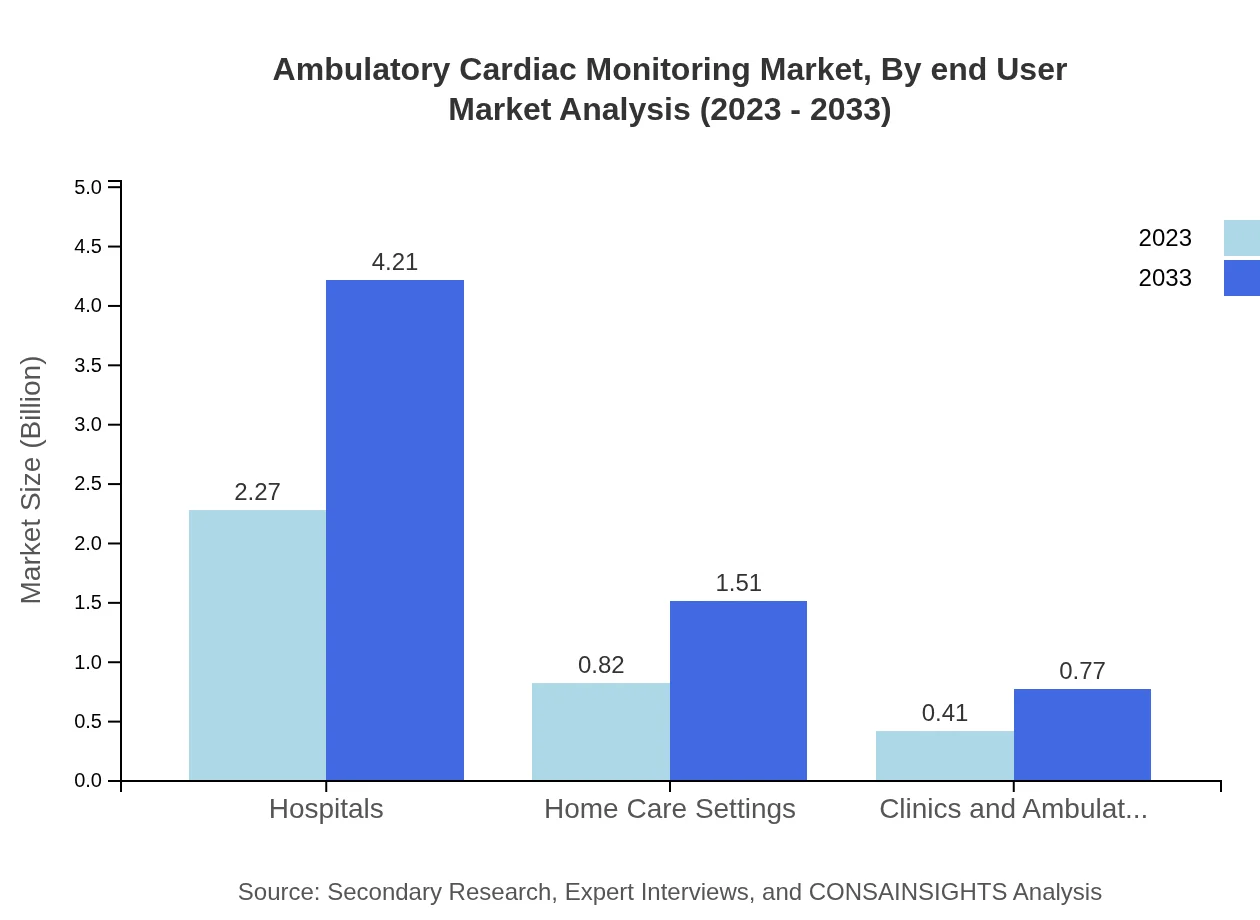
End-user segmentation shows hospitals, home care settings, and clinics as significant contributors to the market. Hospitals command a substantial market size of $2.27 billion in 2023, projected to grow to $4.21 billion by 2033, holding steady at 64.85% market share. With home care settings emerging as a strong growth area, its market size is expected to reach $1.51 billion by 2033.
Ambulatory Cardiac Monitoring Market Analysis By Distribution Channel
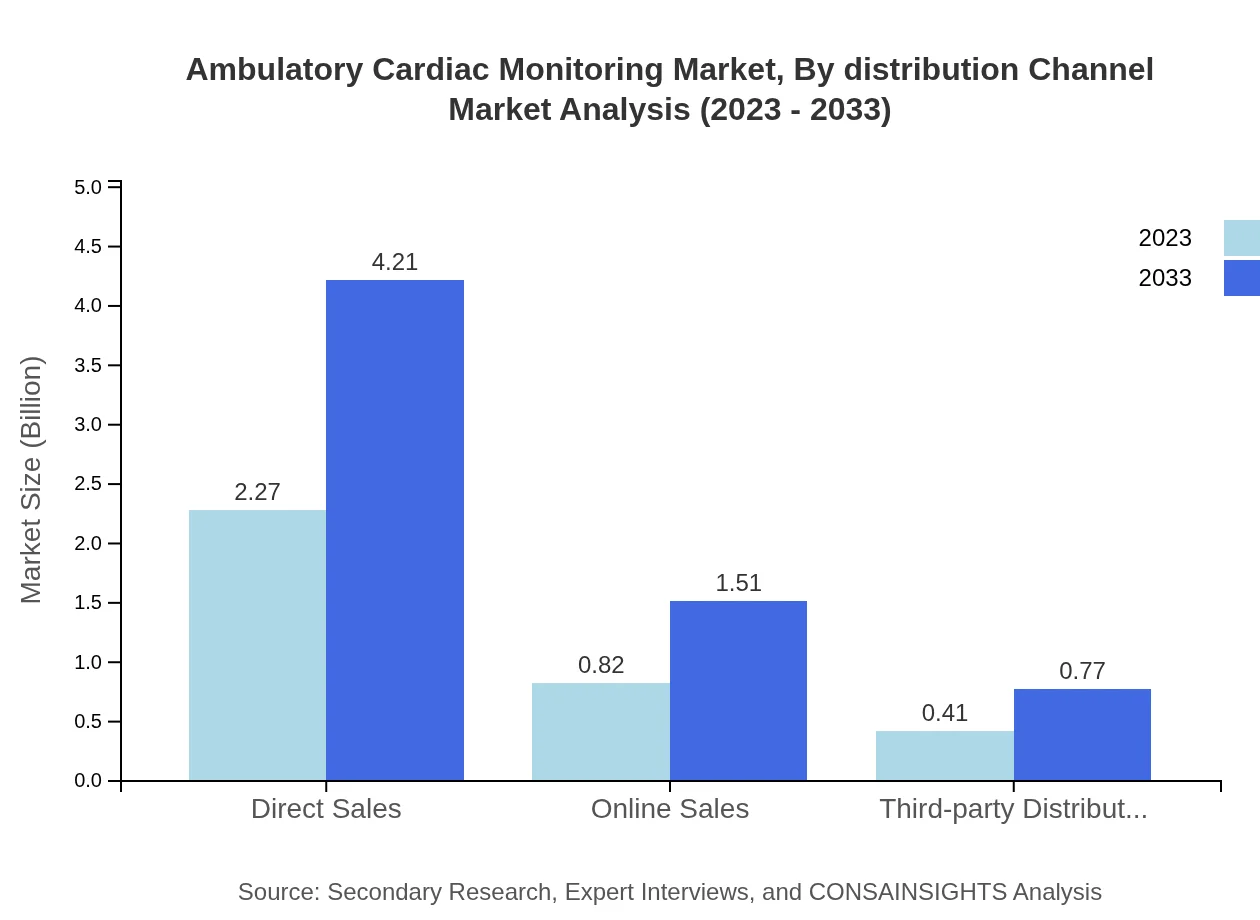
Distribution channels for Ambulatory Cardiac Monitoring products include direct sales, online sales, and third-party distributors. Direct sales dominate with a market size of $2.27 billion in 2023, aiming for $4.21 billion by 2033, making up 64.85% of the market share. Online sales are rising rapidly due to the growing trend of digital healthcare.
Ambulatory Cardiac Monitoring Market Trends and Future Forecast
Tell us your focus area and get a customized research report.
Global Market Leaders and Top Companies in Ambulatory Cardiac Monitoring Industry
Medtronic :
Medtronic is a leader in medical technology, offering innovative cardiac monitoring solutions that improve patient outcomes and enhance the quality of care.Philips Healthcare:
Philips Healthcare specializes in diagnostic imaging and patient monitoring systems, driving advancements in cardiac health management.Abbott Laboratories:
Abbott is known for its continuous glucose monitoring systems and is expanding its portfolio to include advanced cardiac monitoring technologies.GE Healthcare:
GE Healthcare provides comprehensive biometric solutions, including advanced cardiac monitoring devices that support better patient assessment.We're grateful to work with incredible clients.









FAQs
What is the market size of ambulatory cardiac monitoring in 2023?
The market size in 2023 is $3.50 Billion, based on reported figures for the global ambulatory cardiac monitoring market for that year.
How big will the market be in 2033?
The market is projected to reach $6.48 Billion in 2033 according to the provided forecast data covering 2023 to 2033.
What is CAGR for the forecast period?
The reported compound annual growth rate for 2023 to 2033 is 6.2%, reflecting the market expansion over the forecast horizon.
Is there a single fastest Growing region in the Ambulatory Cardiac Monitoring Market Report market?
No single fastest-growing region is stated for the Ambulatory Cardiac Monitoring Market Report market because the top regional implied CAGR values are within 0.15 percentage points of each other, making the ranking too close to call reliably.
Which companies lead the ambulatory cardiac monitoring market?
Top companies listed include Medtronic, Philips Healthcare, Abbott Laboratories and GE Healthcare as prominent participants in this market.
What end User segments are covered?
End-user segmentation includes Hospitals, Home Care Settings, and Clinics and Ambulatory Care Centers as distinct deployment environments.
How are monitoring technologies categorized?
Technology segments include Electrocardiography (ECG), Wearable Devices and Implantable Devices as the primary categories for ambulatory monitoring.
What distribution channels are identified?
Distribution channels reported are Direct Sales, Online Sales and Third-party Distributors for delivering ambulatory monitoring products to customers.
Why is remote patient monitoring important here?
Remote patient monitoring supports continuous assessment outside clinical settings, enabling timely detection and intervention for cardiac conditions, and boosting market adoption.
Who contributed to the research methodology?
Research involved primary interviews with industry experts and secondary research from company reports and publications, followed by data triangulation and internal validation.