

Angioplasty Balloons Market Report
First published: 23 October 2024 | Last updated: 25 May 2026 | Report Code: angioplasty-balloons
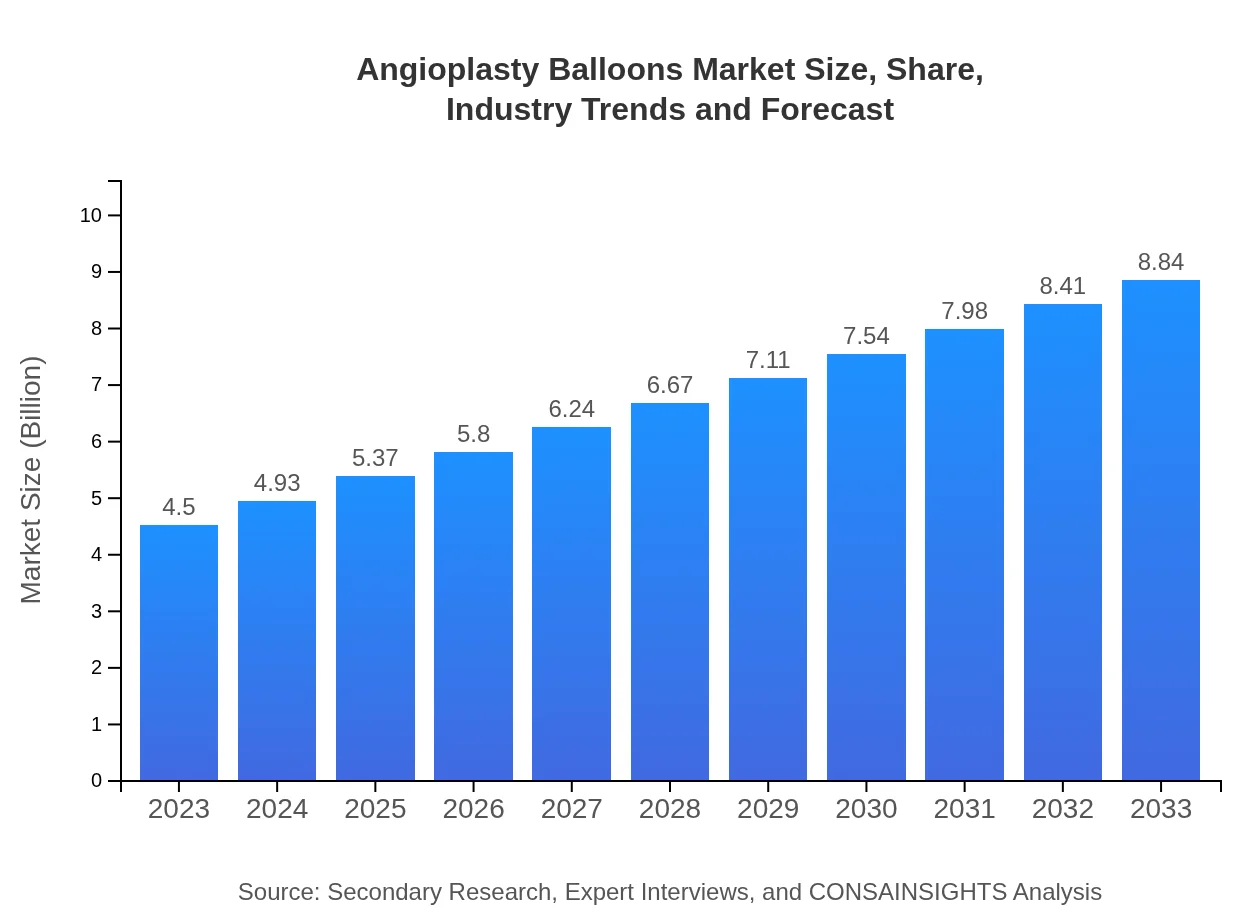
Angioplasty Balloons Market — USD $4.5 Billion in 2023, Growing to USD 8.84B by 2033 at 6.8% CAGR
This report provides a comprehensive analysis of the Angioplasty Balloons market from 2023 to 2033, covering market size, trends, and forecasts. It offers insights into industry dynamics, segmentation, regional performance, and competitive landscape, crucial for stakeholders in making informed decisions.
Key Takeaways
- Global market expands from $4.50 Billion in 2023 to $8.84 Billion in 2033 at a 6.8% CAGR, reflecting sustained demand for interventional cardiovascular devices.
- North America is largest regional market, while no single fastest-growing region is stated because regional CAGR differences remain within 0.15 percentage points.
- Europe grows from $1.15 Billion to $2.25 Billion over the forecast, reflecting investment in catheter-based therapies and advanced device adoption.
- Asia Pacific increases from $0.92 Billion to $1.81 Billion, supported by rising prevalence of cardiovascular disease and expanding treatment access.
- Key manufacturers include Boston Scientific Corporation, Medtronic Plc., Abbott Laboratories, B. Braun Melsungen AG, and Cook Medical, all influencing product innovation.
Angioplasty Balloons Market Report — Executive Summary
North America remains largest market by forecast-period value, while no single fastest-growing region is stated because top regional growth rates are separated by less than 0.15 percentage points. The Angioplasty Balloons Market Report documents steady expansion from a $4.50 Billion base in 2023 to $8.84 Billion by 2033, underpinned by a 6.8% CAGR for 2023 to 2033. Market momentum is driven by demand for minimally invasive cardiovascular treatments, advancements in balloon materials and drug-eluting technologies, and broader healthcare investment. Regional patterns show North America as the largest market, while other regions post significant gains without a single regional market region identified. The industry structure includes multiple product types — bare metal, drug-eluting, and specialty balloons — and end users such as hospitals and cardiac catheterization labs. Leading firms named in the study play key roles in innovation and distribution, with strategies focused on product development and market access. The report synthesizes primary interviews, company literature, and validated secondary data to present an actionable overview for stakeholders.
Key Growth Drivers
- Rising demand for less invasive cardiovascular procedures increases use of angioplasty balloons across care settings.
- Technological progress in drug-eluting and specialty balloon designs enhances clinical outcomes and broadens indications.
- Expanding healthcare infrastructure and procedural capacity in multiple regions supports higher procedure volumes.
- Manufacturer investment and product pipeline activity from established vendors accelerate device availability and adoption.
- Improved diagnostic capabilities and population aging contribute to greater identification and treatment of vascular disease.
| Metric | Value |
|---|---|
| Study Period | 2023 - 2033 |
| 2023 Market Size | $4.50 Billion |
| CAGR (2023-2033) | 6.8% |
| 2033 Market Size | $8.84 Billion |
| Top Companies | Boston Scientific Corporation, Medtronic Plc., Abbott Laboratories, B. Braun Melsungen AG, Cook Medical |
| Published Date | 23 October 2024 |
| Last Modified Date | 25 May 2026 |
Angioplasty Balloons Market Overview
Customize Angioplasty Balloons Market Report market research report
- ✔ Get in-depth analysis of Angioplasty Balloons market size, growth, and forecasts.
- ✔ Understand Angioplasty Balloons's regional dynamics and industry-specific trends.
- ✔ Identify potential applications, end-user demand, and growth segments in Angioplasty Balloons
What is the Market Size & CAGR of Angioplasty Balloons Market Report market in 2023?
Angioplasty Balloons Industry Analysis
Angioplasty Balloons Market Segmentation and Scope
Tell us your focus area and get a customized research report.
Angioplasty Balloons Market Report Market Analysis Report by Region
Europe Angioplasty Balloons Market Report:
Europe grows from $1.15 Billion in 2023 to $2.25 Billion in 2033. The region's growth is supported by investments in catheter-based therapies, regulatory pathways facilitating device availability, and rising clinical adoption of advanced angioplasty balloons.Asia Pacific Angioplasty Balloons Market Report:
Asia Pacific grows from $0.92 Billion in 2023 to $1.81 Billion in 2033. Demand is driven by growing cardiovascular disease prevalence, improving access to interventional care, and expanding hospital and catheterization lab capacity.North America Angioplasty Balloons Market Report:
North America is largest regional market, rising from $1.46 Billion in 2023 to $2.88 Billion in 2033. This expansion is linked to established care infrastructure, high rates of interventional procedures, and active adoption of advanced balloon technologies.South America Angioplasty Balloons Market Report:
Latin America grows from $0.43 Billion in 2023 to $0.85 Billion in 2033. Growth here reflects gradual enhancement of procedural infrastructure, increased training, and broader availability of catheter-based interventions.Middle East & Africa Angioplasty Balloons Market Report:
Middle East and Africa grows from $0.54 Billion in 2023 to $1.05 Billion in 2033. Regional drivers include investment in healthcare facilities, rising procedural uptake, and adoption of improved device designs tailored to clinical needs.Tell us your focus area and get a customized research report.
Research Methodology
Angioplasty Balloons Market Analysis By Product
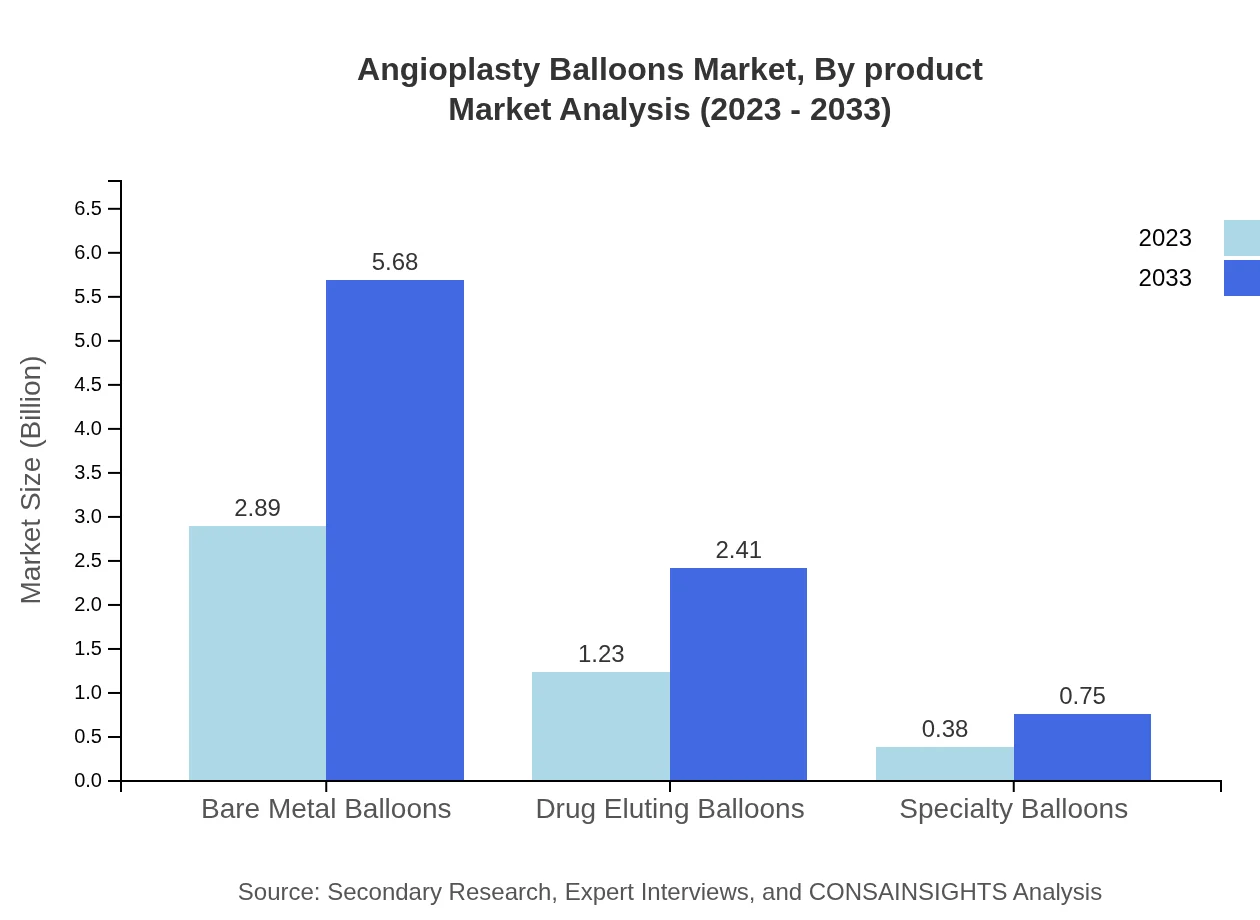
The Angioplasty Balloons market is segmented by product into bare metal balloons, drug-eluting balloons, and specialty balloons. In 2023, bare metal balloons hold a significant market size of $2.89 billion, expected to increase to $5.68 billion by 2033 with a steady market share of 64.24%. Drug-eluting balloons are projected to grow from $1.23 billion to $2.41 billion, holding 27.3% market share, while specialty balloons, despite being smaller in size, will reach $0.75 billion by 2033 with a market share of 8.46%. This segmentation reflects the clinical adaptations to improve patient outcomes in various demographic profiles.
Angioplasty Balloons Market Analysis By Application
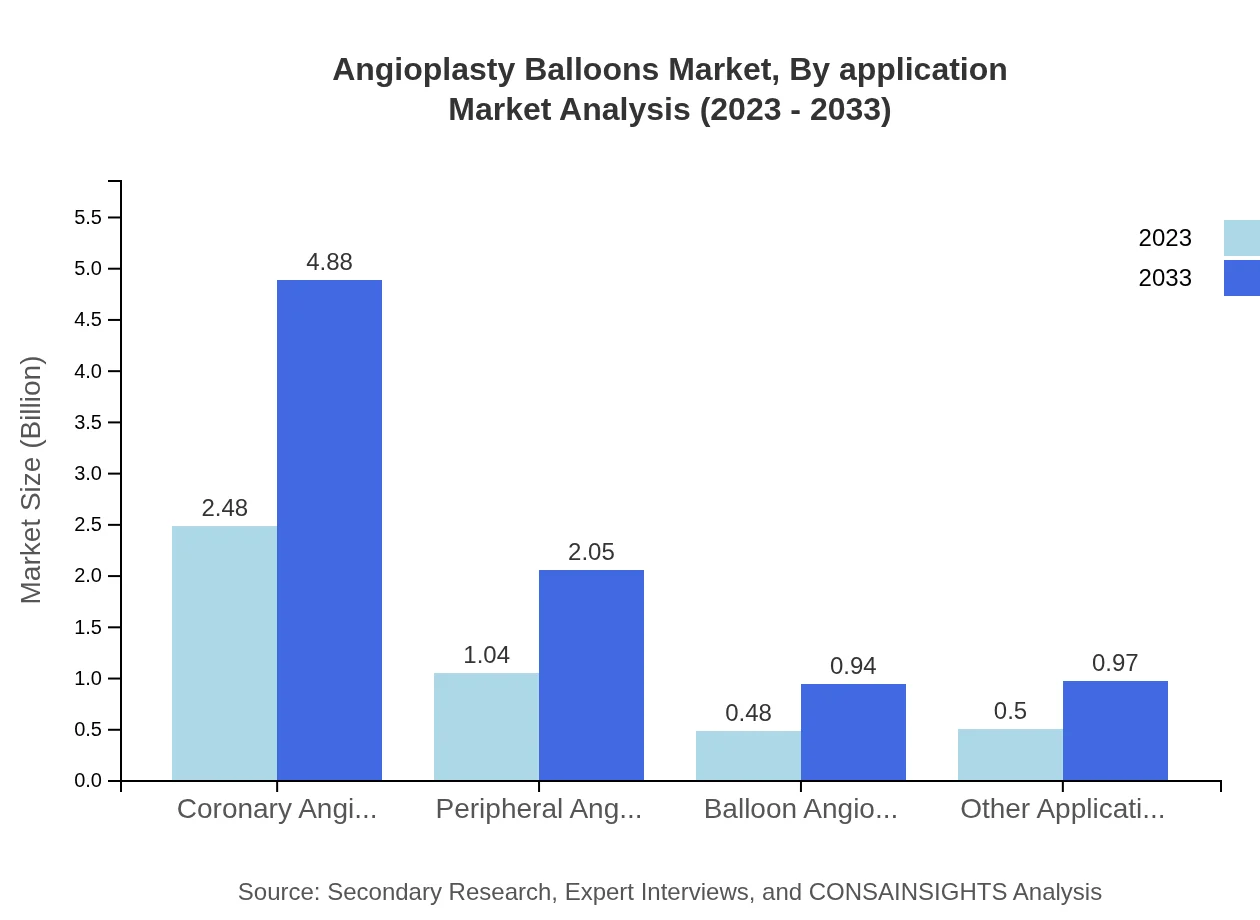
The market is further segmented by application into coronary angioplasty, peripheral angioplasty, balloon angioplasty in children, and other applications. Coronary angioplasty leads the market at $2.48 billion in 2023, expected to rise to $4.88 billion, capturing 55.14% market share. Peripheral angioplasty follows with a market size of $1.04 billion in 2023, projected to grow to $2.05 billion, holding 23.18% market share. Each application highlights the adaptability of angioplasty balloons to various patient needs and conditions.
Angioplasty Balloons Market Analysis By End User
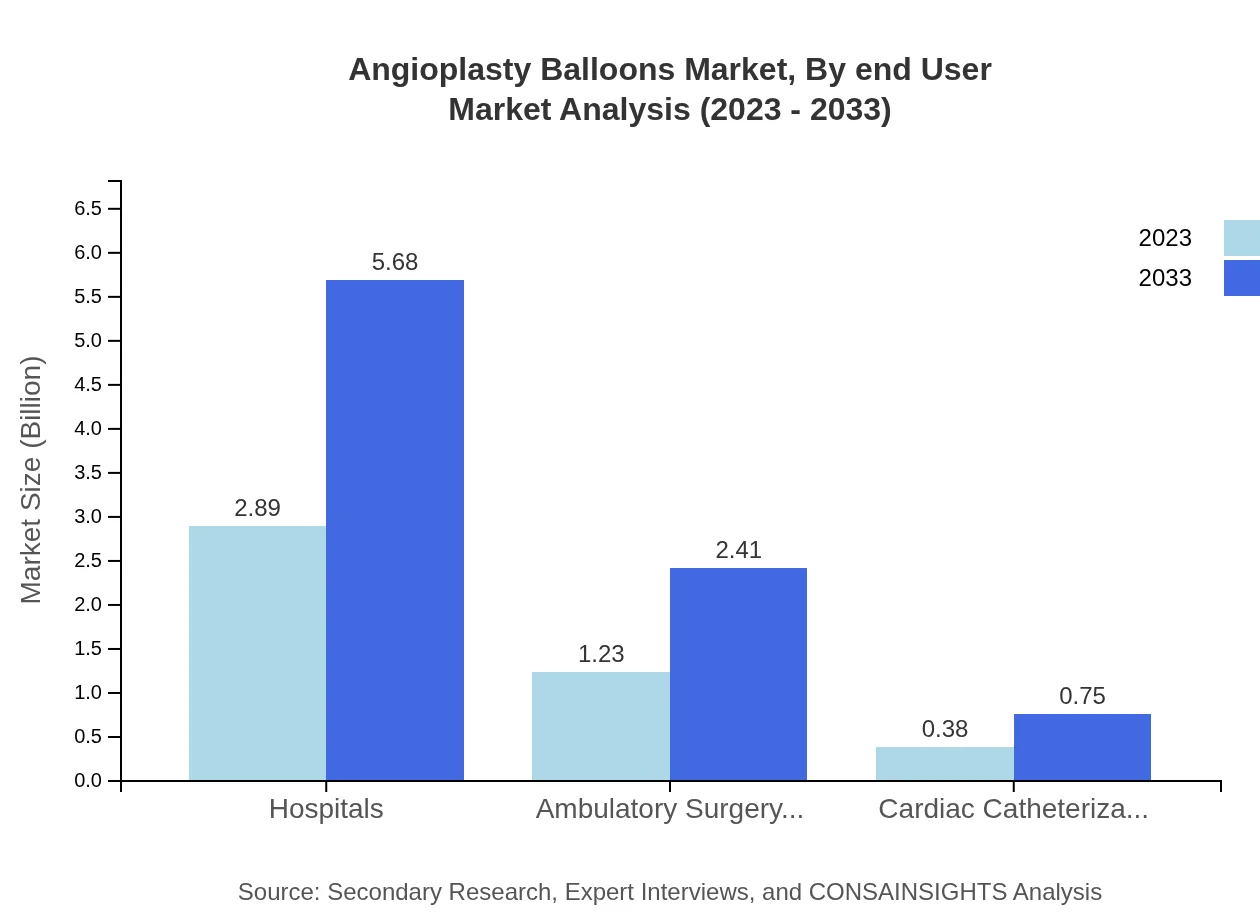
The end-user segmentation consists of hospitals, ambulatory surgery centers, and cardiac catheterization labs. Hospitals dominate the market with a size of $2.89 billion in 2023, aiming for $5.68 billion by 2033, representing a substantial share of 64.24%. Ambulatory surgery centers hold $1.23 billion currently, forecasted to grow to $2.41 billion, while cardiac catheterization labs account for $0.38 billion, aiming to reach $0.75 billion. These segments illustrate the varied environmental settings for angioplasty procedures and their respective impact on market dynamics.
Angioplasty Balloons Market Analysis By Material
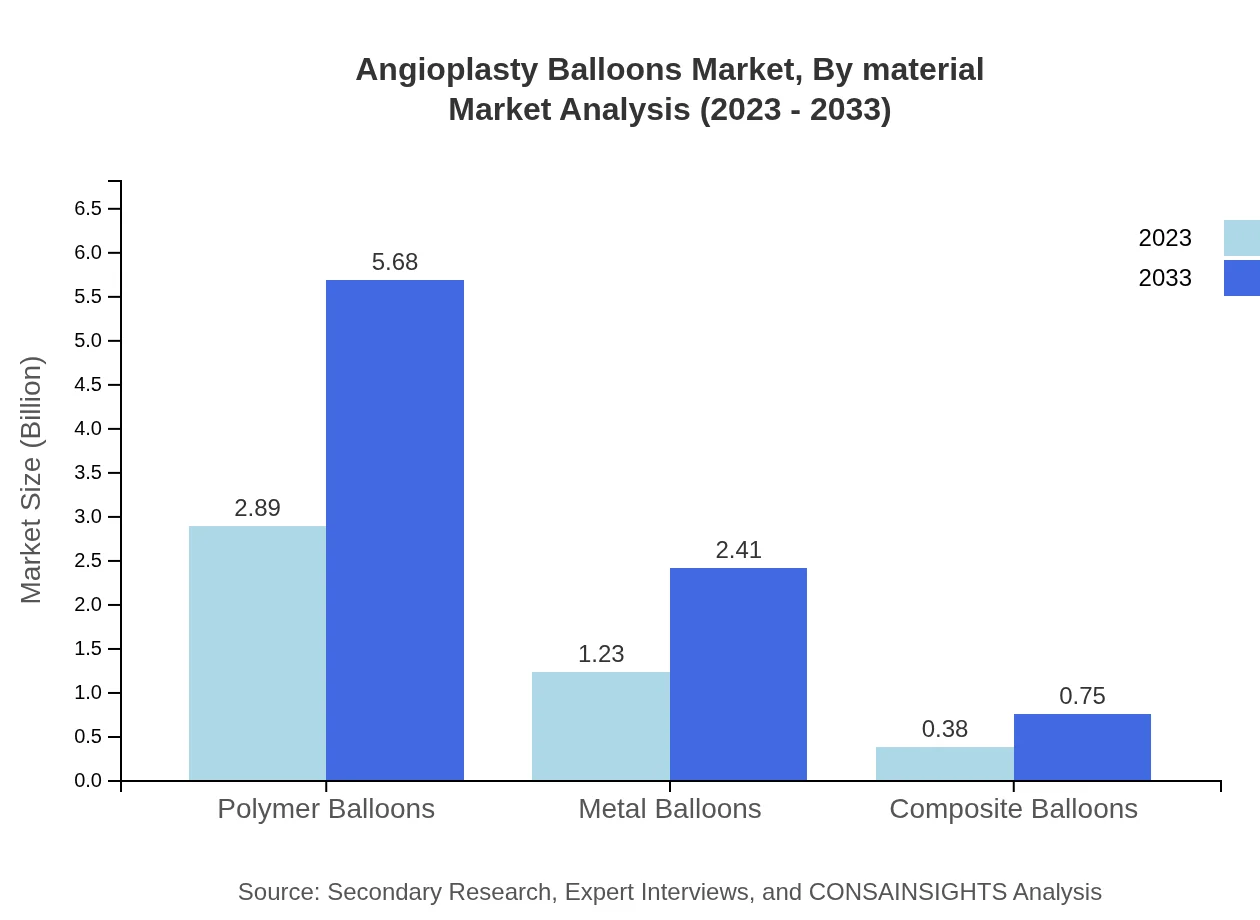
The segmentation by material includes polymer balloons, metal balloons, and composite balloons. Polymer balloons lead with $2.89 billion in 2023, projected to grow to $5.68 billion, maintaining a dominant share of 64.24%. Metal balloons, capturing a 27.3% share, are expected to rise from $1.23 billion to $2.41 billion, while composite balloons expand from $0.38 billion to $0.75 billion across the forecast period. This segmentation reflects the continuing importance of material innovation in enhancing efficacy and safety in angioplasty procedures.
Angioplasty Balloons Market Analysis By Distribution Channel
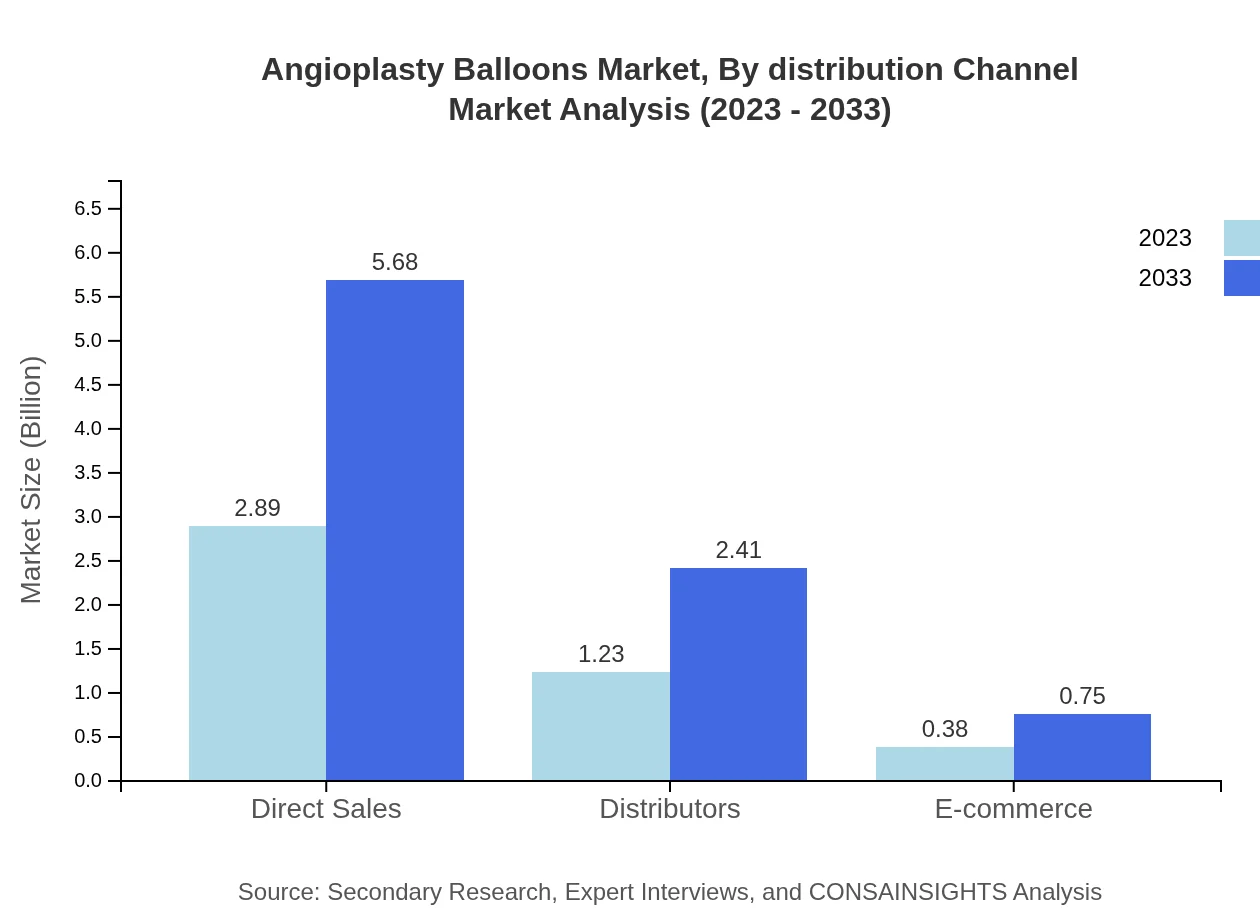
The distribution channel market is divided into direct sales, distributors, and e-commerce. Direct sales lead with $2.89 billion in 2023, likely to project growth to $5.68 billion with a consistent share of 64.24%. Distributors, holding a market size of $1.23 billion, are projected to rise to $2.41 billion, while e-commerce remains a smaller but growing segment from $0.38 billion to $0.75 billion. This delineation highlights the evolving methods of market engagement and the transition towards digital platforms.
Angioplasty Balloons Market Trends and Future Forecast
Tell us your focus area and get a customized research report.
Global Market Leaders and Top Companies in Angioplasty Balloons Industry
Boston Scientific Corporation:
A leading global medical device manufacturer known for its innovative products, including angioplasty balloons, Boston Scientific focuses heavily on the development of drug-eluting technologies that enhance patient outcomes.Medtronic Plc.:
Medtronic is a prominent player in the angioplasty balloon market, offering a wide range of balloon products designed to treat various cardiovascular conditions, driving innovation through research and development.Abbott Laboratories:
Abbott is recognized for its advanced medical devices, specifically its drug-eluting balloons that have revolutionized angioplasty procedures. It emphasizes technological advancements and improved recovery outcomes.B. Braun Melsungen AG:
B. Braun specializes in medical and pharmaceutical products, including angioplasty balloons, focusing on quality and safety in the treatment of various cardiovascular conditions.Cook Medical:
Cook Medical has a diverse portfolio within the vascular product space, including angioplasty balloons, and is noted for its commitment to innovation in vascular therapy.We're grateful to work with incredible clients.







FAQs
What is the market size of the angioplasty balloons market in 2023?
The reported market size for angioplasty balloons in 2023 is $4.50 Billion, serving as the baseline for the forecast from 2023 to 2033.
How big will the angioplasty balloons market be in 2033?
The market is projected to reach $8.84 Billion by 2033, reflecting growth across product types, geographies, and clinical adoption through the forecast period.
What is CAGR of the market from 2023 to 2033?
The compound annual growth rate for the forecast period 2023 to 2033 is 6.8%, based on the market trajectory from 2023 to 2033.
Is there a single fastest Growing region in the Angioplasty Balloons Market Report market?
No single fastest-growing region is stated for the Angioplasty Balloons Market Report market because the top regional implied CAGR values are within 0.15 percentage points of each other, making the ranking too close to call reliably.
Which companies lead the angioplasty balloons market?
Top firms identified include Boston Scientific Corporation, Medtronic Plc., Abbott Laboratories, B. Braun Melsungen AG, and Cook Medical, noted for product development and market presence.
What main product segments are covered in the report?
The report addresses product types such as bare metal balloons, drug-eluting balloons, and specialty balloons, along with material and distribution distinctions.
How big is the Europe market in 2023 and 2033?
Europe is reported at $1.15 Billion in 2023 and grows to $2.25 Billion by 2033, reflecting sustained device adoption and procedural capacity expansion.
Who contributed to the research methodology?
The study is based on primary interviews with industry experts and secondary sources including company reports and publications, combined with data triangulation.
What role do hospitals play in market demand?
Hospitals, identified as a primary end-user, account for a significant share of procedures and device procurement, driving recurring demand for angioplasty balloons.
Why is no fastest Growing region named?
A regional growth market is not specified because the top regional growth rates are within 0.15 percentage points, preventing a clear single designation.