
Reports >
Life Sciences
>
Bariatric Surgery Devices Market Report

Bariatric Surgery Devices Market Report
First published: 23 October 2024 | Last updated: 25 May 2026 | Report Code: bariatric-surgery-devices
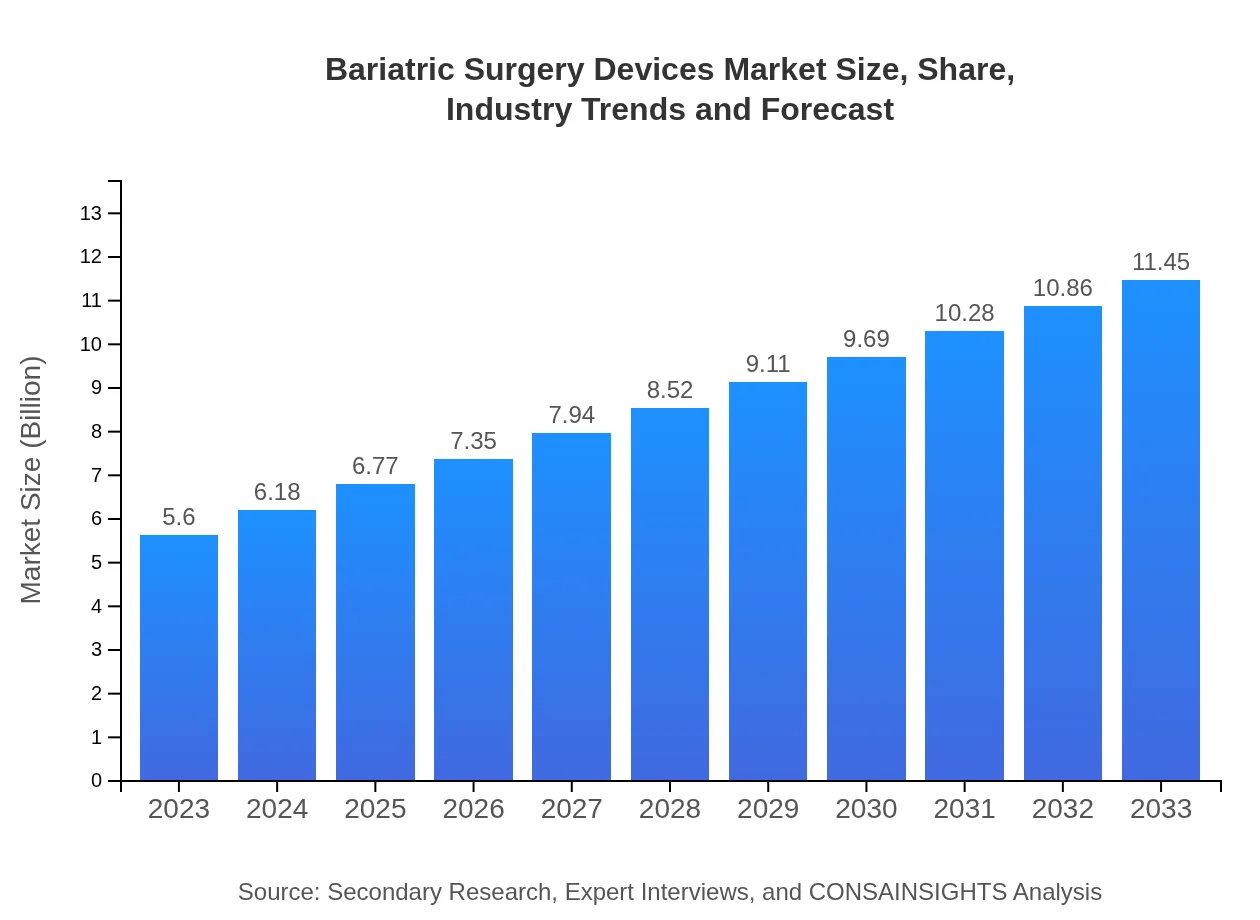
Bariatric Surgery Devices Market — USD 5.6 billion in 2023, Growing to USD 11.45B by 2033 at 7.2% CAGR
This report analyzes the Bariatric Surgery Devices market, providing insights into market size, segmentation, trends, and regional dynamics from 2023 to 2033, helping industry stakeholders understand the growth trajectory and innovations in the sector.
Key Takeaways
- Global market expands from $5.60 Billion in 2023 to $11.45 Billion in 2033, reflecting a 7.2% CAGR over the forecast period.
- Europe is largest regional market, while no single fastest-growing region is stated because regional CAGR differences remain within 0.15 percentage points.
- North America grows from $1.81 Billion in 2023 to $3.69 Billion in 2033, showing substantial regional demand.
- Asia Pacific increases from $1.08 Billion in 2023 to $2.20 Billion in 2033, driven by growing procedure uptake.
- Market participants include Ethicon, Inc., Medtronic, Apollo Endosurgery and Stryker Corporation.
Bariatric Surgery Devices Market Report — Executive Summary
Europe remains largest market by forecast-period value, while no single fastest-growing region is stated because top regional growth rates are separated by less than 0.15 percentage points. The report outlines the Bariatric Surgery Devices market trajectory from $5.60 Billion in 2023 to $11.45 Billion by 2033 at a 7.2% compound annual growth rate for 2023 to 2033. Growth is supported by wider adoption of minimally invasive techniques, advances in surgical instruments and implants, and expanded bariatric procedure acceptance. The market is structured by device type, surgery type, end-users and channels, with hospitals and surgical centers as key demand sources. Regional dynamics vary: Europe is identified as the largest market. Competitive activity centers on product innovation and partnerships among device makers and care providers. The research synthesizes primary expert interviews with secondary company information and internal validation to present an evidence-based outlook for stakeholders.
Key Growth Drivers
- Rising acceptance of minimally invasive surgical techniques that improve outcomes and recovery times.
- Technological advances in implants and surgical instruments expanding procedural options and device utility.
- Increasing procedural volumes driven by greater awareness of obesity-related health risks.
- Healthcare infrastructure expansion and investments that enable broader access to bariatric procedures.
| Metric | Value |
|---|---|
| Study Period | 2023 - 2033 |
| 2023 Market Size | $5.60 Billion |
| CAGR (2023-2033) | 7.2% |
| 2033 Market Size | $11.45 Billion |
| Top Companies | Ethicon, Inc., Medtronic , Apollo Endosurgery, Stryker Corporation |
| Published Date | 23 October 2024 |
| Last Modified Date | 25 May 2026 |
Bariatric Surgery Devices Market Overview
Customize Bariatric Surgery Devices Market Report market research report
- ✔ Get in-depth analysis of Bariatric Surgery Devices market size, growth, and forecasts.
- ✔ Understand Bariatric Surgery Devices's regional dynamics and industry-specific trends.
- ✔ Identify potential applications, end-user demand, and growth segments in Bariatric Surgery Devices
What is the Market Size & CAGR of Bariatric Surgery Devices Market Report market in 2023?
Bariatric Surgery Devices Industry Analysis
Bariatric Surgery Devices Market Segmentation and Scope
Tell us your focus area and get a customized research report.
Bariatric Surgery Devices Market Report Market Analysis Report by Region
Europe Bariatric Surgery Devices Market Report:
Europe is largest regional market, rising from $1.83 Billion in 2023 to $3.74 Billion in 2033. The region’s established healthcare systems and investment in minimally invasive techniques drive sustained demand for surgical instruments and implants.Asia Pacific Bariatric Surgery Devices Market Report:
Asia Pacific grows from $1.08 Billion in 2023 to $2.2 Billion in 2033. Growing awareness of obesity management, expanding healthcare infrastructure and adoption of less invasive procedures support this regional expansion.North America Bariatric Surgery Devices Market Report:
North America grows from $1.81 Billion in 2023 to $3.69 Billion in 2033. This trajectory reflects strong procedural volumes and investments in surgical technologies that support wider adoption of advanced bariatric devices.South America Bariatric Surgery Devices Market Report:
Latin America grows from $0.36 Billion in 2023 to $0.75 Billion in 2033. Market growth is linked to improving access to surgical care and gradual uptake of bariatric procedures supported by healthcare development.Middle East & Africa Bariatric Surgery Devices Market Report:
Middle East and Africa grows from $0.52 Billion in 2023 to $1.07 Billion in 2033. Investments in healthcare capacity and greater acceptance of surgical interventions contribute to the region’s increasing device demand.Tell us your focus area and get a customized research report.
Research Methodology
Bariatric Surgery Devices Market Analysis By Device Type
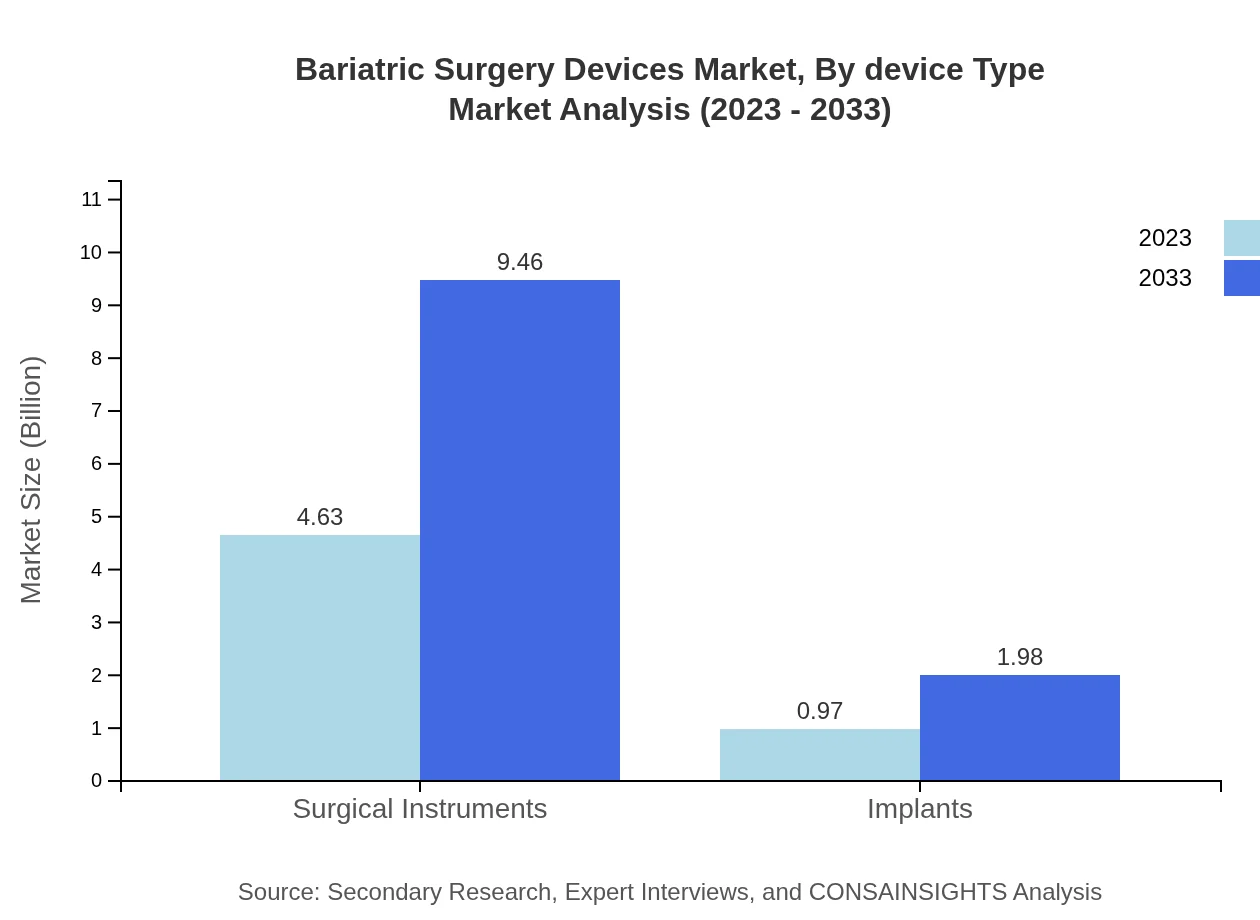
The device type segmentation indicates a strong market presence for surgical instruments, which are estimated to constitute 82.67% market share. Surgical devices are projected to have an overall size of USD $4.63 billion in 2023, growing to USD $9.46 billion by 2033. Implants follow, representing a smaller segment of 17.33% of the market, with revenues expected to double from USD $0.97 billion in 2023 to USD $1.98 billion by 2033.
Bariatric Surgery Devices Market Analysis By Surgery Type
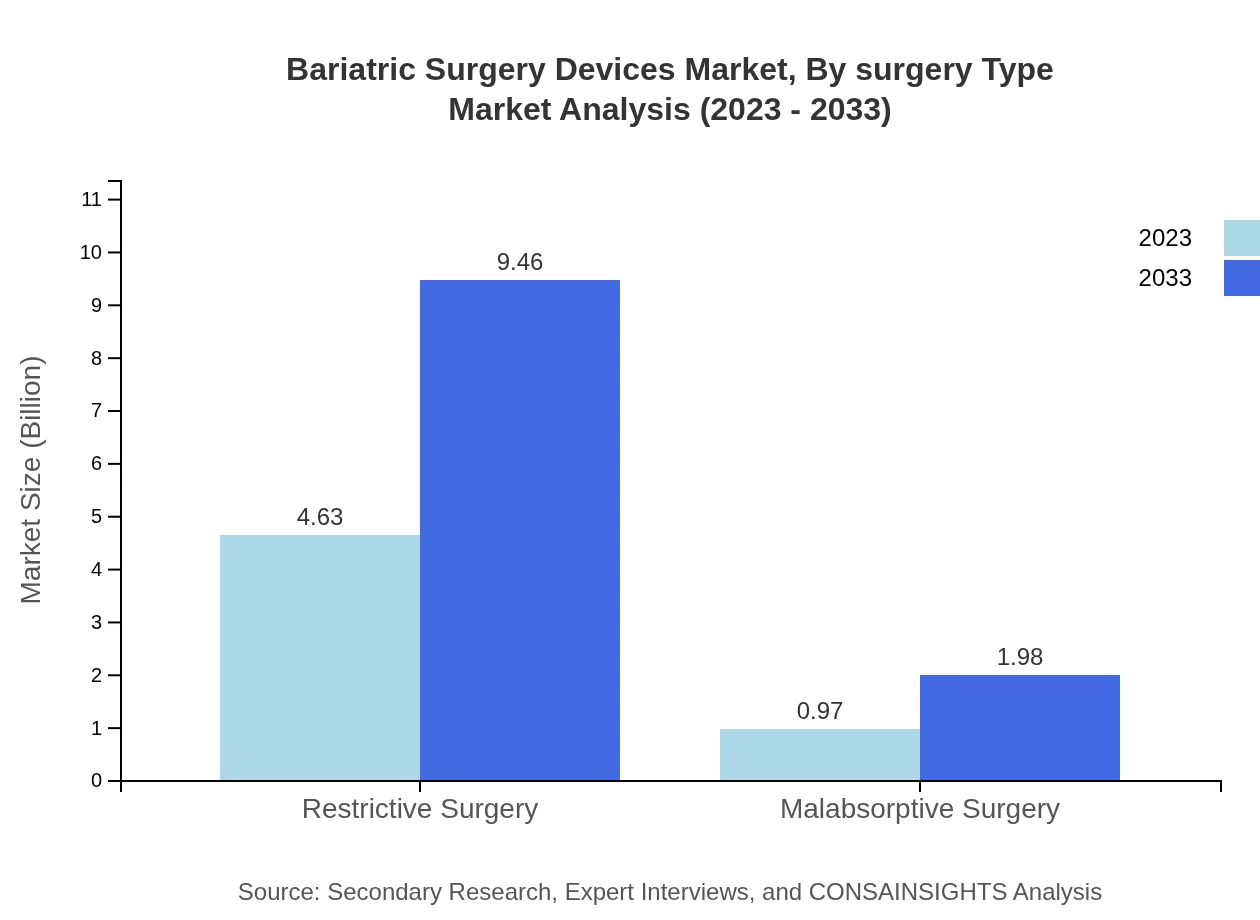
The market is divided between restrictive and malabsorptive surgeries, with restrictive surgery devices representing a larger portion at 82.67% of the market. Growth for restrictive surgery devices is expected from USD $4.63 billion in 2023 to USD $9.46 billion by 2033, highlighting its dominance in this sector.
Bariatric Surgery Devices Market Analysis By End User
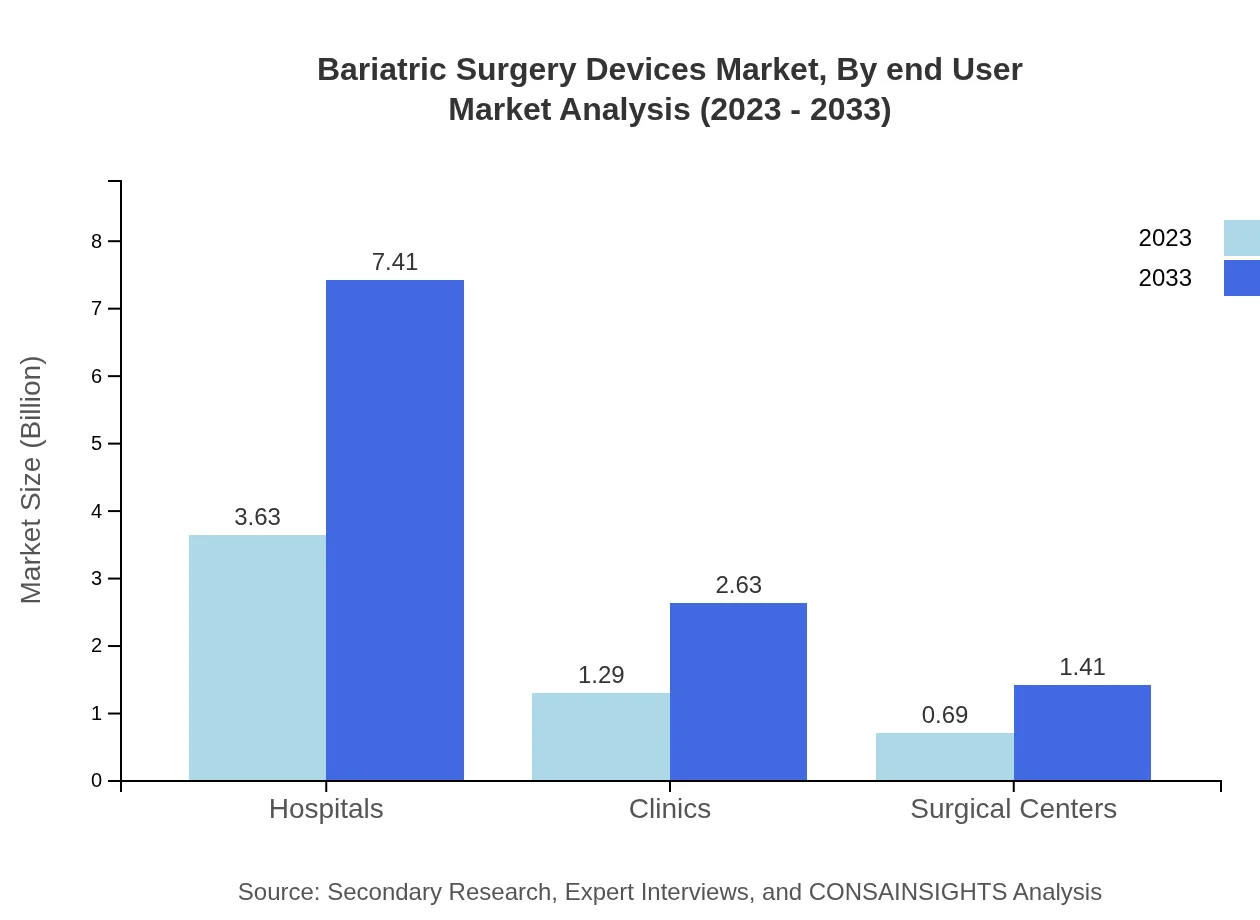
Hospitals maintain the largest share of market utilization, accounting for 64.75% with a projected size of USD $3.63 billion in 2023, increasing to USD $7.41 billion by 2033. Clinics and surgical centers also play significant roles, with market sizes of USD $1.29 billion and USD $0.69 billion, respectively, in 2023.
Bariatric Surgery Devices Market Analysis By Distribution Channel
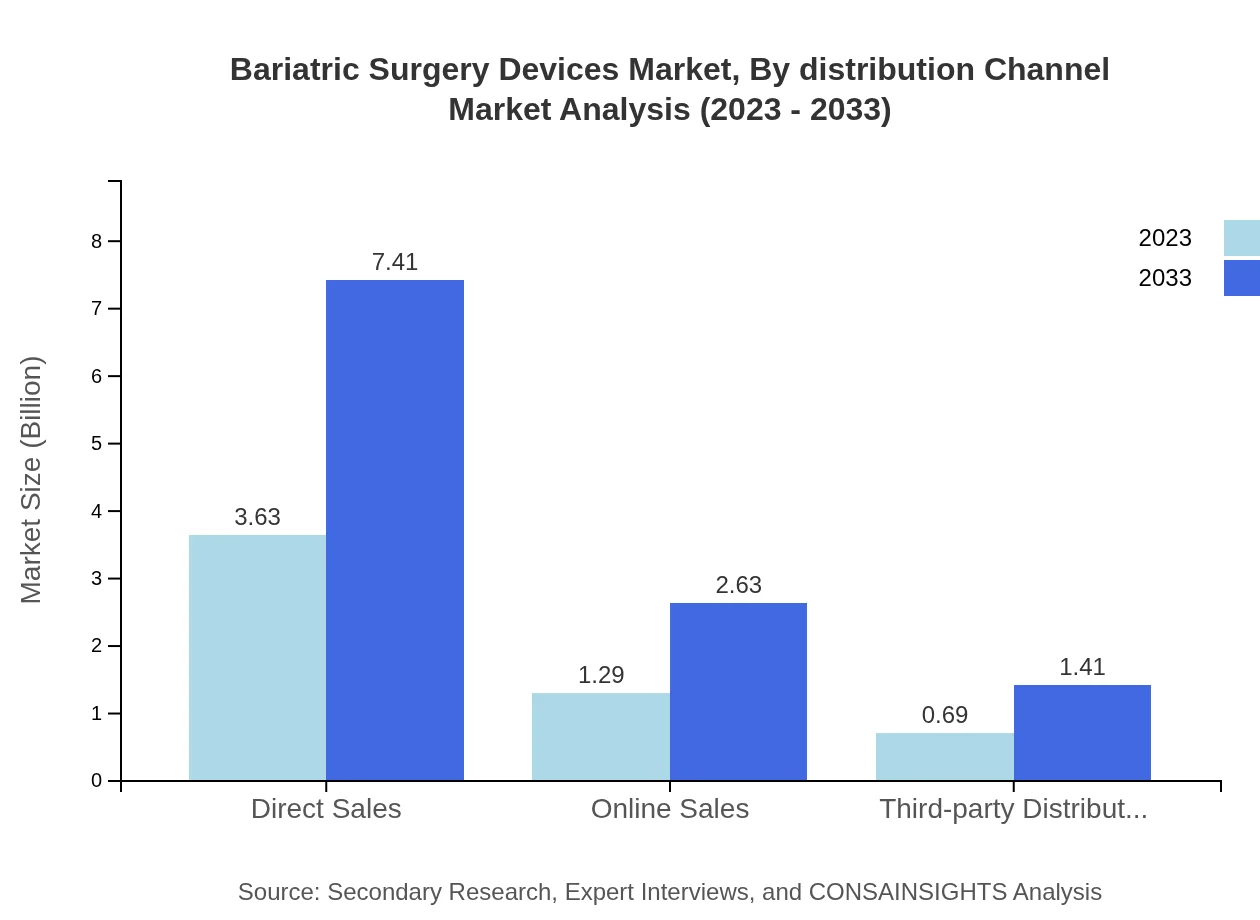
Direct sales remain the primary distribution channel with a 64.75% market share; expected to grow from USD $3.63 billion in 2023 to USD $7.41 billion by 2033. Online sales are also gaining traction, projected to grow from USD $1.29 billion to USD $2.63 billion during the same period.
Bariatric Surgery Devices Market Analysis By End User Population
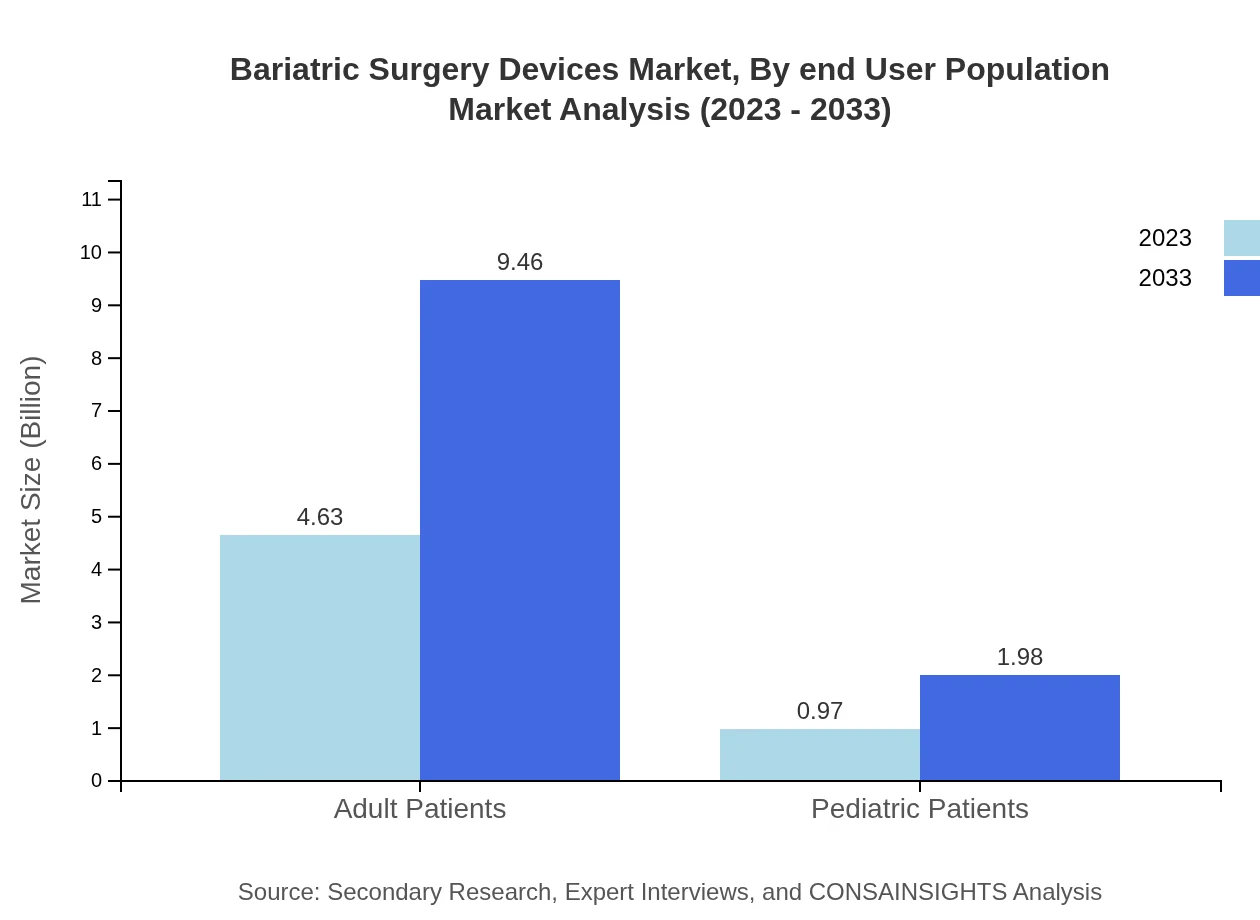
Adult patients dominate the end-user population segment, accounting for 82.67% of the market, with projected revenue growth from USD $4.63 billion in 2023 to USD $9.46 billion by 2033. Pediatric patients form a smaller segment, expected to grow from USD $0.97 billion to USD $1.98 billion over the same period.
Bariatric Surgery Devices Market Trends and Future Forecast
Tell us your focus area and get a customized research report.
Global Market Leaders and Top Companies in Bariatric Surgery Devices Industry
Ethicon, Inc.:
A subsidiary of Johnson & Johnson, Ethicon is known for producing advanced surgical devices, including minimally invasive solutions for bariatric surgery, contributing to improved patient outcomes.Medtronic :
Medtronic is a leader in medical technology that offers a wide range of devices and procedures for obesity treatment, focusing on innovative therapies and devices.Apollo Endosurgery:
Apollo Endosurgery focuses on less invasive surgical options, providing effective devices used in various bariatric procedures, enhancing patient recovery.Stryker Corporation:
Stryker is recognized for its surgical instruments and technologies for improving surgical procedures, including those used in bariatric surgeries.We're grateful to work with incredible clients.







FAQs
What is the market size of the Bariatric Surgery Devices Market Report in 2023?
The market size in 2023 is $5.60 Billion, as stated in the report inputs and used as the baseline for the 2023 to 2033 forecast period.
How big will the market be in 2033?
The market is projected to reach $11.45 Billion by 2033 according to the provided forecast figures included in the report data.
What is CAGR for the forecast period?
The compound annual growth rate for the 2023 to 2033 forecast period is 7.2%, as specified in the input data.
Why is Europe significant in this market?
Europe is the largest regional market, increasing from $1.83 Billion in 2023 to $3.74 Billion in 2033, reflecting strong regional demand and established healthcare infrastructure.
Which companies are listed as top players?
Top companies named in the input are Ethicon, Inc., Medtronic, Apollo Endosurgery, and Stryker Corporation; these represent prominent device manufacturers.
What are the main device categories covered?
Device categories in the segmentation include surgical instruments and implants, as indicated by the provided subsegment listings.
Who are the primary end Users identified?
End-user subsegments include hospitals, clinics and surgical centers, which are cited as key settings for bariatric device utilization.
How was the research conducted?
The methodology comprises primary interviews with industry experts, secondary research from company reports and publications, and data triangulation with internal validation.
What regional data is provided in the report?
Regional figures supplied include values for Europe, North America, Asia Pacific, Latin America, and Middle East and Africa with 2023 and 2033 start and end values.
Is there a single fastest Growing region in the Bariatric Surgery Devices Market Report market?
No single fastest-growing region is stated for the Bariatric Surgery Devices Market Report market because the top regional implied CAGR values are within 0.15 percentage points of each other, making the ranking too close to call reliably.