

Augmented And Virtual Reality In Healthcare Market Report
First published: 21 October 2024 | Last updated: 25 May 2026 | Report Code: augmented-and-virtual-reality-in-healthcare
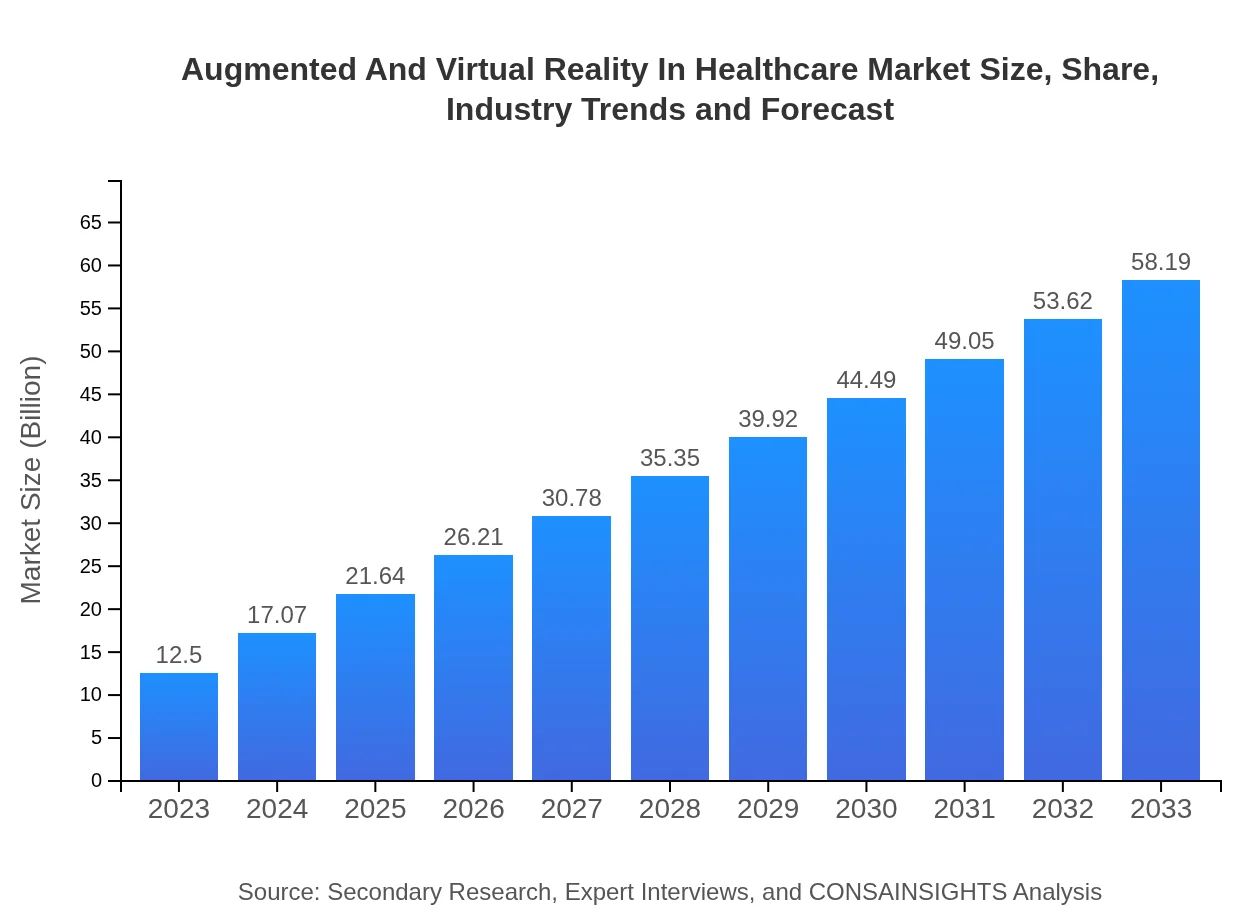
Augmented And Virtual Reality In Healthcare Market — USD 12.5 billion in 2023, Growing to USD 58.19B by 2033 at 15.8% CAGR
This detailed report covers the dynamics of the Augmented and Virtual Reality in Healthcare market from 2023 to 2033, encompassing market overview, size predictions, regional insights, key trends, and forecasts that will guide stakeholders in this rapidly evolving sector.
Key Takeaways
- Global market expands from $12.50 Billion in 2023 to $58.19 Billion in 2033, with a 15.8% CAGR over 2023 to 2033.
- North America is largest regional market, while no single fastest-growing region is stated because regional CAGR differences remain within 0.15 percentage points.
- North America is the largest region, growing from $4.54 Billion in 2023 to $21.15 Billion in 2033.
- Europe and Asia Pacific show sizable gains—Europe: $3.66 Billion to $17.06 Billion; Asia Pacific: $2.39 Billion to $11.14 Billion.
- Top vendors active in the market include Microsoft, Osso VR, PTC, and Magic Leap, supporting clinical and training solutions.
- Applications such as surgical training, rehabilitation, patient education, and pain management are central to industry uptake.
Augmented And Virtual Reality In Healthcare Market Report — Executive Summary
North America remains largest market by forecast-period value, while no single fastest-growing region is stated because top regional growth rates are separated by less than 0.15 percentage points. This report outlines the drivers and structure of the augmented and virtual reality market within healthcare through the 2023 to 2033 forecast. The market size rises from $12.50 Billion in 2023 to $58.19 Billion in 2033 at a 15.8% CAGR, supported by expanding clinical training use cases, rehabilitation programs, and patient education tools. Increased partnerships between technology providers and healthcare organizations, along with investments in software and hardware solutions, are accelerating real-world deployments. Key applications include surgical simulation, pain management, and telehealth-enabled therapies. The competitive landscape features Microsoft, Osso VR, PTC, and Magic Leap among leading providers. Segmentation spans hardware and software technologies, standalone and integrated deployments, and end-users such as hospitals, medical schools, and clinics. Regulatory adaptation and data-security considerations are ongoing structural factors that shape adoption timelines and vendor strategies.
Key Growth Drivers
- Rising demand for simulation-based medical training that reduces risk and improves clinician preparedness.
- Growing use of immersive rehabilitation and pain management programs that extend care beyond traditional clinical settings.
- Stronger collaborations between technology firms and healthcare providers enabling tailored AR/VR solutions.
- Investments in both hardware and software platforms that enhance visualization, diagnostics, and procedural planning.
- Increased acceptance of telemedicine and remote care models that integrate AR/VR for patient engagement.
| Metric | Value |
|---|---|
| Study Period | 2023 - 2033 |
| 2023 Market Size | $12.50 Billion |
| CAGR (2023-2033) | 15.8% |
| 2033 Market Size | $58.19 Billion |
| Top Companies | Microsoft, Osso VR, PTC, Magic Leap |
| Published Date | 21 October 2024 |
| Last Modified Date | 25 May 2026 |
Augmented And Virtual Reality In Healthcare Market Overview
Customize Augmented And Virtual Reality In Healthcare Market Report market research report
- ✔ Get in-depth analysis of Augmented And Virtual Reality In Healthcare market size, growth, and forecasts.
- ✔ Understand Augmented And Virtual Reality In Healthcare's regional dynamics and industry-specific trends.
- ✔ Identify potential applications, end-user demand, and growth segments in Augmented And Virtual Reality In Healthcare
What is the Market Size & CAGR of Augmented And Virtual Reality In Healthcare Market Report market in 2023?
Augmented And Virtual Reality In Healthcare Industry Analysis
Augmented And Virtual Reality In Healthcare Market Segmentation and Scope
Tell us your focus area and get a customized research report.
Augmented And Virtual Reality In Healthcare Market Report Market Analysis Report by Region
Europe Augmented And Virtual Reality In Healthcare Market Report:
Europe grows from $3.66 Billion in 2023 to $17.06 Billion in 2033. 66 Billion in 2023 to $17.06 Billion in 2033, supported by expanding hospital deployments, increased use in medical education, and cross-sector partnerships that adapt AR/VR for patient rehabilitation and telehealth use cases.Asia Pacific Augmented And Virtual Reality In Healthcare Market Report:
Asia Pacific grows from $2.39 Billion in 2023 to $11.14 Billion in 2033. 39 Billion in 2023 to $11.14 Billion in 2033, driven by rising healthcare investments, growing interest in training technologies, and broader acceptance of digital therapeutics including rehabilitation and pain-management solutions.North America Augmented And Virtual Reality In Healthcare Market Report:
North America is largest regional market, rising from $4.54 Billion in 2023 to $21.15 Billion in 2033. Adoption is propelled by strong vendor presence, clinical trial activity, and institutional demand for simulation-based training and surgical visualization tools.South America Augmented And Virtual Reality In Healthcare Market Report:
Latin America grows from $0.16 Billion in 2023 to $0.73 Billion in 2033. 16 Billion in 2023 to $0.73 Billion in 2033, with uptake influenced by targeted clinical programs, partnerships to deploy cost-effective solutions, and growing interest in immersive training and patient education.Middle East & Africa Augmented And Virtual Reality In Healthcare Market Report:
Middle East and Africa grows from $1.74 Billion in 2023 to $8.12 Billion in 2033. 74 Billion in 2023 to $8.12 Billion in 2033, propelled by investments in healthcare infrastructure, adoption of advanced visualization tools for surgical planning, and expanding rehabilitation and training initiatives.Tell us your focus area and get a customized research report.
Research Methodology
Augmented And Virtual Reality In Healthcare Market Analysis By Application
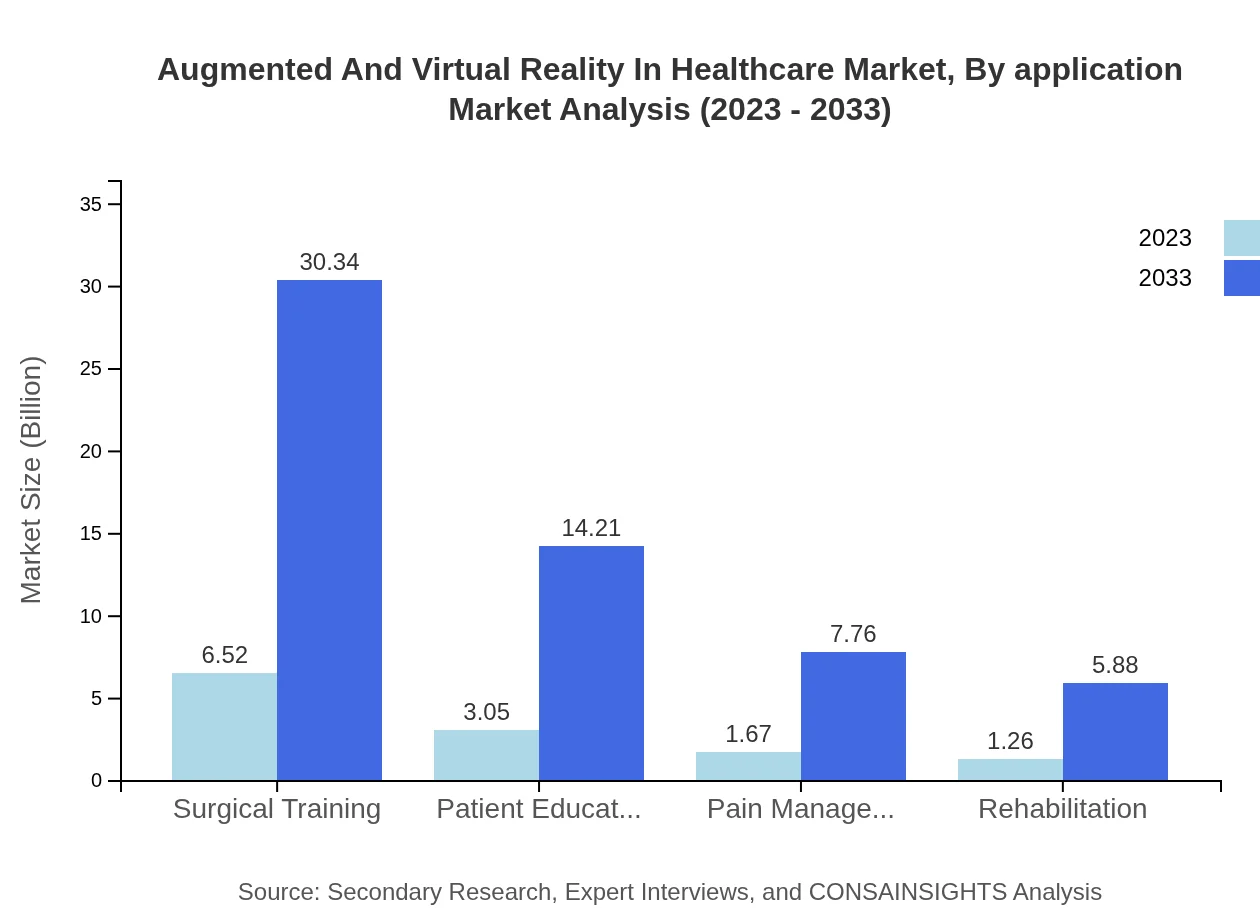
The Augmented and Virtual Reality applications in healthcare are set to reach $35.78 billion by 2033, split across several significant segments. Medical training and surgical simulations dominate, with a market share of 52% as hospitals increasingly adopt AR/VR for skill improvement. Patient education represents another vital area, expected to deliver $14.21 billion, enhancing patient engagement in their treatment plans.
Augmented And Virtual Reality In Healthcare Market Analysis By Technology
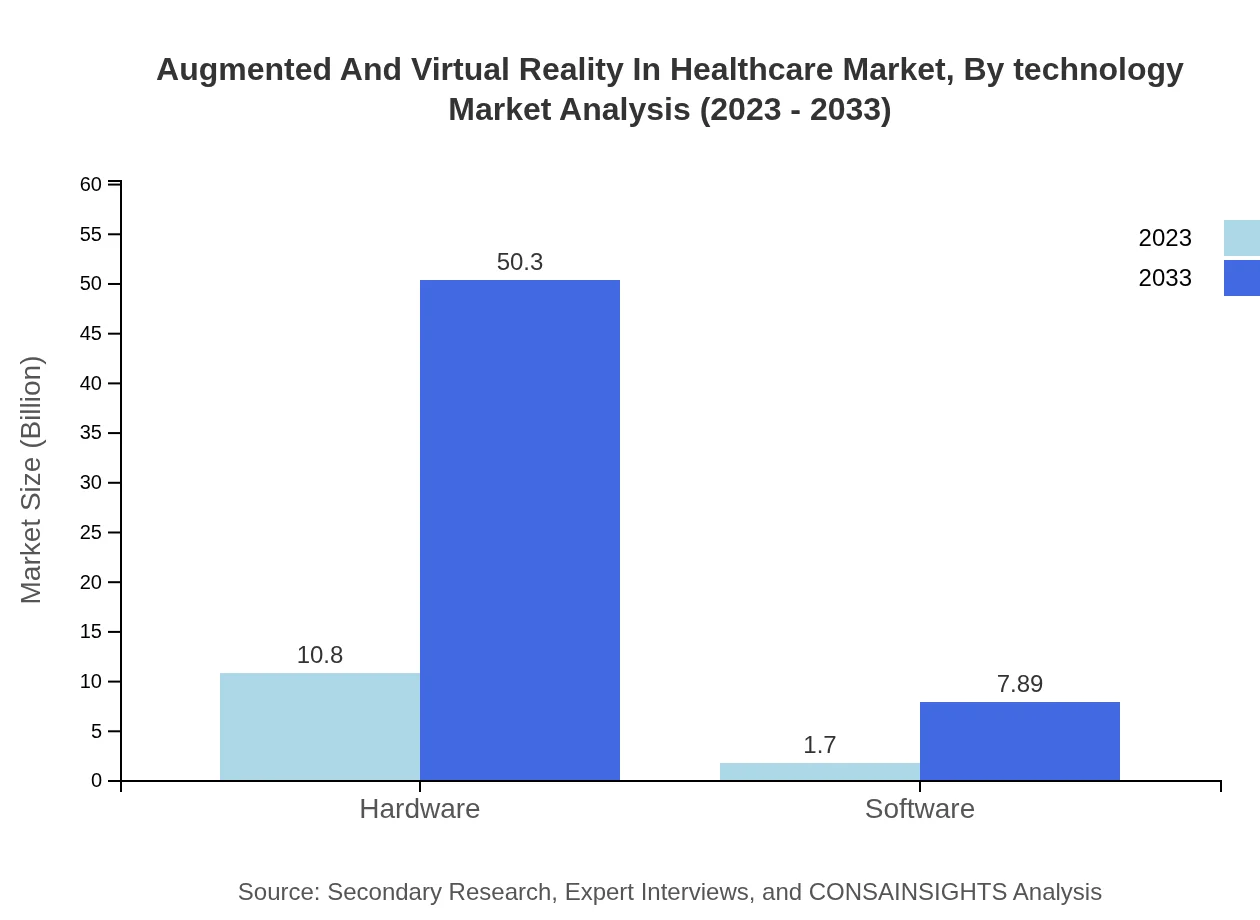
Hardware solutions, encompassing advanced VR headsets and haptic feedback devices, will account for a significant portion of the market, reaching $50.30 billion by 2033. On the other hand, software applications used for simulations and training are projected to reach $7.89 billion, highlighting the essential role of integrated software and data analytics.
Augmented And Virtual Reality In Healthcare Market Analysis By End User
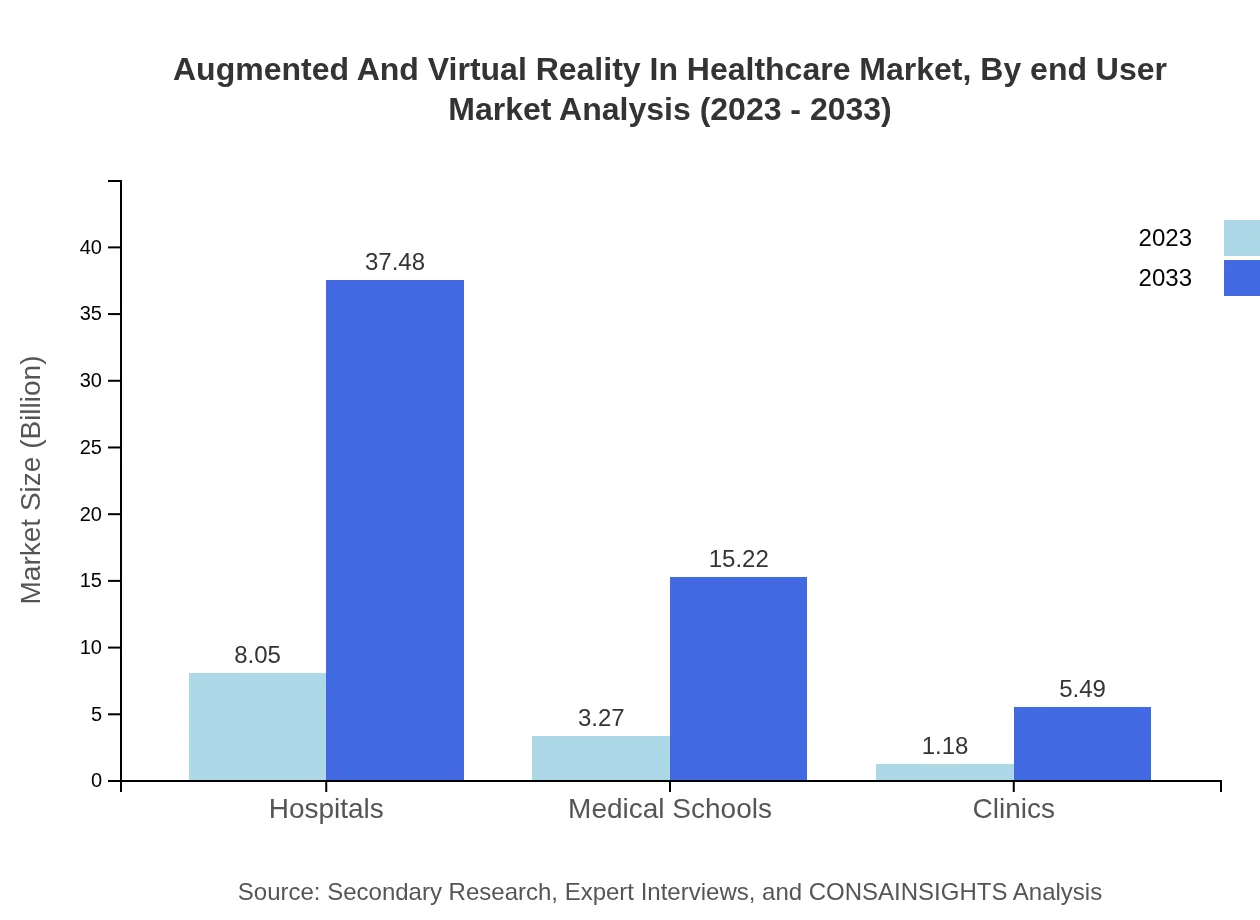
Hospitals will remain the key end-user segment, growing from $8.05 billion in 2023 to $37.48 billion by 2033, which reflects their substantial investment in AR/VR technologies for operational efficiency. Medical schools and clinics are also witnessing growth as they adopt AR simulations for teaching purposes and patient interactions.
Augmented And Virtual Reality In Healthcare Market Analysis By Region
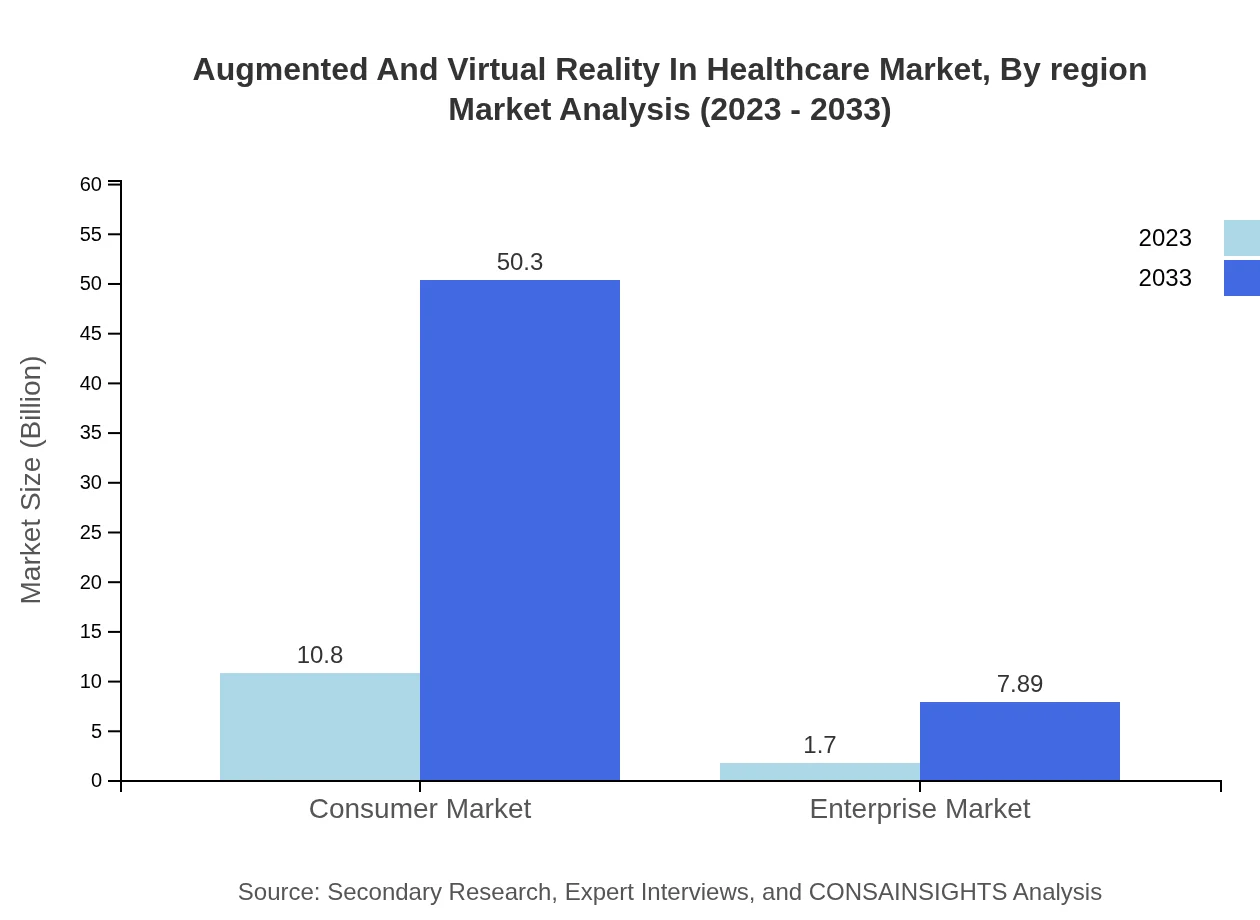
The regional analysis indicates a competitive landscape across North America, Europe, Asia Pacific, South America, and the Middle East & Africa, with North America holding the largest share, followed closely by Europe and Asia Pacific, which are accelerating their technological integration in healthcare practices.
Augmented And Virtual Reality In Healthcare Market Analysis By Integration
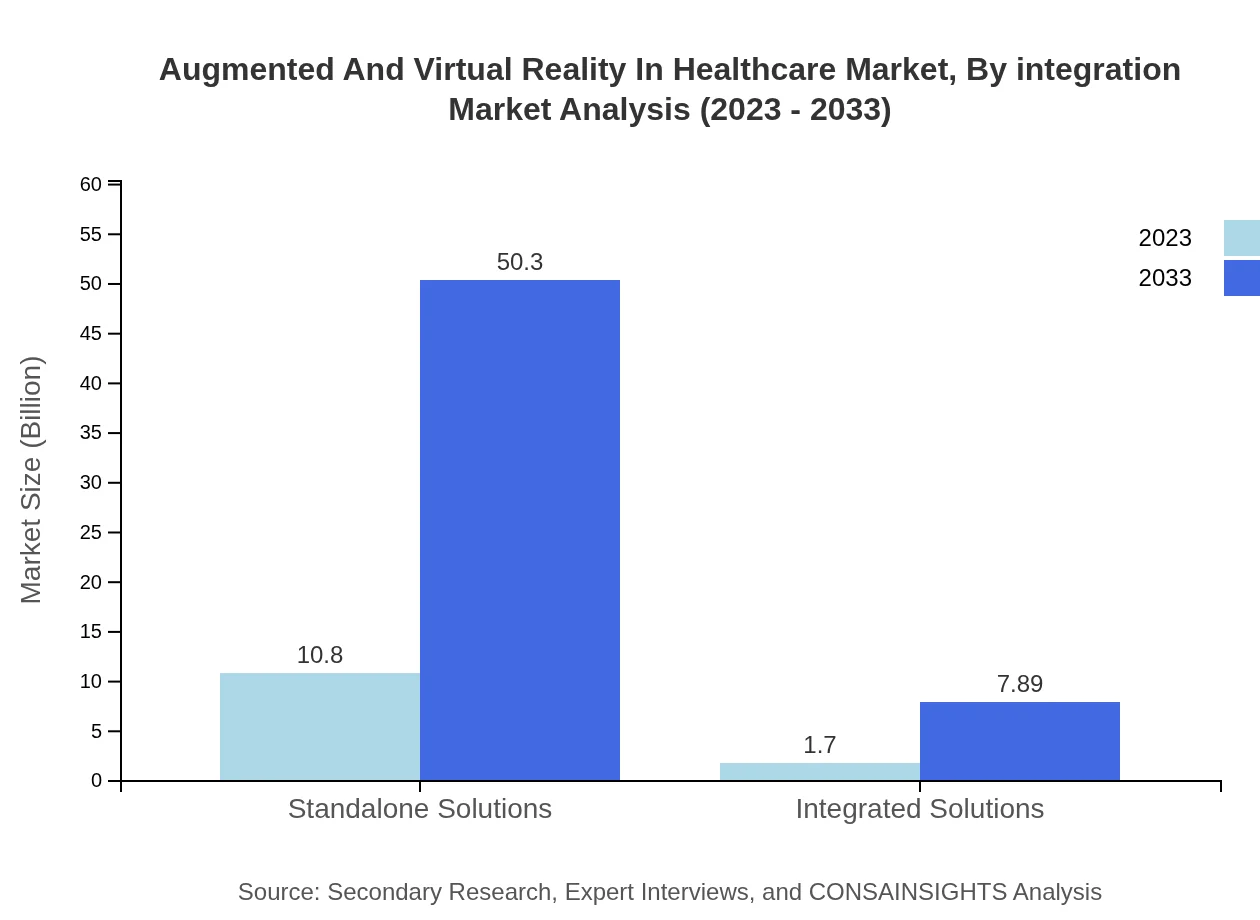
The integration level market reveals a significant divide between standalone and integrated solutions. Standalone AR/VR solutions are anticipated to dominate, with a share of 86.44% by 2033, while integrated AR/VR solutions are expected to capture a share of 13.56%, driven by increasing demand for comprehensive healthcare software solutions.
Augmented And Virtual Reality In Healthcare Market Trends and Future Forecast
Tell us your focus area and get a customized research report.
Global Market Leaders and Top Companies in Augmented And Virtual Reality In Healthcare Industry
Microsoft:
Microsoft has been at the forefront of AR technology in healthcare through its Microsoft HoloLens, offering next-gen surgical solutions and immersive medical training applications.Osso VR:
Osso VR specializes in VR surgical training solutions, providing healthcare professionals with lifelike simulation experiences to improve their skills and patient outcomes.PTC:
PTC provides AR solutions that enhance service and operations in medical devices, streamlining healthcare processes and training for healthcare systems.Magic Leap:
Magic Leap is developing AR technology for healthcare that allows users to visualize and interact with 3D images, which can be utilized for training and procedural workflows.We're grateful to work with incredible clients.









FAQs
What is the current market size of the augmented and virtual reality in healthcare market?
The market size was $12.50 Billion in 2023, as stated in the report data for the 2023 baseline year.
How big is the projected market by 2033?
The market is projected to reach $58.19 Billion by 2033 according to the provided forecast figures.
What is CAGR of the market for the forecast period?
The reported compound annual growth rate (CAGR) for the 2023 to 2033 forecast period is 15.8%.
Is there a single fastest Growing region in the Augmented And Virtual Reality In Healthcare Market Report market?
No single fastest-growing region is stated for the Augmented And Virtual Reality In Healthcare Market Report market because the top regional implied CAGR values are within 0.15 percentage points of each other, making the ranking too close to call reliably.
Which companies are named as top players in the market?
Top companies listed in the report include Microsoft, Osso VR, PTC, and Magic Leap, representing hardware and software solutions.
What are the primary applications driving adoption?
Key applications include surgical training, patient education, pain management, and rehabilitation, all highlighted as important use cases.
How is segmentation defined in the report?
Segmentation covers technology (hardware, software), integration (standalone, integrated), end-users (hospitals, medical schools, clinics) and regional markets.
What methodology underpins the research findings?
The study uses primary interviews, secondary company reports and publications, data triangulation, and expert-led trend analysis for validation.
What regional markets are covered in the analysis?
Regional coverage includes North America, Europe, Asia Pacific, Latin America, and Middle East and Africa with specific 2023 and 2033 values provided.
Why are partnerships between tech firms and healthcare providers important?
Partnerships facilitate product integration, clinical validation, and deployment at scale, accelerating adoption of AR/VR in care pathways.