
Reports >
Life Sciences
>
Biosimulation Market Report

Biosimulation Market Report
First published: 21 October 2024 | Last updated: 25 May 2026 | Report Code: biosimulation
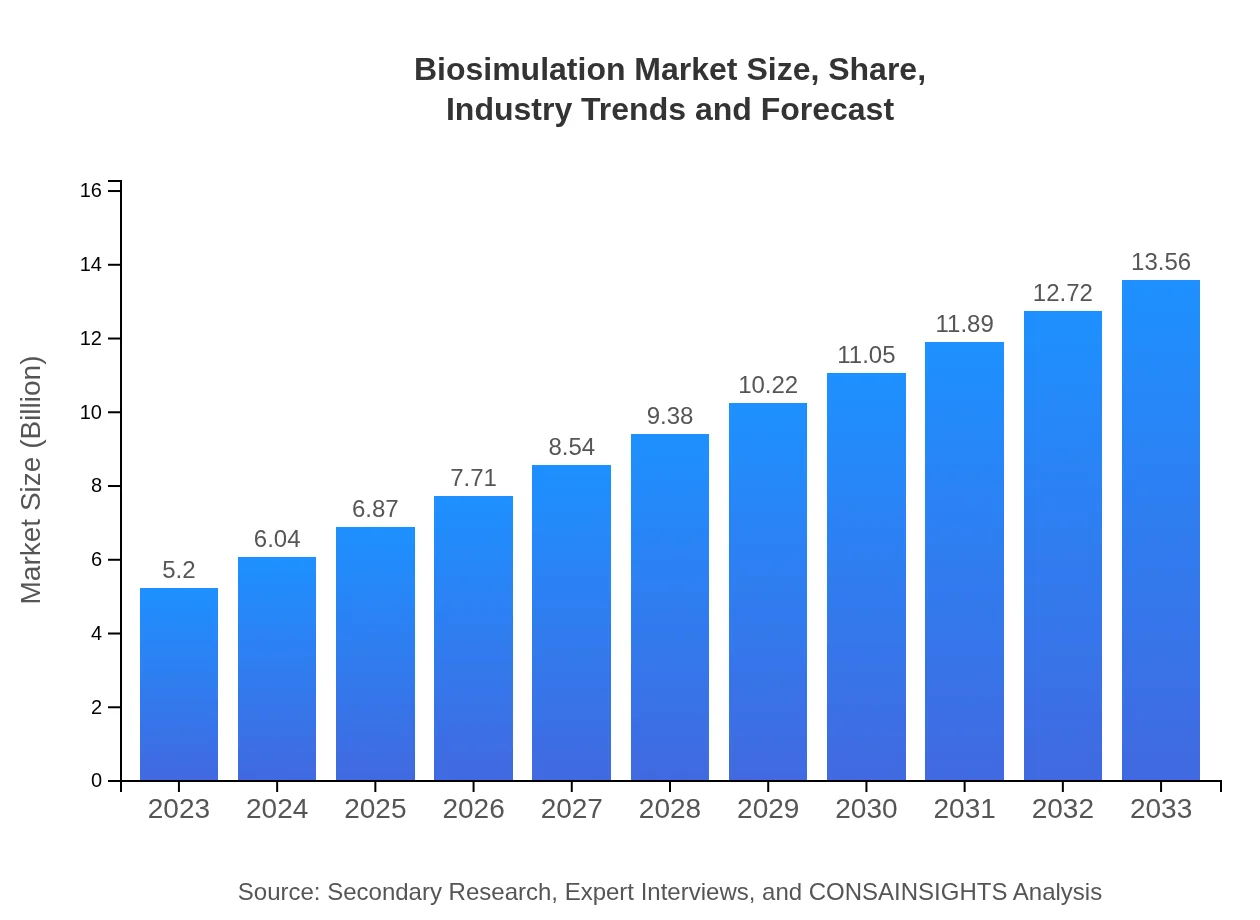
Biosimulation Market — USD 5.2 billion in 2023, Growing to USD 13.56B by 2033 at 9.7% CAGR
This report provides an in-depth analysis of the biosimulation market from 2023 to 2033, highlighting key trends, current market conditions, segmentation, regional insights, and a forecast of growth and challenges in the industry.
Key Takeaways
- Global market value grows from $5.20 Billion in 2023 to $13.56 Billion in 2033 at a 9.7% CAGR.
- North America is largest regional market, while no single fastest-growing region is stated because regional CAGR differences remain within 0.15 percentage points.
- Europe expands from $1.61 Billion to $4.19 Billion between 2023 and 2033, indicating sustained regional adoption.
- Asia Pacific increases from $0.93 Billion to $2.44 Billion over the forecast period, reflecting investment in computational drug development.
- Top companies include Certara, Simulations Plus, Rhenovia Pharma, and Insilico Medicine, driving software and modeling advances.
Biosimulation Market Report — Executive Summary
North America remains largest market by forecast-period value, while no single fastest-growing region is stated because top regional growth rates are separated by less than 0.15 percentage points. This report examines the biosimulation market across software types, techniques, applications, end users and geographies. Market size rises from $5.20 Billion in 2023 to $13.56 Billion in 2033 at a 9.7% CAGR. Growth is driven by demand for more efficient drug development, regulatory acceptance of modeling approaches, and adoption across pharmaceutical, biotechnology and academic institutions. The analysis highlights product segmentation such as cloud-based solutions and licensed software, techniques including in silico and in vitro simulation, and applications from drug discovery to clinical trials. Coverage includes regional trajectories, with North America identified as the largest regional market. Leading vendors like Certara and Simulations Plus are profiled for their role in advancing predictive modeling capabilities.
Key Growth Drivers
- Rising need for cost-efficient drug development workflows that lower time and resource requirements.
- Regulatory agencies increasingly considering simulation data when evaluating drug efficacy and safety.
- Greater adoption of biosimulation by pharmaceutical and biotechnology companies to de-risk clinical programs.
- Advances in modeling methodologies and integration with biological datasets improving predictive accuracy.
- Growing use of cloud-based solutions that enable scalable deployment of biosimulation platforms.
| Metric | Value |
|---|---|
| Study Period | 2023 - 2033 |
| 2023 Market Size | $5.20 Billion |
| CAGR (2023-2033) | 9.7% |
| 2033 Market Size | $13.56 Billion |
| Top Companies | Certara, Simulations Plus, Rhenovia Pharma, Insilico Medicine |
| Published Date | 21 October 2024 |
| Last Modified Date | 25 May 2026 |
Biosimulation Market Overview
Customize Biosimulation Market Report market research report
- ✔ Get in-depth analysis of Biosimulation market size, growth, and forecasts.
- ✔ Understand Biosimulation's regional dynamics and industry-specific trends.
- ✔ Identify potential applications, end-user demand, and growth segments in Biosimulation
What is the Market Size & CAGR of Biosimulation Market Report market in 2023?
Biosimulation Industry Analysis
Biosimulation Market Segmentation and Scope
Tell us your focus area and get a customized research report.
Biosimulation Market Report Market Analysis Report by Region
Europe Biosimulation Market Report:
Europe grows from $1.61 Billion in 2023 to $4.19 Billion in 2033. Adoption in this region is driven by strong life-sciences research hubs, pharmaceutical R&D investments, and increasing incorporation of simulation into development pipelines.Asia Pacific Biosimulation Market Report:
Asia Pacific grows from $0.93 Billion in 2023 to $2.44 Billion in 2033. Expansion is propelled by rising biopharma investment, growing computational capacity, and demand for efficient development tools in emerging markets.North America Biosimulation Market Report:
North America is largest regional market, rising from $1.96 Billion in 2023 to $5.1 Billion in 2033. Regional growth is supported by dense pharmaceutical and biotech activity, investment in computational methods, and early regulatory engagement with modeling approaches.South America Biosimulation Market Report:
Latin America grows from $0.3 Billion in 2023 to $0.78 Billion in 2033. Uptake is influenced by expanding clinical research activities and gradual adoption of modeling practices in regional pharmaceutical and research institutions.Middle East & Africa Biosimulation Market Report:
Middle East and Africa grows from $0.41 Billion in 2023 to $1.06 Billion in 2033. Growth factors include increasing investment in life-sciences infrastructure and a gradual increase in use of computational methods for research and development.Tell us your focus area and get a customized research report.
Research Methodology
Biosimulation Market Analysis By Technique
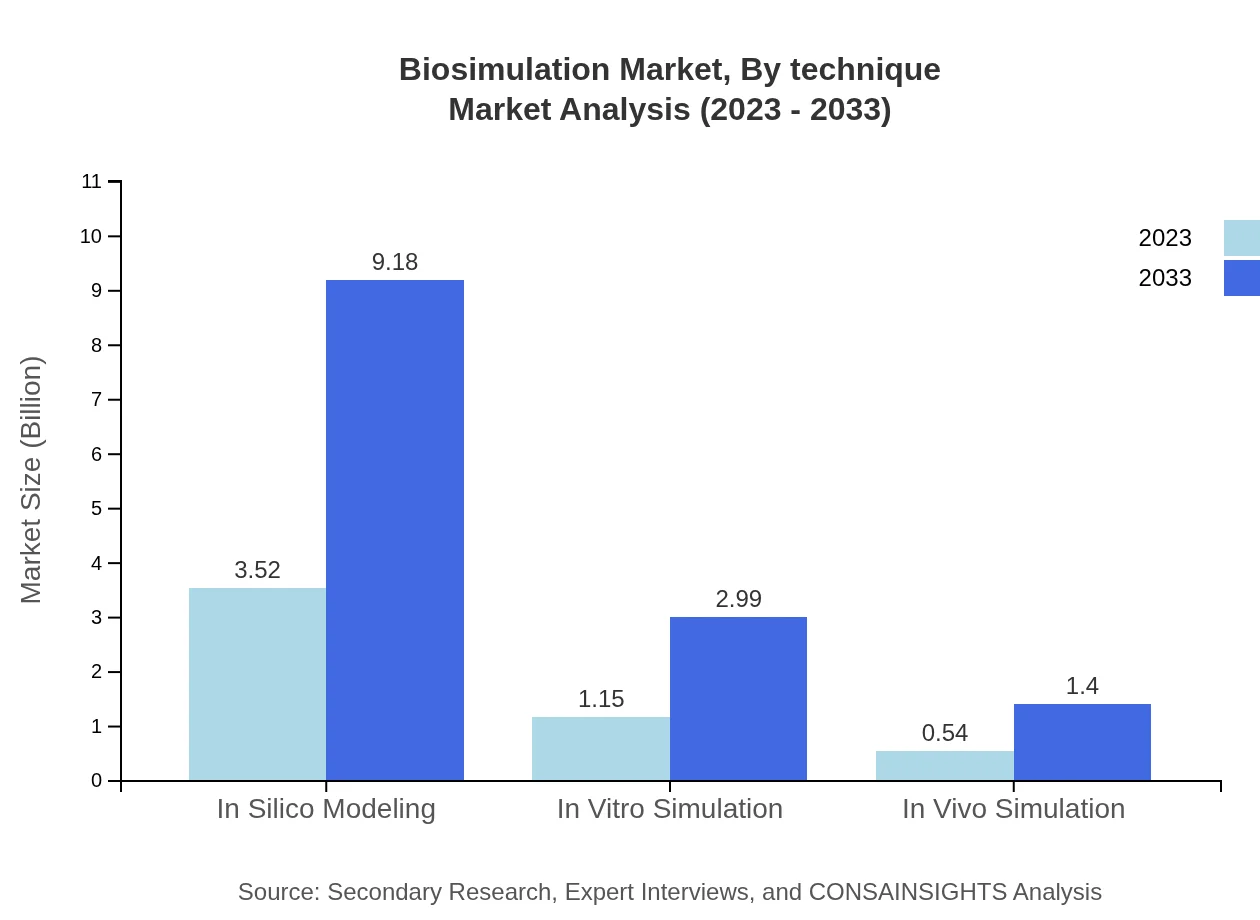
The technique segment encompasses in silico modeling, in vitro simulation, and in vivo simulation approaches. In silico modeling dominates the market, representing 67.66% share due to its applications in drug discovery processes. In vitro and in vivo simulations, while smaller at 22.05% and 10.29% respectively, are vital for testing biological impact and toxicity of compounds.
Biosimulation Market Analysis By Application
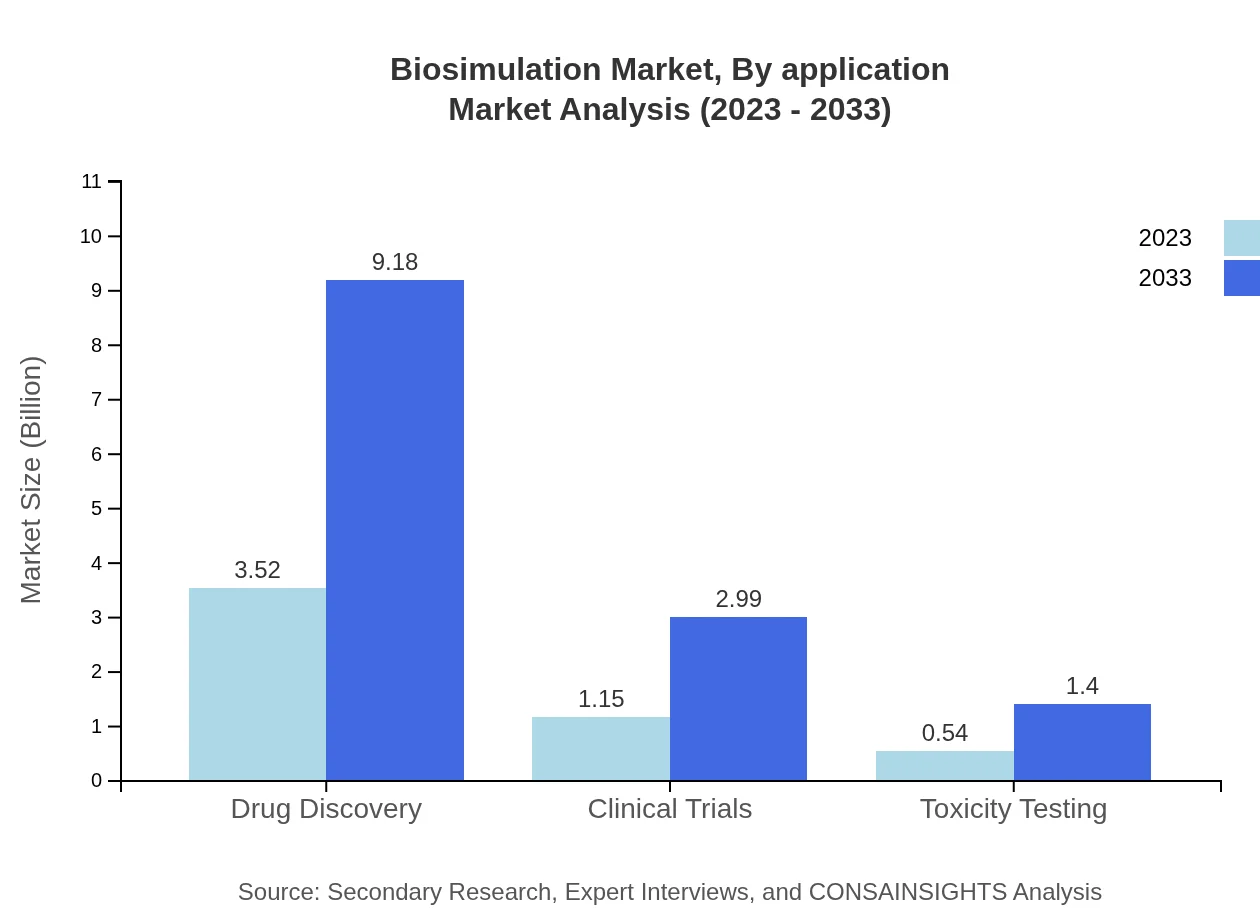
Drug discovery leads this segment, holding a share of 67.66% due to its integration in initial drug development phases. Clinical trials and toxicity testing contribute with shares of 22.05% and 10.29%, respectively, reflecting their crucial roles in validating drug efficacy and safety.
Biosimulation Market Analysis By Software Type
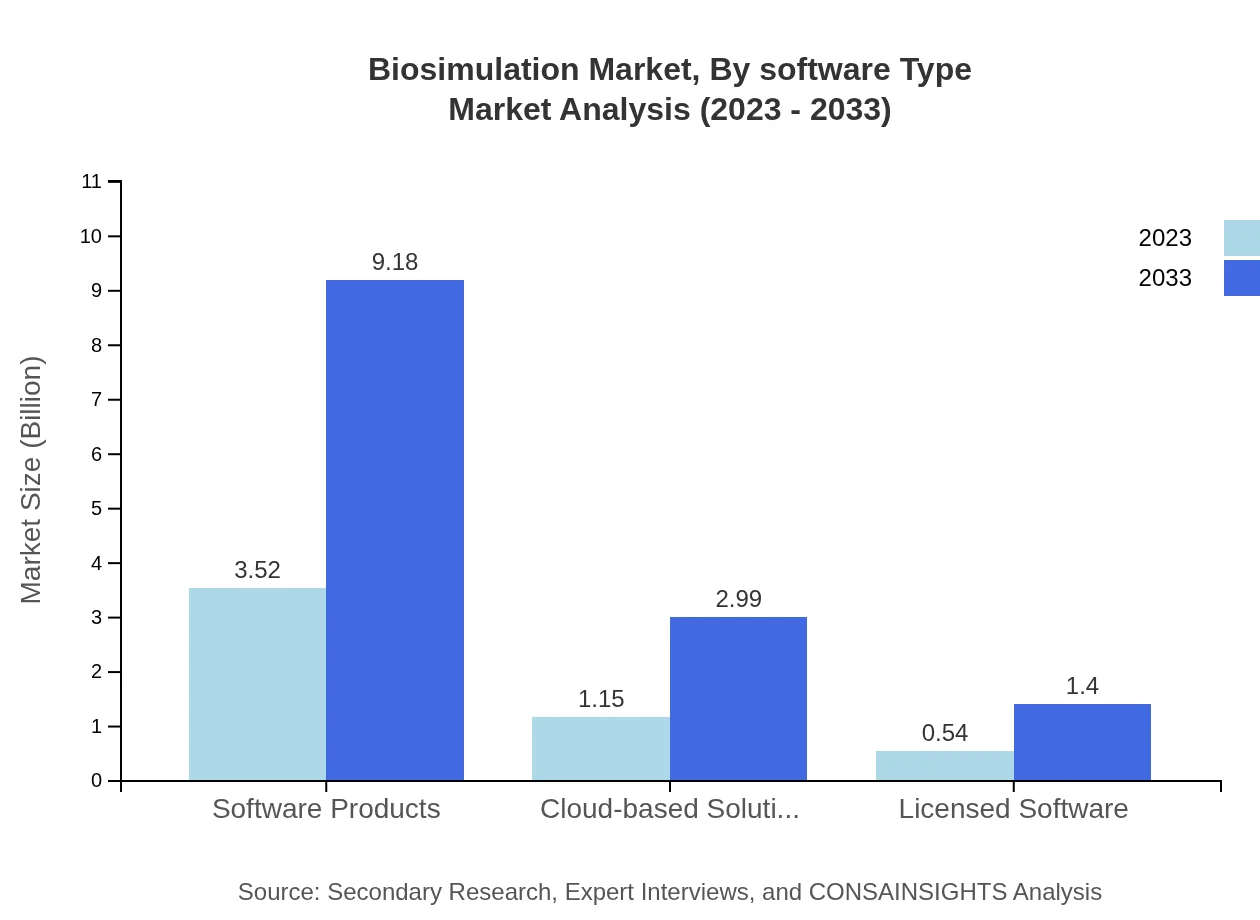
Software products represent the bulk of the market at 67.66%, focusing on in silico modeling applications. Cloud-based solutions are gaining traction, accounting for 22.05% of the share as they offer flexible, scalable options for biotech companies, while licensed software comprises 10.29%.
Biosimulation Market Analysis By End User
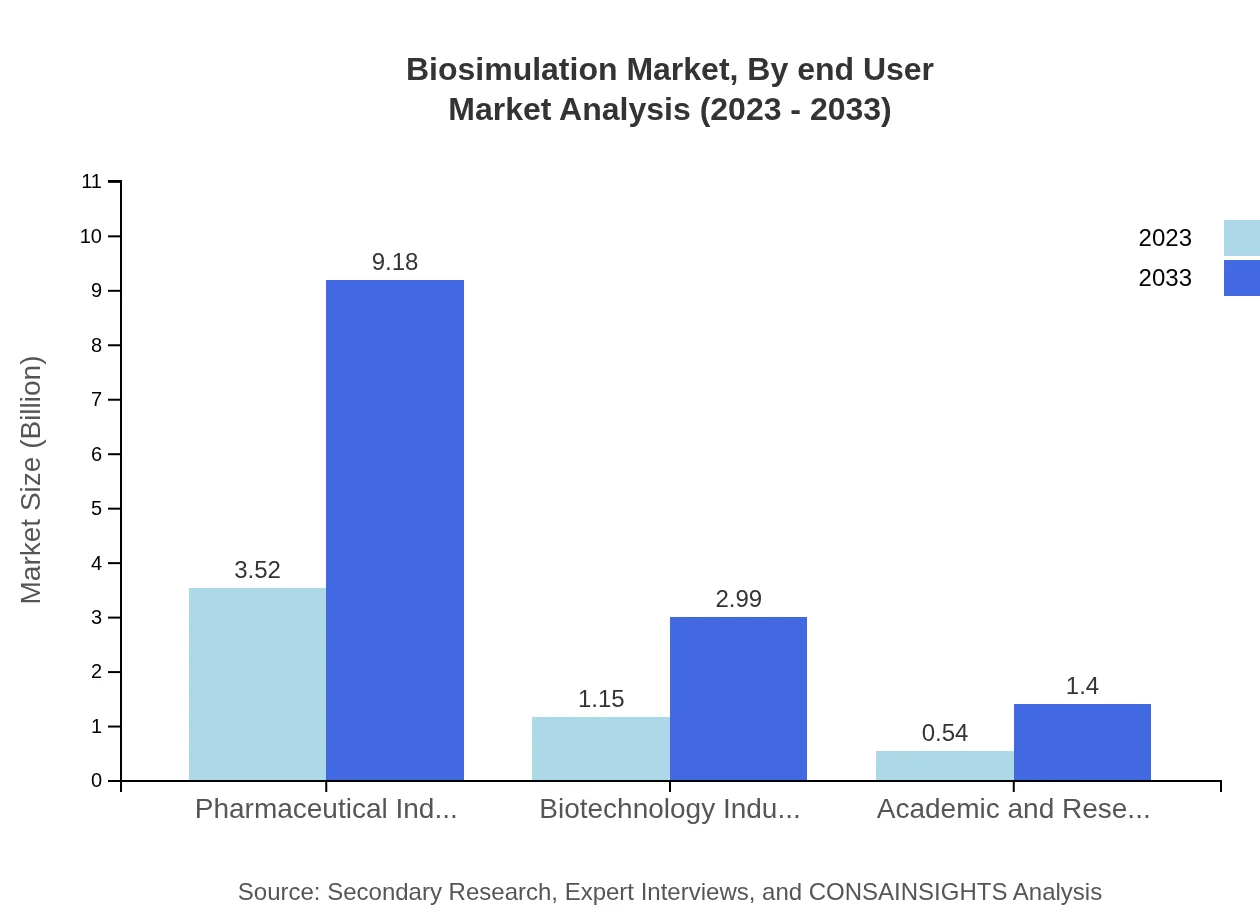
The pharmaceutical industry is the largest end-user, owning 67.66% of the market share as companies leverage biosimulation for drug development. The biotechnology sector accounts for 22.05%, while academic and research institutes hold 10.29% of the market, allowing for educational and foundational research applications.
Biosimulation Market Analysis By Region
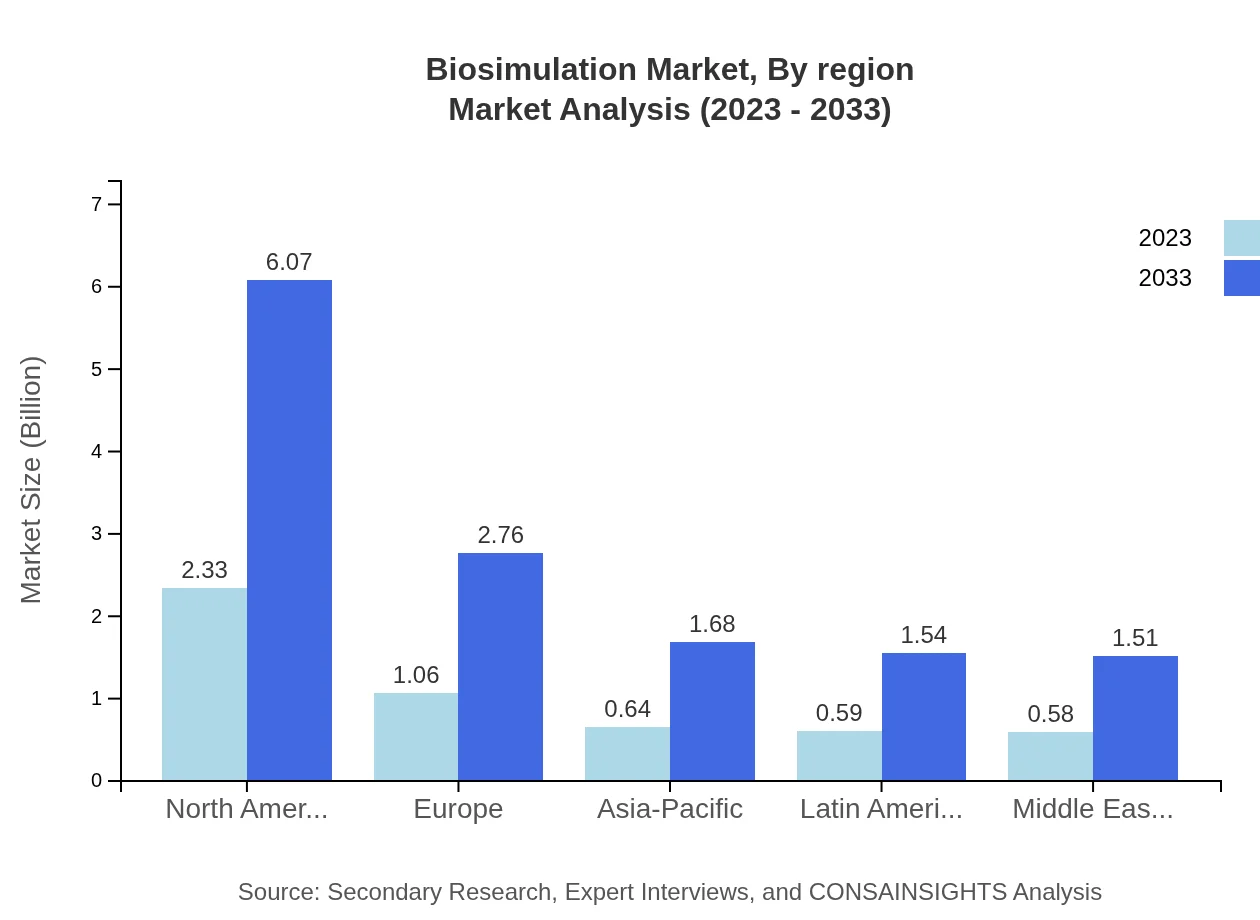
Regional analysis shows North America as the market leader at 44.73% share, driven by innovation and R&D investments. Europe follows with 20.37% share, emphasizing regulatory acceptance. Asia Pacific and Latin America contribute with 12.38% and 11.36% shares respectively as emerging markets ramp up investment in health technologies.
Biosimulation Market Trends and Future Forecast
Tell us your focus area and get a customized research report.
Global Market Leaders and Top Companies in Biosimulation Industry
Certara:
Certara is a leading biosimulation company providing cutting-edge modeling and simulation software, enhancing drug development across FDA-regulated industries.Simulations Plus:
Simulations Plus specializes in software for drug discovery and development, leveraging advanced modeling technologies to predict pharmacokinetics and pharmacodynamics.Rhenovia Pharma:
Rhenovia Pharma focuses on creating computational modeling tools for drug discovery and development, contributing significantly to the biosimulation landscape.Insilico Medicine:
Insilico Medicine utilizes AI and machine learning in biosimulation, providing insights for drug development and personalized therapies.We're grateful to work with incredible clients.








FAQs
What is the market size of the biosimulation market in 2023?
The market size in 2023 is $5.20 Billion, as reported for the biosimulation market for the base year of the study.
How big will the market be in 2033?
By 2033 the market is projected to reach $13.56 Billion according to the forecast included in the report.
What is CAGR of the forecast period?
The compound annual growth rate (CAGR) for the 2023 to 2033 forecast period is stated as 9.7%.
Is there a single fastest Growing region in the Biosimulation Market Report market?
No single fastest-growing region is stated for the Biosimulation Market Report market because the top regional implied CAGR values are within 0.15 percentage points of each other, making the ranking too close to call reliably.
Which companies are leading in biosimulation?
Top companies identified include Certara, Simulations Plus, Rhenovia Pharma, and Insilico Medicine as notable market participants.
What end users adopt biosimulation solutions?
Primary end users include the pharmaceutical industry, biotechnology firms, and academic and research institutes utilizing modeling for development and research.
How are software types categorized in the report?
Software categories covered include software products, cloud-based solutions, and licensed software as distinct software-type segments.
What techniques are addressed in the analysis?
The report examines in silico modeling, in vitro simulation, and in vivo simulation as core technique segments within biosimulation.