
Reports >
Life Sciences
>
Cancer Immunotherapy Market Report

Cancer Immunotherapy Market Report
First published: 08 October 2024 | Last updated: 25 May 2026 | Report Code: cancer-immunotherapy
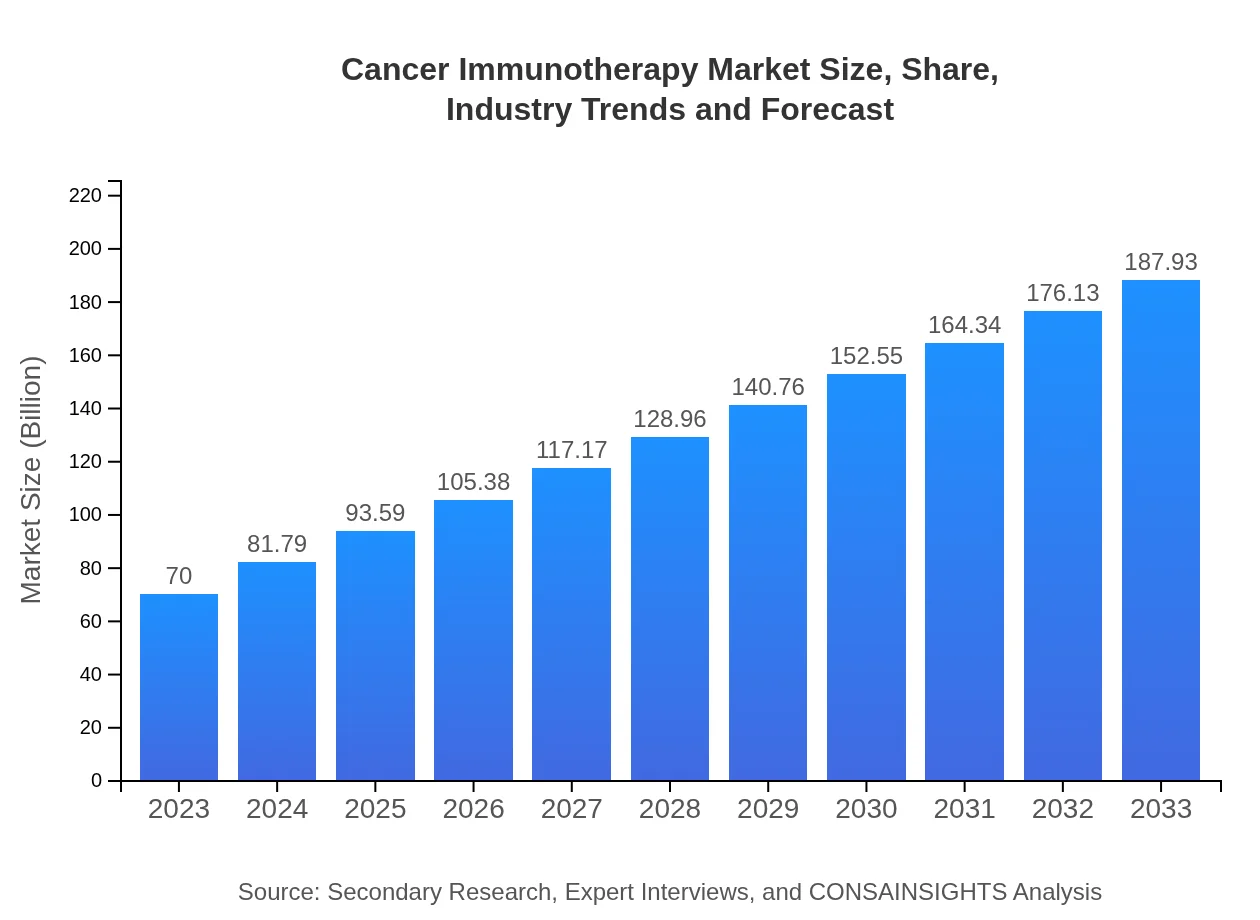
Cancer Immunotherapy Market — USD 70 billion in 2023, Growing to USD 187.93B by 2033 at 10% CAGR
This report provides an in-depth analysis of the Cancer Immunotherapy market, covering market sizes, trends, regional insights, and forecasts from 2023 to 2033. It offers valuable insights into the industry dynamics influencing growth and development in this rapidly evolving sector.
Key Takeaways
- Global market value rises from $70.00 Billion in 2023 to $187.93 Billion in 2033 at a 10% CAGR.
- North America is largest regional market, while no single fastest-growing region is stated because regional CAGR differences remain within 0.15 percentage points.
- Regional expansions are notable across Europe ($17.35B to $46.57B) and Asia Pacific ($15.34B to $41.19B) between 2023 and 2033.
- Leading firms include Roche, Bristol-Myers Squibb, Merck & Co., and Novartis, driving product innovation and approvals.
- Key therapy classes tracked include monoclonal antibodies, checkpoint inhibitors, cancer vaccines, and cellular therapies.
Cancer Immunotherapy Market Report — Executive Summary
North America remains largest market by forecast-period value, while no single fastest-growing region is stated because top regional growth rates are separated by less than 0.15 percentage points. The Cancer Immunotherapy Market Report examines an expanding industry valued at $70.00 Billion in 2023 and projected to reach $187.93 Billion by 2033, reflecting a 10% CAGR over 2023 to 2033. Growth is supported by scientific advancements in monoclonal antibodies, checkpoint inhibitors, cancer vaccines and cellular therapies, and by increasing research and clinical activity. North America represents the largest regional market, rising from $22.49 Billion to $60.38 Billion in the forecast period. Europe, Asia Pacific, Latin America, and the Middle East and Africa also show significant increases in absolute market size. Major companies such as Roche, Bristol-Myers Squibb, Merck & Co., and Novartis play central roles through product portfolios and development pipelines. This report covers market segmentation by therapy type, cancer type, end user and distribution channel, and assesses commercial dynamics and adoption drivers that influence investment and strategic planning.
Key Growth Drivers
- Technological progress in key therapy classes, including monoclonal antibodies and cellular therapies, enabling new treatment options.
- Rising R&D investment and clinical trial activity supporting regulatory filings and new approvals.
- Greater adoption across hospitals, cancer research centers, and pharmaceutical company pipelines expanding market uptake.
- Increased focus on personalized approaches and combination regimens that broaden treatment applicability across cancer types.
| Metric | Value |
|---|---|
| Study Period | 2023 - 2033 |
| 2023 Market Size | $70.00 Billion |
| CAGR (2023-2033) | 10% |
| 2033 Market Size | $187.93 Billion |
| Top Companies | Roche, Bristol-Myers Squibb, Merck & Co., Novartis |
| Published Date | 08 October 2024 |
| Last Modified Date | 25 May 2026 |
Cancer Immunotherapy Market Overview
Customize Cancer Immunotherapy Market Report market research report
- ✔ Get in-depth analysis of Cancer Immunotherapy market size, growth, and forecasts.
- ✔ Understand Cancer Immunotherapy's regional dynamics and industry-specific trends.
- ✔ Identify potential applications, end-user demand, and growth segments in Cancer Immunotherapy
What is the Market Size & CAGR of Cancer Immunotherapy Market Report market in 2023?
Cancer Immunotherapy Industry Analysis
Cancer Immunotherapy Market Segmentation and Scope
Tell us your focus area and get a customized research report.
Cancer Immunotherapy Market Report Market Analysis Report by Region
Europe Cancer Immunotherapy Market Report:
Europe grows from $17.35 Billion in 2023 to $46.57 Billion in 2033. Expansion is supported by active clinical research, regulatory pathways that enable new treatments, and adoption across major hospital and cancer research centers.Asia Pacific Cancer Immunotherapy Market Report:
Asia Pacific grows from $15.34 Billion in 2023 to $41.19 Billion in 2033. Growth drivers include rising healthcare investment, expanding clinical trial activity, and greater access to novel immunotherapies across healthcare institutions.North America Cancer Immunotherapy Market Report:
North America is largest regional market, rising from $22.49 Billion in 2023 to $60.38 Billion in 2033. Regional strength reflects concentrated clinical development, established commercial channels, and significant activity by leading firms in therapy innovation.South America Cancer Immunotherapy Market Report:
Latin America grows from $5.17 Billion in 2023 to $13.87 Billion in 2033. Market progression is linked to improving healthcare infrastructure, increasing participation in clinical studies, and growing availability of immunotherapy treatments.Middle East & Africa Cancer Immunotherapy Market Report:
Middle East and Africa grows from $9.65 Billion in 2023 to $25.91 Billion in 2033. Growth factors include expanding clinical research networks, incremental healthcare investment, and wider institutional adoption of advanced cancer therapies.Tell us your focus area and get a customized research report.
Research Methodology
Cancer Immunotherapy Market Analysis By Therapy Type
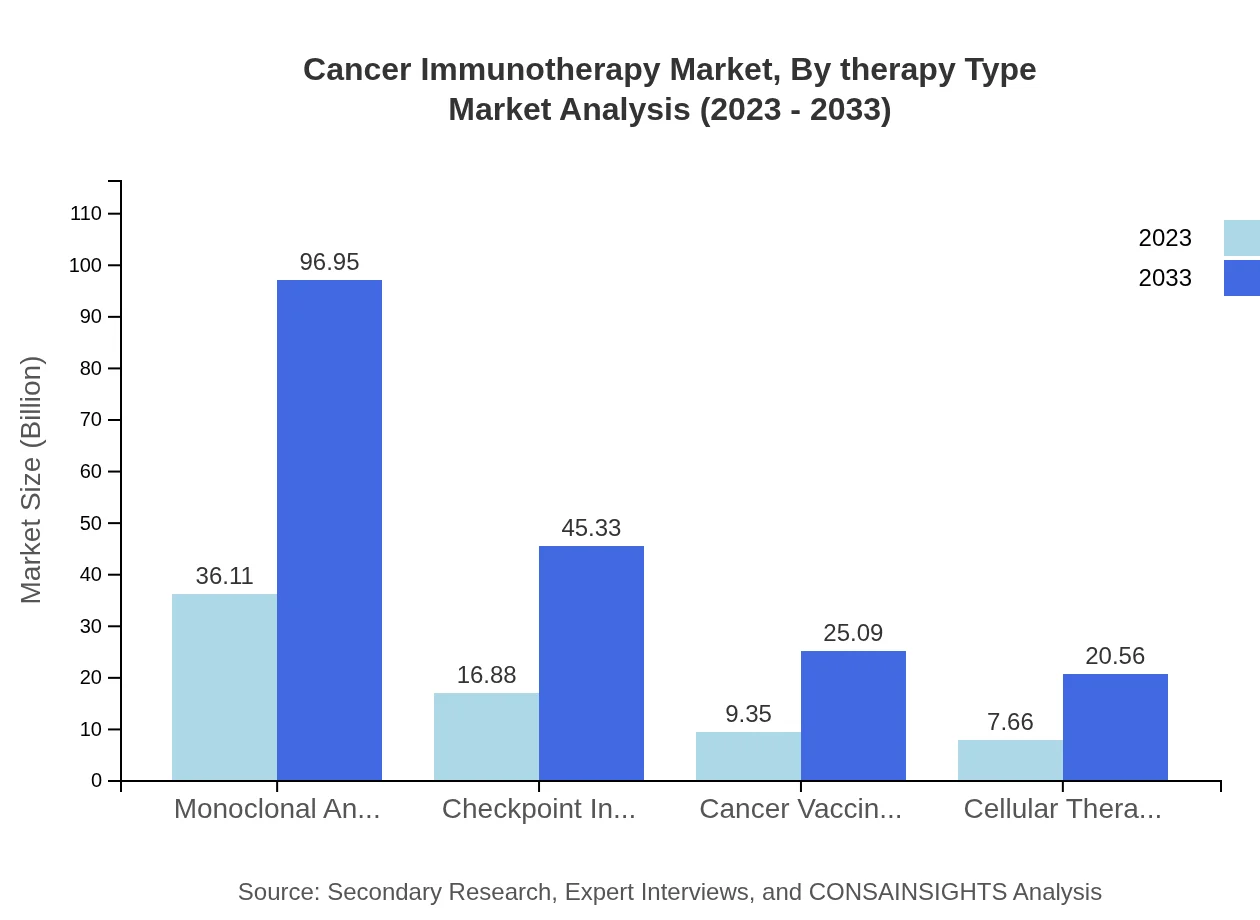
The Cancer Immunotherapy market, by therapy type, is significantly dominated by monoclonal antibodies, valued at approximately $36.11 billion in 2023 and expected to rise to $96.95 billion by 2033. Other key therapy types include checkpoint inhibitors and cancer vaccines, which are gaining traction due to their effectiveness in treating various malignancies. Checkpoint inhibitors represent a growing segment, projected to achieve approximately $16.88 billion in 2023, scaling up to $45.33 billion by 2033.
Cancer Immunotherapy Market Analysis By Cancer Type
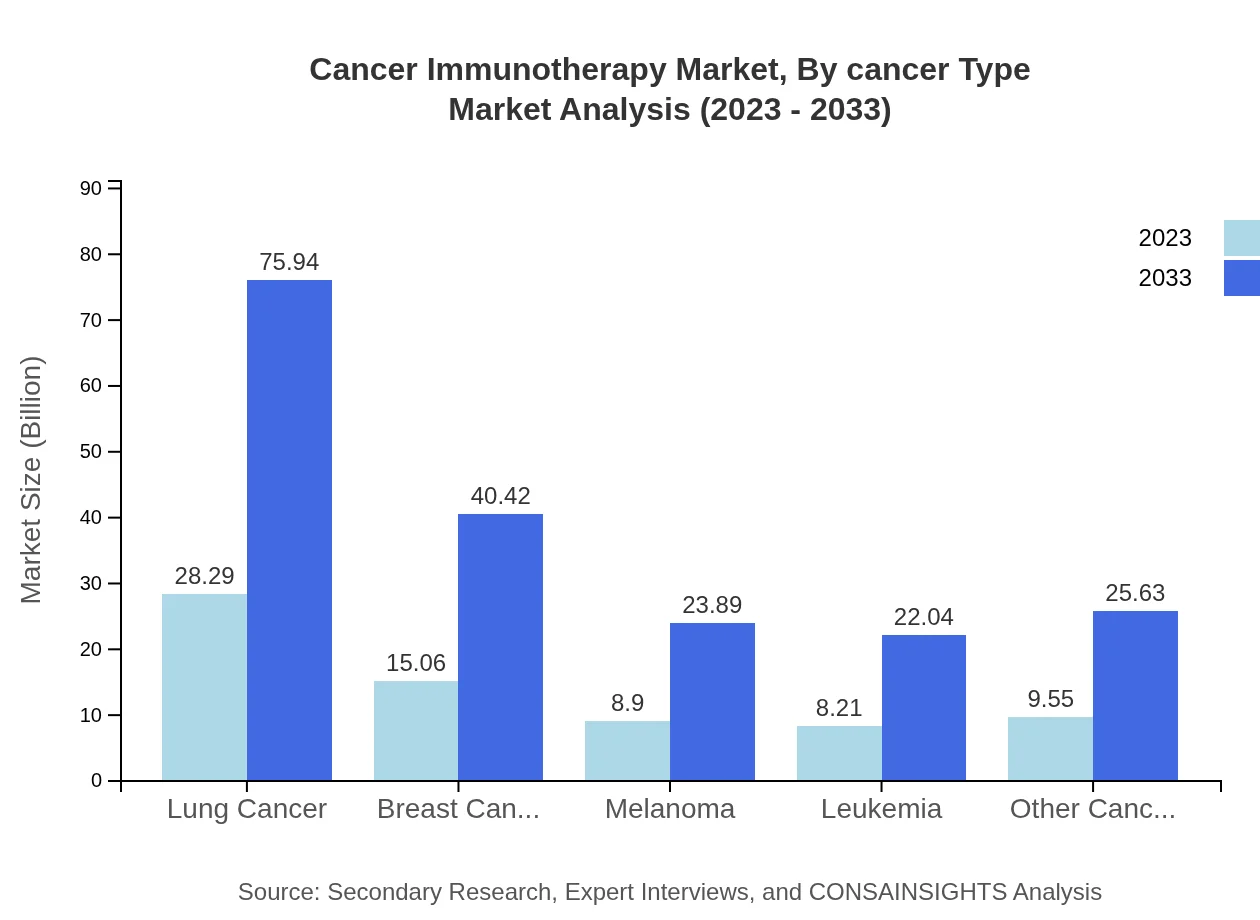
Within the Cancer Immunotherapy market by cancer type, lung cancer remains the largest segment with a market size of $28.29 billion in 2023, forecasted to grow to $75.94 billion by 2033. Following closely, breast cancer treatments are expected to progress from $15.06 billion to $40.42 billion, while melanoma, leukemia, and other cancers also contribute significantly to the overall revenue of the market.
Cancer Immunotherapy Market Analysis By End User
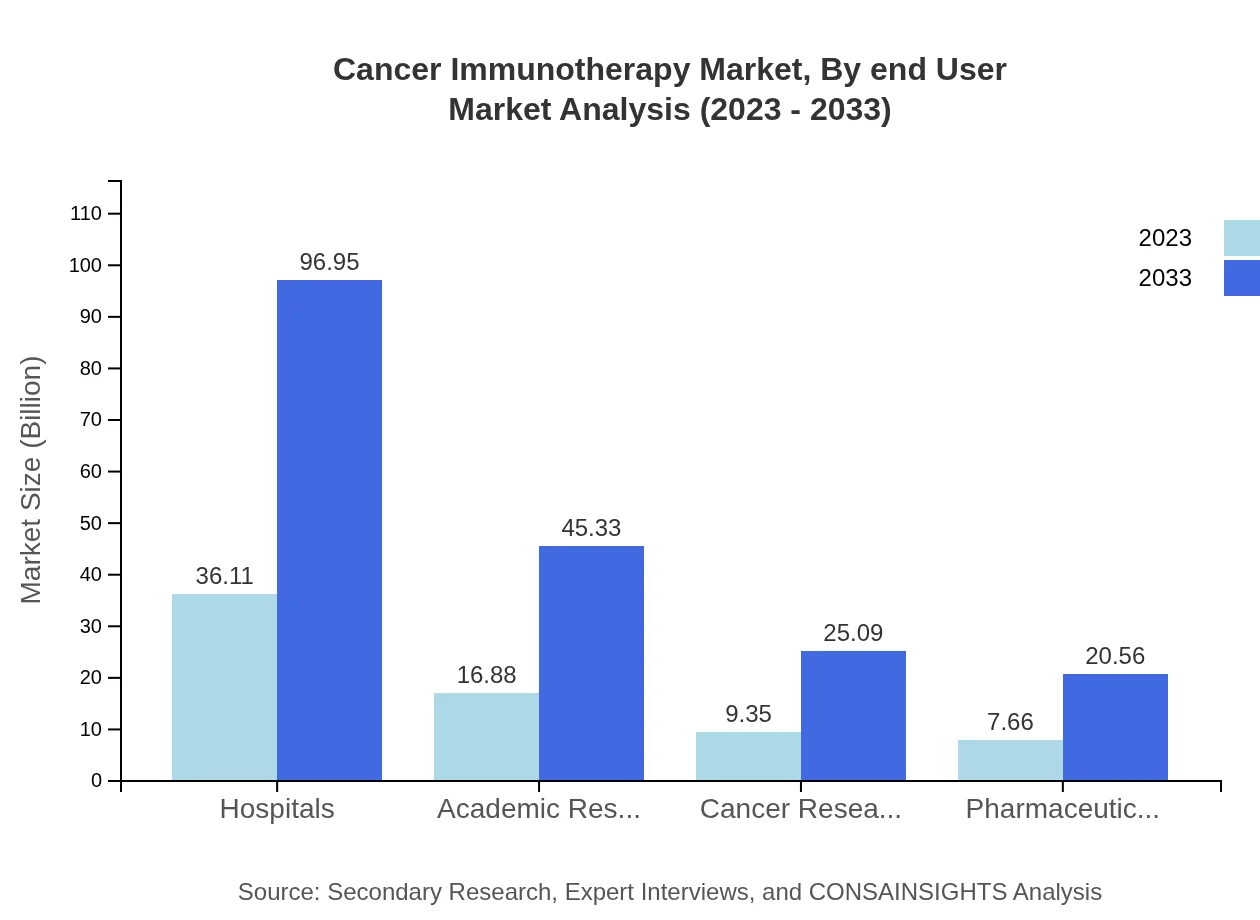
Hospitals are the dominant end-user segment in the Cancer Immunotherapy market, with an estimated value of $46.70 billion in 2023, projected to reach $125.37 billion by 2033, accounting for a significant share of the overall market. Academic research institutes and cancer research centers also play crucial roles, focusing on innovation and clinical trial developments across various platforms.
Cancer Immunotherapy Market Analysis By Distribution Channel
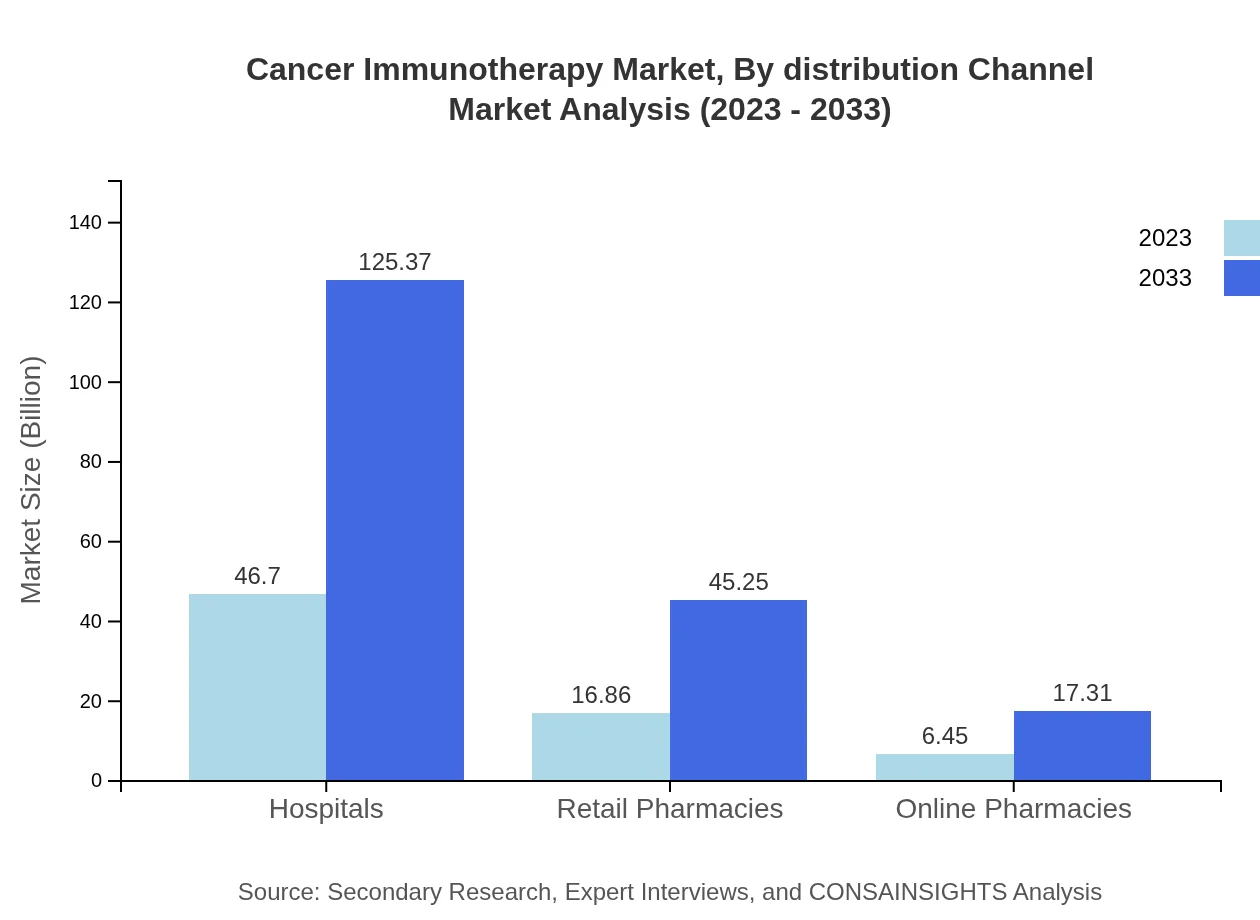
Distribution channels in the Cancer Immunotherapy market include hospitals, retail pharmacies, and online pharmacies, with hospitals being the leading channel due to direct administration and availability of therapies. As of 2023, retail pharmacies contribute significantly, valued at $16.86 billion and expected to rise to $45.25 billion, while online pharmacies are gradually expanding their market foothold backed by increasing digital health trends.
Cancer Immunotherapy Market Trends and Future Forecast
Tell us your focus area and get a customized research report.
Global Market Leaders and Top Companies in Cancer Immunotherapy Industry
Roche:
A leading biotechnology company known for its pioneering work in oncological therapies, including the development of advanced monoclonal antibodies and breakthrough checkpoint inhibitors.Bristol-Myers Squibb:
A key player in the immunotherapy segment, known for its innovative drugs like Opdivo and Yervoy, which target various forms of cancer.Merck & Co.:
Developed the successful immunotherapy Pembrolizumab (Keytruda), focusing on advancing cancer treatment through robust clinical research.Novartis:
Engaged in pioneering work related to CAR-T cell therapies and other innovative treatment modalities in the Cancer Immunotherapy sector.We're grateful to work with incredible clients.









FAQs
What is the market size of the Cancer Immunotherapy Market Report in 2023?
The market size in 2023 is $70.00 Billion, based on the report's baseline valuation for the global cancer immunotherapy sector.
How big will the Cancer Immunotherapy Market Report be in 2033?
The market is projected to reach $187.93 Billion in 2033 according to the report's forecast for the 2023 to 2033 period.
What is CAGR of the Cancer Immunotherapy Market Report?
The reported compound annual growth rate (CAGR) for the market over 2023 to 2033 is 10%.
Is there a single fastest Growing region in the Cancer Immunotherapy Market Report market?
No single fastest-growing region is stated for the Cancer Immunotherapy Market Report market because the top regional implied CAGR values are within 0.15 percentage points of each other, making the ranking too close to call reliably.
Which therapy types are prominent in the market?
Prominent therapy categories tracked include monoclonal antibodies, checkpoint inhibitors, cancer vaccines, and cellular therapies as key treatment modalities.
Who are the top companies featured in the report?
Top companies listed in the report are Roche, Bristol-Myers Squibb, Merck & Co., and Novartis.
What end users are covered in market segmentation?
The report's end-user segmentation includes hospitals, academic research institutes, cancer research centers, and pharmaceutical companies.
How big is the Europe market from 2023 to 2033?
Europe is shown growing from $17.35 Billion in 2023 to $46.57 Billion in 2033 in the regional breakdown provided.
What drives market growth according to the report?
Growth is attributed to therapeutic innovation, increased R&D and clinical trials, and wider adoption across clinical and institutional settings.
Which distribution channels are included in the analysis?
Distribution channels covered comprise hospitals, retail pharmacies, and online pharmacies as primary routes for therapy delivery.