

Global Femtocell
First published: 15 January 2026 | Last updated: 31 January 2026 | Report Code: global-femtocell
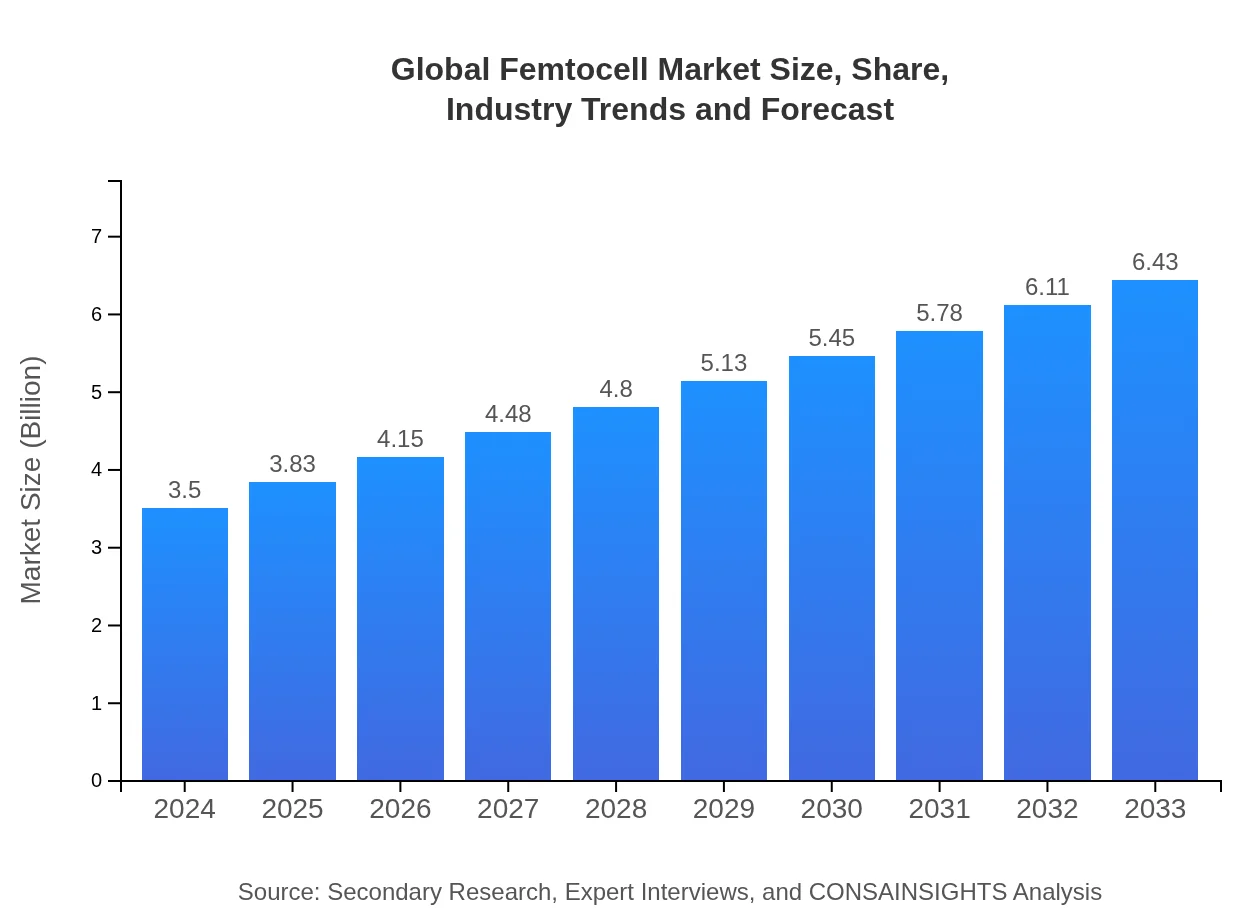
Global Femtocell Market — USD $3.5 Billion in 2024, Growing to USD 6.43 by 2033 at 6.8% CAGR
This report provides a comprehensive analysis of the Global Femtocell market, offering insights into market trends, size, segmentation, regional analysis, industry advancements, and future forecasts for the period between 2024 and 2033. The report encompasses detailed data points and balanced perspectives that cater to both technical and strategic decision-making.
| Metric | Value |
|---|---|
| Study Period | 2024 - 2033 |
| 2024 Market Size | $3.50 Billion |
| CAGR (2024-2033) | 6.8% |
| 2033 Market Size | $6.43 Billion |
| Top Companies | Telecom Innovations Inc., Futura Networks, Cellular Dynamics |
| Published Date | 15 January 2026 |
| Last Modified Date | 31 January 2026 |
Global Femtocell Market Overview
Customize Global Femtocell market research report
- ✔ Get in-depth analysis of Global Femtocell market size, growth, and forecasts.
- ✔ Understand Global Femtocell's regional dynamics and industry-specific trends.
- ✔ Identify potential applications, end-user demand, and growth segments in Global Femtocell
What is the Market Size & CAGR of Global Femtocell market in {Year}?
Global Femtocell Industry Analysis
Global Femtocell Market Segmentation and Scope
Tell us your focus area and get a customized research report.
Global Femtocell Market Analysis Report by Region
Europe Global Femtocell:
Europe stands as one of the most advanced markets in the Global Femtocell sector, with projections increasing from 1.24 in 2024 to 2.27 by 2033. Strong regulatory support, high broadband penetration, and an emphasis on sustainable urban connectivity are notable factors. Technological advancements and collaborations among key players further solidify Europe’s prominence.Asia Pacific Global Femtocell:
Asia Pacific continues to emerge as a significant growth driver for the Global Femtocell market. The region has experienced an increase from a market size of 0.62 in 2024 to an anticipated 1.14 by 2033. This expansion is fueled by high population density, burgeoning urbanization, and accelerated adoption of wireless technologies. Government initiatives and investments in digital infrastructure further enhance market prospects in this region.North America Global Femtocell:
North America remains a mature and competitive market with robust market size figures that are projected to climb from 1.13 in 2024 to 2.07 by 2033. The region benefits from advanced technological infrastructure, high consumer spending, and an early adoption of next-generation femtocell solutions. Major stakeholders are continuously investing in R&D to address evolving network demands.South America Global Femtocell:
South America shows promising potential despite current market constraints. With an initial market size of 0.23 in 2024 and projected growth to 0.42 by 2033, the region is catching up due to improved network infrastructure and the increasing integration of digital services into everyday life. Political and economic factors may influence the pace of adoption, but gradual improvements are anticipated.Middle East & Africa Global Femtocell:
The Middle East and Africa region, while smaller in current market size, is poised for growth. Starting from 0.28 in 2024 and expecting to reach 0.52 by 2033, the region benefits from the rapid expansion of telecommunication networks, increased mobile device usage, and strategic government initiatives aimed at digital transformation and rural connectivity.Tell us your focus area and get a customized research report.
Global Femtocell Market Analysis By Product Type
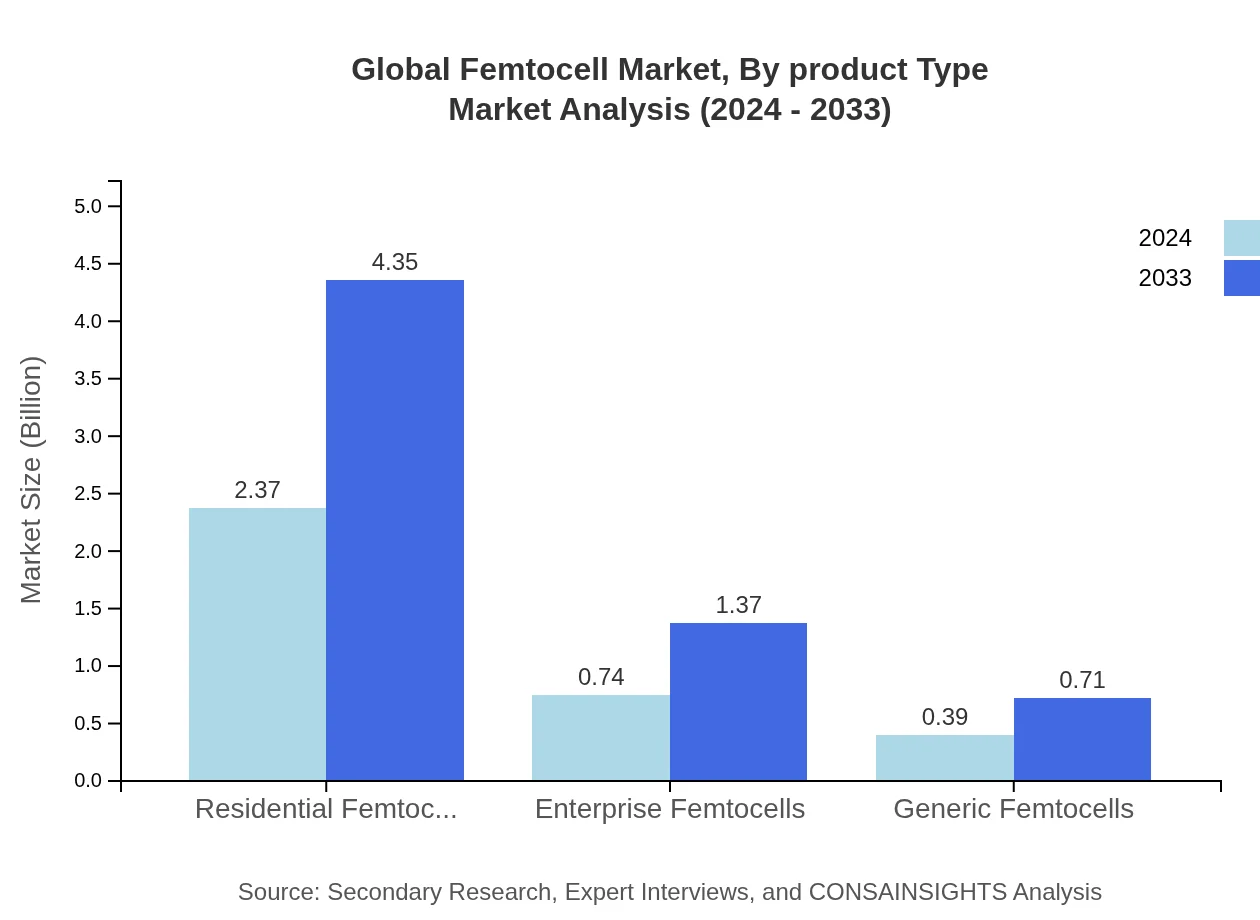
The market is segmented by product type into solutions designed for Residential Users, Business Users, and Government and Public Sector applications. Residential Users segment leads with a significant market share and size, reflecting high demand for indoor connectivity. In contrast, Business Users and Government/Public sectors demonstrate steady growth with dedicated investments in secure and reliable communication infrastructure. This segmentation emphasizes the need for tailored solutions as user requirements differ significantly.
Global Femtocell Market Analysis By Technology
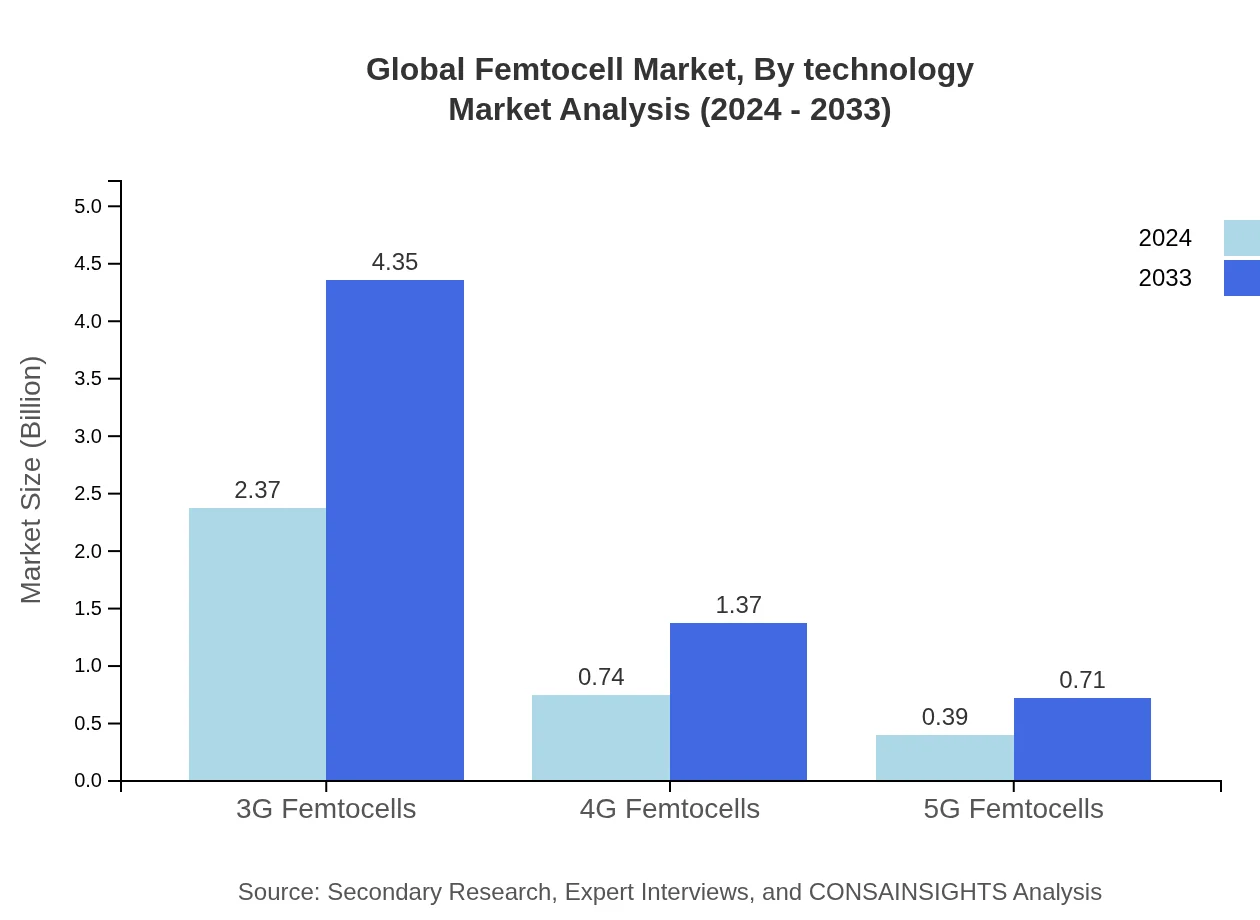
Technological segmentation differentiates market offerings based on 3G, 4G, and 5G femtocell technologies. With 3G femtocells holding a dominant share due to their established presence, 4G and 5G technologies are rapidly improving in performance. The market is witnessing innovation in signal processing and interference management, which enhances the attractiveness of advanced technologies. These trends not only support enhanced data speeds and connectivity but also update legacy systems efficiently.
Global Femtocell Market Analysis By Installation Location
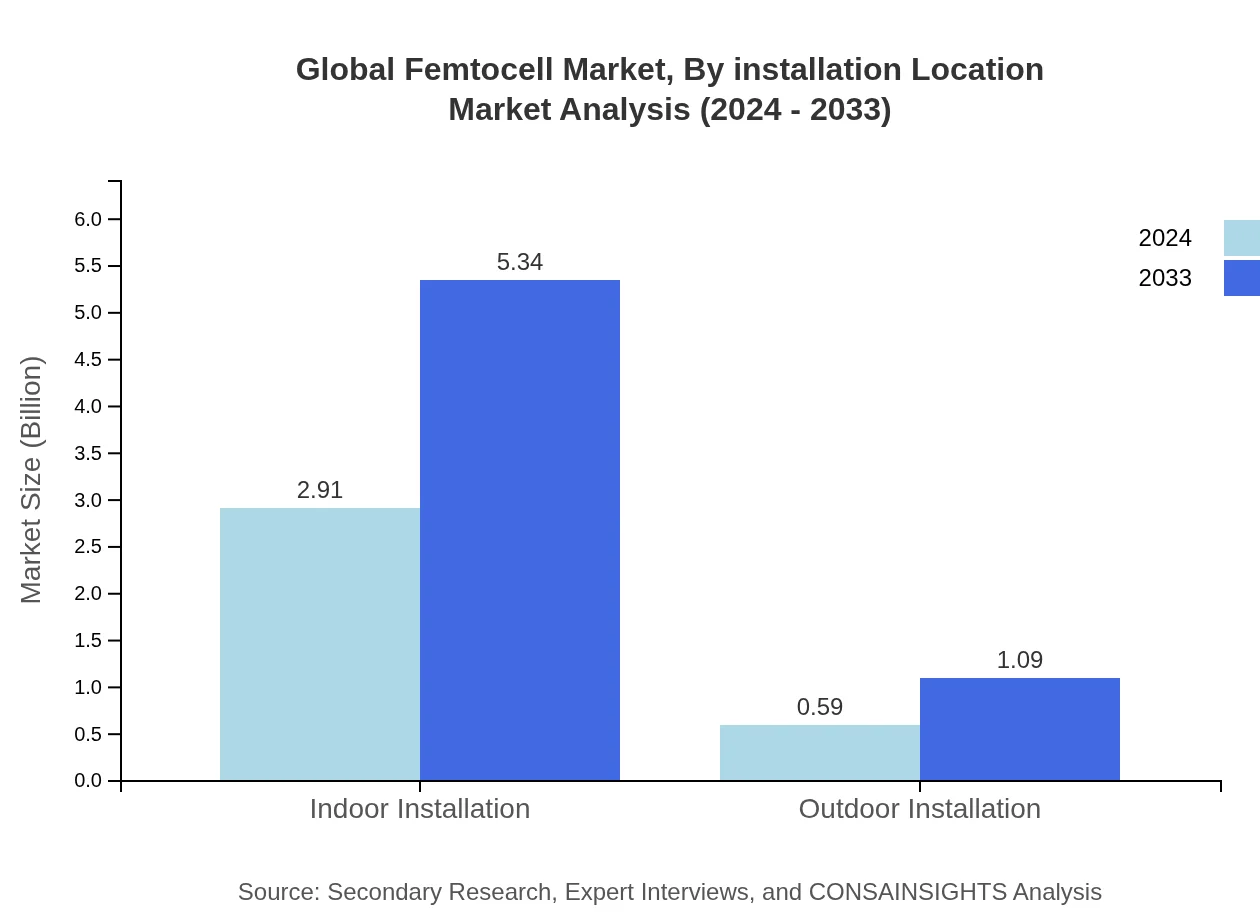
Installation location analysis divides the market into indoor and outdoor deployments. Indoor installation, with a market share as high as 83.09% in 2024, caters to residential and enterprise environments that require minimal interference and strong signal penetration. Conversely, outdoor installation, although a smaller segment at 16.91%, is crucial for augmenting coverage in challenging terrains and urban clusters. The strategic deployment in both locations ensures comprehensive network coverage.
Global Femtocell Market Analysis By End User
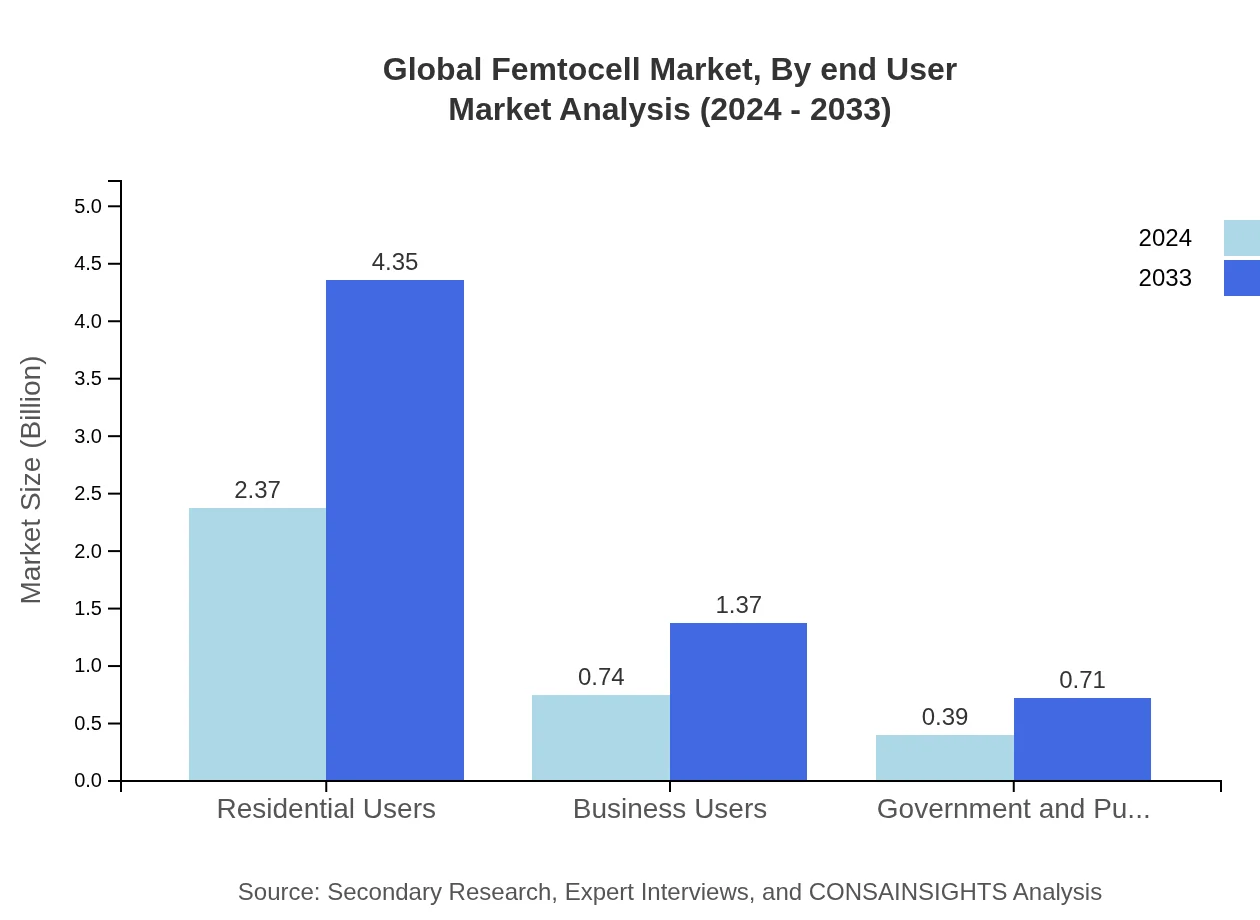
End-user segmentation focuses on the distinct requirements of various user categories including Residential, Business, and Government sectors. Residential femtocell solutions are designed to provide robust connectivity indoors, while enterprise femtocells are structured to support high-density work environments with significant data throughput demands. The government and public sector segment prioritizes secure and efficient communication channels. Each category is driven by unique factors such as usage patterns, financial investment capacity, and regulatory parameters.
Global Femtocell Market Analysis By Application
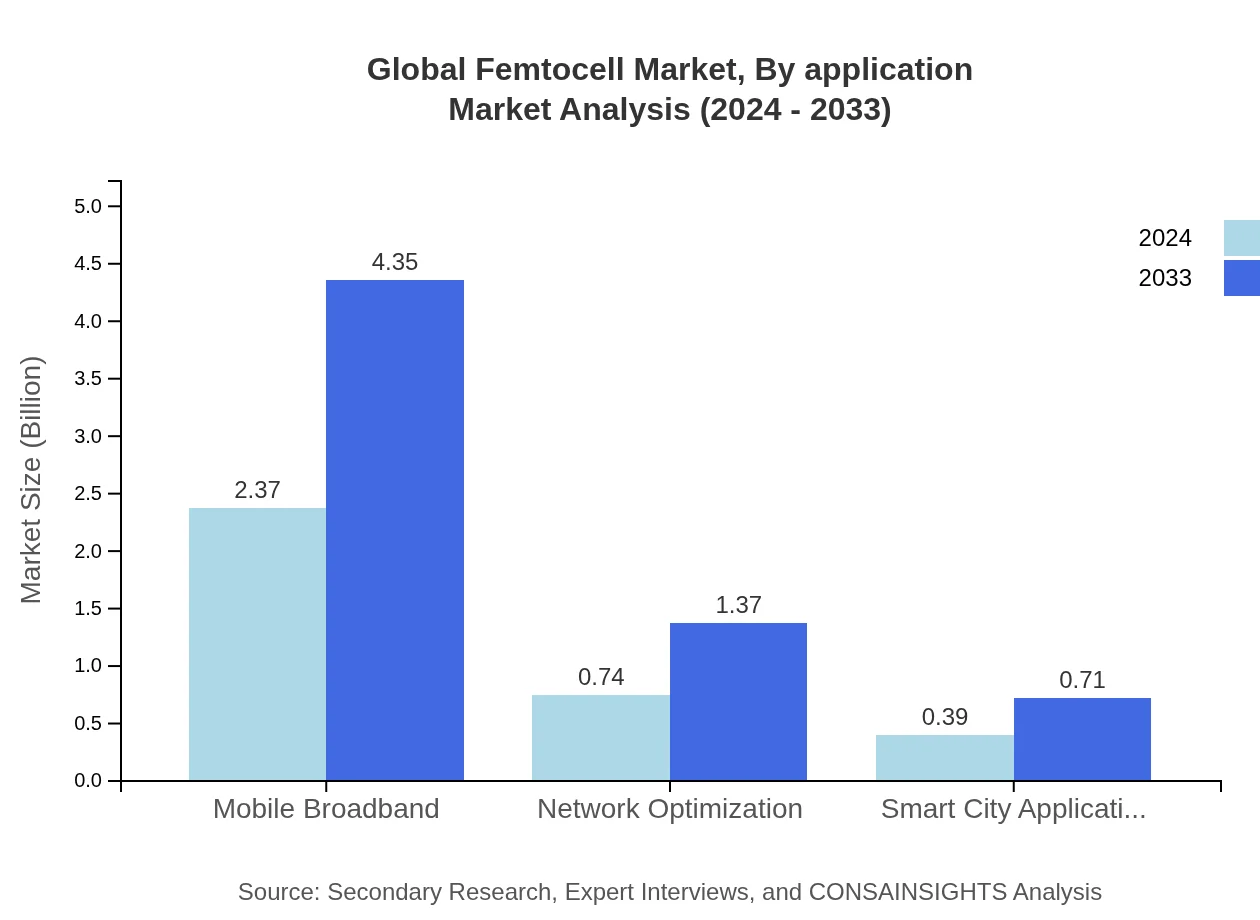
The application-based segmentation categorizes the market into primary domains such as Mobile Broadband, Network Optimization, and Smart City Applications. Mobile Broadband dominates due to its direct impact on consumer connectivity and data consumption. Meanwhile, network optimization focuses on efficient resource allocation and interference management. Smart City Applications are gaining traction as urban centers integrate advanced communication technologies to support IoT, surveillance, and real-time data analytics, underscoring a multidimensional growth potential.
Global Femtocell Market Trends and Future Forecast
Tell us your focus area and get a customized research report.
Global Market Leaders and Top Companies in Global Femtocell Industry
Telecom Innovations Inc.:
A leader in advanced femtocell solutions, Telecom Innovations Inc. has been at the forefront of developing innovative, energy-efficient products that drive enhanced indoor connectivity for both residential and commercial users.Futura Networks:
Futura Networks is renowned for its strategic investments in 4G and 5G femtocell technologies. Their products are widely recognized for reliability and high performance in diverse market segments and regions.Cellular Dynamics:
Specializing in smart city applications and network optimization, Cellular Dynamics provides comprehensive solutions that integrate femtocell technology with modern digital infrastructure, ensuring seamless user experiences.We're grateful to work with incredible clients.









FAQs
How can the global Femtocell report help align our marketing strategy with customer adoption trends?
The global femtocell market is projected to grow to $3.5 billion at a CAGR of 6.8% from 2024 to 2033. This data aids marketing strategy alignment through targeted outreach based on adoption rates, enabling effective campaign planning and product positioning to meet evolving consumer demands.
What product features are in highest demand according to the global Femtocell trends?
Features in highest demand include enhanced coverage for residential and enterprise users. The market data indicates a significant focus on 3G and 4G femtocells, which constituted 67.71% and 21.28% share respectively in 2024, reflecting the need for reliable mobile broadband.
Which regions offer the best market entry and expansion opportunities in the global Femtocell industry?
Europe leads with a 2024 market size of $1.24 billion, expanding to $2.27 billion by 2033. North America follows closely, moving from $1.13 billion to $2.07 billion, highlighting strong growth potential in these regions for market entry and strategic expansions.
What emerging technologies and innovations are shaping the global Femtocell market?
Innovations such as advanced 5G femtocells and smart city applications are crucial to the sector's evolution. The projected market for 5G femtocells is expected to grow from $0.39 billion in 2024 to $0.71 billion in 2033, indicating a pivotal shift towards next-gen connectivity.
Does the global Femtocell report include competitive landscape and market share analysis?
Yes, the report provides a comprehensive competitive landscape analysis, detailing market shares across various segments and technologies, including residential, enterprise, and mobile broadband femtocells which collectively cover a significant market share in the industry.
How can executives use the global Femtocell report to evaluate investment risks and ROI?
Executives can leverage market trends and projected growth data from the report to assess potential investment risks and return on investment. Understanding the CAGR of 6.8% and segment performance enables informed decision-making and strategy formulation.
What are the future market sizes projected for different regions in the global Femtocell sector?
By 2033, the European market is expected to reach $2.27 billion, while Asia Pacific may grow to $1.14 billion. North America will likely expand to $2.07 billion, with Latin America at $0.42 billion and Middle East & Africa at $0.52 billion, indicating regional growth trajectories.