
Reports >
Technology And Media
>
Fake Image Detection

Fake Image Detection
First published: 15 January 2026 | Last updated: 31 January 2026 | Report Code: fake-image-detection
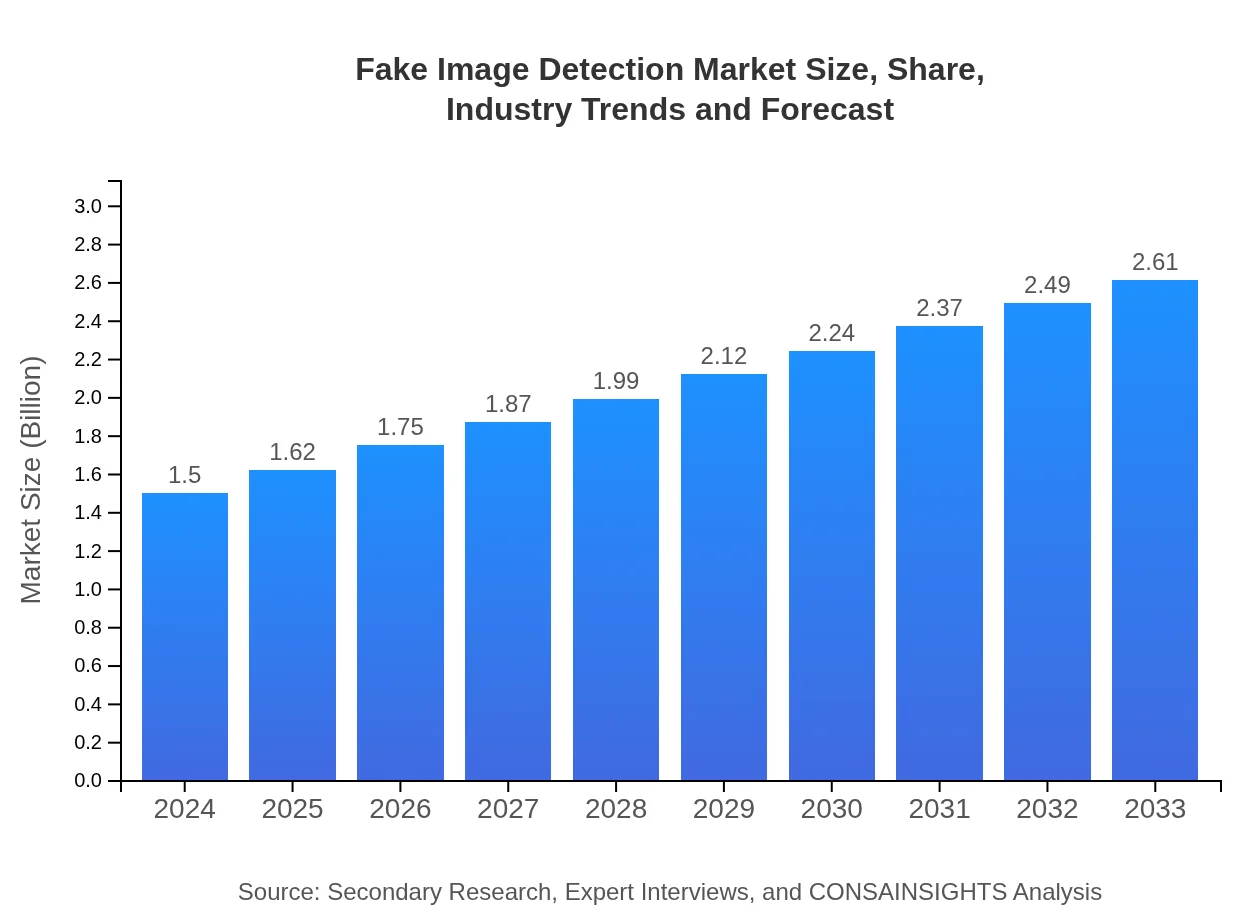
Fake Image Detection Market — USD $1.5 Billion in 2024, Growing to USD 2.61 by 2033 at 6.2% CAGR
This detailed report on Fake Image Detection provides comprehensive insights into market trends, technology innovations, and product performances, covering forecasts for the period 2024 to 2033. The report delves into market size metrics, regional analyses, segmentation details, and growth forecasts, equipping stakeholders with critical data and competitive intelligence to navigate this evolving industry.
| Metric | Value |
|---|---|
| Study Period | 2024 - 2033 |
| 2024 Market Size | $1.50 Billion |
| CAGR (2024-2033) | 6.2% |
| 2033 Market Size | $2.61 Billion |
| Top Companies | TechGuard Solutions, ImageShield Inc., VeriFake Technologies, SecureVision Labs |
| Published Date | 15 January 2026 |
| Last Modified Date | 31 January 2026 |
Fake Image Detection Market Overview
Customize Fake Image Detection market research report
- ✔ Get in-depth analysis of Fake Image Detection market size, growth, and forecasts.
- ✔ Understand Fake Image Detection's regional dynamics and industry-specific trends.
- ✔ Identify potential applications, end-user demand, and growth segments in Fake Image Detection
What is the Market Size & CAGR of Fake Image Detection market in 2024?
Fake Image Detection Industry Analysis
Fake Image Detection Market Segmentation and Scope
Tell us your focus area and get a customized research report.
Fake Image Detection Market Analysis Report by Region
Europe Fake Image Detection:
Europe presents a robust market scenario where the market size is projected to expand from 0.50 in 2024 to 0.88 by 2033. The region benefits from progressive regulatory policies that aim to curb digital fraud and enhance media transparency. European investors are increasingly channeling funds into innovation, thus driving the development of more effective Fake Image Detection systems. The mature socio-economic environment coupled with high digital literacy levels positions Europe as a major hub for technological advancements in this space.Asia Pacific Fake Image Detection:
In the Asia Pacific region, the market is expected to grow from a base of approximately 0.28 in 2024 to 0.50 by 2033. This growth is fueled by rapid digitalization, increased investments in IT infrastructure, and a high demand for advanced security measures. Rising consumer awareness and government initiatives promoting digital integrity further enhance the market potential, making this region a significant contributor to the overall growth in Fake Image Detection.North America Fake Image Detection:
The North American region is a key market for Fake Image Detection, with estimated growth from 0.50 in 2024 to 0.87 by 2033. Strong technological infrastructure, a high rate of digital content consumption, and early adoption of sophisticated detection technologies contribute to this region's leadership. Strict regulatory requirements and heightened consumer vigilance further encourage investments in advanced detection solutions, ensuring continued market expansion.South America Fake Image Detection:
South America’s market dynamics in Fake Image Detection highlight a transition from a nascent stage of 0.12 in 2024 to a more mature market size of 0.20 by 2033. This steady growth is largely supported by the expanding digital media ecosystem and increased participation by local players. The sector is bolstered by improving regulatory frameworks and increased cross-border collaborations, which in turn spur technology upgrades and infrastructure investments.Middle East & Africa Fake Image Detection:
The Middle East and Africa region, though relatively smaller in scale, is poised for gradual growth, evolving from an estimated market size of 0.10 in 2024 to 0.17 by 2033. Strategic government initiatives aimed at boosting digital infrastructure and the acceleration of technology-driven enterprises are primary growth drivers. Despite lower baseline figures, increasing awareness and investment in cybersecurity have begun to position the region as an emerging market for advanced image detection solutions.Tell us your focus area and get a customized research report.
Fake Image Detection Market Analysis By Technology
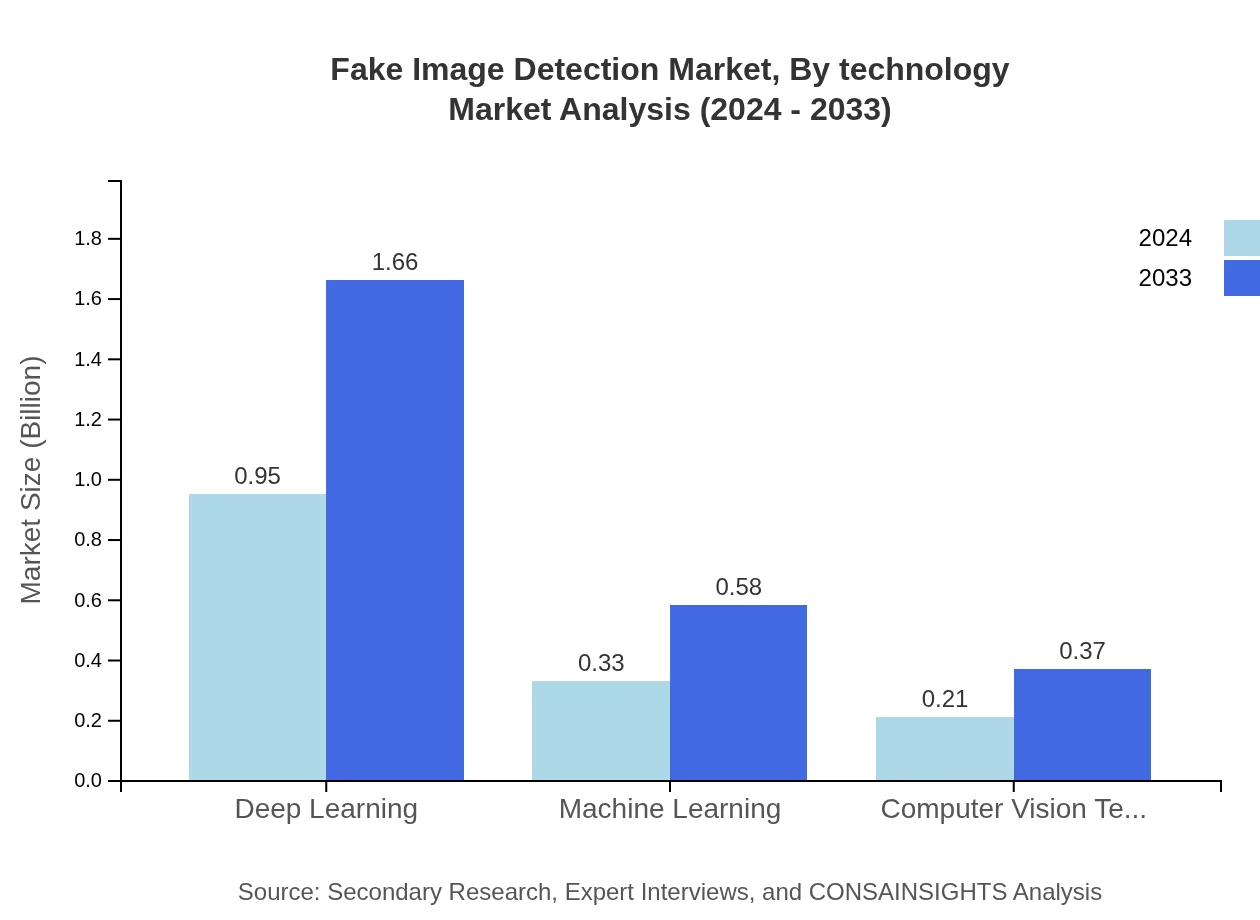
The technology segmentation of the Fake Image Detection market places a significant emphasis on deep learning, which is recognized as the foremost driver due to its superior accuracy in distinguishing subtle anomalies in manipulated images. In 2024, deep learning accounted for a market size of 0.95, which is expected to rise to 1.66 by 2033, maintaining a dominant share of approximately 63.58%. Complementing deep learning are machine learning algorithms and computer vision techniques, which contribute 22.1% and 14.32% to the market share respectively. These technologies collectively enhance detection capabilities by refining algorithm precision and offering robust, scalable solutions. The integration of these advanced methods effectively addresses the challenges posed by increasingly sophisticated image manipulation, ensuring high-performance detection systems that meet both consumer and regulatory demands.
Fake Image Detection Market Analysis By Deployment
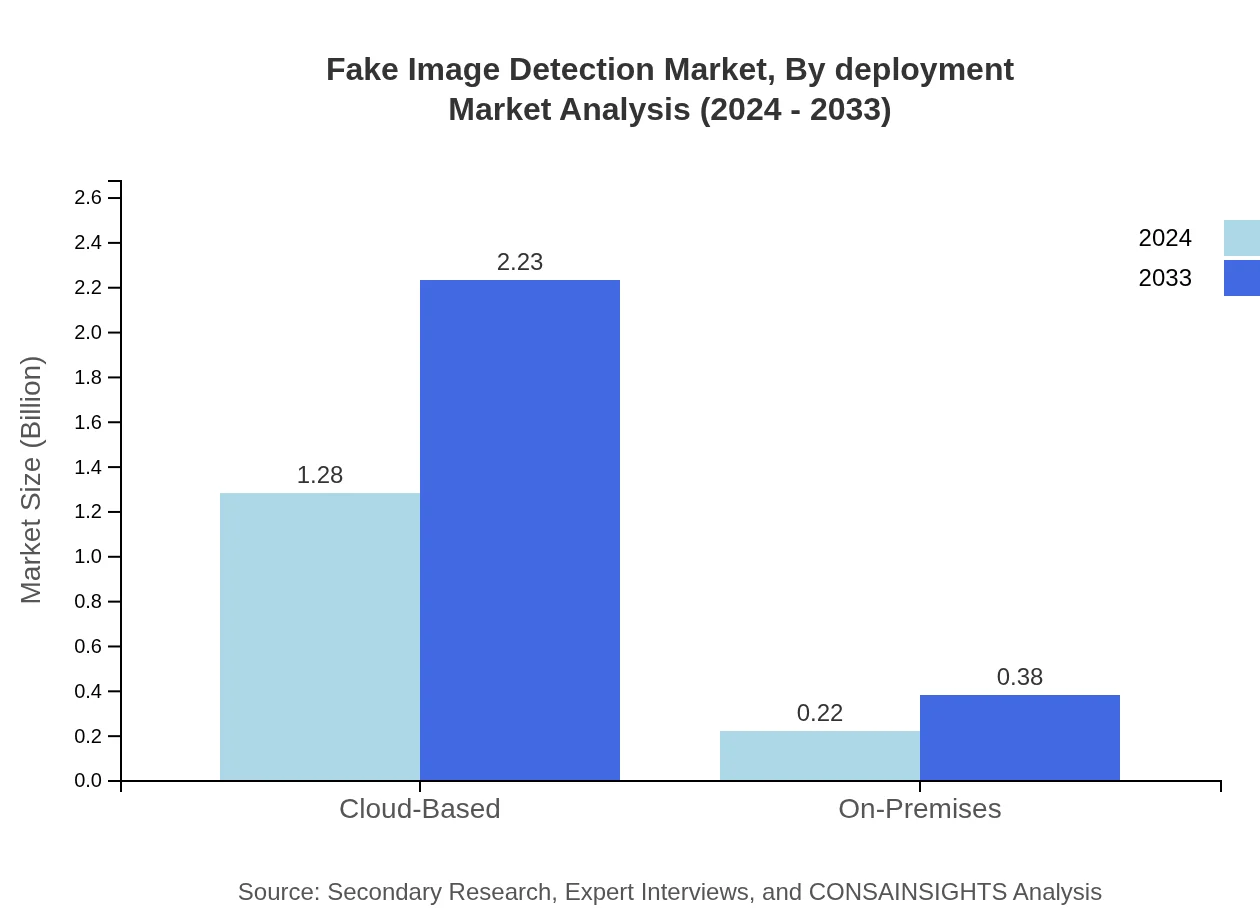
Deployment analysis reveals that cloud-based solutions dominate the Fake Image Detection market due to their flexibility, scalability, and ease of integration across diverse operational environments. In 2024, cloud-based systems were valued at 1.28 and are projected to grow to 2.23 by 2033 while holding an impressive share of 85.48%. In contrast, on-premises solutions, although essential for high-security environments, represent a smaller fraction with a market size of 0.22 in 2024, expanding to 0.38 by 2033 with a share of 14.52%. This divergence highlights the prevailing industry trend towards cloud adoption, driven by the need for continuous updates, lower maintenance overheads, and infrastructure cost efficiencies. Organizations are therefore increasingly opting for cloud-enabled detection systems to ensure rapid deployment and seamless scalability.
Fake Image Detection Market Analysis By Industry
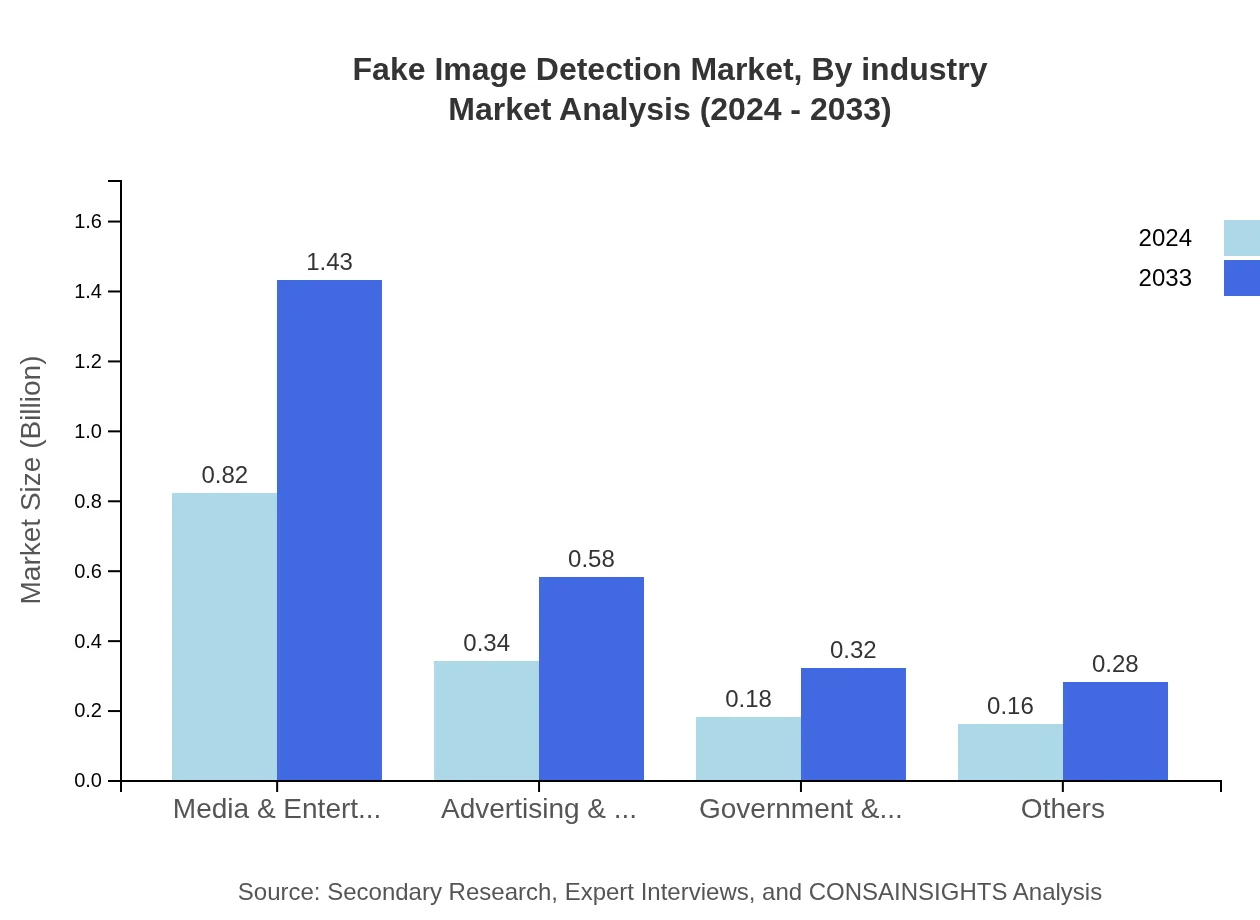
Analyzing the Fake Image Detection market by industry reveals varied applications across key sectors. The media & entertainment industry leads with a market size of 0.82 in 2024, growing to 1.43 by 2033, and represents a dominant market share of approximately 54.73%. This is followed by the advertising & marketing sector, which, while smaller in scale with a size of 0.34 in 2024 growing to 0.58 by 2033, maintains a stable share of 22.35%. Additionally, the government & defense segment is witnessing increased adoption due to stringent national security needs, with market growth from 0.18 in 2024 to 0.32 by 2033 and holding a share of 12.29%. The others segment, although constituting a minor portion of the market with sizes of 0.16 and 0.28 in 2024 and 2033 respectively, contributes 10.63% of the market share. This segmentation underlines the importance of tailored solutions that address the unique requirements and regulatory environments of each industry vertical.
Fake Image Detection Market Analysis By Functionality
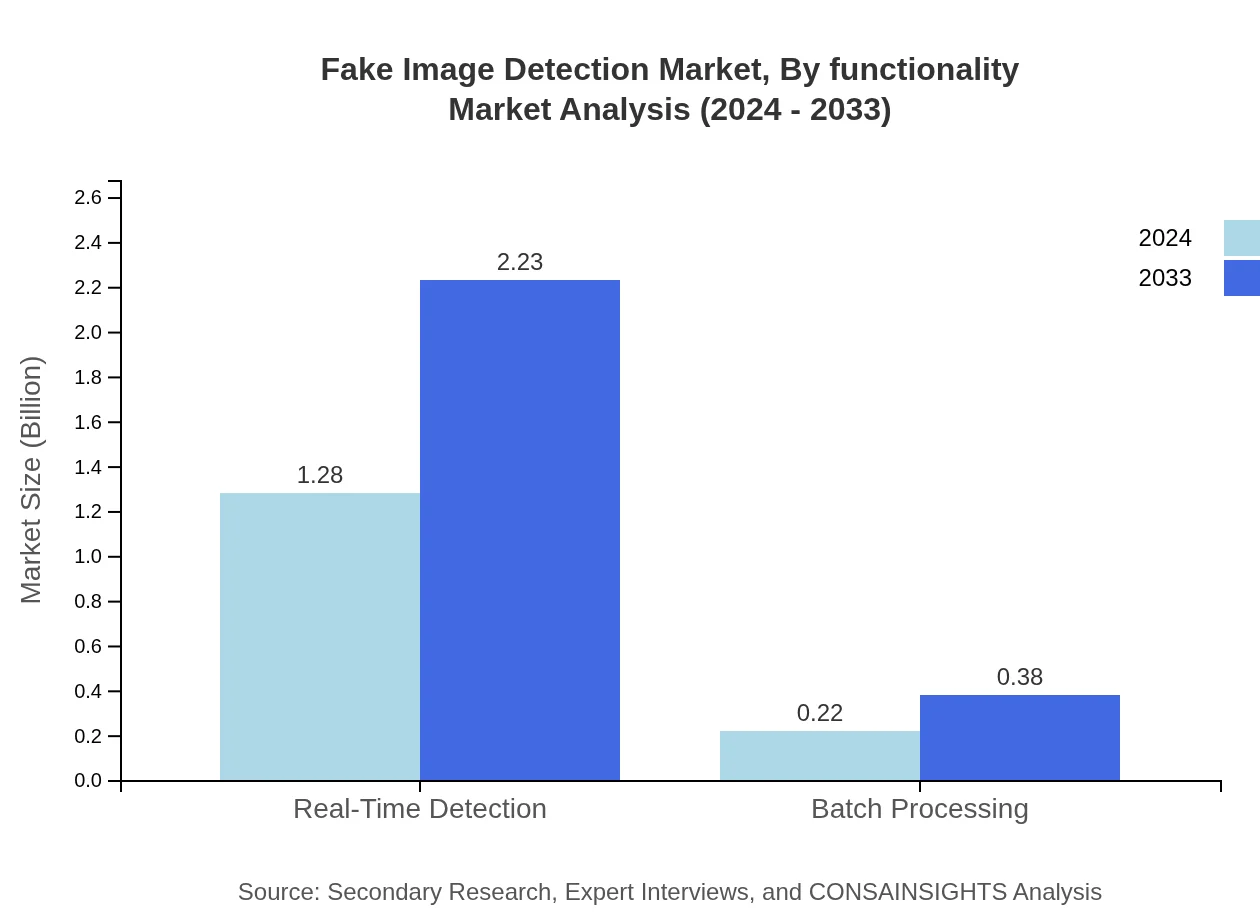
The functionality-based segmentation of the Fake Image Detection market focuses on the dichotomy between real-time detection and batch processing. Real-time detection systems, which are crucial for applications requiring immediate verification, represent a market size of 1.28 in 2024 and are projected to reach 2.23 by 2033, holding a dominant share of 85.48%. In contrast, batch processing, used primarily for retrospective data analysis and compliance auditing, is valued at 0.22 in 2024, growing to 0.38 by 2033 with a corresponding market share of 14.52%. These functionality insights reveal the strategic importance of real-time detection in environments such as live broadcasting, financial transactions, and social media, while batch processing remains indispensable for large-scale data analytics where time-sensitivity is lower. The continued evolution of both these functionalities is expected to further enhance the overall performance and reliability of Fake Image Detection systems.
Fake Image Detection Market Trends and Future Forecast
Tell us your focus area and get a customized research report.
Global Market Leaders and Top Companies in Fake Image Detection Industry
TechGuard Solutions:
TechGuard Solutions is a pioneering company specializing in AI-driven image verification tools. With a focus on deep learning and real-time analytics, TechGuard has consistently delivered robust detection solutions that cater to both enterprise and government needs.ImageShield Inc.:
ImageShield Inc. has established itself as a leader in the domain of digital content security. The company integrates advanced machine learning algorithms with cloud-based deployment to provide comprehensive protections against image forgery and manipulation.VeriFake Technologies:
VeriFake Technologies is renowned for its innovative approach combining computer vision and artificial intelligence. Their cutting-edge platforms are widely deployed across industries to ensure content authenticity and protect digital media assets.SecureVision Labs:
SecureVision Labs focuses on research and development in the area of image authenticity verification. Their solutions, which blend on-premises and cloud-based capabilities, empower organizations to rapidly detect and mitigate counterfeiting risks.We're grateful to work with incredible clients.









FAQs
How can the Fake Image Detection report help align our marketing strategy with customer adoption trends?
The Fake Image Detection market is valued at $1.5 billion with a CAGR of 6.2%. By understanding adoption trends, marketing strategies can be tailored to meet consumer demands, enhancing customer engagement and ultimately boosting market share.
What product features are in highest demand according to the Fake Image Detection trends?
Key features driving demand include real-time detection and cloud-based options. Segment data reveals deep learning contributes to 63.58% market share, indicating a strong preference for advanced and effective detection capabilities.
Which regions offer the best market entry and expansion opportunities in the Fake Image Detection industry?
North America and Europe are promising regions; North America will grow from $0.50 billion in 2024 to $0.87 billion by 2033. Europe follows closely, projected to reach $0.88 billion, indicating lucrative opportunities.
What emerging technologies and innovations are shaping the Fake Image Detection market?
Emerging technologies include deep learning and advanced computer vision techniques. These innovations are crucial as they enhance accuracy and efficiency in detecting fake images, vital in various applications from media to security.
Does the Fake Image Detection report include competitive landscape and market share analysis?
The report provides comprehensive insights into market share across segments, with cloud-based solutions leading at 85.48% in 2024, allowing businesses to identify key competitors and strategize effectively.
How can executives use the Fake Image Detection report to evaluate investment risks and ROI?
Executives can analyze market size and CAGR of 6.2%, focusing on high-growth regions and segments. Investment decisions can thus be based on projected growth and risks associated with emerging trends.
What are the market segments that show potential growth in Fake Image Detection?
The Media & Entertainment segment dominates with a share of 54.73%, while Cloud-Based solutions are also significant at 85.48%. Both segments represent growth opportunities critical for targeting investments.