

Granulocytecolony Stimulating Factor Market Report
First published: 11 October 2024 | Last updated: 25 May 2026 | Report Code: granulocytecolony-stimulating-factor
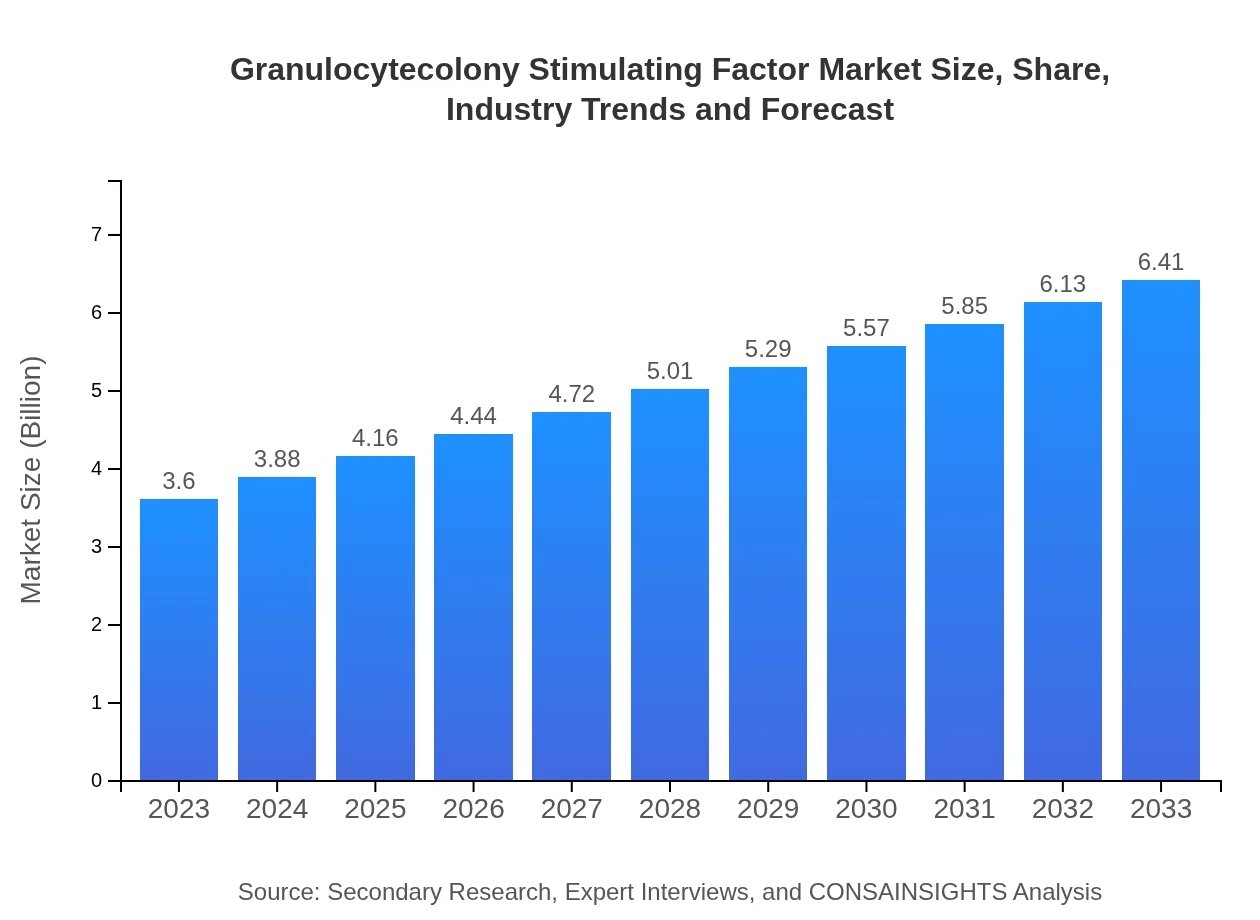
Granulocytecolony Stimulating Factor Market — USD 3.6 billion in 2023, Growing to USD 6.41B by 2033 at 5.8% CAGR
This report provides an in-depth analysis of the Granulocytecolony Stimulating Factor market from 2023 to 2033, including market size, growth projections, industry trends, regional insights, and key players, along with detailed segment analysis.
Key Takeaways
- Global market grows from $3.60 Billion in 2023 to $6.41 Billion in 2033 at a 5.8% CAGR.
- North America is largest regional market, while no single fastest-growing region is stated because regional CAGR differences remain within 0.15 percentage points.
- Regional expansion across Europe, Asia Pacific, Latin America, and Middle East & Africa supports overall market momentum.
- Leading players include Amgen Inc., Celgene Corporation, Sandoz, and Teva Pharmaceutical Industries Ltd.
Granulocytecolony Stimulating Factor Market Report — Executive Summary
North America remains largest market by forecast-period value, while no single fastest-growing region is stated because top regional growth rates are separated by less than 0.15 percentage points. The Granulocytecolony Stimulating Factor Market Report examines a global market rising from $3.60 Billion in 2023 to $6.41 Billion in 2033, reflecting a 5.8% CAGR for the 2023 to 2033 forecast period. Growth is driven by sustained clinical demand in oncology and hemato-oncology indications, formulation innovation, and broader adoption across healthcare settings. The study analyzes product and formulation categories—such as Filgrastim and Pegfilgrastim, lyophilized and liquid forms—and distribution channels including hospital and retail pharmacies plus e-commerce. Regional coverage highlights North America as the largest market, with detailed figures for Europe, Asia Pacific, Latin America, and the Middle East and Africa. Competitive profiling focuses on major firms such as Amgen Inc., Celgene Corporation, Sandoz, and Teva Pharmaceutical Industries Ltd., and the research integrates primary expert interviews with secondary sources to map current dynamics and near-term opportunities.
Key Growth Drivers
- Rising clinical utilization in oncology and hemato-oncology driving demand for supportive care agents.
- Advances in formulation and delivery expanding product options across lyophilized and liquid forms.
- Wider availability through hospital and retail pharmacies and growing e-commerce distribution.
- Ongoing innovation and competition among established manufacturers such as Amgen Inc. and Teva supporting product development.
| Metric | Value |
|---|---|
| Study Period | 2023 - 2033 |
| 2023 Market Size | $3.60 Billion |
| CAGR (2023-2033) | 5.8% |
| 2033 Market Size | $6.41 Billion |
| Top Companies | Amgen Inc., Celgene Corporation, Sandoz, Teva Pharmaceutical Industries Ltd. |
| Published Date | 11 October 2024 |
| Last Modified Date | 25 May 2026 |
Granulocytecolony Stimulating Factor Market Overview
Customize Granulocytecolony Stimulating Factor Market Report market research report
- ✔ Get in-depth analysis of Granulocytecolony Stimulating Factor market size, growth, and forecasts.
- ✔ Understand Granulocytecolony Stimulating Factor's regional dynamics and industry-specific trends.
- ✔ Identify potential applications, end-user demand, and growth segments in Granulocytecolony Stimulating Factor
What is the Market Size & CAGR of Granulocytecolony Stimulating Factor Market Report market in 2023?
Granulocytecolony Stimulating Factor Industry Analysis
Granulocytecolony Stimulating Factor Market Segmentation and Scope
Tell us your focus area and get a customized research report.
Granulocytecolony Stimulating Factor Market Report Market Analysis Report by Region
Europe Granulocytecolony Stimulating Factor Market Report:
Europe grows from $0.98 Billion in 2023 to $1.74 Billion in 2033. Adoption in oncology and hemato-oncology, along with formulation improvements and competitive supply dynamics, supports market expansion across the region.Asia Pacific Granulocytecolony Stimulating Factor Market Report:
Asia Pacific grows from $0.75 Billion in 2023 to $1.34 Billion in 2033. Growth drivers include rising healthcare access, expanding oncology services, and greater availability through hospital and retail pharmacy channels.North America Granulocytecolony Stimulating Factor Market Report:
North America is largest regional market, rising from $1.24 Billion in 2023 to $2.21 Billion in 2033. Regional expansion is bolstered by established clinical infrastructures, high uptake in oncology care, and active participation by major manufacturers.South America Granulocytecolony Stimulating Factor Market Report:
Latin America grows from $0.36 Billion in 2023 to $0.64 Billion in 2033. Market gains are influenced by growing clinical demand, wider distribution networks, and increasing attention to supportive cancer therapies.Middle East & Africa Granulocytecolony Stimulating Factor Market Report:
Middle East and Africa grows from $0.27 Billion in 2023 to $0.48 Billion in 2033. Expansion reflects strengthening healthcare services, increased adoption in oncology settings, and improved access to pharmaceutical products.Tell us your focus area and get a customized research report.
Research Methodology
Granulocytecolony Stimulating Factor Market Analysis By Product
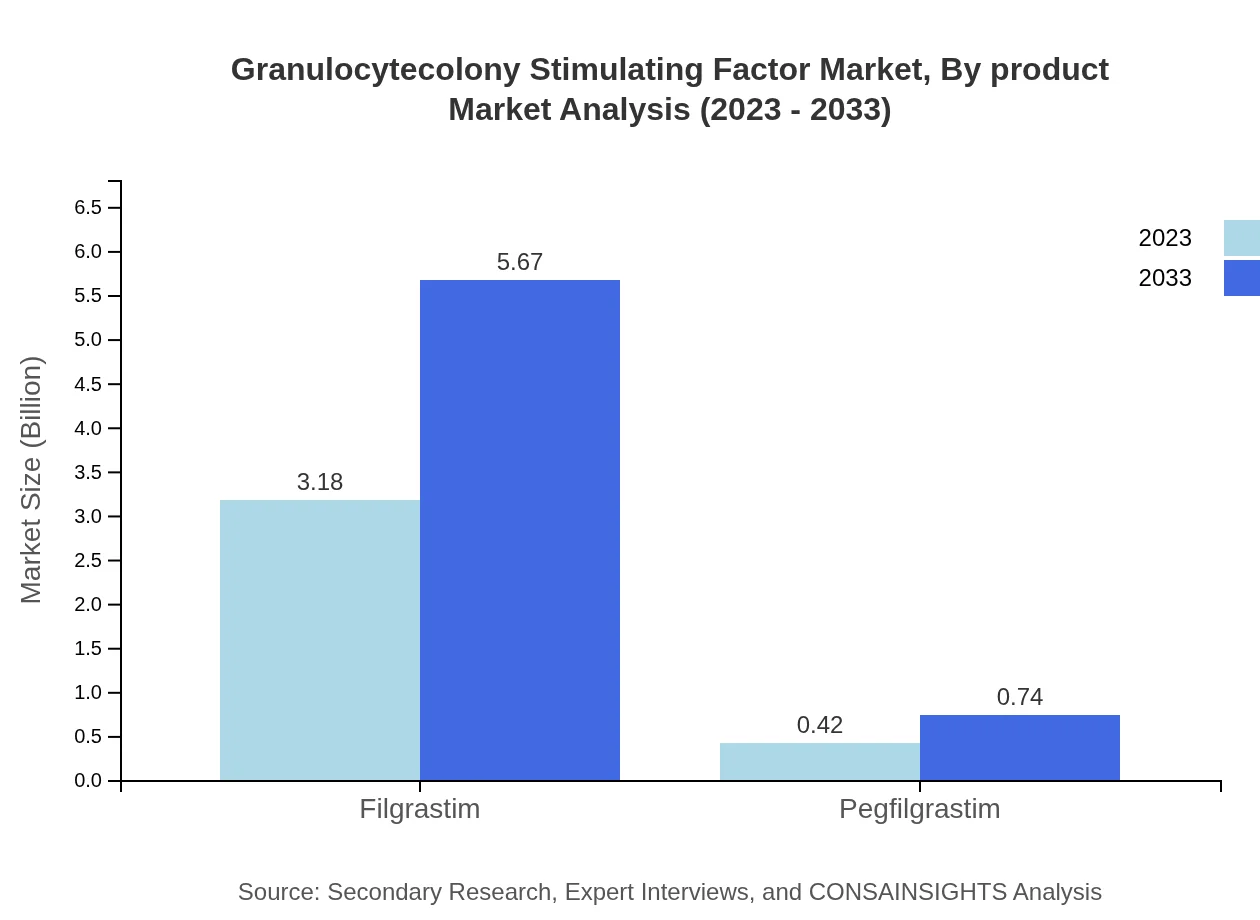
The product segment of the G-CSF market predominantly consists of Filgrastim and Pegfilgrastim. Filgrastim leads the market with a size of $3.18 billion in 2023, expected to reach $5.67 billion by 2033, holding an 88.47% market share. Pegfilgrastim is smaller, with a market size of $0.42 billion in 2023, projected at $0.74 billion by 2033, maintaining an 11.53% share.
Granulocytecolony Stimulating Factor Market Analysis By Application
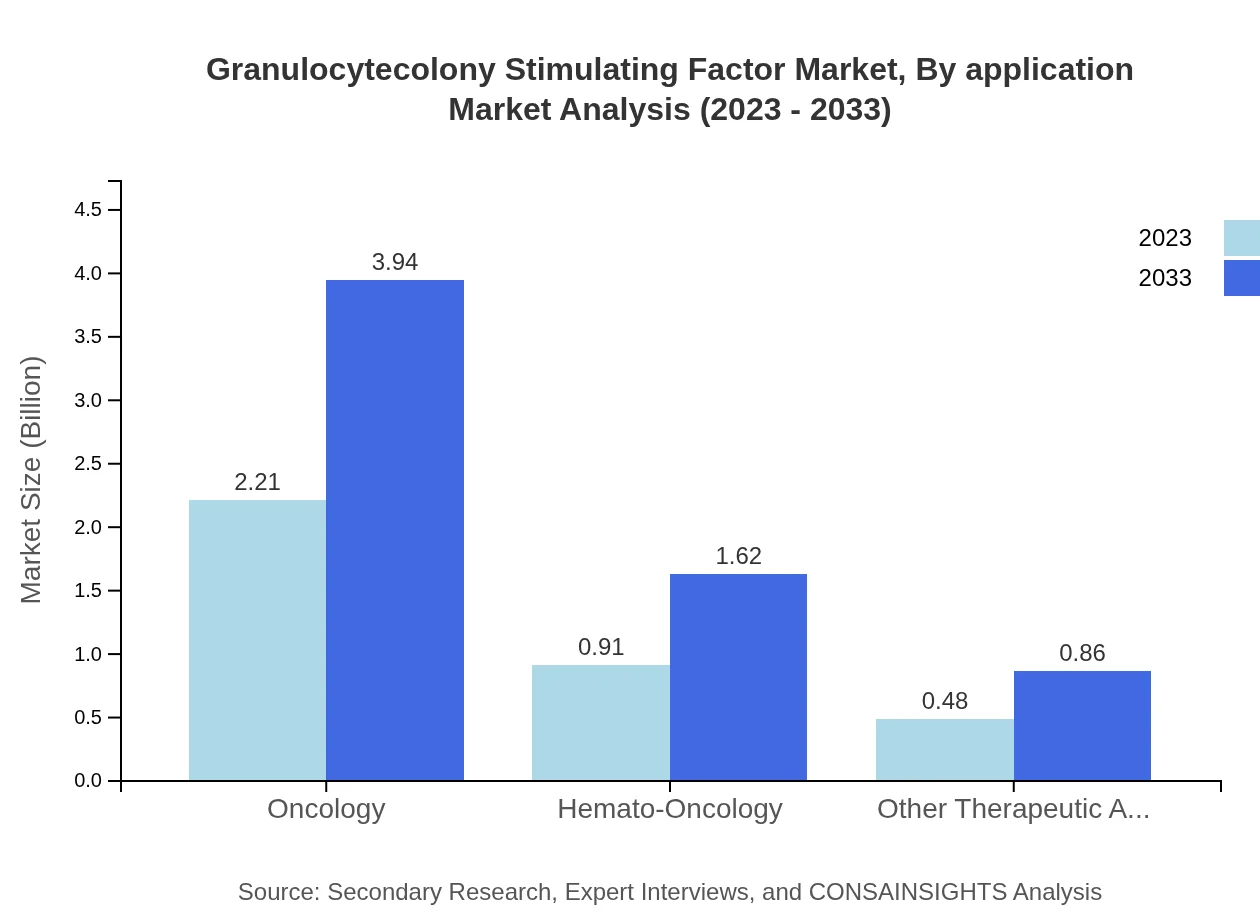
The G-CSF market application segment is primarily categorized into Oncology, Hemato-Oncology, and other therapeutic areas. The Oncology sector is the largest, sized at $2.21 billion in 2023, with a projected growth to $3.94 billion by 2033 (61.41% market share). Hemato-Oncology accounts for $0.91 billion in 2023, expected to grow to $1.62 billion by 2033 (25.21% market share). The segment of other therapeutic areas is valued at $0.48 billion in 2023 and is projected at $0.86 billion by 2033 (13.38% market share).
Granulocytecolony Stimulating Factor Market Analysis By End User
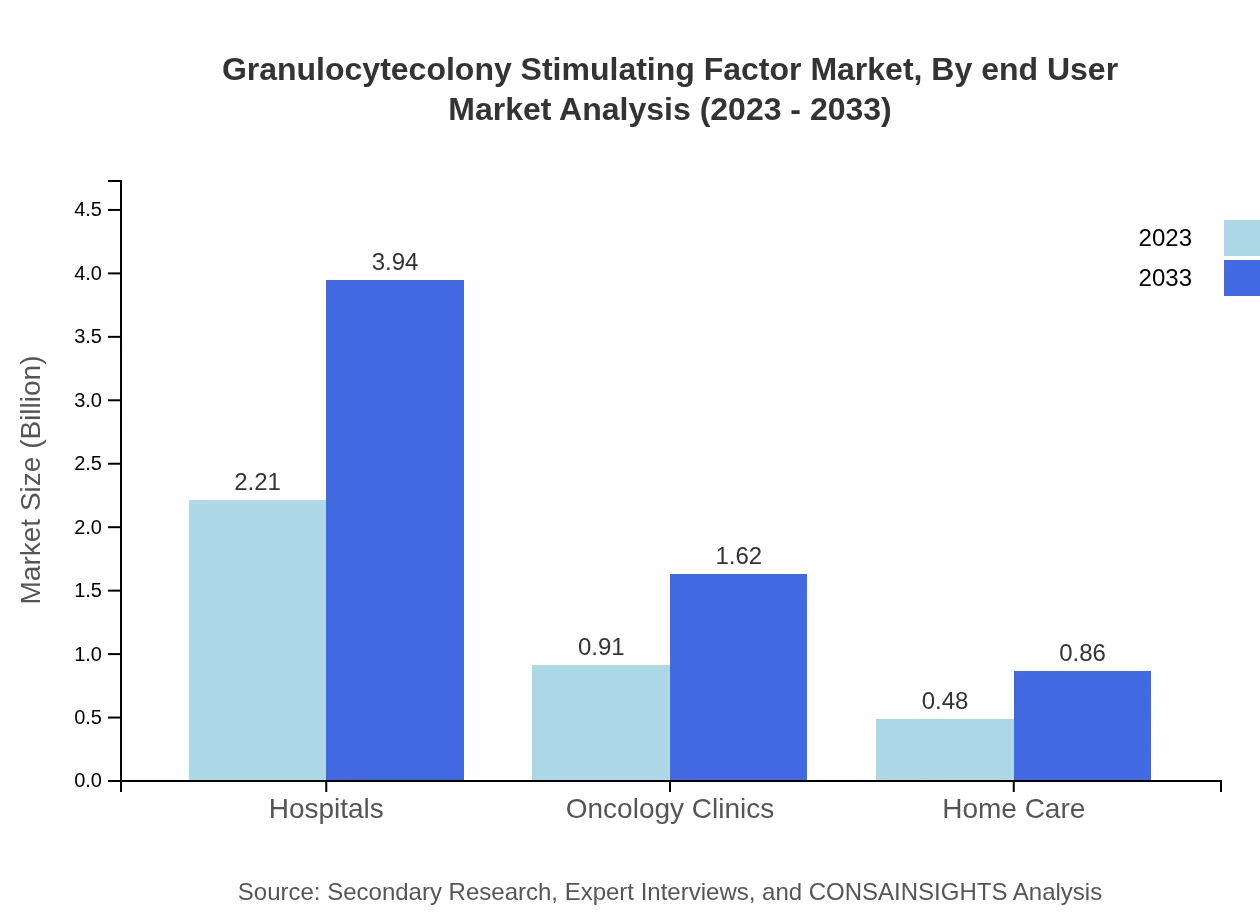
End-users of G-CSF include Hospitals, Oncology Clinics, and Home Care settings. Hospitals hold the majority with $2.21 billion in 2023, rising to $3.94 billion by 2033 (61.41% share), while Oncology Clinics are expected to expand from $0.91 billion to $1.62 billion (25.21% share). Home Care settings will grow from $0.48 billion to $0.86 billion, maintaining a 13.38% share.
Granulocytecolony Stimulating Factor Market Analysis By Formulation
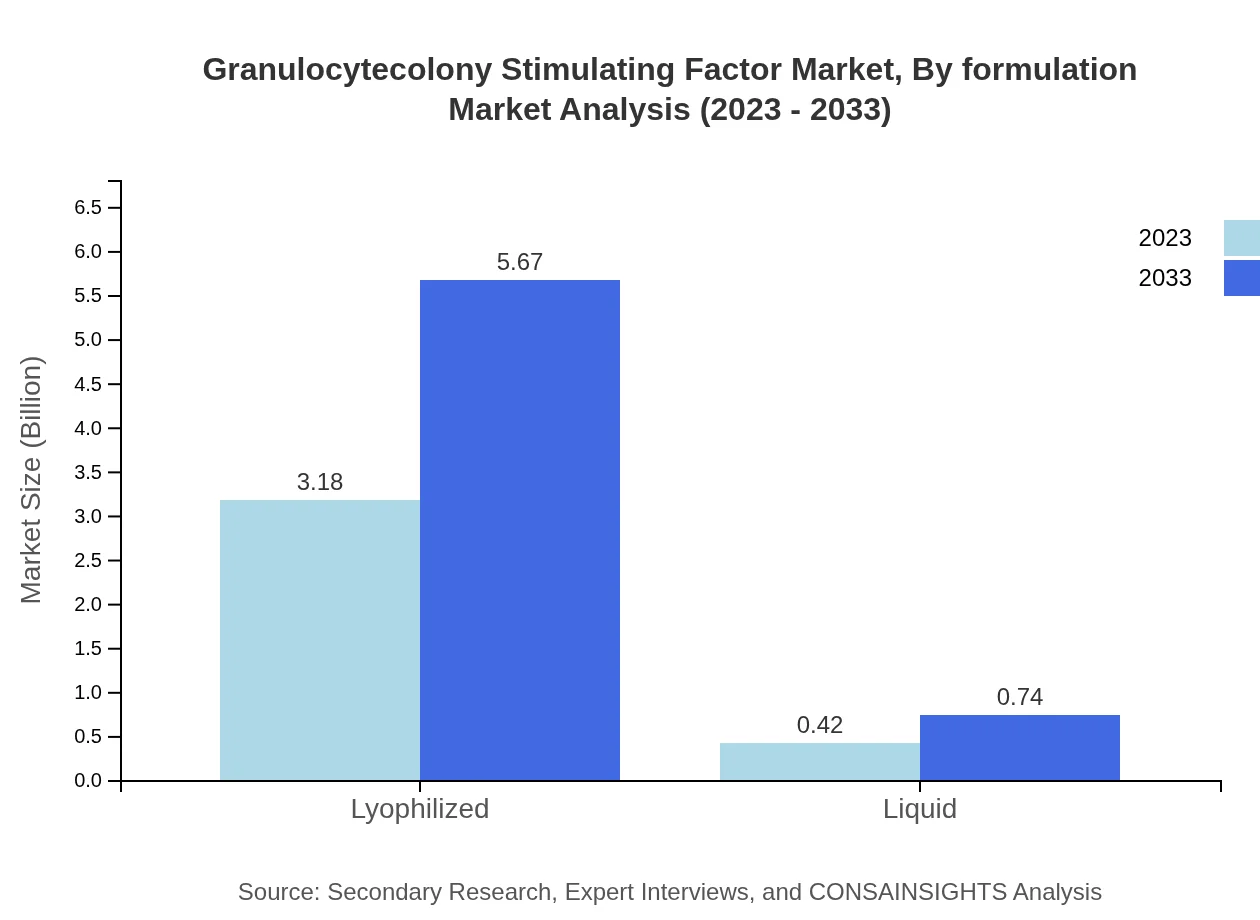
The G-CSF market is segmented into Lyophilized and Liquid formulations. The Lyophilized formulation leads the market, expected to grow from $3.18 billion in 2023 to $5.67 billion in 2033, while holding an 88.47% share. Liquid formulations follow with sizes of $0.42 billion in 2023 and $0.74 billion in 2033, covering an 11.53% share.
Granulocytecolony Stimulating Factor Market Analysis By Distribution Channel
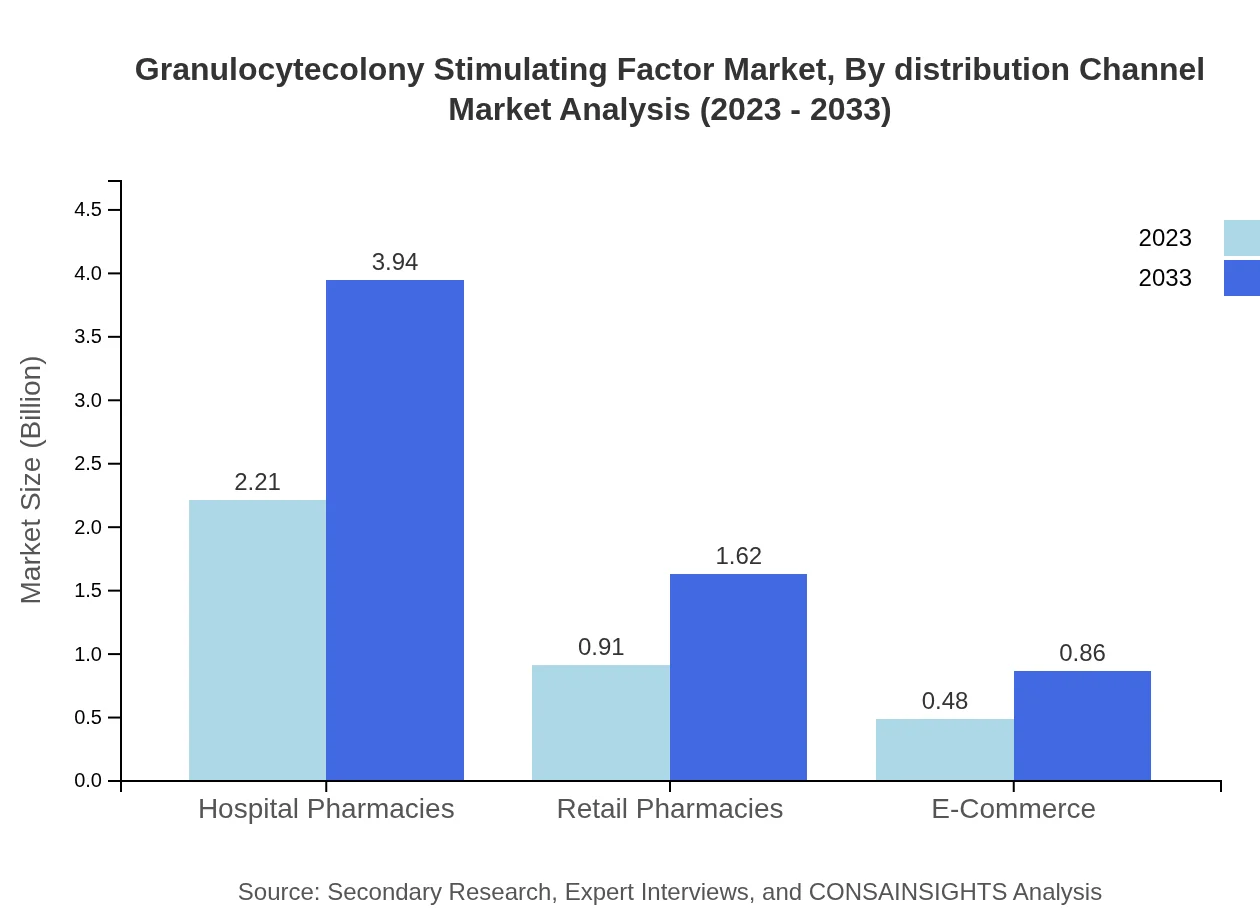
Distribution channels for G-CSF include Hospital Pharmacies, Retail Pharmacies, and E-Commerce. Hospital Pharmacies maintained a size of $2.21 billion in 2023, projected to reach $3.94 billion by 2033 (61.41% market share). Retail Pharmacies account for $0.91 billion in 2023 expected to grow to $1.62 billion by 2033 (25.21% share), while E-Commerce shows growth from $0.48 billion to $0.86 billion, maintaining a 13.38% share.
Granulocytecolony Stimulating Factor Market Trends and Future Forecast
Tell us your focus area and get a customized research report.
Global Market Leaders and Top Companies in Granulocytecolony Stimulating Factor Industry
Amgen Inc.:
A pioneer in the biotechnology industry, Amgen has developed innovative therapies primarily focusing on oncology and hematology, including G-CSF products like Neupogen that significantly support cancer treatment.Celgene Corporation:
Celgene Corporation offers advanced therapy options in hematology and oncology, and their contributions include developing effective G-CSF products for managing neutropenia.Sandoz:
As a global leader in generic pharmaceuticals, Sandoz provides cost-effective G-CSF products and has a robust pipeline targeted at improving cancer care.Teva Pharmaceutical Industries Ltd.:
Teva is a global pharmaceutical leader invested in biosimilars and specialty medications, which includes G-CSF therapies critical for patient care.We're grateful to work with incredible clients.






FAQs
What is the market size of the Granulocytecolony Stimulating Factor Market Report in 2023?
The market size in 2023 is $3.60 Billion according to the report's baseline figure for that year.
How big will the market be in 2033?
By 2033 the market is projected to reach $6.41 Billion as stated for the end of the forecast period.
What is CAGR for the forecast period?
The compound annual growth rate for the 2023 to 2033 forecast period is 5.8% as specified in the report.
Is there a single fastest Growing region in the Granulocytecolony Stimulating Factor Market Report market?
No single fastest-growing region is stated for the Granulocytecolony Stimulating Factor Market Report market because the top regional implied CAGR values are within 0.15 percentage points of each other, making the ranking too close to call reliably.
Which product subsegments are covered in the report?
Product coverage includes Filgrastim and Pegfilgrastim as the primary subsegments listed in the segmentation facts.
Who are the top companies featured in the analysis?
Key companies named in the report include Amgen Inc., Celgene Corporation, Sandoz, and Teva Pharmaceutical Industries Ltd.
What distribution channels are analyzed?
The report includes hospital pharmacies, retail pharmacies, and e-commerce as the primary distribution channels.
How does the report treat fastest Growing region?
regional growth market is Not specified because the top regional growth rates are within 0.15 percentage points, so no single region is named.