
Reports >
Life Sciences
>
High Content Screening Market Report

High Content Screening Market Report
First published: 08 October 2024 | Last updated: 25 May 2026 | Report Code: high-content-screening
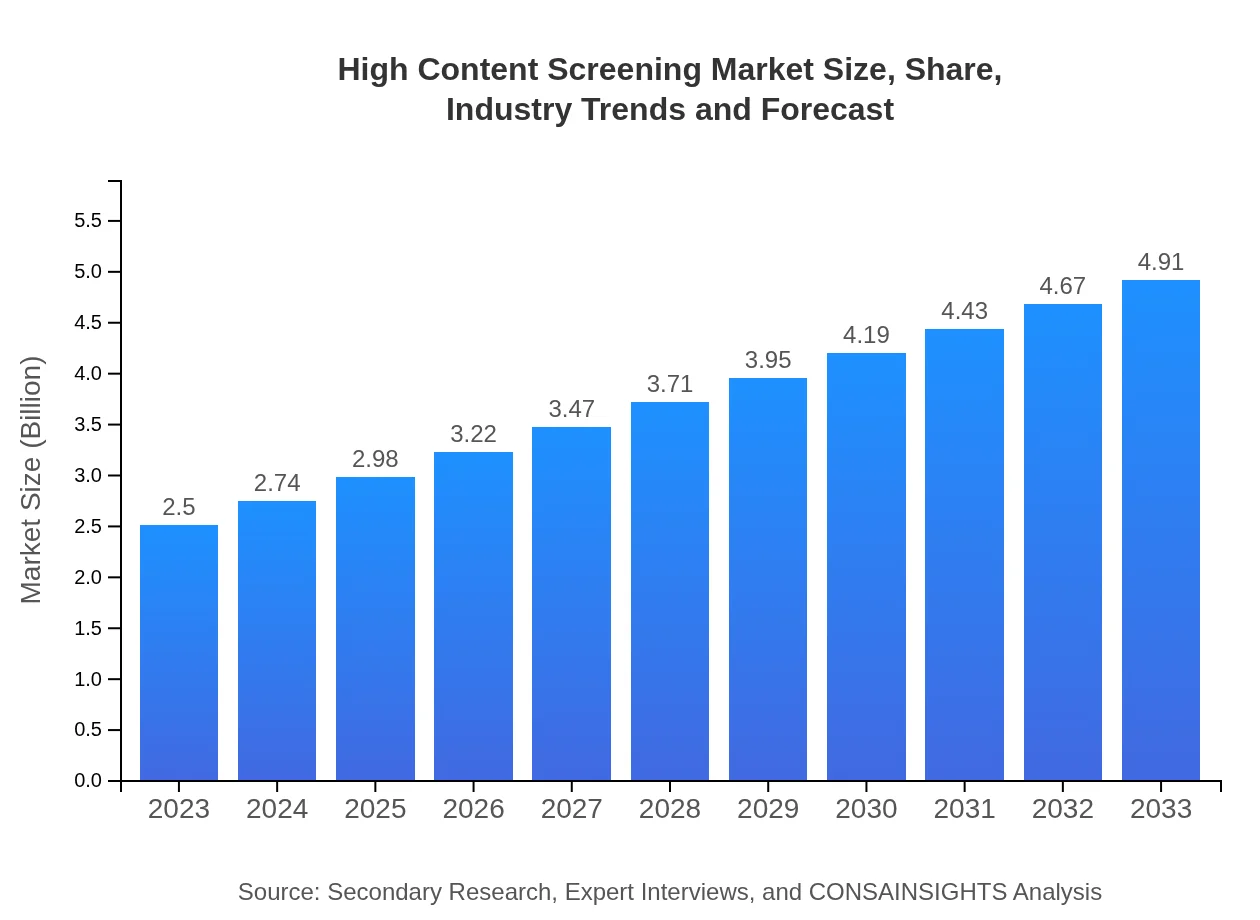
High Content Screening Market — USD 2.5 billion in 2023, Growing to USD 4.91B by 2033 at 6.8% CAGR
This report provides an in-depth analysis of the High Content Screening market from 2023 to 2033, highlighting market dynamics, segmentation, regional insights, and trends. It includes projections and analyses of market size and growth rates, identifying key players and future growth opportunities.
Key Takeaways
- Global market grows from $2.50 Billion in 2023 to $4.91 Billion in 2033 at a 6.8% CAGR.
- North America is largest regional market, while no single fastest-growing region is stated because regional CAGR differences remain within 0.15 percentage points.
- Europe and Asia Pacific each show sizeable expansion: Europe from $0.64 Billion to $1.27 Billion; Asia Pacific from $0.53 Billion to $1.05 Billion.
- Major vendors include Thermo Fisher Scientific, BD Biosciences, PerkinElmer, Evos, and GE Healthcare.
- Market momentum is driven by higher R&D budgets, demand for high-resolution imaging, and increasing automation and analytics capabilities.
High Content Screening Market Report — Executive Summary
North America remains largest market by forecast-period value, while no single fastest-growing region is stated because top regional growth rates are separated by less than 0.15 percentage points. This report provides a concise assessment of the High Content Screening market, highlighting demand drivers, technical developments, and regional performance. Rising R&D expenditure in pharmaceuticals and biotechnology, combined with the need for detailed cellular imaging, underpins market expansion. Advances in automation, software analytics, and imaging hardware are shaping product roadmaps and buyer priorities. The analysis covers solution categories such as instruments, software, and services; technology types including automated and manual systems; and applications like drug discovery, toxicity testing, biomarker discovery, and compound screening. Regional coverage details shifts in market value across North America, Europe, Asia Pacific, Latin America, and Middle East and Africa. Competitive profiling lists leading companies and their strategic positioning. Research draws on primary interviews, company reports, and expert validation to support practical insights for stakeholders planning procurement, R&D investments, or market entry.
Key Growth Drivers
- Increased research and development spending in pharmaceuticals and biotech expands demand for high-content imaging and analysis.
- Growing emphasis on personalized medicine requires higher-resolution cellular assays, fueling adoption of advanced HCS systems.
- Automation and improved software analytics reduce time-to-result and boost throughput, encouraging lab consolidation around integrated solutions.
- Rising need for multiplexed cellular readouts in drug discovery and toxicity testing supports uptake of instruments, software, and services.
- Academic and contract research organizations are expanding HCS capacity to meet collaborative and outsourced screening needs.
| Metric | Value |
|---|---|
| Study Period | 2023 - 2033 |
| 2023 Market Size | $2.50 Billion |
| CAGR (2023-2033) | 6.8% |
| 2033 Market Size | $4.91 Billion |
| Top Companies | Thermo Fisher Scientific, BD Biosciences, PerkinElmer, Evos, GE Healthcare |
| Published Date | 08 October 2024 |
| Last Modified Date | 25 May 2026 |
High Content Screening Market Overview
Customize High Content Screening Market Report market research report
- ✔ Get in-depth analysis of High Content Screening market size, growth, and forecasts.
- ✔ Understand High Content Screening's regional dynamics and industry-specific trends.
- ✔ Identify potential applications, end-user demand, and growth segments in High Content Screening
What is the Market Size & CAGR of High Content Screening Market Report market in 2023?
High Content Screening Industry Analysis
High Content Screening Market Segmentation and Scope
Tell us your focus area and get a customized research report.
High Content Screening Market Report Market Analysis Report by Region
Europe High Content Screening Market Report:
Europe grows from $0.64 Billion in 2023 to $1.27 Billion in 2033. Regional expansion is linked to strong academic research activity, investments in translational science, and demand for imaging and analytics tools in drug development.Asia Pacific High Content Screening Market Report:
Asia Pacific grows from $0.53 Billion in 2023 to $1.05 Billion in 2033. Growth drivers include expanding life-sciences R&D capacity, rising clinical research efforts, and wider adoption of automated screening technologies.North America High Content Screening Market Report:
North America is largest regional market, rising from $0.85 Billion in 2023 to $1.67 Billion in 2033. This region’s scale reflects concentrated pharmaceutical and biotech R&D spending and rapid uptake of automated imaging platforms and integrated analytics.South America High Content Screening Market Report:
Latin America grows from $0.13 Billion in 2023 to $0.25 Billion in 2033. Market growth is supported by developing research infrastructure and gradual uptake of imaging systems and related analytical services.Middle East & Africa High Content Screening Market Report:
Middle East and Africa grows from $0.35 Billion in 2023 to $0.68 Billion in 2033. Expansion is driven by growing investment in biomedical research and increased interest in automated and high-resolution screening technologies.Tell us your focus area and get a customized research report.
Research Methodology
High Content Screening Market Analysis By Solution
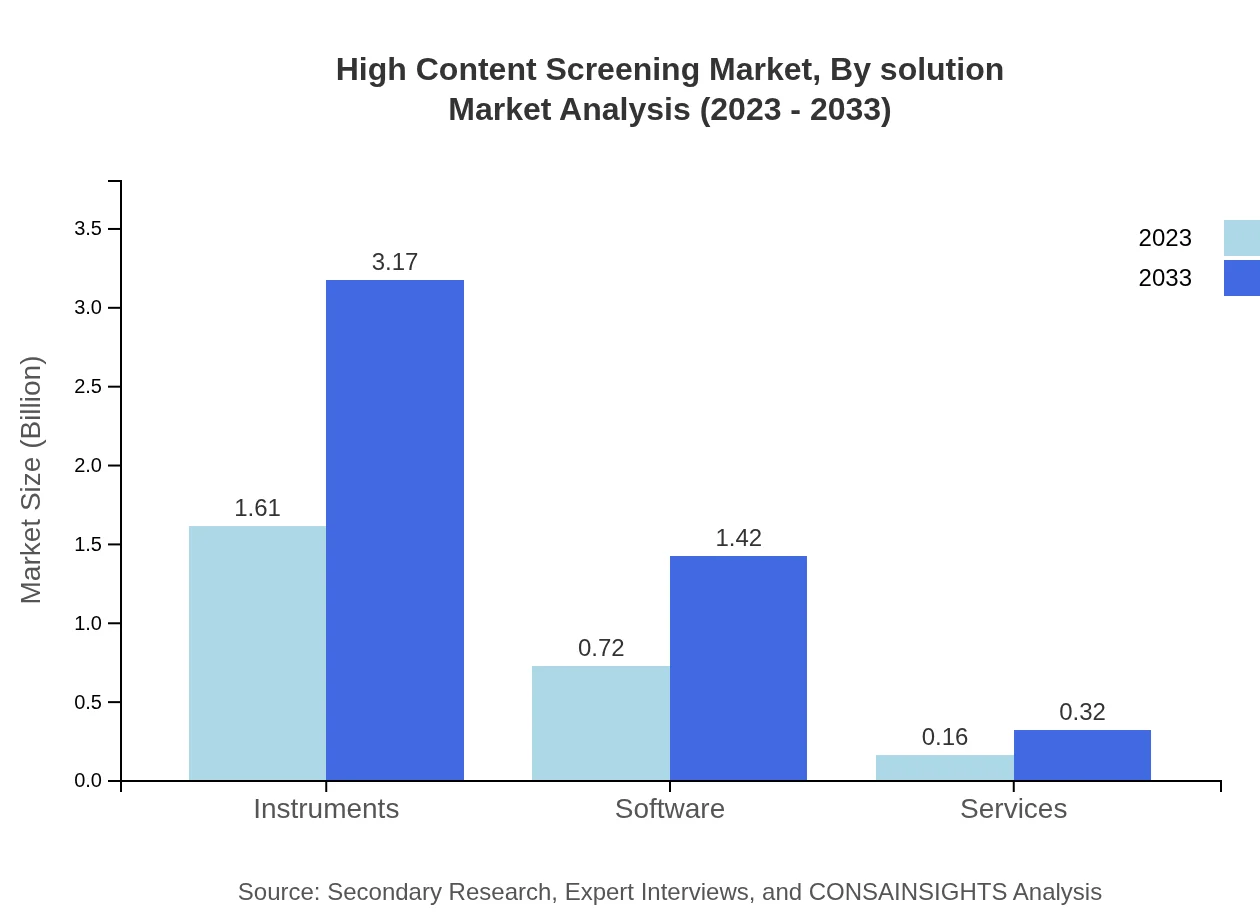
The High-Content Screening market by solution includes instruments, software, and services. In 2023, instruments hold the largest segment with a market size of $1.61 billion, anticipated to grow to $3.17 billion by 2033. Software solutions follow with a current market size of $0.72 billion, expected to increase to $1.42 billion, reflecting the significance of data analysis tools in HCS. Services also contribute to market growth, albeit at a smaller scale, showing a steady growth from $0.16 billion to $0.32 billion.
High Content Screening Market Analysis By Application
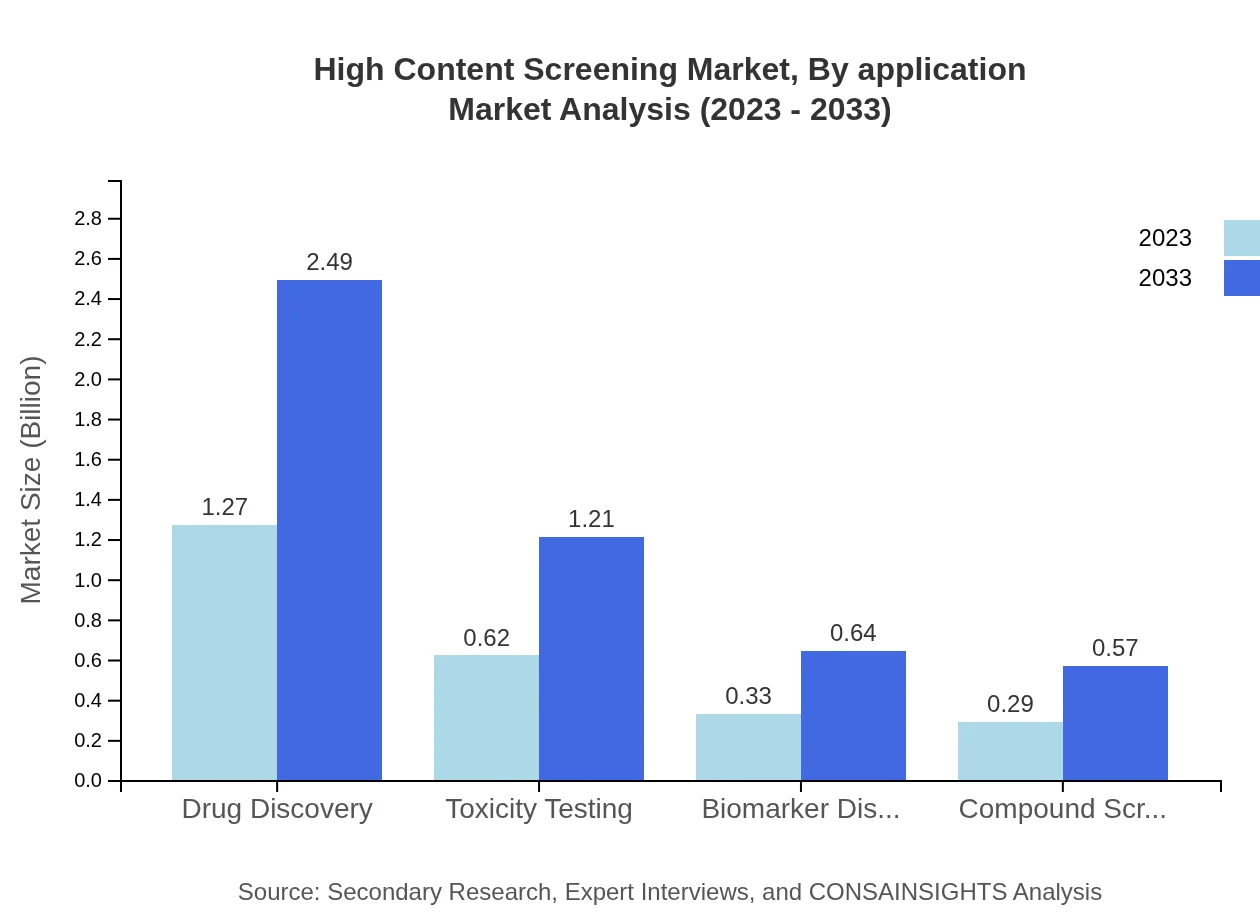
In the application segment, drug discovery dominates with a market size of $1.27 billion in 2023 and projected growth to $2.49 billion by 2033. Toxicity testing and biomarker discovery are also significant, growing steadily from $0.62 billion to $1.21 billion and $0.33 billion to $0.64 billion, respectively. Each application emphasizes the need for more precise and efficient screening processes in drug development.
High Content Screening Market Analysis By End User
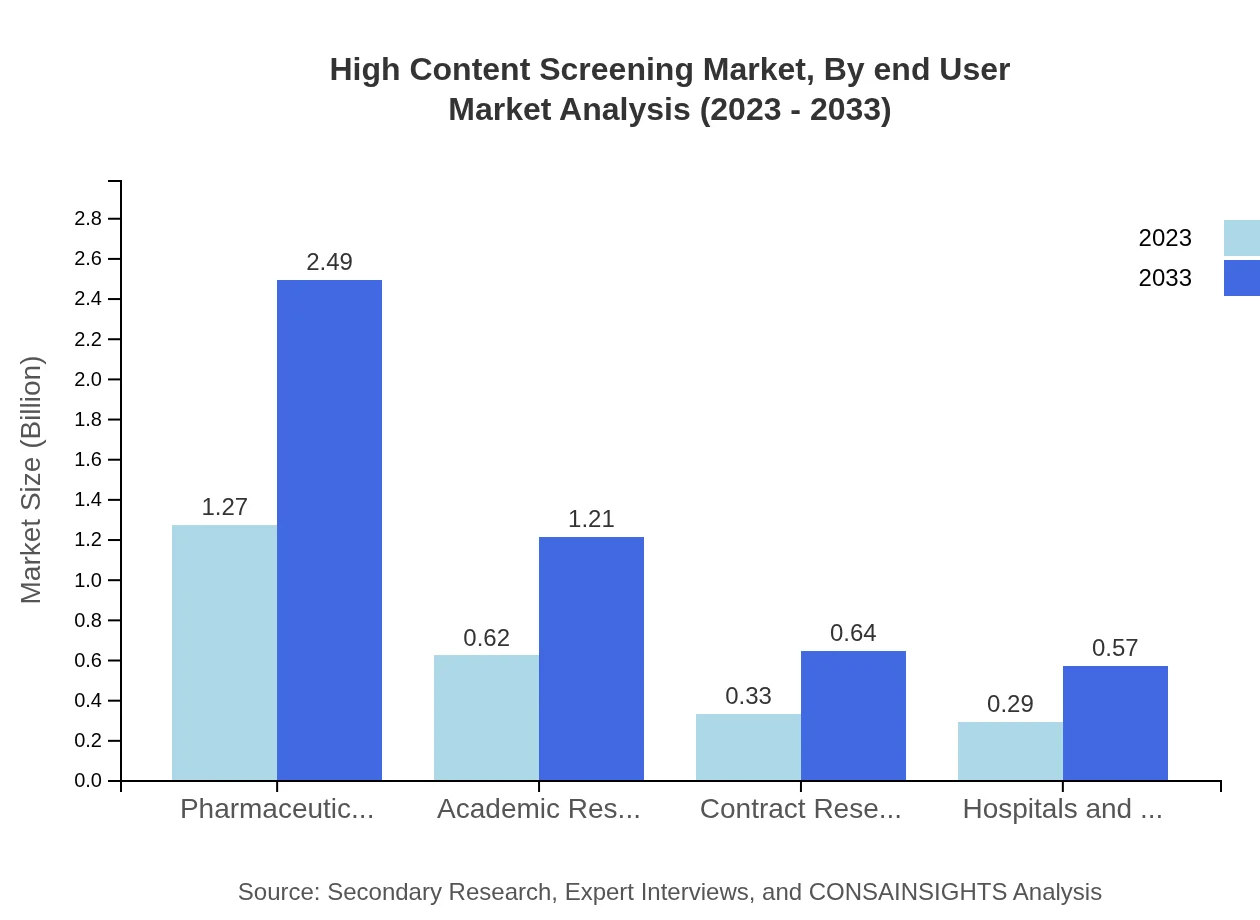
The end-user segmentation shows pharmaceutical companies leading with significant share, starting at $1.27 billion in 2023 and expected to reach $2.49 billion in 2033. Academic research institutions and CROs also present important markets, with sizes of $0.62 billion to $1.21 billion and $0.33 billion to $0.64 billion respectively. Hospitals and clinics represent a smaller but growing market, currently at $0.29 billion and forecasted to increase to $0.57 billion.
High Content Screening Market Analysis By Region
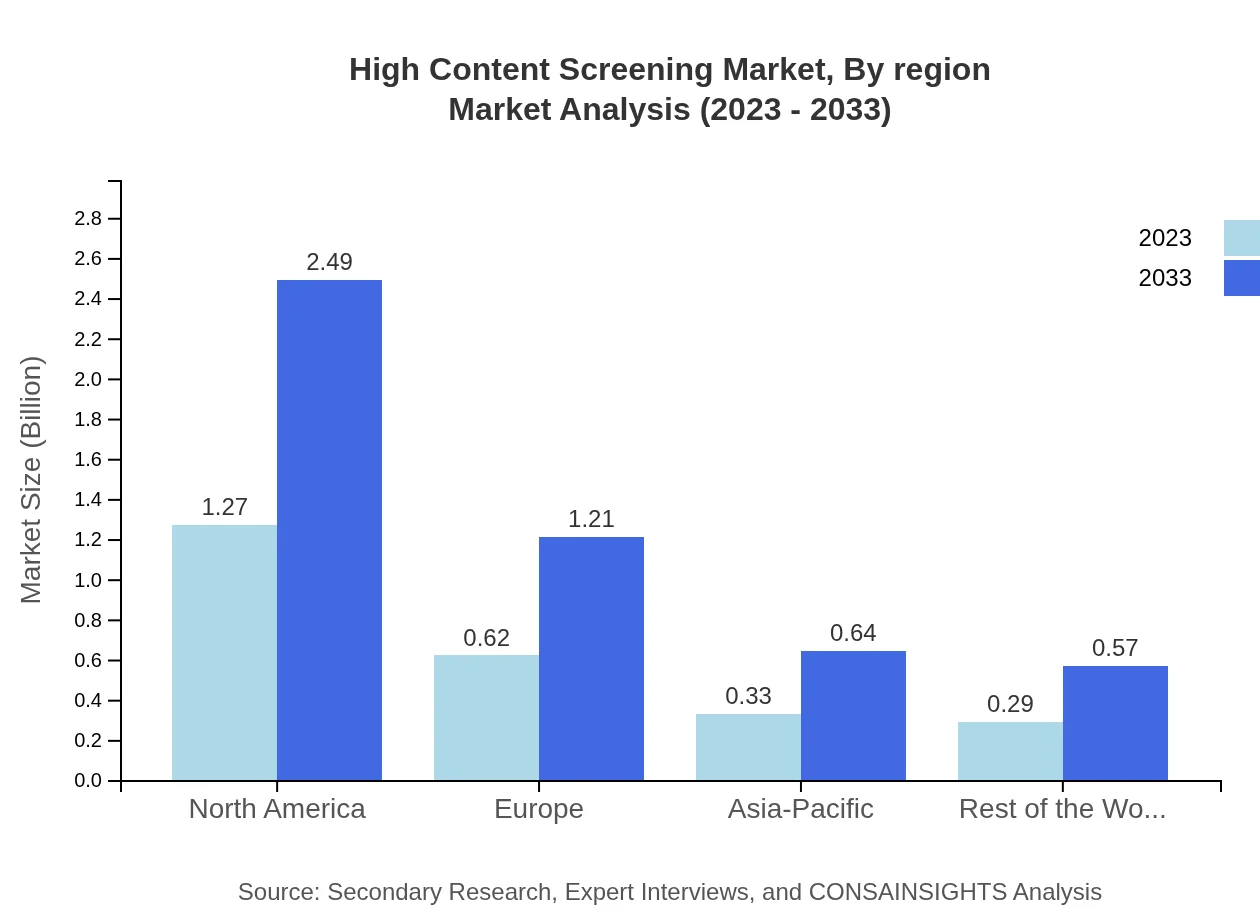
The market analysis by region highlights North America's dominance with a size of $0.85 billion in 2023 and a robust increase to $1.67 billion. Europe and Asia-Pacific also exhibit strong growth, from $0.64 billion to $1.27 billion and $0.53 billion to $1.05 billion, respectively. South America and the Middle East-Africa regions, while smaller, are on an upward trajectory, indicating opportunities for market penetration.
High Content Screening Market Analysis By Technology
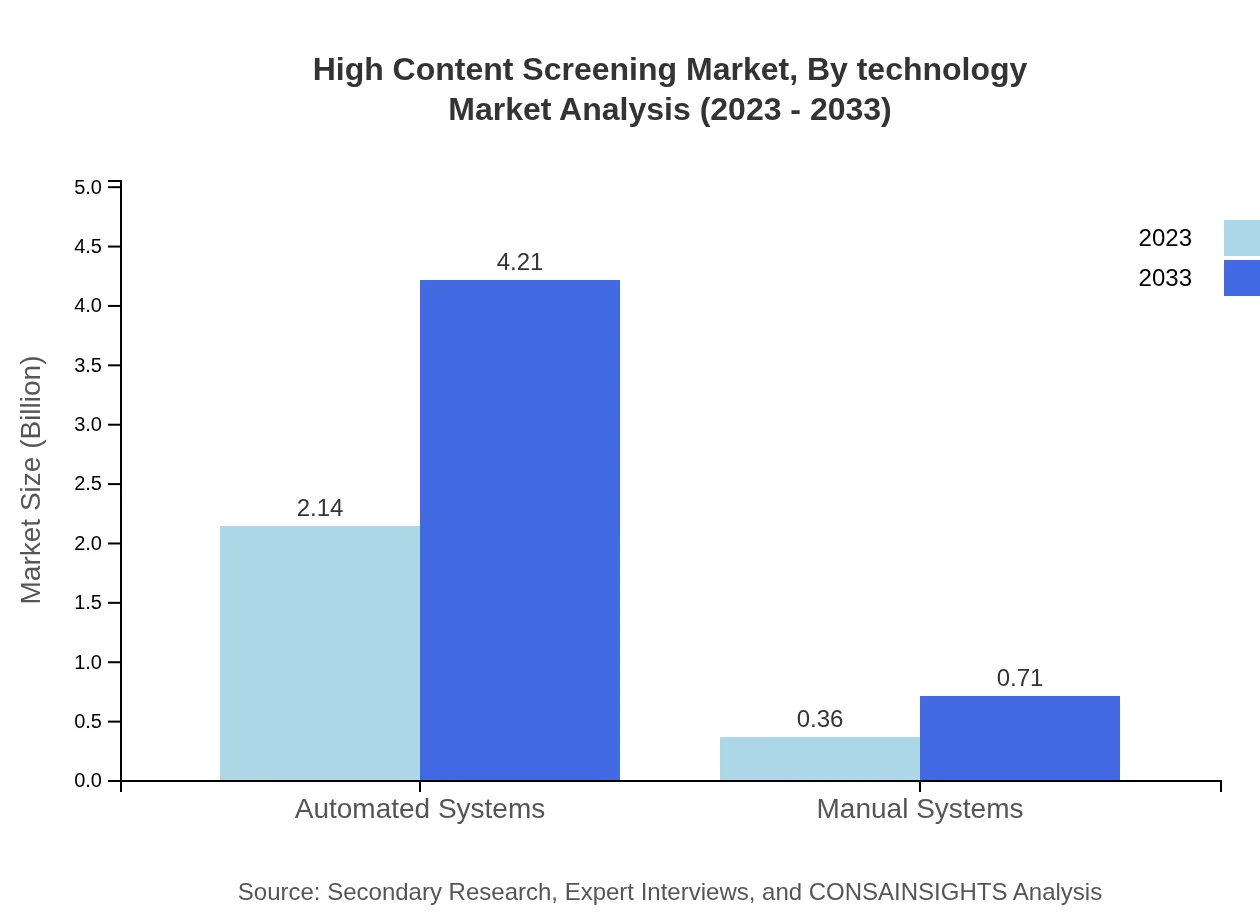
In terms of technology, automated systems account for the largest share at 85.61% of the market with a size of $2.14 billion in 2023, growing to $4.21 billion by 2033. Manual systems, although less significant, are also contributing to overall market dynamics, reflecting the transition towards automation in screening processes.
High Content Screening Market Trends and Future Forecast
Tell us your focus area and get a customized research report.
Global Market Leaders and Top Companies in High Content Screening Industry
Thermo Fisher Scientific:
A leading company in the field of analytical instrumentation, offering innovative solutions including high-content screening technologies for drug discovery.BD Biosciences:
Known for its advanced technologies in flow cytometry and imaging systems, BD Biosciences plays a crucial role in high-content screening applications.PerkinElmer:
A key player in the life sciences and diagnostics arena, PerkinElmer provides extensive high-content screening platforms to enhance the drug development process.Evos:
Evos develops high-quality microscopy systems essential for high-content screening and cell analysis, catering to both academic and pharmaceutical research.GE Healthcare:
With a robust portfolio of imaging and diagnostic technologies, GE Healthcare integrates high-content screening into routine laboratory workflows to facilitate faster research outcomes.We're grateful to work with incredible clients.








FAQs
What is the market size of the High Content Screening market in 2023?
The market size for 2023 is $2.50 Billion, as reported for the High Content Screening market.
How big will the market be in 2033?
The market is projected to reach $4.91 Billion by 2033, based on the forecasted progression over the 2023 to 2033 period.
What is CAGR for the forecast period?
The compound annual growth rate for the 2023 to 2033 forecast period is 6.8%.
Is there a single fastest Growing region in the High Content Screening Market Report market?
No single fastest-growing region is stated for the High Content Screening Market Report market because the top regional implied CAGR values are within 0.15 percentage points of each other, making the ranking too close to call reliably.
Which vendors are prominent in the High Content Screening space?
Key companies named in the report include Thermo Fisher Scientific, BD Biosciences, PerkinElmer, Evos, and GE Healthcare.
What applications drive HCS adoption?
Primary applications include drug discovery, toxicity testing, biomarker discovery, and compound screening, supporting diverse screening workflows in research and development settings.
How does technology segmentation appear in the market?
The market is segmented by automated systems and manual systems, reflecting varied laboratory automation levels and throughput requirements.
What end users rely on HCS solutions?
Major end users include pharmaceutical companies, academic research institutions, contract research organizations (CROs), and hospitals and clinics.
What solutions categories are tracked in the report?
Solutions covered comprise instruments, software, and services, capturing hardware, analytics, and support offerings within HCS deployments.
Why are software and analytics important for HCS?
Software and analytics enable high-content image processing and multiparametric analysis, improving interpretability and throughput for complex cellular assays.