
Reports >
Life Sciences
>
Human Liver Models Market Report

Human Liver Models Market Report
First published: 21 October 2024 | Last updated: 28 May 2026 | Report Code: human-liver-models
Human Liver Models Market — USD $1.5 Billion in 2023, Growing to USD 2.78null by 2033 at 6.2% CAGR
This report provides an in-depth analysis of the Human Liver Models market, covering market trends, size, segmentation, and regional insights from 2023 to 2033. Detailed forecasts and evaluations of key market players are also included to assist stakeholders in strategic planning.
Key Takeaways
- Global market expands from $1.50 Billion in 2023 to $2.78 Billion in 2033 at a 6.2% CAGR over 2023 to 2033.
- North America is largest regional market; Middle East and Africa is regional market region based on implied CAGR across 2023 to 2033.
- Middle East and Africa is identified as the regional market region, rising from $0.2 Billion in 2023 to $0.38 Billion in 2033.
- Europe grows from $0.42 Billion to $0.78 Billion between 2023 and 2033, reflecting sustained adoption across research and industry sectors.
- Key suppliers named include InSphero AG and Mimetas, active in advanced liver modeling technologies.
Human Liver Models Market Report — Executive Summary
Regional analysis shows North America as largest market and Middle East and Africa as fastest-growing region by implied CAGR. The Human Liver Models market is expanding through 2033, supported by technological improvements in in vitro and in vivo platforms and growing uptake in pharmaceutical and academic research. Market value rises from $1.50 Billion in 2023 to $2.78 Billion in 2033, reflecting a 6.2% CAGR during the 2023 to 2033 period. Demand drivers include the need for reliable toxicity screening and drug discovery tools, regulatory encouragement to reduce animal testing, and the emergence of personalized approaches that require accurate human-relevant models. Regional patterns show a dominant North American market and a notably accelerating Middle East and Africa segment. Market participants such as InSphero AG and Mimetas are positioned around advanced 2D and 3D model offerings and related technologies. The report structure addresses market sizing, segmentation by model type, technology and application, regional breakdown, and a competitive landscape informed by primary interviews and secondary literature.
Key Growth Drivers
- Advances in liver modeling techniques that improve physiological relevance and predictive accuracy for drug screening.
- Rising use in drug discovery and toxicity testing by pharmaceutical companies and research institutions.
- Regulatory emphasis on alternatives to animal testing, encouraging adoption of human-relevant models.
- Growth in personalized medicine approaches increasing demand for patient-specific and high-fidelity liver models.
- Collaboration between biotech firms and academic centers accelerating model development and validation.
| Metric | Value |
|---|---|
| Study Period | 2023 - 2033 |
| 2023 Market Size | $1.50 Billion |
| CAGR (2023-2033) | 6.2% |
| 2033 Market Size | $2.78 Billion |
| Top Companies | InSphero AG, Mimetas |
| Published Date | 21 October 2024 |
| Last Modified Date | 28 May 2026 |
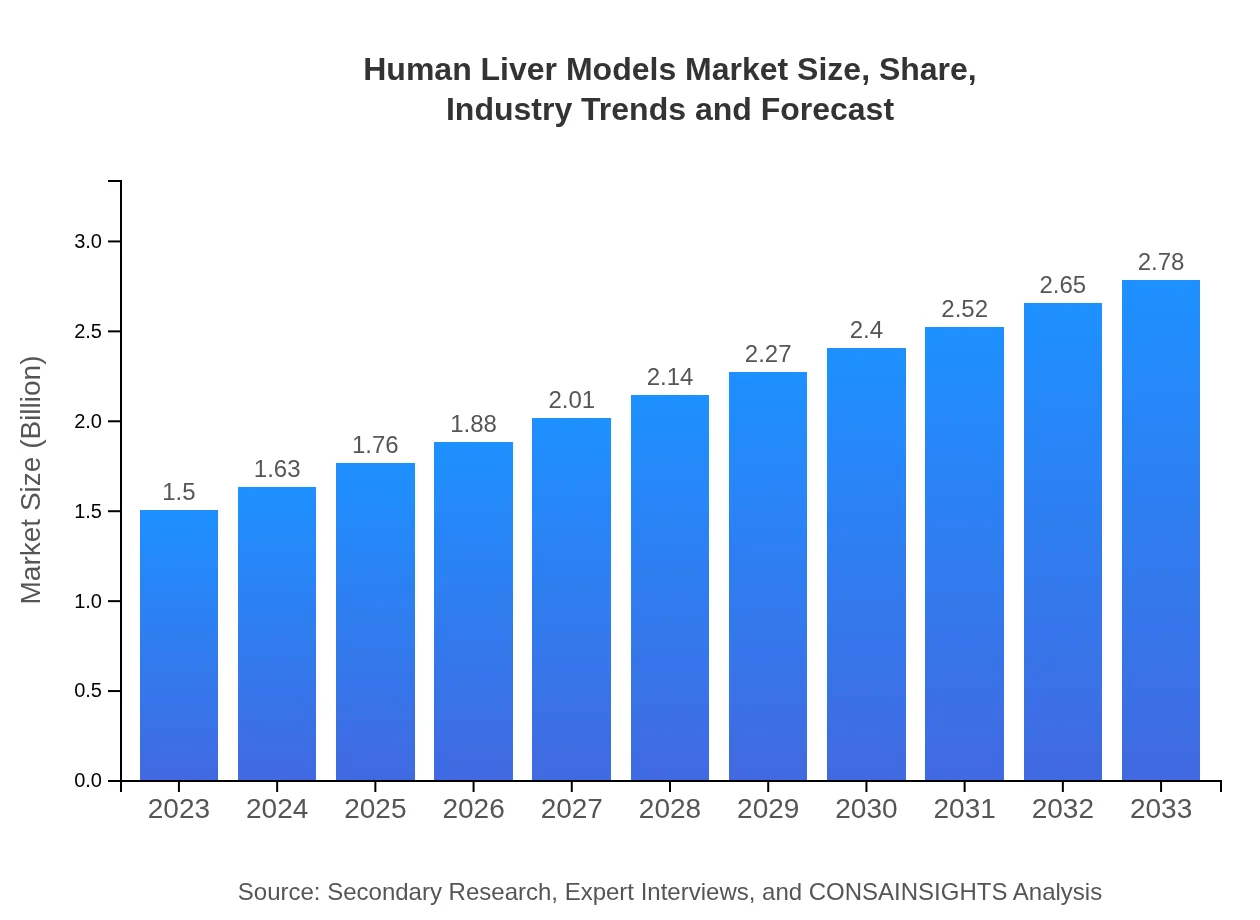
Human Liver Models Market Overview
Customize Human Liver Models Market Report market research report
- ✔ Get in-depth analysis of Human Liver Models market size, growth, and forecasts.
- ✔ Understand Human Liver Models's regional dynamics and industry-specific trends.
- ✔ Identify potential applications, end-user demand, and growth segments in Human Liver Models
What is the Market Size & CAGR of Human Liver Models Market Report market in 2023?
Human Liver Models Industry Analysis
Human Liver Models Market Segmentation and Scope
Tell us your focus area and get a customized research report.
Human Liver Models Market Report Market Analysis Report by Region
Europe Human Liver Models Market Report:
Europe grows from $0.42 Billion in 2023 to $0.78 Billion in 2033. 42 Billion in 2023 to $0.78 Billion in 2033, reflecting steady adoption in drug development and research institutions. Regulatory moves toward alternatives to animal testing and collaborations between academia and industry support regional growth.Asia Pacific Human Liver Models Market Report:
Asia Pacific grows from $0.29 Billion in 2023 to $0.53 Billion in 2033. Market gains are underpinned by expanding biotech investment, increasing drug discovery activity, and growing research infrastructure in several countries.North America Human Liver Models Market Report:
North America is largest regional market, rising from $0.55 Billion in 2023 to $1.02 Billion in 2033. Expansion is driven by concentrated pharmaceutical R&D, strong academic research activity, and uptake of advanced 2D and 3D model systems.South America Human Liver Models Market Report:
Latin America grows from $0.04 Billion in 2023 to $0.07 Billion in 2033. 04 Billion in 2023 to $0.07 Billion in 2033, with uptake influenced by regional research initiatives and selective industry partnerships focused on translational studies.Middle East & Africa Human Liver Models Market Report:
Middle East and Africa is fastest-growing region by implied CAGR, increasing from $0.2 Billion in 2023 to $0.38 Billion in 2033. Growth reflects emerging research investment, technology transfer, and increased interest in alternatives to animal-based testing.Tell us your focus area and get a customized research report.
Research Methodology
Human Liver Models Market Analysis By Model Type
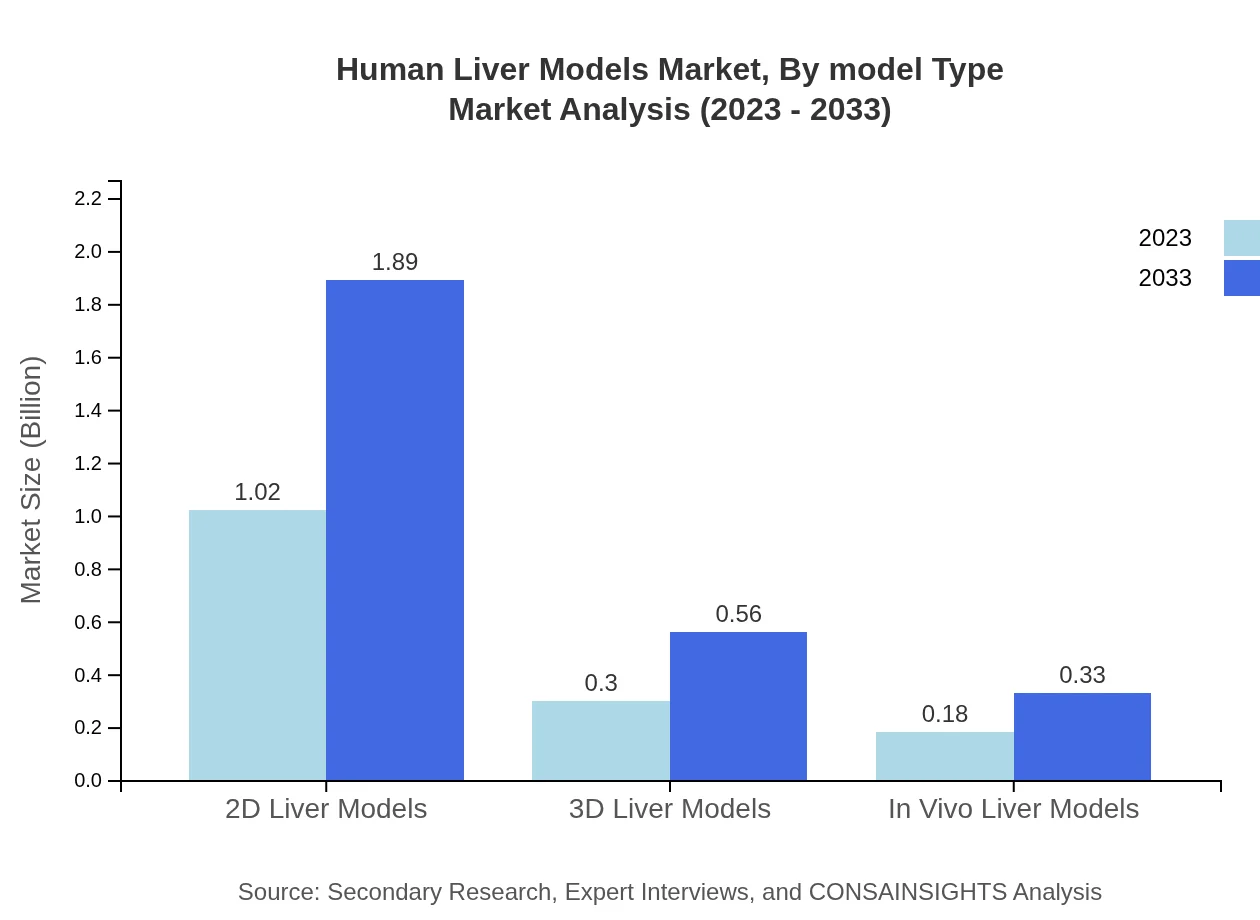
In 2023, the market for 2D Liver Models stands at USD 1.02 billion, dominating with a share of 67.91%. By 2033, it is projected to reach USD 1.89 billion. 3D Liver Models, valued at USD 0.30 billion in 2023, are expected to grow to USD 0.56 billion. In Vivo models represent a smaller yet significant market at USD 0.18 billion, projected to grow to USD 0.33 billion by 2033.
Human Liver Models Market Analysis By Application
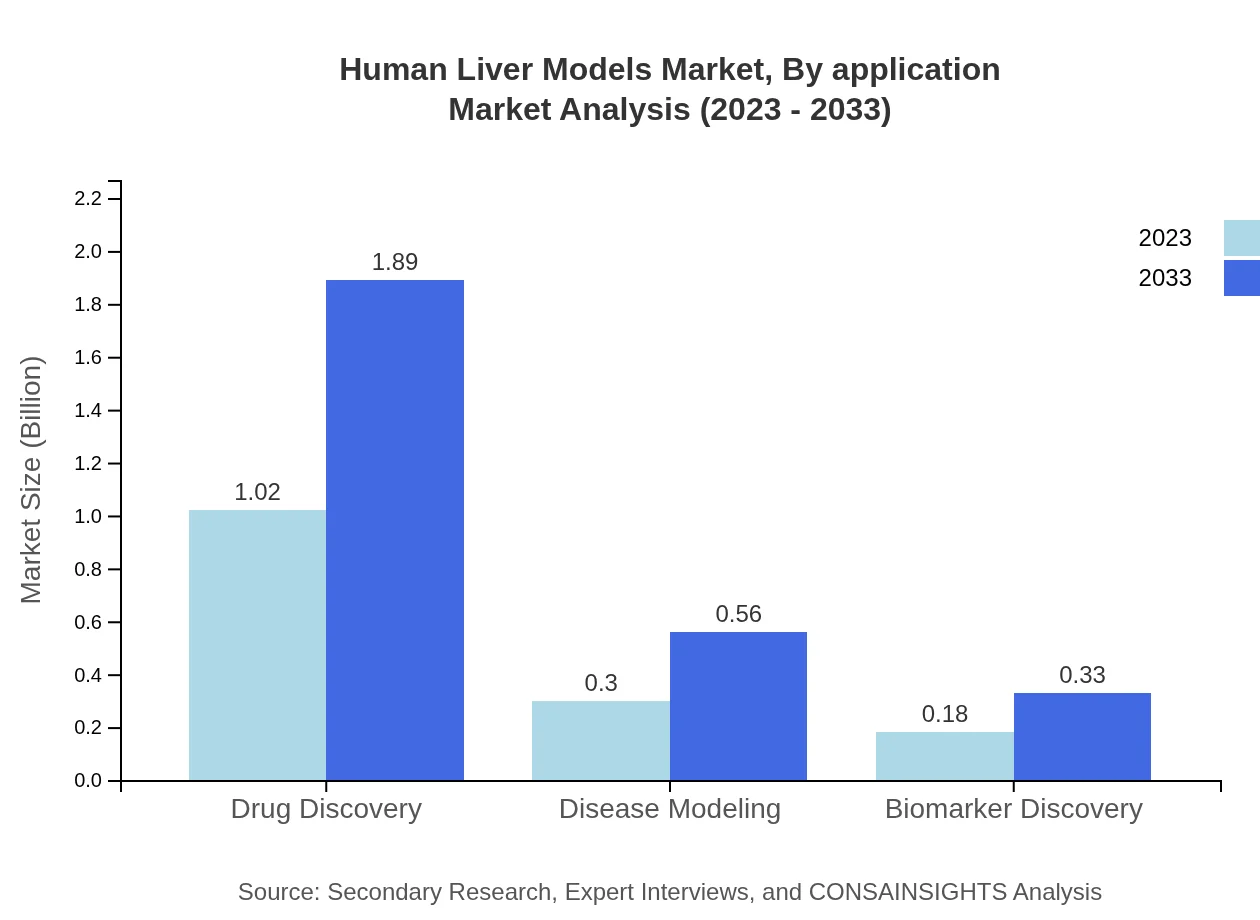
Drug Discovery currently holds a substantial portion of the market, valued at USD 1.02 billion in 2023 (67.91% share), and is expected to reach USD 1.89 billion by 2033. Other applications such as Disease Modeling and Biomarker Discovery are also growing, with Disease Modeling expected to increase from USD 0.30 billion to USD 0.56 billion during the same period.
Human Liver Models Market Analysis By End User
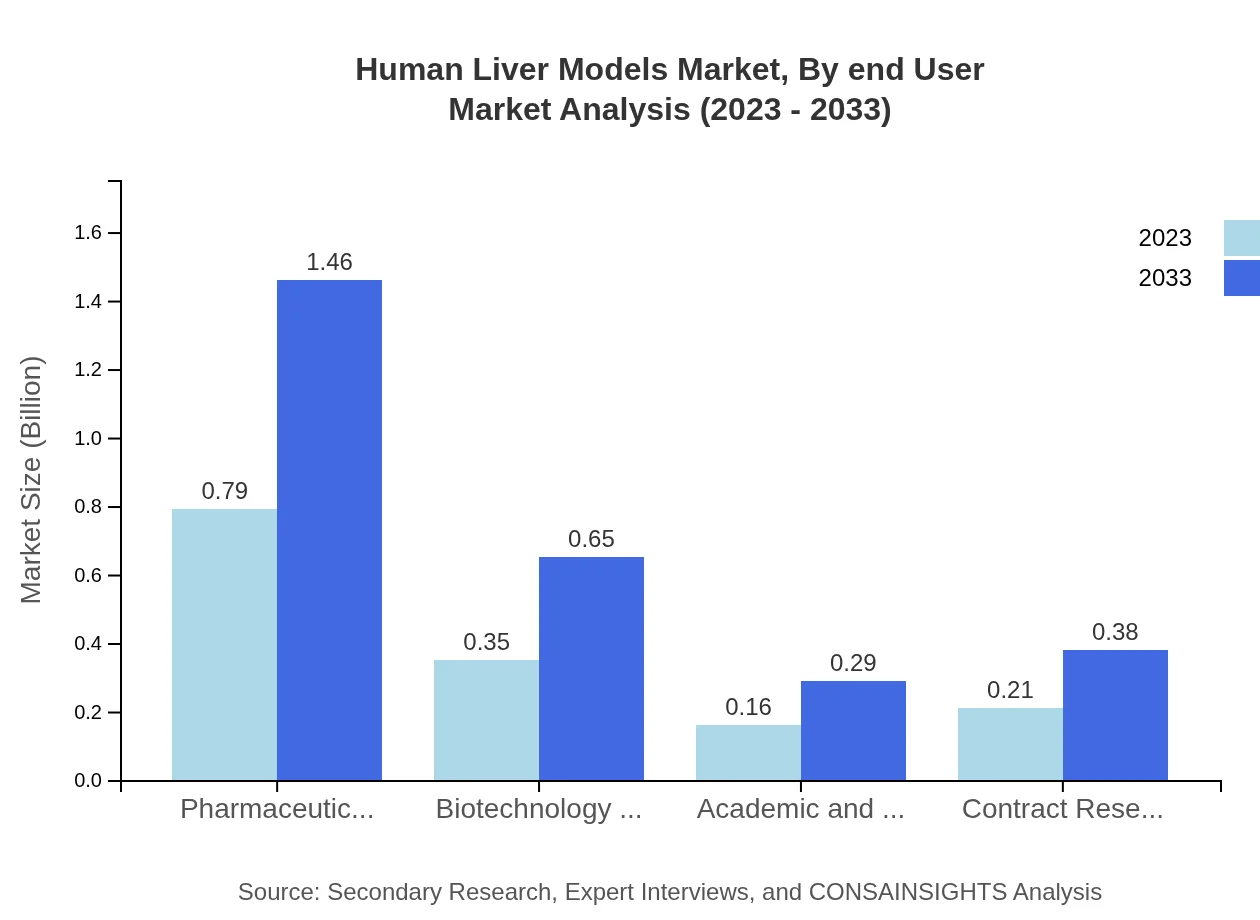
Pharmaceutical Companies dominate the market, with revenue of USD 0.79 billion in 2023 and a share of 52.42%. Biotechnology firms and academic institutions are also key players, with expected revenue growth from USD 0.35 billion to USD 0.65 billion and from USD 0.16 billion to USD 0.29 billion respectively through 2033.
Human Liver Models Market Analysis By Technology
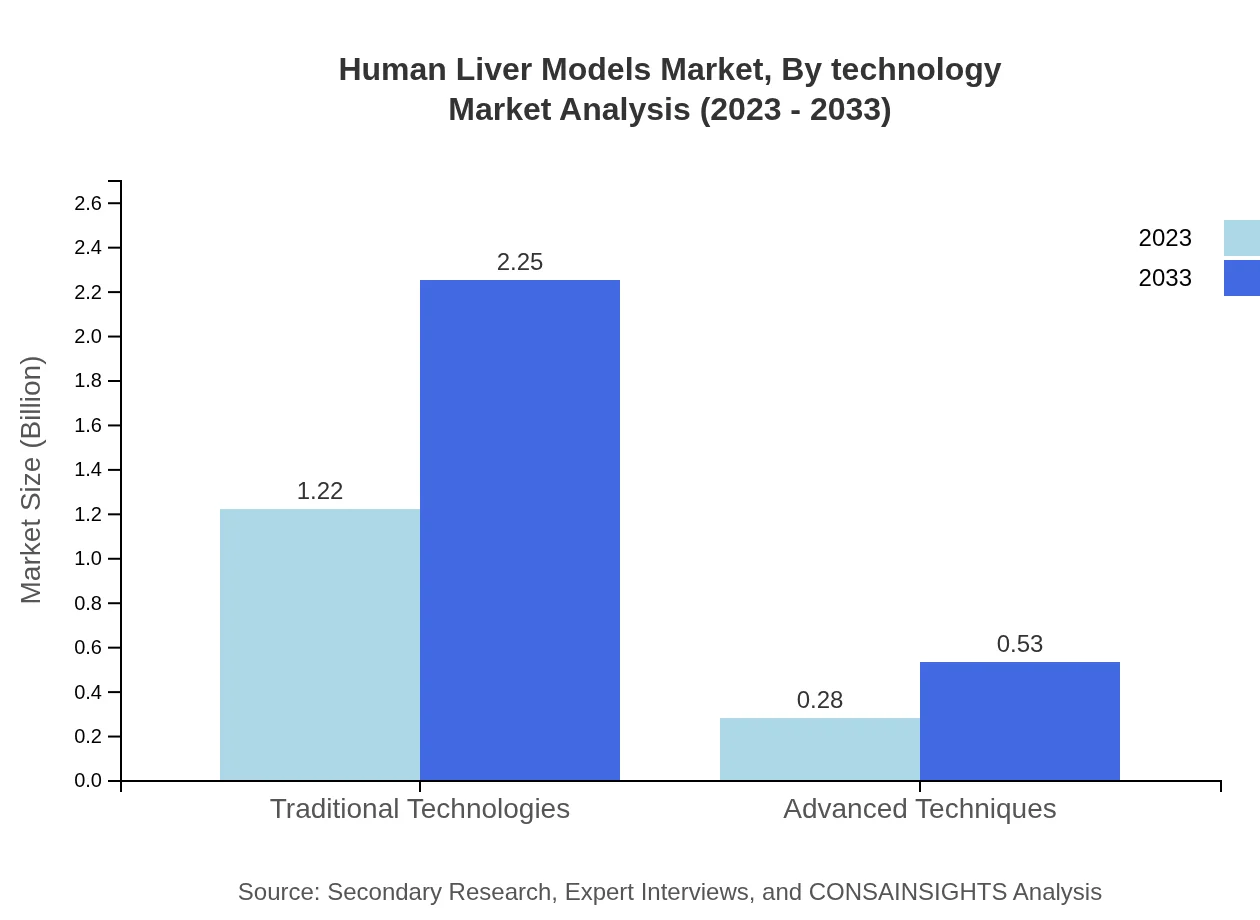
Traditional Technologies continue to lead the market with a size of USD 1.22 billion in 2023, growing to USD 2.25 billion by 2033. Advances in Techniques showcase rapid growth potential, projected to expand from USD 0.28 billion to USD 0.53 billion during the forecast period.
Human Liver Models Market Trends and Future Forecast
Tell us your focus area and get a customized research report.
Global Market Leaders and Top Companies in Human Liver Models Industry
InSphero AG:
A pioneering company known for its 3D liver model technology, providing solutions for drug discovery and disease modeling.Mimetas:
Specializes in organ-on-a-chip technologies, focusing on replicating human biology with liver models for drug testing.We're grateful to work with incredible clients.









FAQs
What is the market size of the Human Liver Models market in 2023?
The market size in 2023 is $1.50 Billion, as reported for the Human Liver Models market, serving pharmaceutical, biotech, and academic research needs.
How big will the Human Liver Models market be in 2033?
By 2033 the market is projected to reach $2.78 Billion, reflecting growth across technologies and applications over the 2023 to 2033 forecast period.
What is CAGR for the forecast period?
The reported CAGR for the 2023 to 2033 forecast period is 6.2%, based on market expansion from $1.50 Billion to $2.78 Billion.
Which region is the fastest Growing in the Human Liver Models Market Report market?
Middle East and Africa is the fastest-growing region, projected to expand from $0.2 Billion in 2023 to $0.38 Billion in 2033, reflecting an implied 6.63% CAGR over the forecast period.
Which region is growing the fastest?
Middle East and Africa is identified as the regional market region, increasing from $0.2 Billion in 2023 to $0.38 Billion in 2033 at an implied 6.63% CAGR.
What are common model types covered in the market?
Model types include 2D Liver Models, 3D Liver Models, and In Vivo Liver Models, reflecting a range of platforms used across research and industry applications.
Who are notable companies active in this market?
Top companies listed in the report include InSphero AG and Mimetas, recognized for offerings in advanced liver modeling and related technologies.
Which end users drive demand for liver models?
Key end users are pharmaceutical companies, biotechnology firms, academic and research institutions, and contract research organizations (CROs).
How do regulatory trends affect market adoption?
Regulatory emphasis on reducing animal testing supports wider adoption of human liver models, encouraging development and validation of alternative in vitro and in vivo platforms.
What applications are prominent for liver models?
Primary applications include drug discovery, disease modeling, and biomarker discovery, reflecting core uses in pharmaceutical and translational research.