

Nanotechnology Drug Delivery Market Report
First published: 10 October 2024 | Last updated: 25 May 2026 | Report Code: nanotechnology-drug-delivery
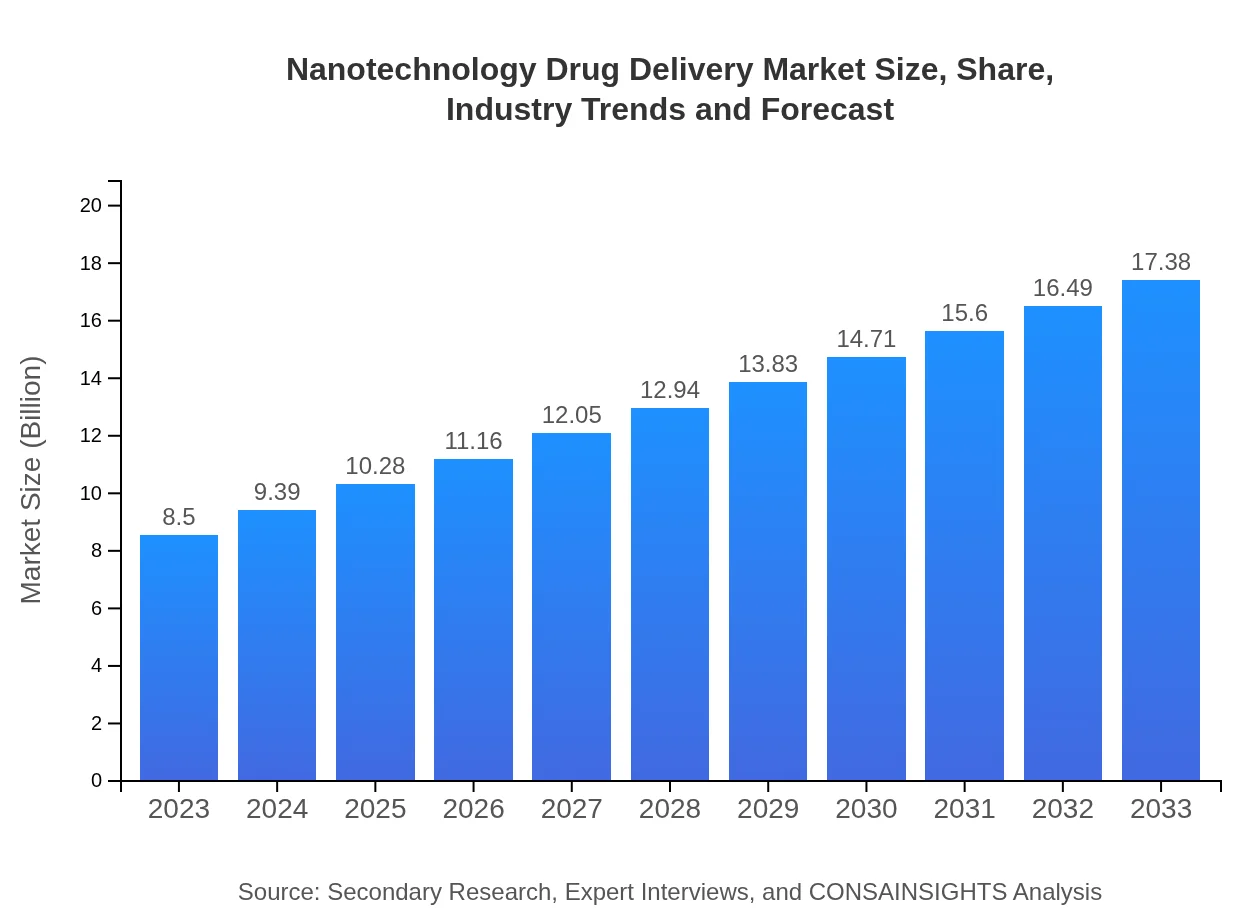
Nanotechnology Drug Delivery Market — USD $8.5 Billion in 2023, Growing to USD 17.38null by 2033 at 7.2% CAGR
This report provides a comprehensive analysis of the Nanotechnology Drug Delivery market, covering market size, growth forecasts, and key trends from 2023 to 2033, alongside regional insights and competitive landscape evaluations.
Key Takeaways
- Global market expands from $8.50 Billion in 2023 to $17.38 Billion in 2033 at a 7.2% CAGR.
- North America is largest regional market, while no single fastest-growing region is stated because regional CAGR differences remain within 0.15 percentage points.
- North America is the largest region, rising from $2.84 Billion in 2023 to $5.81 Billion in 2033.
- Regional markets such as Europe and Asia Pacific show substantial growth—Europe from $2.19 Billion to $4.47 Billion, Asia Pacific from $1.84 Billion to $3.76 Billion.
- Leading industry players include Bristol-Myers Squibb, Amgen, and Pfizer, driving R&D and commercialization.
- Key technological segments include liposomes, nanosuspensions, and polymeric nanomaterials supporting targeted and controlled delivery.
Nanotechnology Drug Delivery Market Report — Executive Summary
North America remains largest market by forecast-period value, while no single fastest-growing region is stated because top regional growth rates are separated by less than 0.15 percentage points. The Nanotechnology Drug Delivery market is forecast to grow from $8.50 Billion in 2023 to $17.38 Billion by 2033, reflecting a 7.2% CAGR over 2023 to 2033. Growth is propelled by advances in nanocarriers, rising application in oncology and biologics delivery, and investments from major life-sciences firms such as Bristol-Myers Squibb, Amgen, and Pfizer. Product innovation in liposomes, nanosuspensions, and polymeric nanomaterials is enabling targeted drug delivery and improved bioavailability. Regional expansion is notable, with North America holding the largest market value, supported by strong R&D infrastructure and commercialization capability. Europe, Asia Pacific, Latin America, and Middle East and Africa each show measurable gains driven by clinical research activities, increasing healthcare investment, and growing focus on precision therapies. Ongoing challenges include regulatory pathways and standardized testing requirements, which may influence adoption timelines. The report organizes findings by technology, chemistry, application, formulation, and end-user to provide actionable insights for stakeholders assessing investment, partnership, and development opportunities.
Key Growth Drivers
- Advances in nanocarrier technologies enabling targeted and controlled drug release.
- Increased R&D spending by major pharmaceutical firms to improve biologic delivery and solubility.
- Rising demand for precision and personalized therapies, particularly in oncology and neurology.
- Expanding clinical research and regulatory attention supporting commercialization pathways.
- Adoption of biodegradable and non-biodegradable materials across varied formulation strategies.
| Metric | Value |
|---|---|
| Study Period | 2023 - 2033 |
| 2023 Market Size | $8.50 Billion |
| CAGR (2023-2033) | 7.2% |
| 2033 Market Size | $17.38 Billion |
| Top Companies | Bristol-Myers Squibb, Amgen, Pfizer |
| Published Date | 10 October 2024 |
| Last Modified Date | 25 May 2026 |
Nanotechnology Drug Delivery Market Overview
Customize Nanotechnology Drug Delivery Market Report market research report
- ✔ Get in-depth analysis of Nanotechnology Drug Delivery market size, growth, and forecasts.
- ✔ Understand Nanotechnology Drug Delivery's regional dynamics and industry-specific trends.
- ✔ Identify potential applications, end-user demand, and growth segments in Nanotechnology Drug Delivery
What is the Market Size & CAGR of Nanotechnology Drug Delivery Market Report market in 2023?
Nanotechnology Drug Delivery Industry Analysis
Nanotechnology Drug Delivery Market Segmentation and Scope
Tell us your focus area and get a customized research report.
Nanotechnology Drug Delivery Market Report Market Analysis Report by Region
Europe Nanotechnology Drug Delivery Market Report:
Europe grows from $2.19 Billion in 2023 to $4.47 Billion in 2033. Regional drivers include active clinical research, growing investment in precision medicine, and regulatory frameworks that support advancement of targeted drug delivery technologies.Asia Pacific Nanotechnology Drug Delivery Market Report:
Asia Pacific grows from $1.84 Billion in 2023 to $3.76 Billion in 2033. Growth is driven by increasing healthcare expenditure, rising clinical trial activity, and expanding manufacturing and research capabilities focused on nanotechnology-enabled therapeutics.North America Nanotechnology Drug Delivery Market Report:
North America is largest regional market, rising from $2.84 Billion in 2023 to $5.81 Billion in 2033. This expansion reflects concentrated R&D capacity, strong pharmaceutical investment, and established clinical development pathways that accelerate the translation of nanotechnology into approved therapies.South America Nanotechnology Drug Delivery Market Report:
Latin America grows from $0.63 Billion in 2023 to $1.28 Billion in 2033. Local expansion is supported by improving healthcare infrastructure, greater access to innovative therapies, and growing interest in precision treatment approaches.Middle East & Africa Nanotechnology Drug Delivery Market Report:
Middle East and Africa grows from $1 Billion in 2023 to $2.05 Billion in 2033. Drivers include expanding healthcare investments, growing clinical research initiatives, and efforts to integrate advanced drug delivery solutions into regional healthcare systems.Tell us your focus area and get a customized research report.
Research Methodology
Nanotechnology Drug Delivery Market Analysis Pharmaceutical_companies
Global Nanotechnology Drug Delivery Market by Pharmaceutical Companies (2023 - 2033)
In 2023, pharmaceutical companies dominate the market with a share valued at USD 4.99 billion, representing 58.67%. By 2033, this segment is expected to grow to USD 10.19 billion, maintaining the same market share. Their significant R&D efforts are central to innovations in nanotechnology drug delivery.
Nanotechnology Drug Delivery Market Analysis Research_institutes
Global Nanotechnology Drug Delivery Market by Research Institutes (2023 - 2033)
Research institutes accounted for USD 1.83 billion in 2023, growing to USD 3.74 billion by 2033, representing 21.55% market share. These institutions play pivotal roles in the development of new nanocarriers and drug delivery systems.
Nanotechnology Drug Delivery Market Analysis Hospitals
Global Nanotechnology Drug Delivery Market by Hospitals (2023 - 2033)
Hospitals’ involvement in the market is also notable, starting at USD 0.84 billion in 2023 and rising to USD 1.71 billion by 2033, with a consistent share of 9.83%. Their adoption of novel therapies is crucial to patient treatment outcomes.
Nanotechnology Drug Delivery Market Analysis Diagnostic_laboratories
Global Nanotechnology Drug Delivery Market by Diagnostic Laboratories (2023 - 2033)
Diagnostic laboratories represent a significant sector valued at USD 0.85 billion in 2023, expected to see growth to USD 1.73 billion in 2033, maintaining a share of 9.95%. These labs are integral in validating the efficacy of nanotechnology-based treatments.
Nanotechnology Drug Delivery Market Analysis Biodegradable_materials
Global Nanotechnology Drug Delivery Market by Biodegradable Materials (2023 - 2033)
Biodegradable materials lead the market with a size of USD 6.85 billion in 2023, growing to USD 13.99 billion by 2033, holding a commanding share of 80.54%. They are essential for the development of safer drug delivery systems that minimize adverse effects.
Nanotechnology Drug Delivery Market Trends and Future Forecast
Tell us your focus area and get a customized research report.
Global Market Leaders and Top Companies in Nanotechnology Drug Delivery Industry
Bristol-Myers Squibb:
A pioneering pharmaceutical company leveraging nanotechnology in developing innovative drug delivery systems for targeted cancer therapies.Amgen:
Amgen is investing in nanomedicine initiatives to enhance drug bioavailability and therapeutic outcomes in a wide variety of diseases.Pfizer :
Pfizer is at the forefront of research into nanotechnology for drug delivery, utilizing liposomal delivery systems to enhance drug effectiveness.We're grateful to work with incredible clients.







FAQs
What is the current market size of the Nanotechnology Drug Delivery market?
The market size is $8.50 Billion in 2023 according to the provided report data.
How big will the market be in 2033?
The market is projected to reach $17.38 Billion by 2033 as stated in the forecast.
What is CAGR of the market for 2023 to 2033?
The compound annual growth rate for the period 2023 to 2033 is 7.2%.
Is there a single fastest Growing region in the Nanotechnology Drug Delivery Market Report market?
No single fastest-growing region is stated for the Nanotechnology Drug Delivery Market Report market because the top regional implied CAGR values are within 0.15 percentage points of each other, making the ranking too close to call reliably.
Which companies lead the nanotechnology drug delivery sector?
Top companies identified in the report include Bristol-Myers Squibb, Amgen, and Pfizer.
What are key technology segments in the market?
Primary technology segments include liposomes, nanosuspensions, and polymeric nanomaterials, each supporting targeted delivery and improved bioavailability.
How are applications distributed across therapeutic areas?
Applications span oncology, neurology, infectious diseases, autoimmune and cardiovascular disorders, reflecting broad clinical utility.
What is the forecast period used in the report?
The forecast period covered by the report is 2023 to 2033.
Who are the primary end Users covered?
End-users include pharmaceutical companies, research institutes, hospitals, and diagnostic laboratories as listed in the segmentation.
Why are formulation strategies important for market growth?
Formulations such as conventional and targeted drug delivery determine therapeutic efficiency and influence adoption across therapeutic applications.