

Next Generation Sequencing Services Market Report
First published: 10 October 2024 | Last updated: 25 May 2026 | Report Code: next-generation-sequencing-services
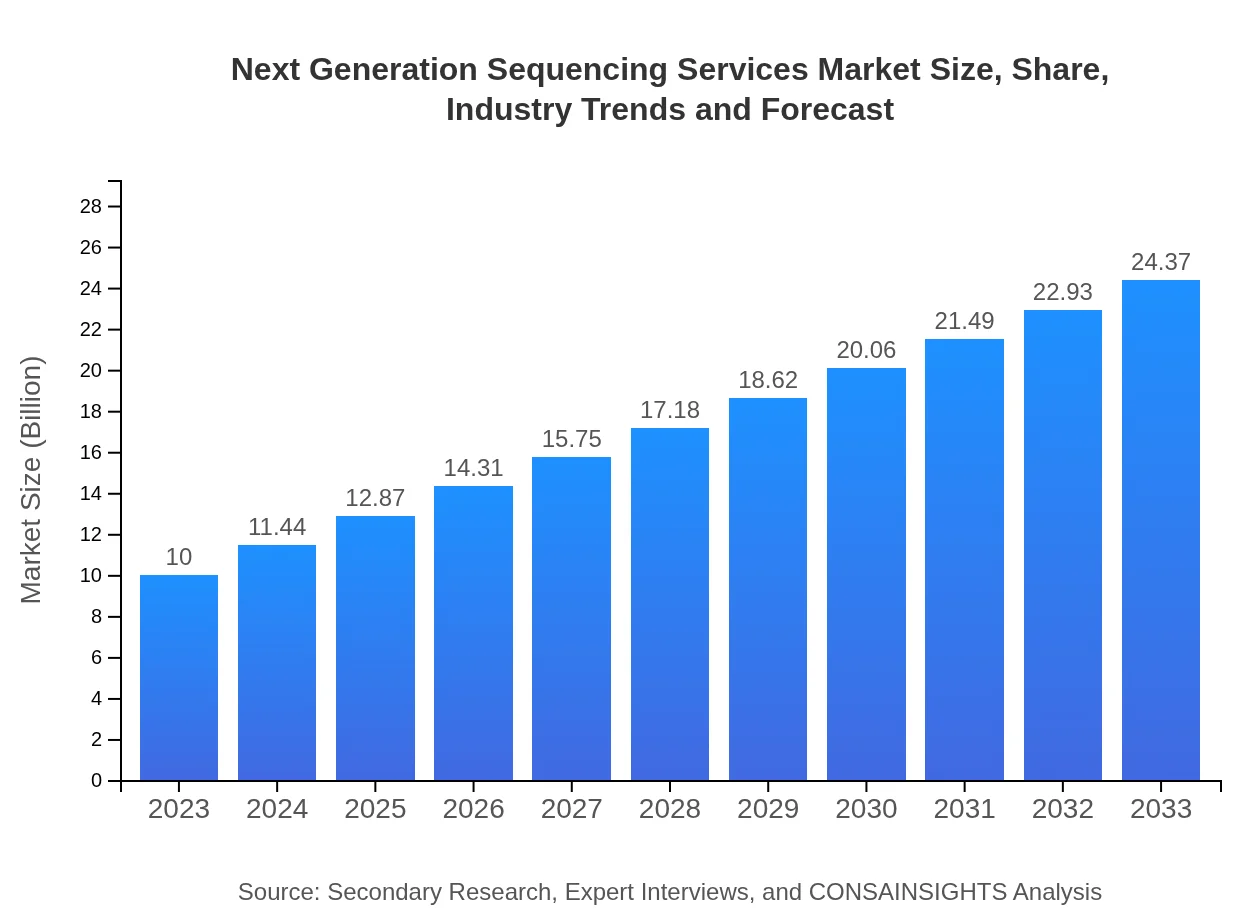
Next Generation Sequencing Services Market — USD 10 billion in 2023, Growing to USD 24.37B by 2033 at 9% CAGR
This report offers a comprehensive analysis of the Next Generation Sequencing Services market, exploring trends, size, growth forecasts, and competitive landscapes from 2023 to 2033.
Key Takeaways
- Global market grows from $10.00 Billion in 2023 to $24.37 Billion in 2033 at a 9% CAGR.
- North America is largest regional market, while no single fastest-growing region is stated because regional CAGR differences remain within 0.15 percentage points.
- Europe and Asia Pacific show substantial expansion, with Europe reaching $7.64 Billion and Asia Pacific $4.67 Billion by 2033.
- Leading providers include Illumina, Inc., Thermo Fisher Scientific Inc., PacBio, and Oxford Nanopore Technologies Ltd.
- Demand drivers include broader clinical adoption, genomic research growth, and expanding bioinformatics capabilities.
Next Generation Sequencing Services Market Report — Executive Summary
North America remains largest market by forecast-period value, while no single fastest-growing region is stated because top regional growth rates are separated by less than 0.15 percentage points. The Next Generation Sequencing Services market is poised for sustained expansion driven by broader research use and clinical adoption. From a base of $10.00 Billion in 2023, the market is forecast to reach $24.37 Billion in 2033 at a 9% CAGR during 2023 to 2033. Key catalysts include falling sequencing costs, improvements in throughput and accuracy, and growing demand for genomic applications across oncology, infectious disease, and pharmacogenomics. The landscape combines established sequencing platform providers and specialized service firms; notable companies listed are Illumina, Inc., Thermo Fisher Scientific Inc., PacBio, and Oxford Nanopore Technologies Ltd. Service offerings span sequencing, data analysis, and consultation services, with end users ranging from academic research institutes to clinical laboratories and pharmaceutical companies. Regional dynamics vary: North America holds the largest share, while Europe, Asia Pacific, Latin America, and Middle East and Africa each contribute distinct demand drivers tied to research investment, clinical infrastructure, and public health needs. The report synthesizes primary interviews, company disclosures, and triangulated data to outline market opportunities and near-term trends.
Key Growth Drivers
- Expanding clinical applications for genomic testing increase demand for outsourced sequencing services.
- Advances in sequencing platforms raise throughput and reduce per-sample costs, encouraging wider adoption.
- Integration of bioinformatics and data analysis services enhances value propositions for service providers.
- Rising investment in genomic research from public and private sectors fuels service volume.
- Collaborations among technology vendors, labs, and research institutions expand service networks.
| Metric | Value |
|---|---|
| Study Period | 2023 - 2033 |
| 2023 Market Size | $10.00 Billion |
| CAGR (2023-2033) | 9% |
| 2033 Market Size | $24.37 Billion |
| Top Companies | Illumina, Inc., Thermo Fisher Scientific Inc., PacBio, Oxford Nanopore Technologies Ltd. |
| Published Date | 10 October 2024 |
| Last Modified Date | 25 May 2026 |
Next Generation Sequencing Services Market Overview
Customize Next Generation Sequencing Services Market Report market research report
- ✔ Get in-depth analysis of Next Generation Sequencing Services market size, growth, and forecasts.
- ✔ Understand Next Generation Sequencing Services's regional dynamics and industry-specific trends.
- ✔ Identify potential applications, end-user demand, and growth segments in Next Generation Sequencing Services
What is the Market Size & CAGR of Next Generation Sequencing Services Market Report market in 2023?
Next Generation Sequencing Services Industry Analysis
Next Generation Sequencing Services Market Segmentation and Scope
Tell us your focus area and get a customized research report.
Next Generation Sequencing Services Market Report Market Analysis Report by Region
Europe Next Generation Sequencing Services Market Report:
Europe grows from $3.13 Billion in 2023 to $7.64 Billion in 2033. Expansion is driven by academic research investment, increasing clinical genomics programs, and collaborations between sequencing vendors and laboratories supporting regional service uptake.Asia Pacific Next Generation Sequencing Services Market Report:
Asia Pacific grows from $1.91 Billion in 2023 to $4.67 Billion in 2033. Growth is linked to rising research funding, expanded clinical sequencing initiatives, and the development of regional service providers supporting genomics and public health applications.North America Next Generation Sequencing Services Market Report:
North America is largest regional market, rising from $3.42 Billion in 2023 to $8.34 Billion in 2033. The region's scale reflects robust research infrastructure, widespread clinical sequencing adoption, and strong presence of major platform providers that support service demand. North America is identified as the largest regional market.South America Next Generation Sequencing Services Market Report:
Latin America grows from $0.51 Billion in 2023 to $1.25 Billion in 2033. Demand in the region is influenced by expanding research activities, growing public health sequencing efforts, and gradual adoption of outsourced sequencing and analytical services.Middle East & Africa Next Generation Sequencing Services Market Report:
Middle East and Africa grows from $1.02 Billion in 2023 to $2.48 Billion in 2033. Growth drivers include increasing investment in genomic research, developing clinical sequencing capacity, and partnerships that broaden access to outsourced sequencing services.Tell us your focus area and get a customized research report.
Research Methodology
Next Generation Sequencing Services Market Analysis By Technology
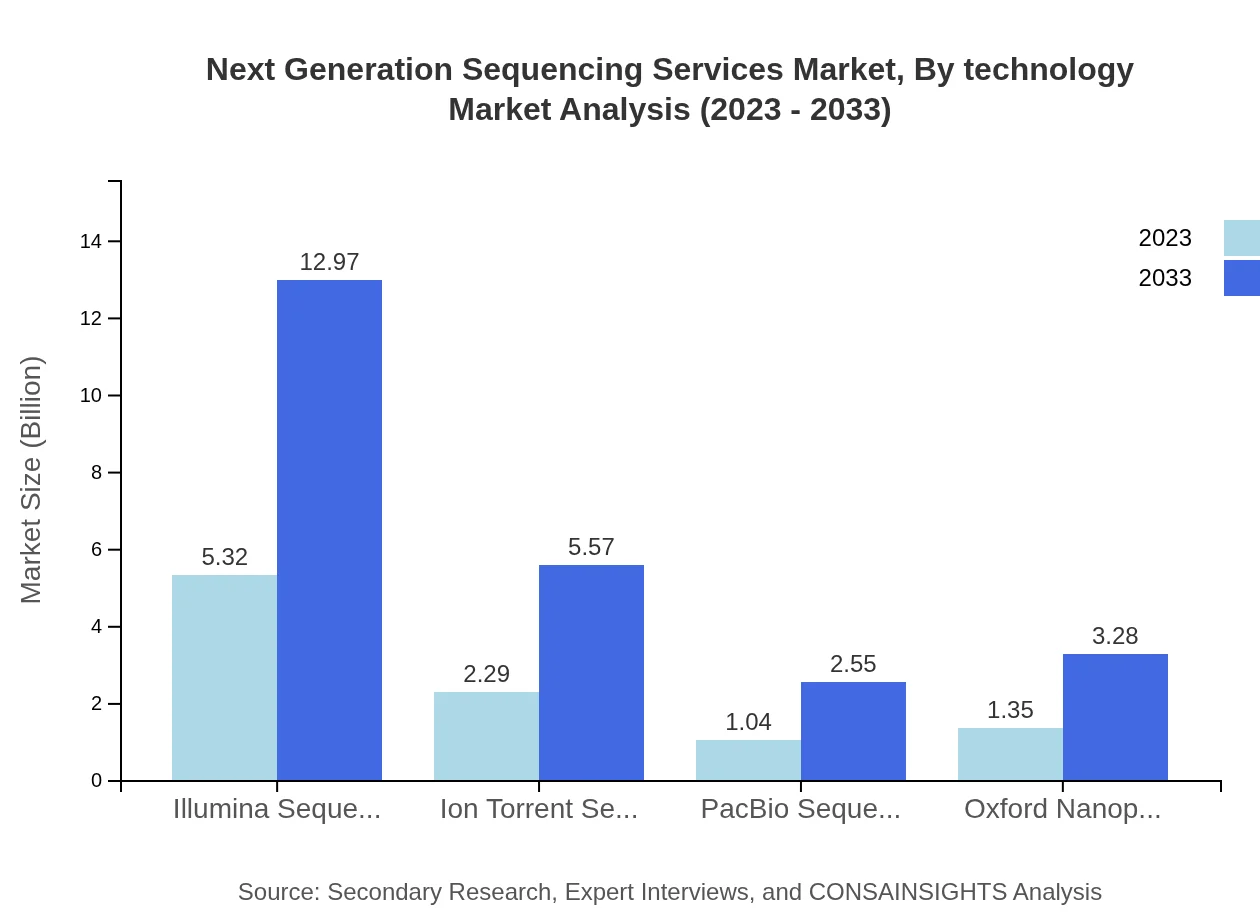
Market analysis by technology reveals that Illumina Sequencing dominates the segment with a market share of 53.22% in 2023, growing from $5.32 billion to approximately $12.97 billion by 2033. Ion Torrent contributes to 22.86% market share, growing from $2.29 billion to $5.57 billion. Other technologies such as PacBio and Oxford Nanopore Technologies are also gaining traction due to their unique advantages in specific research areas.
Next Generation Sequencing Services Market Analysis By Application
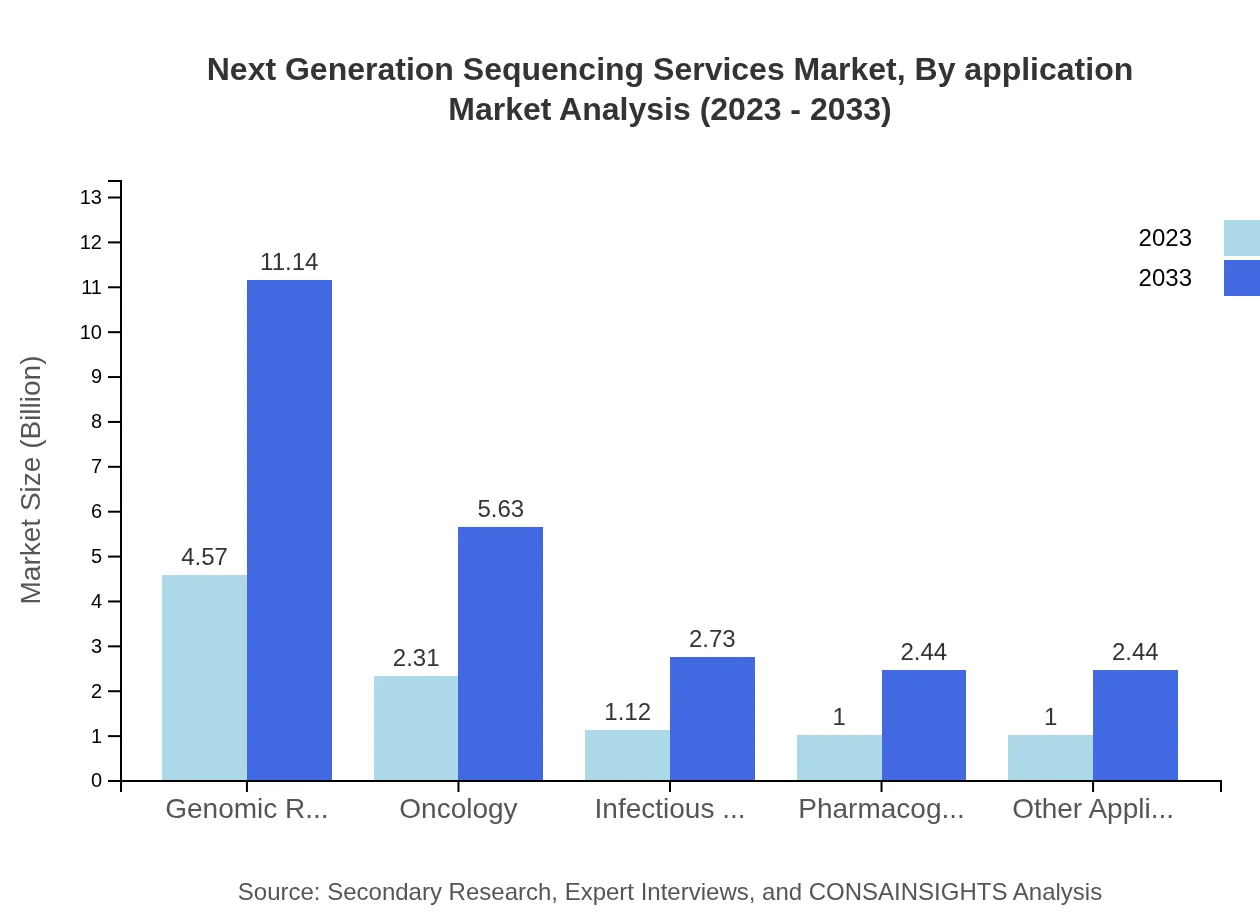
In the application segment, Genomic Research holds a significant market share of 45.71% in 2023, projected to increase from $4.57 billion to $11.14 billion by 2033. Oncology applications follow closely with a share of 23.1%, growing from $2.31 billion to $5.63 billion. Infectious diseases and pharmacogenomics are also crucial segments, witnessing notable growth as personalized medicine continues to evolve.
Next Generation Sequencing Services Market Analysis By Service Type
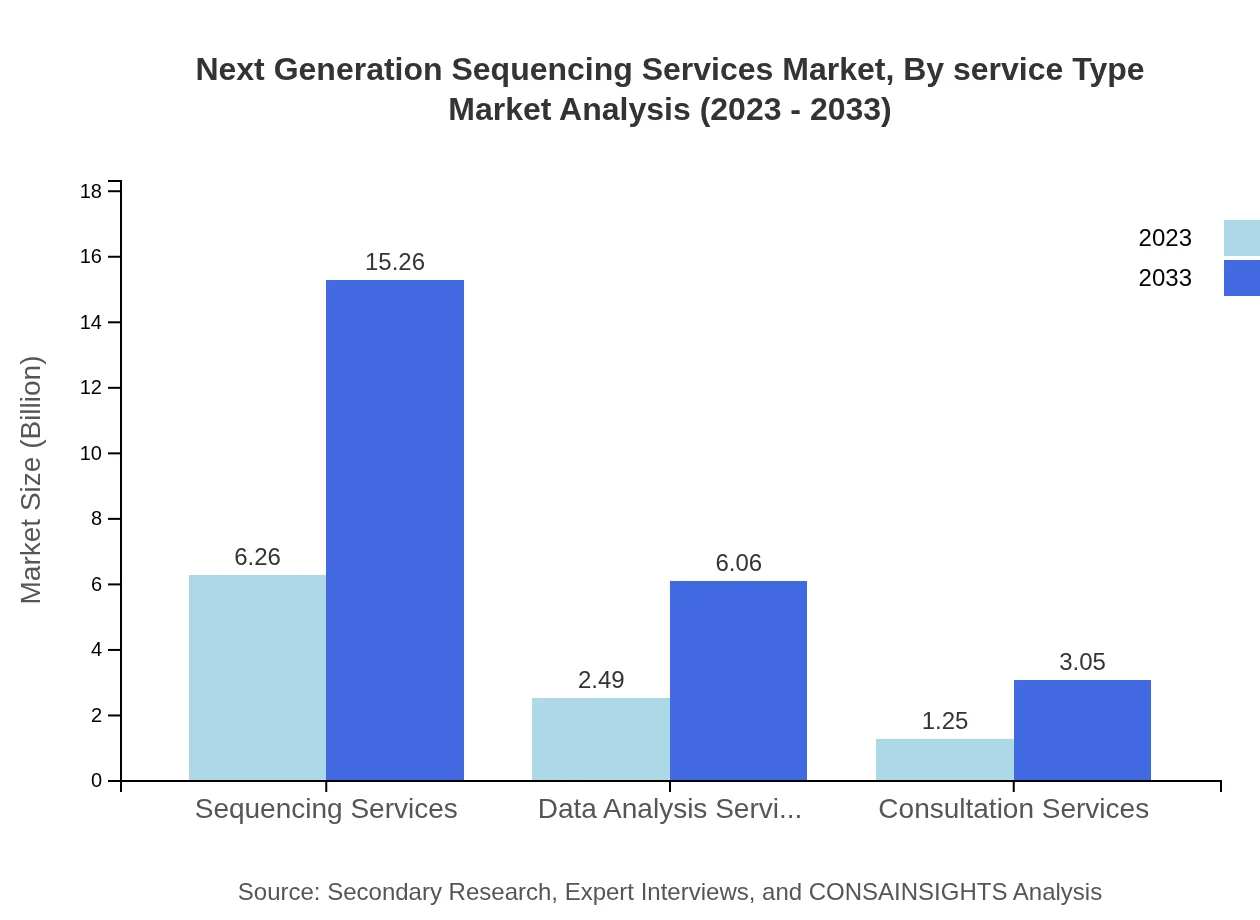
The service type segment is primarily led by Sequencing Services which accounts for 62.64% market share, projected to rise from $6.26 billion in 2023 to $15.26 billion by 2033. Following this, Data Analysis Services and Consultation Services are also significant, with shares of 24.86% and 12.5% respectively, highlighting the importance of integrated service offerings in the NGS market.
Next Generation Sequencing Services Market Analysis By End User
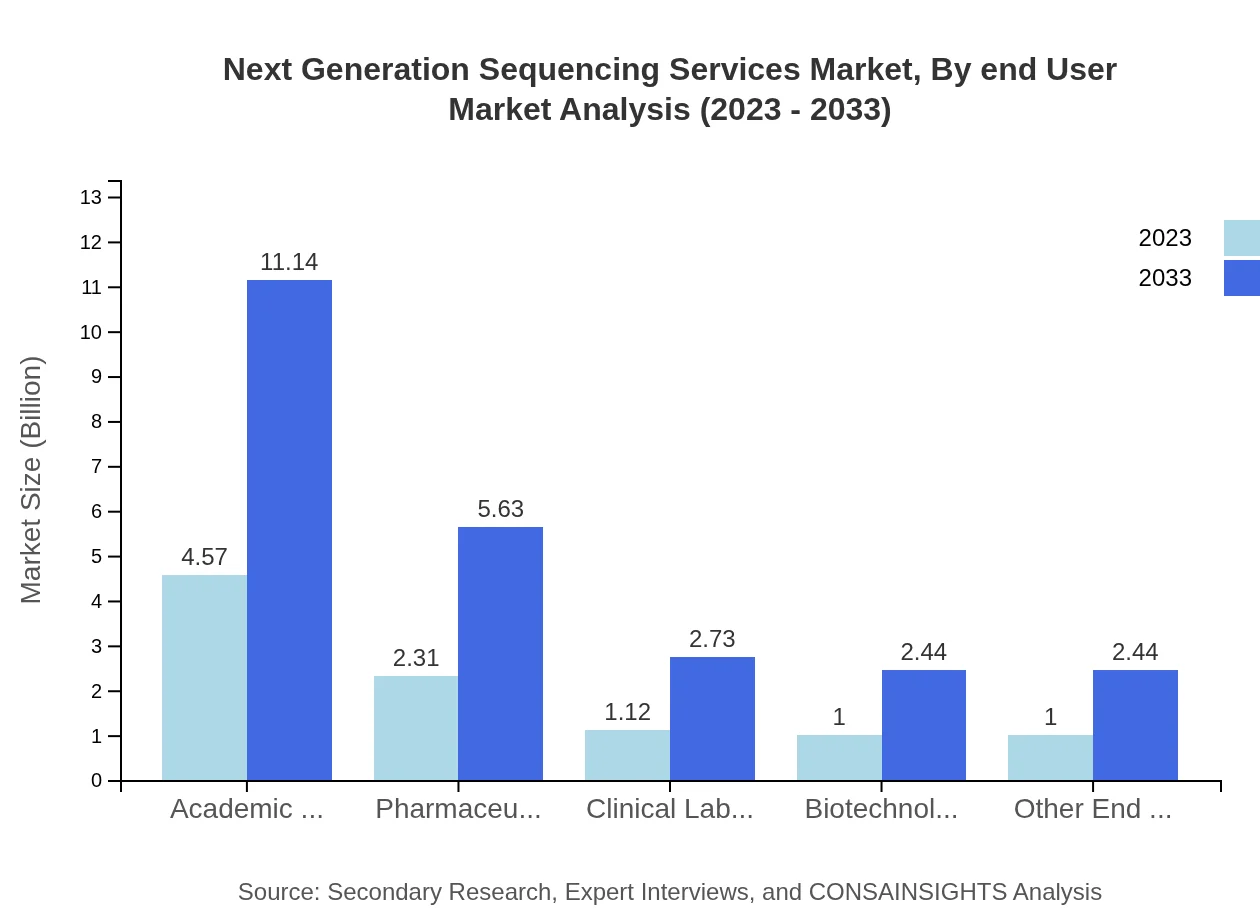
Key end-users of NGS services include Academic Research Institutes which comprise 45.71% at a market size of $4.57 billion, promising growth to $11.14 billion by 2033. Pharmaceutical Companies play an essential role too, accounting for 23.1% of the market share. Clinical Laboratories and Biotechnology Firms are critical end-users contributing to the market's development.
Next Generation Sequencing Services Market Trends and Future Forecast
Tell us your focus area and get a customized research report.
Global Market Leaders and Top Companies in Next Generation Sequencing Services Industry
Illumina, Inc.:
Illumina is a leading developer, manufacturer, and marketer of life sciences tools and integrated systems for the analysis of genetic variation and function. Its sequencing technology is widely used in genomic research and clinical applications worldwide.Thermo Fisher Scientific Inc.:
Thermo Fisher provides innovative sequencing solutions that enable researchers and clinical laboratories to harness the power of genomics to advance the understanding of disease and improve patient care.PacBio:
Pacific Biosciences of California, Inc. (PacBio) is known for its SMRT sequencing technology that provides high accuracy and long reads, making significant contributions to genomic research, especially in complex genomic regions.Oxford Nanopore Technologies Ltd.:
Oxford Nanopore Technologies offers a disruptive technology that enables real-time, portable DNA sequencing. Their devices cater to users from academic researchers to field-based applications in clinical and environmental settings.We're grateful to work with incredible clients.









FAQs
What is the market size of the Next Generation Sequencing Services market in 2023?
The market size in 2023 is $10.00 Billion, based on the provided report figures for the Next Generation Sequencing Services market.
How big is the projected market in 2033?
The market is projected to reach $24.37 Billion in 2033 according to the report's stated forecast for the Next Generation Sequencing Services market.
What is CAGR for the forecast period?
The forecast period CAGR is 9% for 2023 to 2033, as specified in the report data for the Next Generation Sequencing Services market.
Is there a single fastest Growing region in the Next Generation Sequencing Services Market Report market?
No single fastest-growing region is stated for the Next Generation Sequencing Services Market Report market because the top regional implied CAGR values are within 0.15 percentage points of each other, making the ranking too close to call reliably.
Which companies are highlighted in the report?
Top companies listed include Illumina, Inc., Thermo Fisher Scientific Inc., PacBio, and Oxford Nanopore Technologies Ltd., as provided in the input data.
What are the main service types covered?
Service types specified are Sequencing Services, Data Analysis Services, and Consultation Services according to the segmentation facts.
How big is the Europe market in 2023 and 2033?
Europe is reported at $3.13 Billion in 2023 and grows to $7.64 Billion by 2033, per the regional facts supplied.
What drives demand in Asia Pacific?
Asia Pacific demand is supported by expanding genomic research and clinical programs; its market rises from $1.91 Billion in 2023 to $4.67 Billion in 2033.
Who are the end users for NGS services?
End users include Academic Research Institutes, Pharmaceutical Companies, Clinical Laboratories, Biotechnology Firms, and Other End Users as listed in the segmentation.
What is the role of bioinformatics in the market?
Bioinformatics and data analysis services are essential for interpreting sequencing results and are included as a core service type in the report's segmentation.