

Overactive Bladder Treatment Market Report
First published: 11 October 2024 | Last updated: 25 May 2026 | Report Code: overactive-bladder-treatment
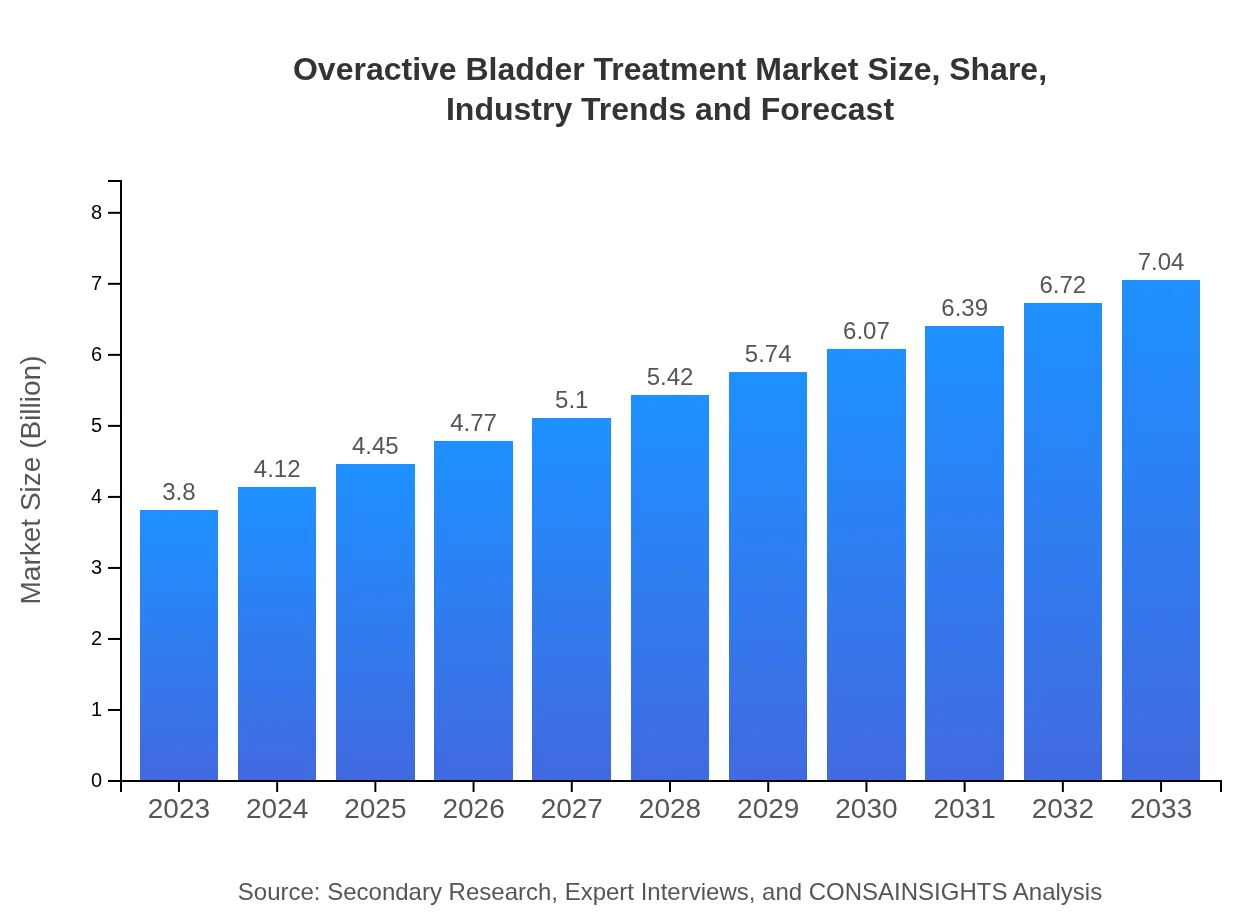
Overactive Bladder Treatment Market — USD $3.8 Billion in 2023, Growing to USD 7.04null by 2033 at 6.2% CAGR
This report provides a comprehensive analysis of the Overactive Bladder Treatment market, with insights into market trends, segmentation, regional analysis, and future forecasts covering the period from 2023 to 2033.
Key Takeaways
- Global market value moves from $3.80 Billion in 2023 to $7.04 Billion in 2033, reflecting a 6.2% CAGR over the forecast period.
- North America is largest regional market, while no single fastest-growing region is stated because regional CAGR differences remain within 0.15 percentage points.
- Europe expands from $1.12 Billion in 2023 to $2.07 Billion in 2033, driven by clinical adoption and product availability.
- Asia Pacific grows from $0.67 Billion in 2023 to $1.25 Billion in 2033 amid increasing awareness and healthcare access.
- Key drug classes include Antimuscarinics, Beta-3 Adrenergic Agonists, and Botulinum Toxin; distribution spans hospital, retail, and e-commerce channels.
- Leading companies such as Astellas Pharma Inc., Boehringer Ingelheim GmbH, Eli Lilly and Company, Pfizer Inc., and Merck & Co., Inc. shape market activity.
Overactive Bladder Treatment Market Report — Executive Summary
North America remains largest market by forecast-period value, while no single fastest-growing region is stated because top regional growth rates are separated by less than 0.15 percentage points. The Overactive Bladder Treatment market is on a steady growth trajectory, increasing from $3.80 Billion in 2023 to $7.04 Billion by 2033 at a 6.2% CAGR. Expansion is supported by demographic shifts, rising prevalence of urinary disorders, and improvement in therapeutic options including pharmacological and minimally invasive interventions. Regional performance varies: North America is the largest market by value, while Europe and Asia Pacific also show meaningful increases. Market segmentation covers drug classes—Antimuscarinics, Beta-3 Adrenergic Agonists, Botulinum Toxin—therapy types, patient cohorts, and distribution channels. Stakeholders include major pharmaceutical firms such as Astellas Pharma Inc., Boehringer Ingelheim GmbH, Eli Lilly and Company, Pfizer Inc., and Merck & Co., Inc. This report combines primary expert interviews and secondary sources to present trend analysis, competitive context, and implications for manufacturers, healthcare providers, and payers.
Key Growth Drivers
- Aging populations and higher prevalence of urinary dysfunction increasing demand for OAB therapies.
- Advances in drug formulations and expanded therapeutic options improving treatment efficacy and patient adherence.
- Greater awareness and diagnosis rates driven by education and health system outreach programs.
- Wider distribution networks, including e-commerce, expanding patient access to pharmacological and non-pharmacological options.
- Ongoing investment and product activity by established pharmaceutical companies sustaining innovation and market availability.
| Metric | Value |
|---|---|
| Study Period | 2023 - 2033 |
| 2023 Market Size | $3.80 Billion |
| CAGR (2023-2033) | 6.2% |
| 2033 Market Size | $7.04 Billion |
| Top Companies | Astellas Pharma Inc., Boehringer Ingelheim GmbH, Eli Lilly and Company, Pfizer Inc., Merck & Co., Inc. |
| Published Date | 11 October 2024 |
| Last Modified Date | 25 May 2026 |
Overactive Bladder Treatment Market Overview
Customize Overactive Bladder Treatment Market Report market research report
- ✔ Get in-depth analysis of Overactive Bladder Treatment market size, growth, and forecasts.
- ✔ Understand Overactive Bladder Treatment's regional dynamics and industry-specific trends.
- ✔ Identify potential applications, end-user demand, and growth segments in Overactive Bladder Treatment
What is the Market Size & CAGR of Overactive Bladder Treatment Market Report market in 2023?
Overactive Bladder Treatment Industry Analysis
Overactive Bladder Treatment Market Segmentation and Scope
Tell us your focus area and get a customized research report.
Overactive Bladder Treatment Market Report Market Analysis Report by Region
Europe Overactive Bladder Treatment Market Report:
Europe grows from $1.12 Billion in 2023 to $2.07 Billion in 2033. Regional advancement is influenced by clinical guideline adoption, enhanced diagnostic awareness, and availability of pharmacological and non-pharmacological therapies.Asia Pacific Overactive Bladder Treatment Market Report:
Asia Pacific grows from $0.67 Billion in 2023 to $1.25 Billion in 2033. Growth is driven by improving healthcare access, rising patient awareness, and increased availability of treatment options across urban and regional centers.North America Overactive Bladder Treatment Market Report:
North America is largest regional market, rising from $1.46 Billion in 2023 to $2.7 Billion in 2033. Market value gains reflect clinical adoption, established distribution networks, and active participation by major pharmaceutical firms in the region.South America Overactive Bladder Treatment Market Report:
Latin America grows from $0.26 Billion in 2023 to $0.49 Billion in 2033. Market expansion in this region is supported by growing healthcare infrastructure and broader availability of established therapies.Middle East & Africa Overactive Bladder Treatment Market Report:
Middle East and Africa grows from $0.29 Billion in 2023 to $0.54 Billion in 2033. Regional progress is linked to improved diagnostic capabilities, expanding healthcare services, and greater awareness of treatment pathways.Tell us your focus area and get a customized research report.
Research Methodology
Overactive Bladder Treatment Market Analysis By Drug Class
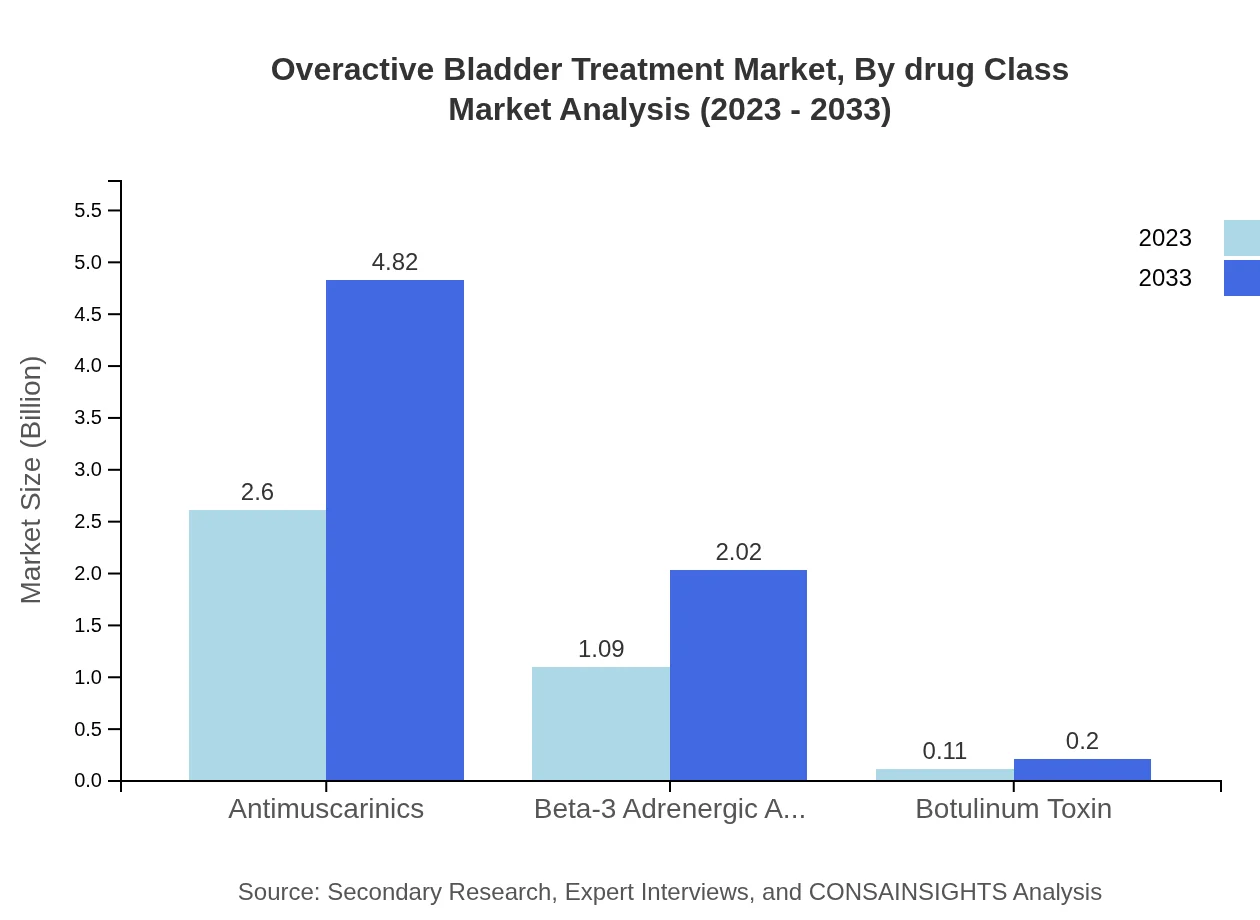
The drug class segment is dominated by antimuscarinics, expected to grow from $2.60 billion in 2023 to $4.82 billion by 2033, making up approximately 68.43% of the market share. Beta-3 adrenergic agonists are also witnessing considerable growth, projected to expand from $1.09 billion to $2.02 billion, maintaining a 28.67% market share. Botulinum toxin represents a smaller segment, with anticipated growth from $0.11 billion to $0.20 billion.
Overactive Bladder Treatment Market Analysis By Therapy Type
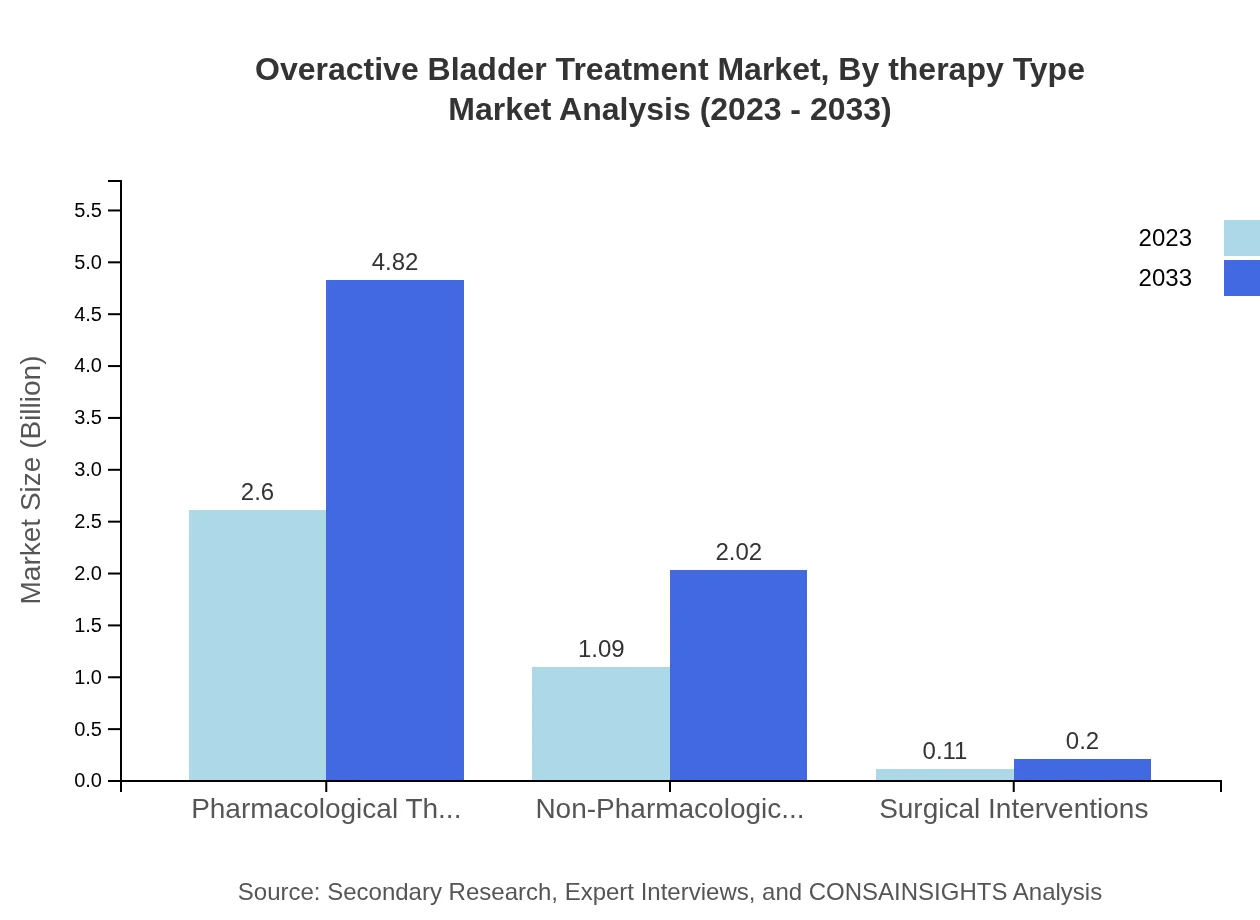
Pharmacological therapy remains the primary treatment modality, valued at $2.60 billion in 2023, 68.43% of the market share, and expected to rise to $4.82 billion by 2033. Non-pharmacological methods, including behavioral therapy, are also significant, projected to grow from $1.09 billion to $2.02 billion, with a 28.67% market share.
Overactive Bladder Treatment Market Analysis By Patient Type
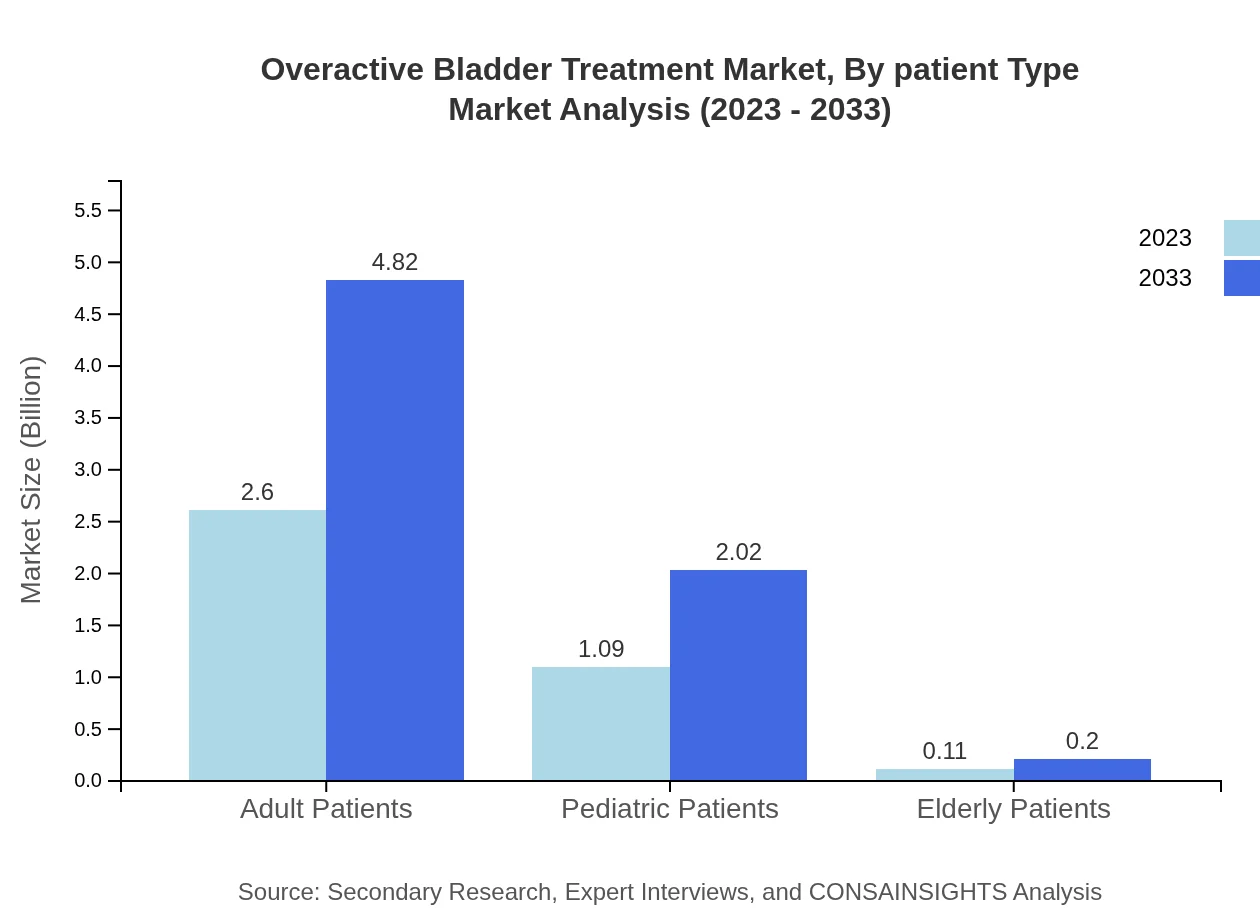
The adult patient segment captures the largest share of the market at approximately 68.43%, valued at $2.60 billion in 2023 and projected to reach $4.82 billion by 2033. Pediatric and elderly patients account for the remaining market, primarily due to varying treatment approaches tailored for different age groups.
Overactive Bladder Treatment Market Analysis By Distribution Channel
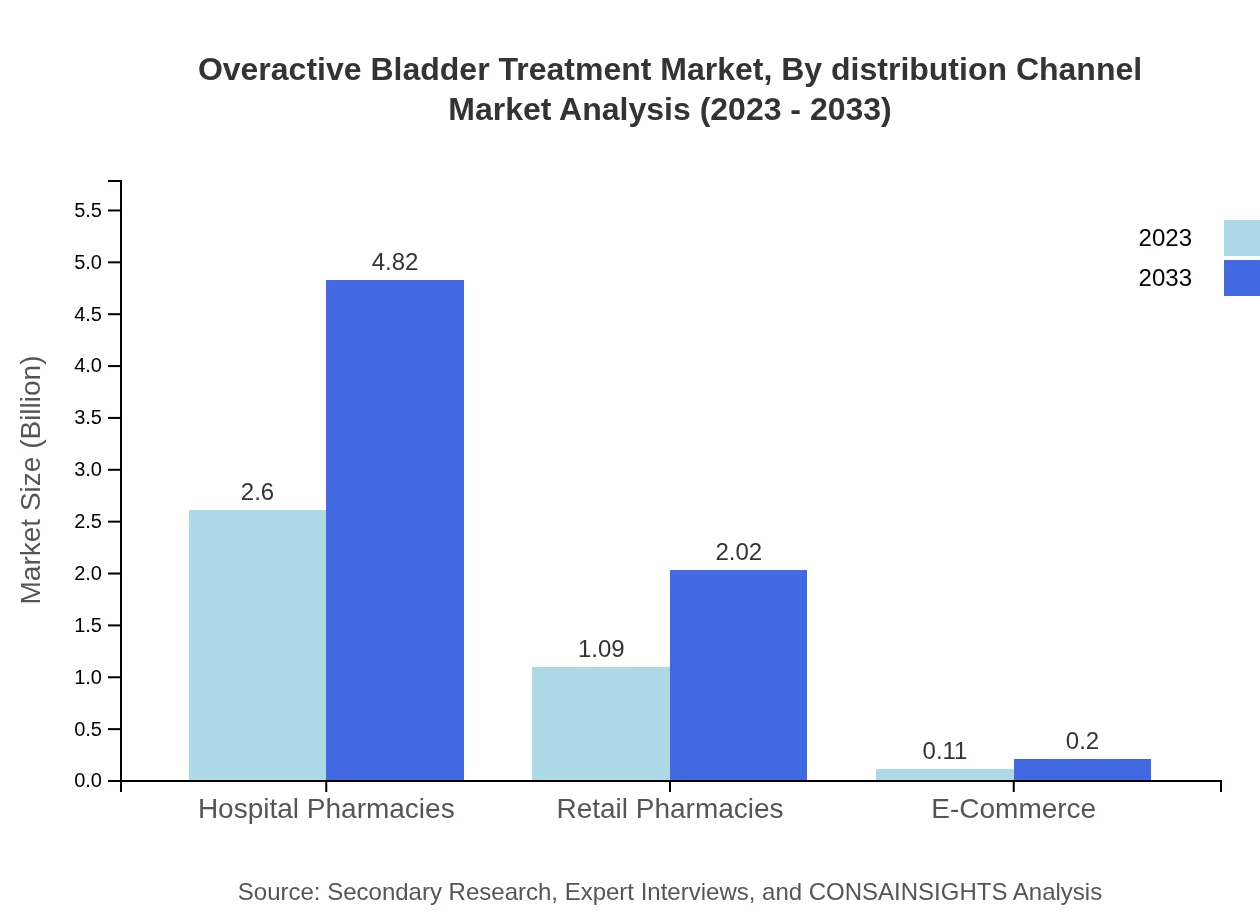
Hospital pharmacies lead in distribution, holding a 68.43% market share in 2023, anticipated to grow from $2.60 billion to $4.82 billion by 2033. Retail pharmacies and e-commerce channels are growing rapidly, especially as consumer preferences shift toward online shopping and home delivery options.
Overactive Bladder Treatment Market Analysis By Region
Global Overactive Bladder Treatment Market, By Region Market Analysis (2023 - 2033)
This section examines the market's performance in various regions with unique growth drivers and challenges affecting OAB treatments and patient accessibility.
Overactive Bladder Treatment Market Trends and Future Forecast
Tell us your focus area and get a customized research report.
Global Market Leaders and Top Companies in Overactive Bladder Treatment Industry
Astellas Pharma Inc.:
Astellas Pharma is a leading pharmaceutical provider focused on developing innovative therapies for urological conditions, including the manufacturing of antimuscarinic medications.Boehringer Ingelheim GmbH:
Boehringer Ingelheim is committed to providing cutting-edge therapies with its Beta-3 adrenergic agonist portfolio contributing significantly to the OAB market.Eli Lilly and Company:
Eli Lilly provides innovative solutions in urology, particularly noted for their botulinum toxin products which are used for managing OAB.Pfizer Inc.:
Pfizer is a global leader developing medication for a variety of conditions, including a robust range of pharmacological therapies for OAB treatment.Merck & Co., Inc.:
Merck continues to invest in OAB therapeutic solutions and is recognized for reliability and efficiency across diverse treatment options.We're grateful to work with incredible clients.









FAQs
What is the current market size of the Overactive Bladder Treatment market?
The market size in 2023 is $3.80 Billion as provided in the report data for the Overactive Bladder Treatment market.
How big will the Overactive Bladder Treatment market be in 2033?
According to the supplied figures, the market is projected to reach $7.04 Billion by 2033 under the indicated forecast.
What is CAGR for the forecast period?
The report specifies a CAGR of 6.2% for the forecast period spanning 2023 to 2033.
Is there a single fastest Growing region in the Overactive Bladder Treatment Market Report market?
No single fastest-growing region is stated for the Overactive Bladder Treatment Market Report market because the top regional implied CAGR values are within 0.15 percentage points of each other, making the ranking too close to call reliably.
Which drug classes are covered in the segmentation?
Segmentation includes Antimuscarinics, Beta-3 Adrenergic Agonists, and Botulinum Toxin as the primary drug-class categories listed in the input.
Who are the top companies mentioned in the report?
Top companies cited are Astellas Pharma Inc., Boehringer Ingelheim GmbH, Eli Lilly and Company, Pfizer Inc., and Merck & Co., Inc.
What distribution channels are listed for market delivery?
Distribution channels specified include Hospital Pharmacies, Retail Pharmacies, and E-Commerce as per the input segment facts.
How was the research conducted for this report?
Research combined primary interviews with industry experts and secondary review of company reports and publications, with data triangulation and expert-led validation.