
Reports >
Life Sciences
>
Preclinical Imaging Market Report

Preclinical Imaging Market Report
First published: 08 October 2024 | Last updated: 28 May 2026 | Report Code: preclinical-imaging
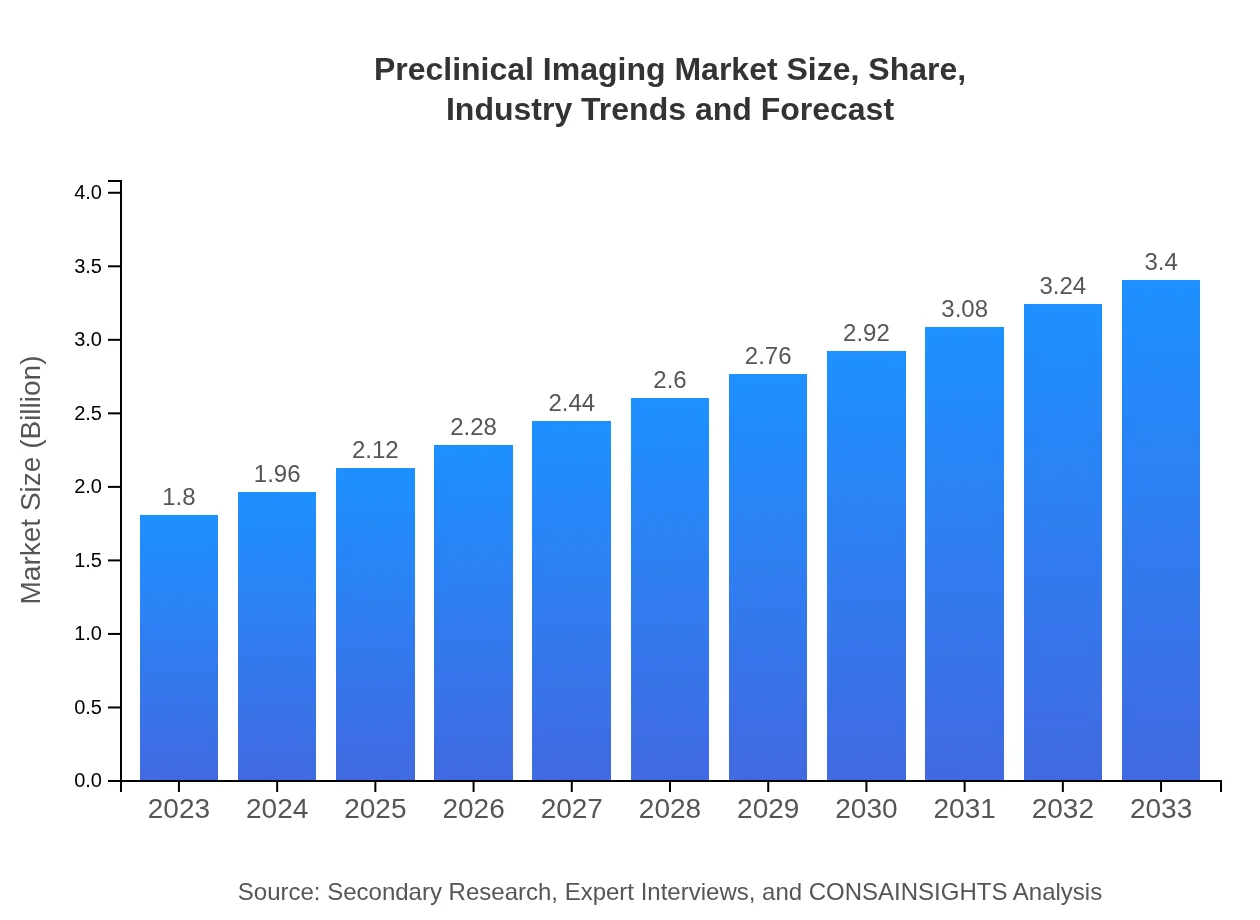
Preclinical Imaging Market — USD 1.8 billion in 2023, Growing to USD 3.40B by 2033 at 6.4% CAGR
This report provides a comprehensive analysis of the Preclinical Imaging market, examining its size, growth potential, segmentation, and regional insights. Covering the forecast period from 2023 to 2033, it aims to equip stakeholders with actionable data for strategic planning.
Key Takeaways
- Global market expands from $1.80 Billion in 2023 to $3.40 Billion in 2033 at a 6.4% CAGR.
- Europe is largest regional market; Latin America is regional market region based on implied CAGR across 2023 to 2033.
- North America grows from $0.6 Billion to $1.13 Billion between 2023 and 2033, reflecting steady investment.
- Latin America is the regional market region, increasing from $0.01 Billion in 2023 to $0.02 Billion in 2033 at an implied 7.18% CAGR.
- Key vendors active in the market include Bruker Corporation, Siemens Healthineers, GE Healthcare, and PerkinElmer Inc.
Preclinical Imaging Market Report — Executive Summary
Regional analysis shows Europe as largest market and Latin America as fastest-growing region by implied CAGR. The market for preclinical imaging is driven by rising investment in drug discovery, advances in imaging modalities, and greater emphasis on translational research. Demand for MRI, CT, optical, and nuclear imaging in laboratory and institutional settings is a core structural element. Technology upgrades and data-driven interpretation methods are enabling higher-resolution studies and improved throughput for pharmaceutical and biotech end users. Regional patterns show Europe as the largest market and Latin America as the regional market region by implied CAGR. Major suppliers such as Bruker Corporation, Siemens Healthineers, GE Healthcare, and PerkinElmer Inc. are shaping product availability and service networks. The report examines segmentation by modality, application, research type, and end user, and outlines use-case-driven adoption across academic, contract research, and industry laboratories.
Key Growth Drivers
- Expanded preclinical investment by pharmaceutical and biotechnology firms to accelerate drug discovery and candidate validation.
- Improvements in imaging hardware and contrast agents enabling higher-resolution, quantitative studies in small-animal models.
- Greater adoption of advanced data analytics and image processing improving interpretability and throughput of preclinical studies.
- Rising prevalence of chronic and complex diseases increasing demand for targeted preclinical research across multiple therapeutic areas.
| Metric | Value |
|---|---|
| Study Period | 2023 - 2033 |
| 2023 Market Size | $1.80 Billion |
| CAGR (2023-2033) | 6.4% |
| 2033 Market Size | $3.40 Billion |
| Top Companies | Bruker Corporation, Siemens Healthineers, GE Healthcare, PerkinElmer Inc. |
| Published Date | 08 October 2024 |
| Last Modified Date | 28 May 2026 |
Preclinical Imaging Market Overview
Customize Preclinical Imaging Market Report market research report
- ✔ Get in-depth analysis of Preclinical Imaging market size, growth, and forecasts.
- ✔ Understand Preclinical Imaging's regional dynamics and industry-specific trends.
- ✔ Identify potential applications, end-user demand, and growth segments in Preclinical Imaging
What is the Market Size & CAGR of Preclinical Imaging Market Report market in 2023?
Preclinical Imaging Industry Analysis
Preclinical Imaging Market Segmentation and Scope
Tell us your focus area and get a customized research report.
Preclinical Imaging Market Report Market Analysis Report by Region
Europe Preclinical Imaging Market Report:
Europe is largest regional market, rising from $0.66 Billion in 2023 to $1.24 Billion in 2033. 66 Billion in 2023 to $1.24 Billion in 2033, making it the largest regional market. Strong academic-industry collaboration, research funding, and concentrated vendor presence support continued adoption.Asia Pacific Preclinical Imaging Market Report:
Asia Pacific grows from $0.33 Billion in 2023 to $0.62 Billion in 2033. Expanding research infrastructure, rising biotech activity, and adoption of modern imaging modalities are driving regional demand.North America Preclinical Imaging Market Report:
North America grows from $0.6 Billion in 2023 to $1.13 Billion in 2033. This trajectory reflects sustained investment by pharmaceutical developers and research institutions, plus established service networks and procurement of advanced imaging systems.South America Preclinical Imaging Market Report:
Latin America is fastest-growing region by implied CAGR, increasing from $0.01 Billion in 2023 to $0.02 Billion in 2033. 01 Billion in 2023 to $0.02 Billion in 2033 and is identified as the regional growth market at an implied 7.18% CAGR. Emerging research capacity and targeted investments underpin this accelerated percentage growth.Middle East & Africa Preclinical Imaging Market Report:
Middle East and Africa grows from $0.2 Billion in 2023 to $0.38 Billion in 2033. 2 Billion in 2023 to $0.38 Billion in 2033, supported by growing research funding, partnerships, and procurement of essential imaging equipment for preclinical studies.Tell us your focus area and get a customized research report.
Research Methodology
Preclinical Imaging Market Analysis By Modality
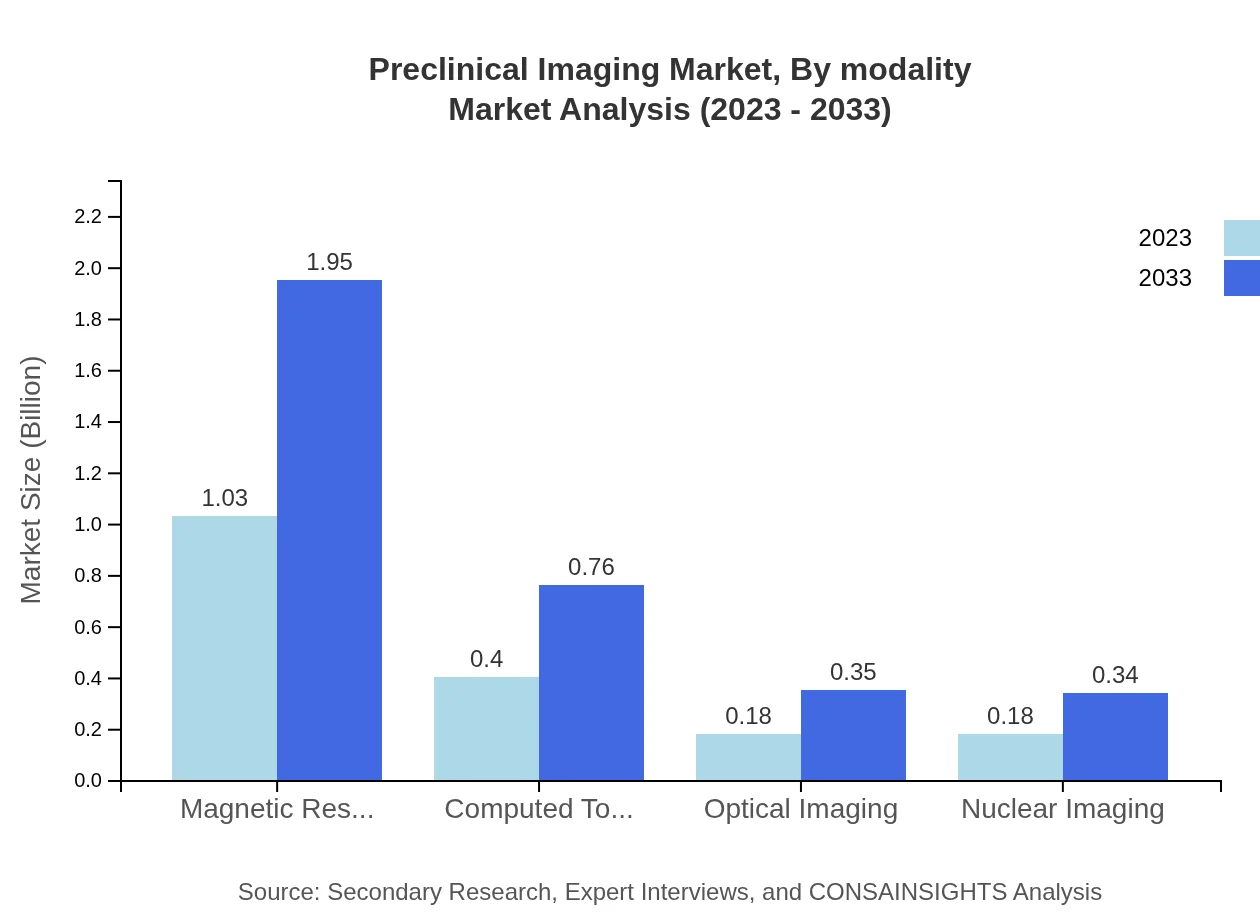
The market is categorized by imaging modalities, with Magnetic Resonance Imaging (MRI) and Computed Tomography (CT) leading the segment. MRI holds a significant market size of approximately $1.03 billion in 2023, expected to rise to $1.95 billion by 2033, primarily due to its widespread application in drug discovery and cancer research. Other modalities like Optical Imaging and Nuclear Imaging also contribute with modest market sizes of $0.18 billion each in 2023, reflecting the diverse applications of preclinical imaging technologies.
Preclinical Imaging Market Analysis By Application
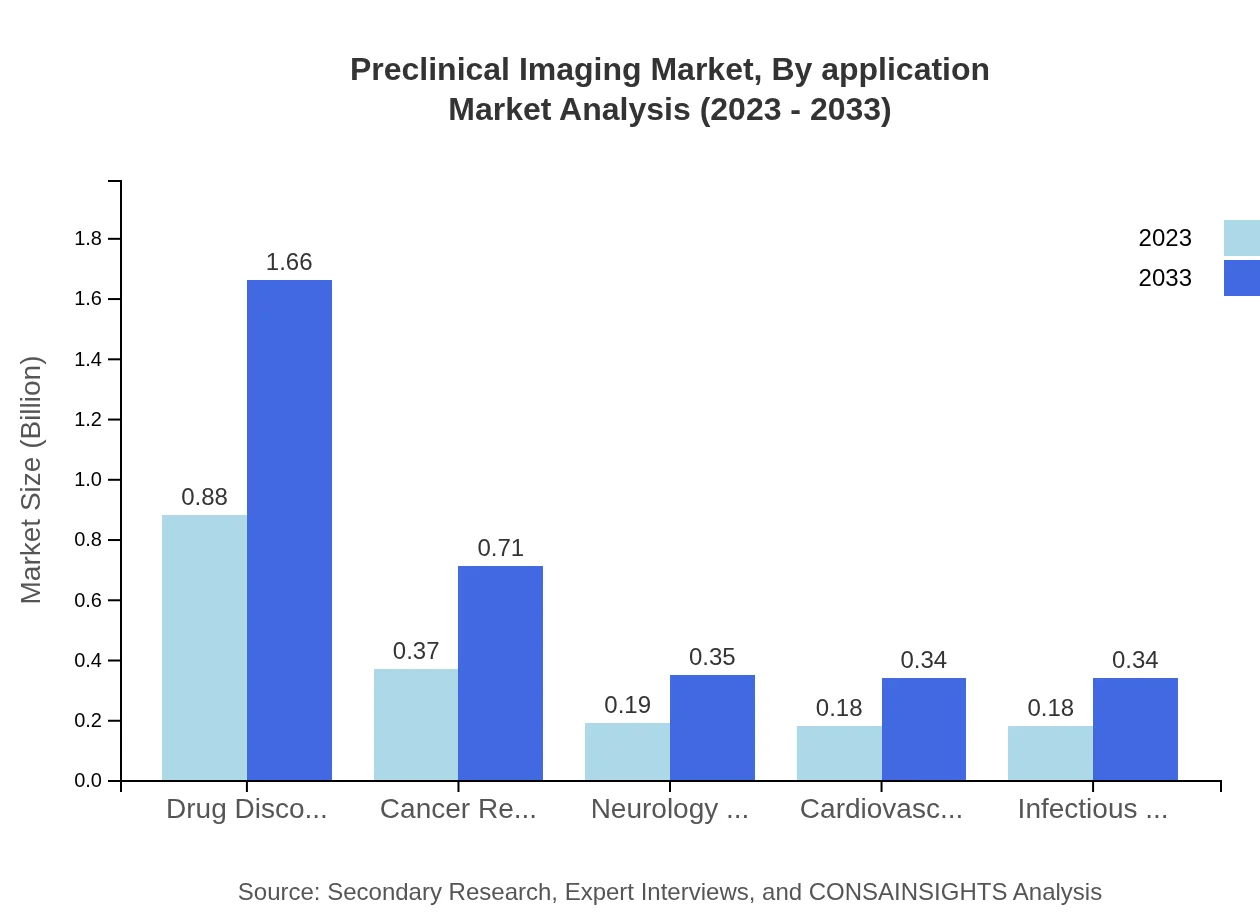
Applications within the Preclinical Imaging market include Drug Discovery, Cancer Research, Neurology Research, and Basic Research. Drug Discovery commands a significant share with a market size of around $0.88 billion in 2023, expected to rise to $1.66 billion by 2033, driven by increased R&D activities across biopharmaceutical companies. Cancer Research follows closely, reflecting the urgent need for new therapeutic solutions, projecting a size growth from $0.37 billion to $0.71 billion in the same period.
Preclinical Imaging Market Analysis By Research Type
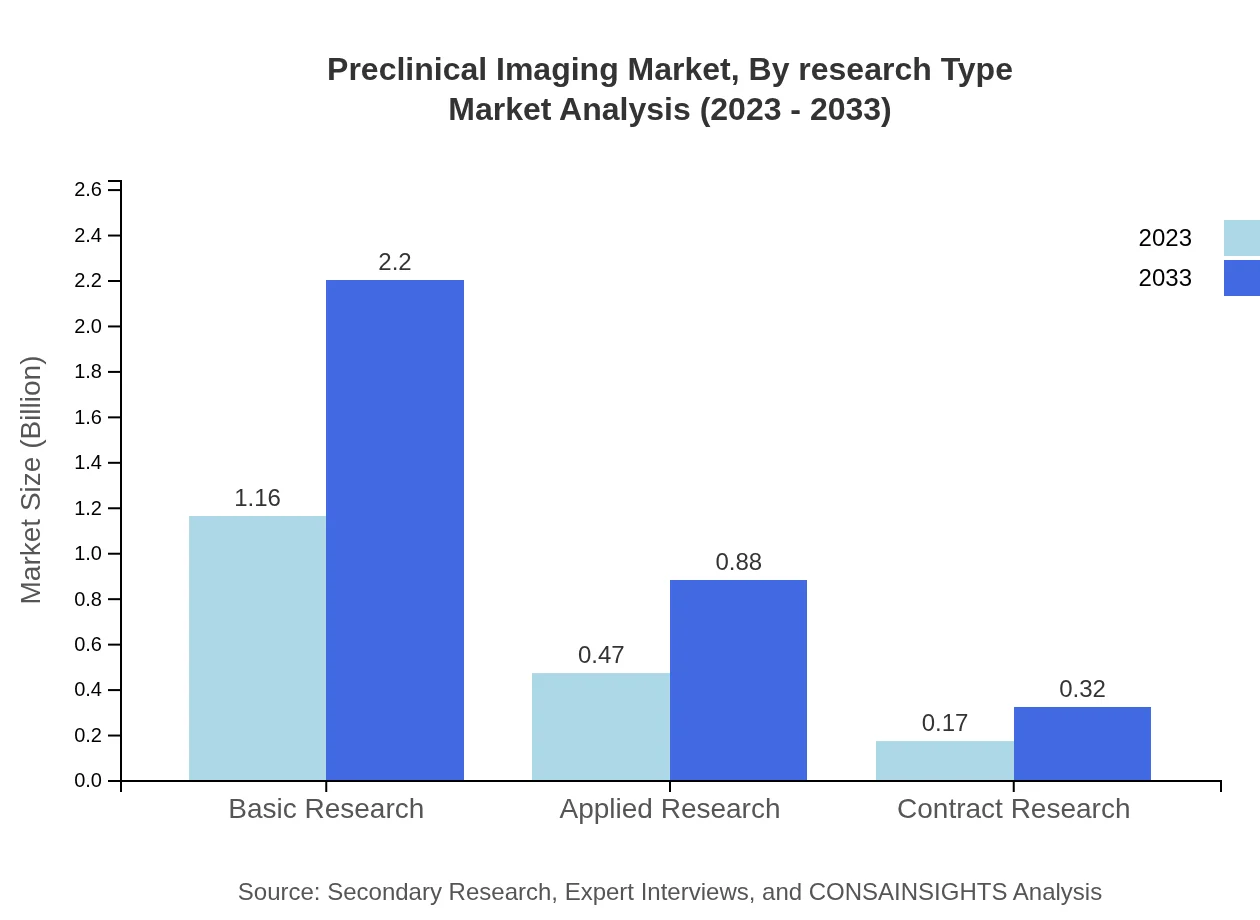
Research types are categorized into Basic and Applied Research. Basic Research leads with a considerable market size of approximately $1.16 billion in 2023, expected to grow to $2.20 billion by 2033, due to the ongoing need for foundational studies in biological sciences. Applied Research also shows promising growth, with a forecast from $0.47 billion to $0.88 billion, indicating a shift towards practical applications of research findings in real-world scenarios.
Preclinical Imaging Market Analysis By End User
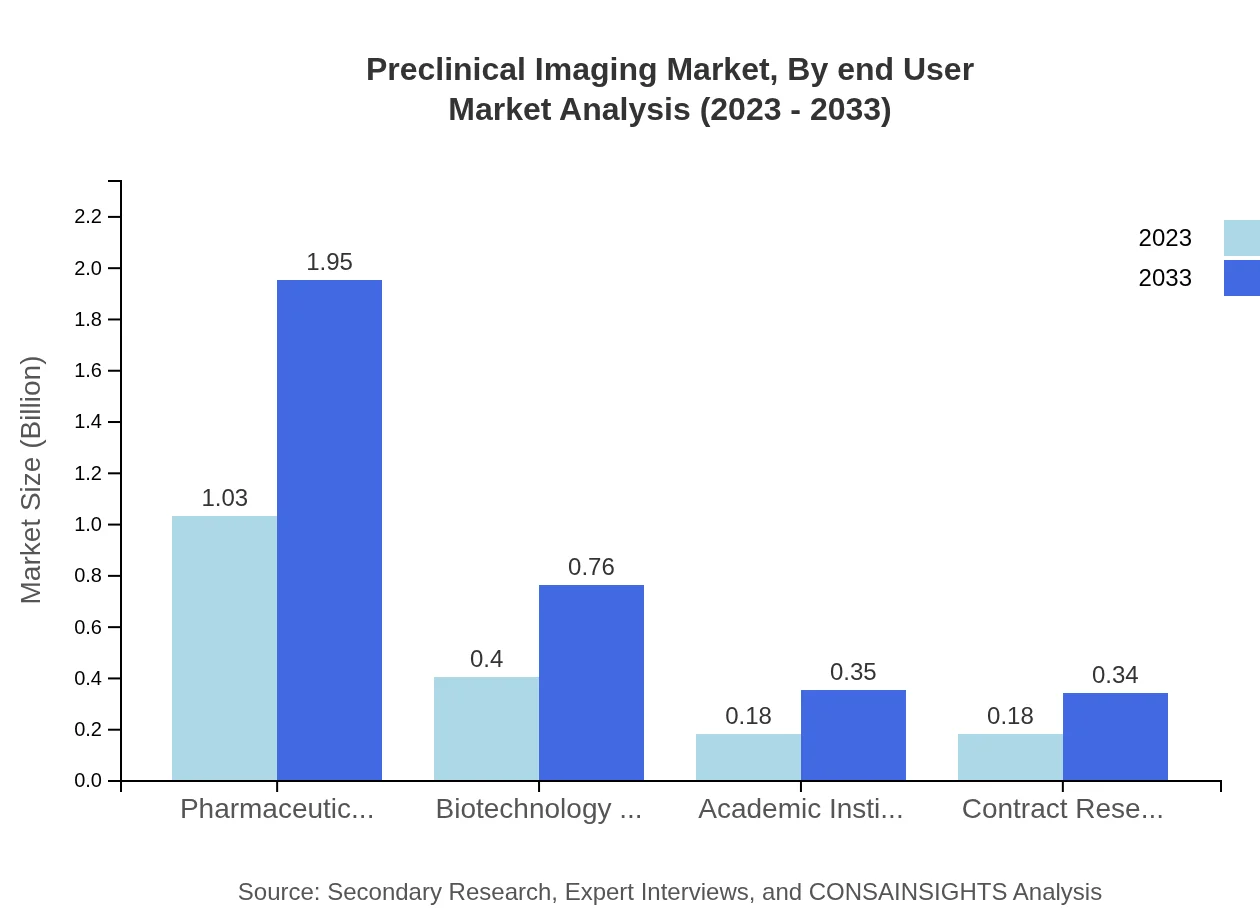
The end-user segment highlights the importance of Pharmaceutical Companies, Biotechnology Companies, Academic Institutions, and Contract Research Organizations. Pharmaceutical Companies dominate significantly with a market size of $1.03 billion in 2023 and will continue to hold a robust share in the market, leading innovations and research initiatives. Biotechnology Companies, though smaller, exhibit significant growth potential from $0.40 billion in 2023 to $0.76 billion by 2033.
Preclinical Imaging Market Trends and Future Forecast
Tell us your focus area and get a customized research report.
Global Market Leaders and Top Companies in Preclinical Imaging Industry
Bruker Corporation:
A key player in the field, Bruker provides innovative solutions for preclinical imaging and molecular imaging, focusing on enhancing imaging quality and applicability in drug research.Siemens Healthineers:
Siemens is renowned for its advanced imaging platforms and technologies, offering a range of products from MRI to CT, solidifying its presence as a market leader in preclinical research.GE Healthcare:
Famous for its innovations in imaging technologies, GE continues to invest heavily in developing state-of-the-art preclinical imaging solutions for better drug discovery and disease understanding.PerkinElmer Inc.:
Specializing in life sciences, PerkinElmer's preclinical imaging technologies facilitate groundbreaking research in pharmacology and molecular biology.We're grateful to work with incredible clients.









FAQs
What is the market size of the preclinical imaging market in 2023?
The market size for 2023 is $1.80 Billion as reported for the preclinical imaging sector, reflecting the baseline for the 2023 to 2033 forecast period and strategic planning.
How big will the market be in 2033?
By 2033 the market is projected at $3.40 Billion, representing the end-point value provided for the 2023 to 2033 forecast window in this analysis.
What is CAGR for the forecast period?
The compound annual growth rate for the period 2023 to 2033 is 6.4%, as specified for the market’s projected expansion between the two reported years.
Which region is the fastest Growing in the Preclinical Imaging Market Report market?
Latin America is the fastest-growing region, projected to expand from $0.01 Billion in 2023 to $0.02 Billion in 2033, reflecting an implied 7.18% CAGR over the forecast period.
Which region is growing the fastest?
Latin America is noted as the regional market region with an implied 7.18% CAGR, moving from $0.01 Billion in 2023 to $0.02 Billion in 2033.
Who are key companies operating in this market?
Top companies listed include Bruker Corporation, Siemens Healthineers, GE Healthcare, and PerkinElmer Inc., representing major equipment and solutions providers in the sector.
What end users are covered in the segmentation?
End-user segmentation includes Pharmaceutical Companies, Biotechnology Companies, Academic Institutions, and Contract Research Organizations as the specified subsegments for use contexts.
Which imaging modalities are included in the report?
Modalities enumerated comprise Magnetic Resonance Imaging (MRI), Computed Tomography (CT), Optical Imaging, and Nuclear Imaging, reflecting the primary technical categories.