
Reports >
Life Sciences
>
Surface Plasmon Resonance Market Report

Surface Plasmon Resonance Market Report
First published: 11 October 2024 | Last updated: 28 May 2026 | Report Code: surface-plasmon-resonance
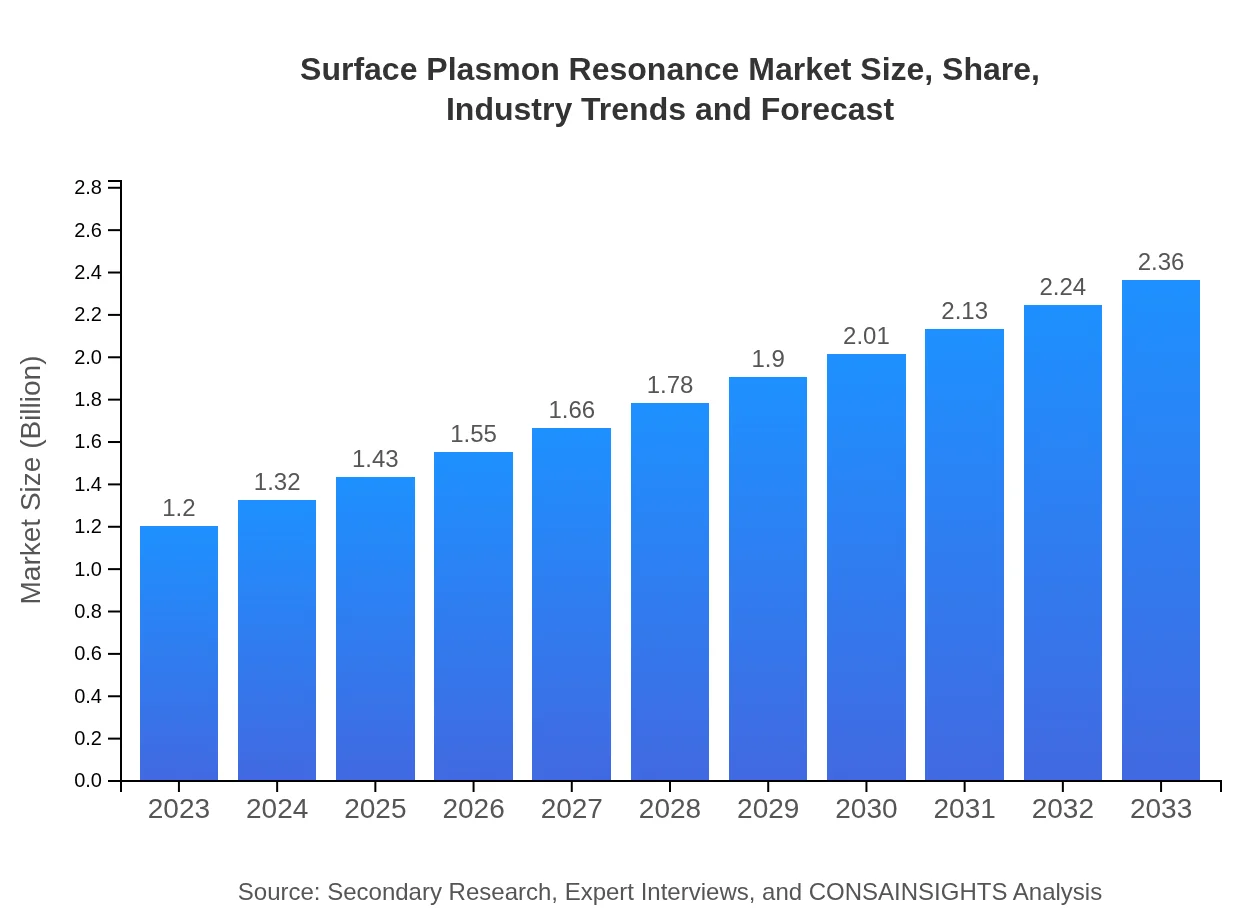
Surface Plasmon Resonance Market — USD 1.2 billion in 2023, Growing to USD 2.36B by 2033 at 6.8% CAGR
This report provides an in-depth analysis of the Surface Plasmon Resonance market from 2023 to 2033, focusing on market trends, size, growth rate, and regional insights, showcasing the competitive landscape and future projections.
Key Takeaways
- Global market expands from $1.20 Billion in 2023 to $2.36 Billion in 2033 at a 6.8% CAGR.
- North America is largest regional market, while no single fastest-growing region is stated because regional CAGR differences remain within 0.15 percentage points.
- Europe and Asia Pacific show significant growth potential with Europe moving from $0.29 Billion to $0.58 Billion and Asia Pacific from $0.23 Billion to $0.46 Billion.
- Leading vendors identified include Biosensing Instrumentation, GE Healthcare, Horiba Scientific, and Reid Bioinformatics.
- Market growth supported by adoption in biotechnology, pharmaceutical research, and medical diagnostics.
Surface Plasmon Resonance Market Report — Executive Summary
North America remains largest market by forecast-period value, while no single fastest-growing region is stated because top regional growth rates are separated by less than 0.15 percentage points. The Surface Plasmon Resonance market is driven by increasing adoption in biotechnology and pharmaceutical research, where label-free and real-time interaction analysis is critical. The market is forecast to grow from $1.20 Billion in 2023 to $2.36 Billion in 2033 at a 6.8% CAGR. Key trends include ongoing sensor technology improvements, broader use in medical diagnostics and environmental testing, and product innovation by established suppliers such as Biosensing Instrumentation, GE Healthcare, Horiba Scientific, and Reid Bioinformatics. Regional dynamics vary: North America is the largest market, while Europe, Asia Pacific, Latin America, and Middle East & Africa each exhibit steady expansion. Demand is tempered by equipment costs and the need for trained operators, but advancements in usability and application breadth support adoption. The report structure covers market sizing, segmentation by type, deployment, end-user and application, North America remains largest market by forecast-period value, while no single fastest-growing region is stated because top regional growth rates are separated by less than 0.15 percentage points.
Key Growth Drivers
- Rising demand in biotechnology and pharmaceutical R&D for label-free molecular interaction analysis.
- Increasing use of SPR in medical diagnostics and environmental testing expands application scope.
- Advances in sensor technology and device performance improve sensitivity and broaden usability.
- Ongoing product development and competition among firms such as Biosensing Instrumentation and GE Healthcare accelerate market offerings.
| Metric | Value |
|---|---|
| Study Period | 2023 - 2033 |
| 2023 Market Size | $1.20 Billion |
| CAGR (2023-2033) | 6.8% |
| 2033 Market Size | $2.36 Billion |
| Top Companies | Biosensing Instrumentation, GE Healthcare, Horiba Scientific, Reid Bioinformatics |
| Published Date | 11 October 2024 |
| Last Modified Date | 28 May 2026 |
Surface Plasmon Resonance Market Overview
Customize Surface Plasmon Resonance Market Report market research report
- ✔ Get in-depth analysis of Surface Plasmon Resonance market size, growth, and forecasts.
- ✔ Understand Surface Plasmon Resonance's regional dynamics and industry-specific trends.
- ✔ Identify potential applications, end-user demand, and growth segments in Surface Plasmon Resonance
What is the Market Size & CAGR of Surface Plasmon Resonance Market Report market in 2023?
Surface Plasmon Resonance Industry Analysis
Surface Plasmon Resonance Market Segmentation and Scope
Tell us your focus area and get a customized research report.
Surface Plasmon Resonance Market Report Market Analysis Report by Region
Europe Surface Plasmon Resonance Market Report:
Europe grows from $0.29 Billion in 2023 to $0.58 Billion in 2033. Growth is supported by strong academic research activity, clinical laboratory deployment, and rising application in medical diagnostics and environmental testing across European markets.Asia Pacific Surface Plasmon Resonance Market Report:
Asia Pacific grows from $0.23 Billion in 2023 to $0.46 Billion in 2033. Expansion is driven by growing biotechnology sectors, increased pharmaceutical research spending, and broader awareness of label-free interaction analysis in regional laboratories.North America Surface Plasmon Resonance Market Report:
North America is largest regional market, rising from $0.46 Billion in 2023 to $0.9 Billion in 2033. This expansion reflects concentrated biotech and pharmaceutical research investments, established research institutions, and the presence of major suppliers fostering adoption.South America Surface Plasmon Resonance Market Report:
Latin America grows from $0.05 Billion in 2023 to $0.1 Billion in 2033. The region’s growth is influenced by developing research infrastructure, rising clinical laboratory activity, and gradual uptake of advanced analytical techniques in environmental and medical testing.Middle East & Africa Surface Plasmon Resonance Market Report:
Middle East and Africa grows from $0.17 Billion in 2023 to $0.33 Billion in 2033. Market advancement is tied to expanding research capabilities, increasing healthcare diagnostics deployment, and investment in laboratory technologies across the region.Tell us your focus area and get a customized research report.
Research Methodology
Surface Plasmon Resonance Market Analysis By Type
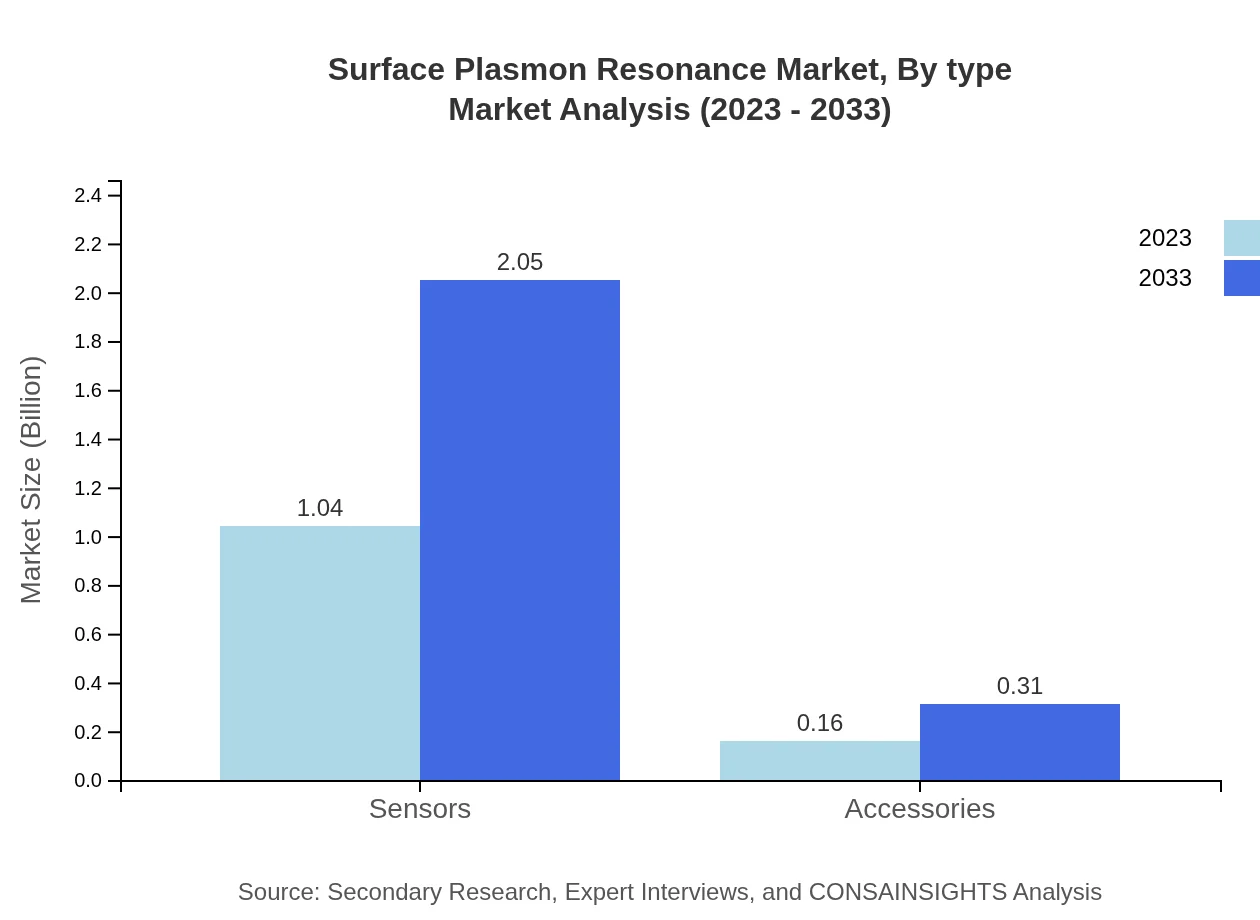
The Surface Plasmon Resonance market by type includes Sensors and Accessories. Sensors dominate the market with an estimated size of $1.04 billion in 2023, which is expected to grow to $2.05 billion by 2033. Accessories, essential for enhancing sensor functionality, contribute significantly as well, growing from $0.16 billion in 2023 to $0.31 billion by 2033.
Surface Plasmon Resonance Market Analysis By Application
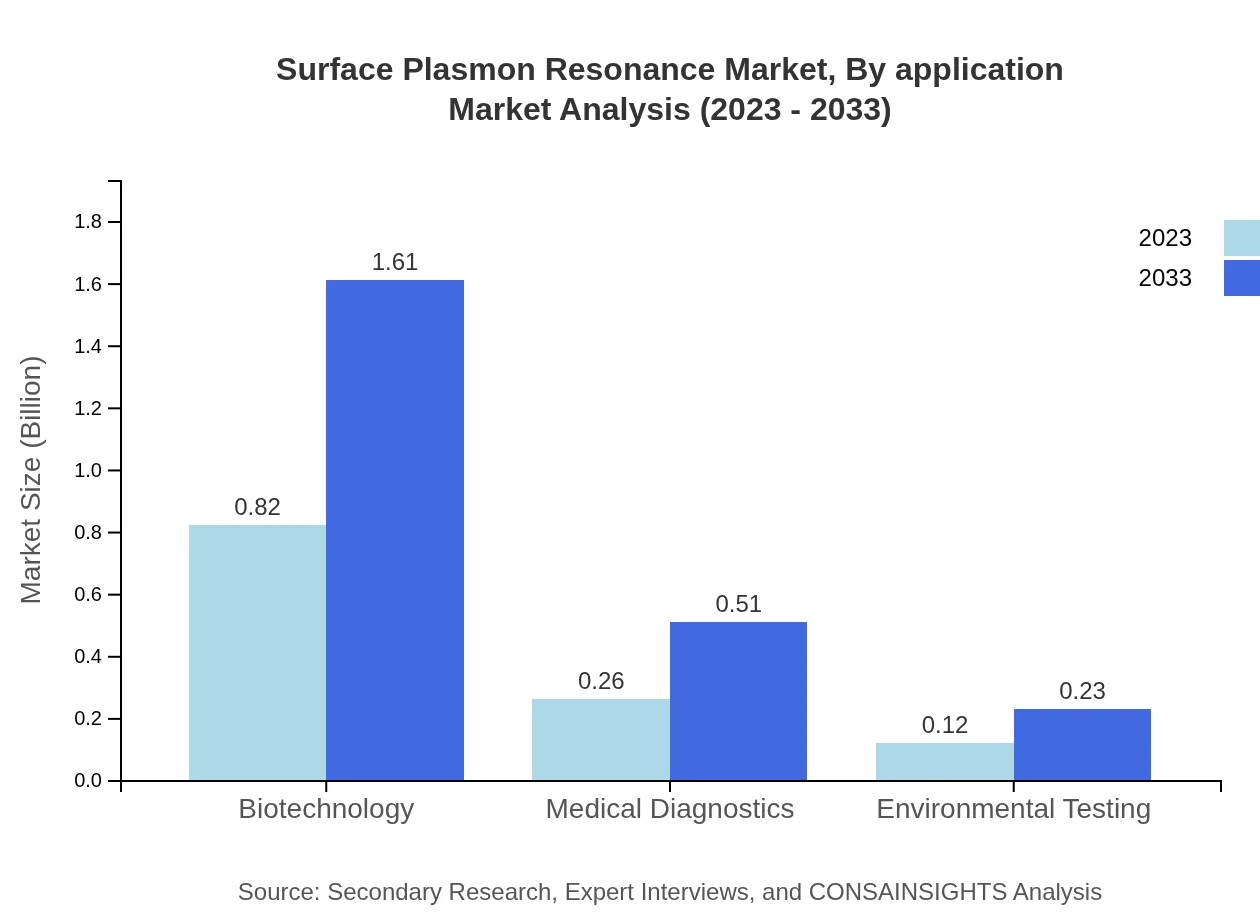
The applications of SPR span across Academic Research, Pharmaceutical, Clinical Laboratories, Biotechnology, Medical Diagnostics, and Environmental Testing. Academic Research and Biotechnology collectively hold a significant market share and are expected to drive growth with $0.82 billion in 2023, rising to $1.61 billion by 2033.
Surface Plasmon Resonance Market Analysis By End User
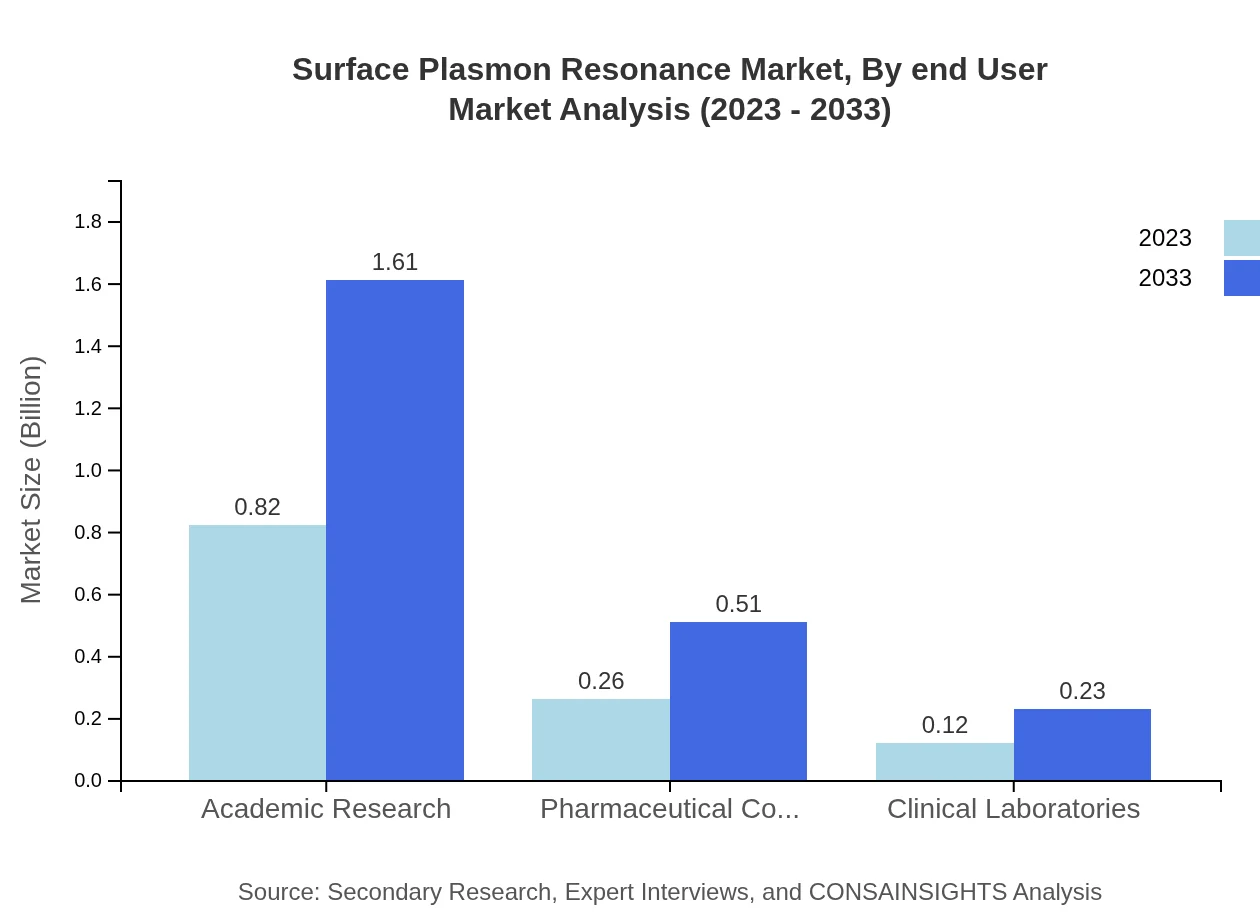
The end-user segments include Pharmaceutical Companies, Clinical Laboratories, Biotechnology firms, Medical Diagnostics, and Environmental testing agencies. Biotech companies are leading users, with a market size of $0.82 billion in 2023, projected to reach $1.61 billion by 2033, reflecting the increasing adoption of SPR for molecular interaction studies.
Surface Plasmon Resonance Market Analysis By Region
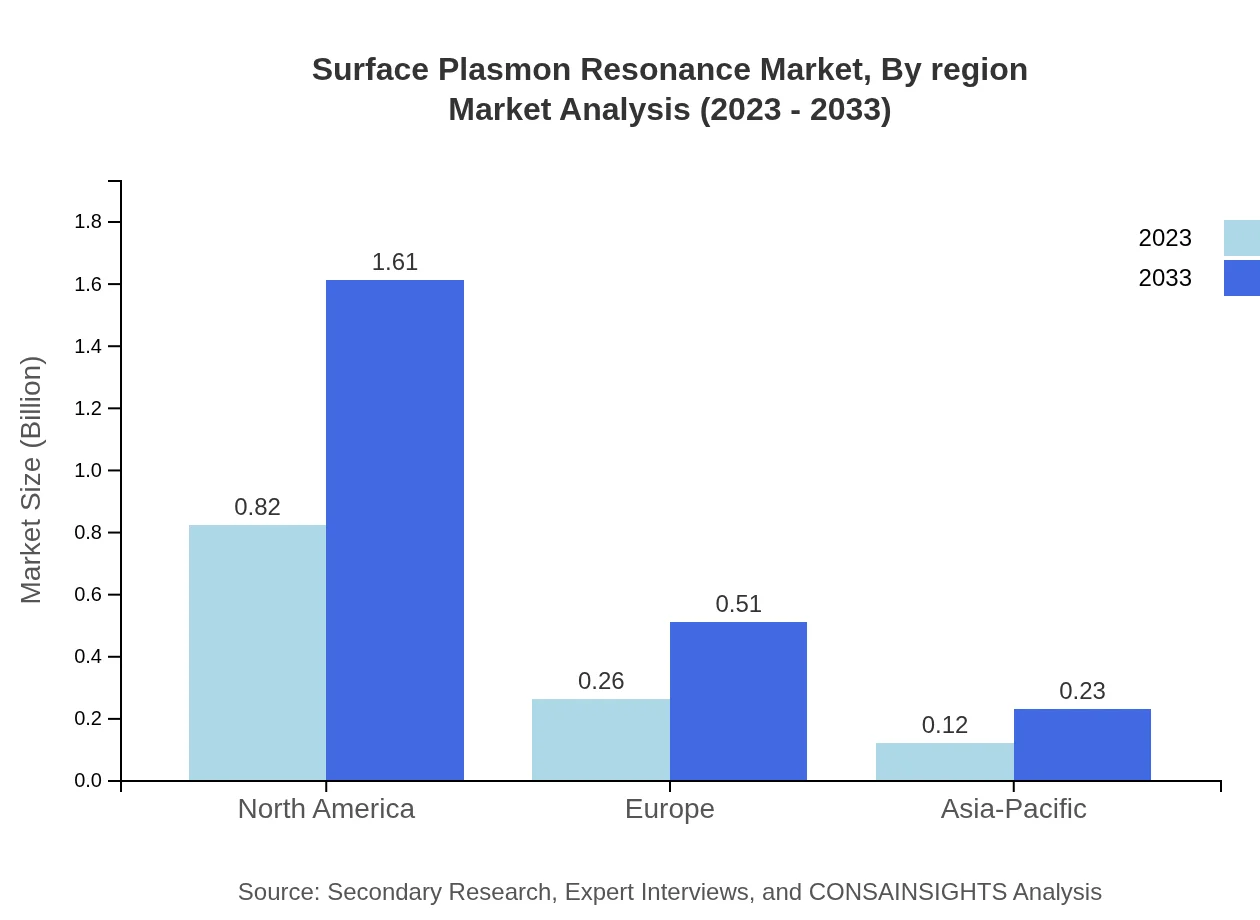
Regional analysis indicates that North America leads significantly, holding 68.35% of the market share in 2023, with Europe at 21.74% and Asia Pacific at 9.91%. Forecasts suggest that while North America will maintain its dominance, Asian countries will increasingly adopt SPR technology as their research and healthcare sectors grow.
Surface Plasmon Resonance Market Trends and Future Forecast
Tell us your focus area and get a customized research report.
Global Market Leaders and Top Companies in Surface Plasmon Resonance Industry
Biosensing Instrumentation:
A leader in SPR technology, specializing in developing innovative biosensors for a wide range of applications, from pharmaceuticals to environmental testing.GE Healthcare:
Offers comprehensive solutions in the life sciences sector, including advanced SPR systems for drug discovery and research.Horiba Scientific:
Provides high-quality instrumentation and solutions in the SPR market, recognized for their commitment to R&D and precision.Reid Bioinformatics:
Focuses on providing analytical tools and SPR systems for academic research and clinical applications, contributing to advancements in diagnostics.We're grateful to work with incredible clients.








FAQs
What is the current market size of the Surface Plasmon Resonance market?
The market size for 2023 is $1.20 Billion as stated in the report data, representing the baseline for the 2023 to 2033 forecast period.
How big will the market be in 2033?
The market is projected to reach $2.36 Billion by 2033 according to the provided forecast figures for the 2023 to 2033 period.
What is the CAGR for the forecast period?
The specified compound annual growth rate for the 2023 to 2033 forecast period is 6.8% as given in the input data.
Is there a single fastest Growing region in the Surface Plasmon Resonance Market Report market?
No single fastest-growing region is stated for the Surface Plasmon Resonance Market Report market because the top regional implied CAGR values are within 0.15 percentage points of each other, making the ranking too close to call reliably.
Which companies are listed as key players?
Top companies cited in the data include Biosensing Instrumentation, GE Healthcare, Horiba Scientific, and Reid Bioinformatics.
What are primary application areas for SPR technology?
Applications highlighted include biotechnology, medical diagnostics, and environmental testing, reflecting the technology's role in molecular interaction analysis.
How does regional growth vary across markets?
Regional figures show different scales: Europe from $0.29 Billion to $0.58 Billion, Asia Pacific from $0.23 Billion to $0.46 Billion, Latin America from $0.05 Billion to $0.1 Billion, and Middle East and Africa from $0.17 Billion to $0.33 Billion.
What are common adoption challenges?
Reported challenges include the high cost of SPR equipment and the requirement for skilled personnel to operate and interpret results, which can limit uptake.
What segments are used in the report?
Segmentation in the supplied data covers type, region, end-user, and application, with listed subsegments such as Sensors, Accessories, Academic Research, and Pharmaceutical Companies.
Who contributed to the research methodology?
Research incorporated primary interviews with industry experts and secondary sources including company reports and publications, with data triangulation and expert-led analysis.