
Reports >
Life Sciences
>
Bone Densitometer Devices Market Report

Bone Densitometer Devices Market Report
First published: 07 October 2024 | Last updated: 25 May 2026 | Report Code: bone-densitometer-devices
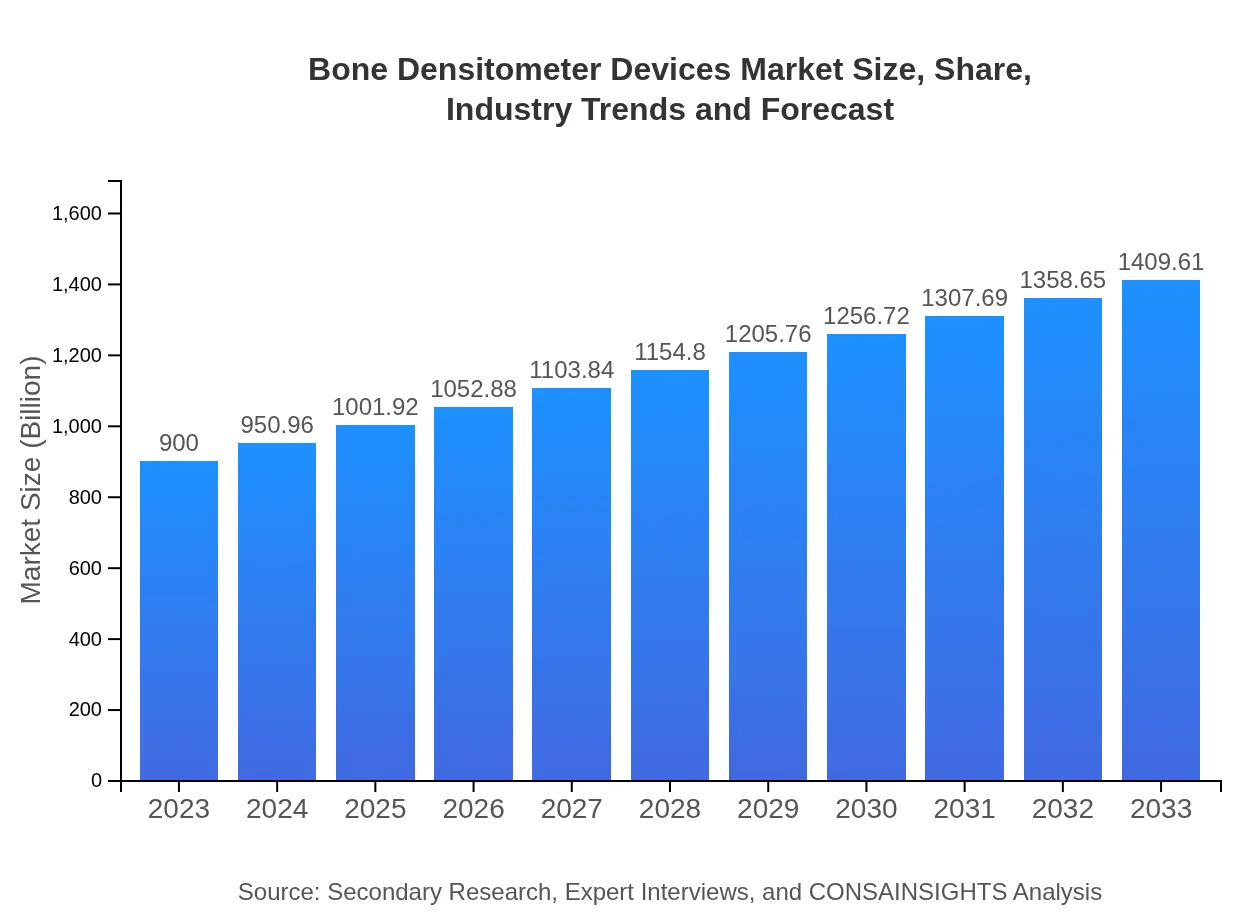
Bone Densitometer Devices Market — USD 900 million in 2023, Growing to USD 1409.61M by 2033 at 4.5% CAGR
This report provides an in-depth analysis of the Bone Densitometer Devices market from 2023 to 2033, covering market size, growth projections, and key trends affecting the industry. It offers insights into segments, regional performance, and leading market players.
Key Takeaways
- Global market expands from $900.00 Billion in 2023 to $1409.61 Billion by 2033, reflecting a 4.5% CAGR over 2023 to 2033.
- North America is largest regional market, while no single fastest-growing region is stated because regional CAGR differences remain within 0.15 percentage points.
- Europe grows from $240.48 Billion to $376.65 Billion between 2023 and 2033, while Asia Pacific increases from $192.42 Billion to $301.37 Billion.
- Segment mix includes DEXA, ultrasound, and QCT devices, with end users spanning hospitals, diagnostic centers, research institutes, and home care settings.
- Leading vendors listed include Hologic, Inc., GE Healthcare, Siemens Healthineers, and Phillips Healthcare, indicating competitive innovation and partnerships.
Bone Densitometer Devices Market Report — Executive Summary
North America remains largest market by forecast-period value, while no single fastest-growing region is stated because top regional growth rates are separated by less than 0.15 percentage points. The Bone Densitometer Devices market is forecast to expand from $900.00 Billion in 2023 to $1409.61 Billion by 2033 at a 4.5% CAGR for 2023 to 2033. Growth is supported by demographic trends such as an aging population, rising awareness of bone health, and improvements in diagnostic technology including portable and DEXA systems. Market structure covers product types—Dual-Energy X-Ray Absorptiometry (DEXA), ultrasound, and quantitative computed tomography—across applications like osteoporosis diagnosis, clinical research, and sports medicine. End-user channels include hospitals, diagnostic centers, research institutes, and increasing use in home care settings, while distribution spans direct sales, distributors, and online retail. Competitive dynamics feature established vendors such as Hologic, Inc., GE Healthcare, Siemens Healthineers, and Phillips Healthcare, emphasizing product development, strategic collaborations, and broader clinical adoption. Regulatory considerations and the need for ongoing innovation remain industry priorities.
Key Growth Drivers
- Aging populations increasing the prevalence of osteoporosis and related diagnostic demand.
- Technological improvements in imaging and portable densitometers enhancing accessibility and accuracy.
- Growing awareness of bone health and preventive screening expanding routine diagnostic adoption.
- Wider adoption in hospitals, diagnostic centers, research institutes, and home care settings supporting market uptake.
- Distribution diversification through direct sales, distributors, and online retail broadening market reach.
| Metric | Value |
|---|---|
| Study Period | 2023 - 2033 |
| 2023 Market Size | $900.00 Million |
| CAGR (2023-2033) | 4.5% |
| 2033 Market Size | $1409.61 Million |
| Top Companies | Hologic, Inc., GE Healthcare, Siemens Healthineers, Phillips Healthcare |
| Published Date | 07 October 2024 |
| Last Modified Date | 25 May 2026 |
Bone Densitometer Devices Market Overview
Customize Bone Densitometer Devices Market Report market research report
- ✔ Get in-depth analysis of Bone Densitometer Devices market size, growth, and forecasts.
- ✔ Understand Bone Densitometer Devices's regional dynamics and industry-specific trends.
- ✔ Identify potential applications, end-user demand, and growth segments in Bone Densitometer Devices
What is the Market Size & CAGR of Bone Densitometer Devices Market Report market in 2023?
Bone Densitometer Devices Industry Analysis
Bone Densitometer Devices Market Segmentation and Scope
Tell us your focus area and get a customized research report.
Bone Densitometer Devices Market Report Market Analysis Report by Region
Europe Bone Densitometer Devices Market Report:
Europe grows from $240.48 Billion in 2023 to $376.65 Billion in 2033. Growth is supported by awareness of osteoporosis, investments in diagnostic infrastructure, and uptake of DEXA and advanced imaging in clinical settings.Asia Pacific Bone Densitometer Devices Market Report:
Asia Pacific grows from $192.42 Billion in 2023 to $301.37 Billion in 2033. Drivers include expanding healthcare access, rising screening initiatives, and increasing deployment of portable and clinic-based densitometry equipment.North America Bone Densitometer Devices Market Report:
North America is largest regional market, rising from $330.39 Billion in 2023 to $517.47 Billion in 2033. Regional growth reflects strong hospital and diagnostic center adoption, technology uptake, and established vendor presence supporting demand.South America Bone Densitometer Devices Market Report:
Latin America grows from $14.4 Billion in 2023 to $22.55 Billion in 2033. Market progress is tied to expanding diagnostic services, increased health awareness, and gradual adoption of imaging technologies in clinical facilities.Middle East & Africa Bone Densitometer Devices Market Report:
Middle East and Africa grows from $122.31 Billion in 2023 to $191.57 Billion in 2033. Growth factors include improving healthcare infrastructure, greater emphasis on chronic disease diagnosis, and wider adoption in hospitals and diagnostic centers.Tell us your focus area and get a customized research report.
Research Methodology
Bone Densitometer Devices Market Analysis By Product Type
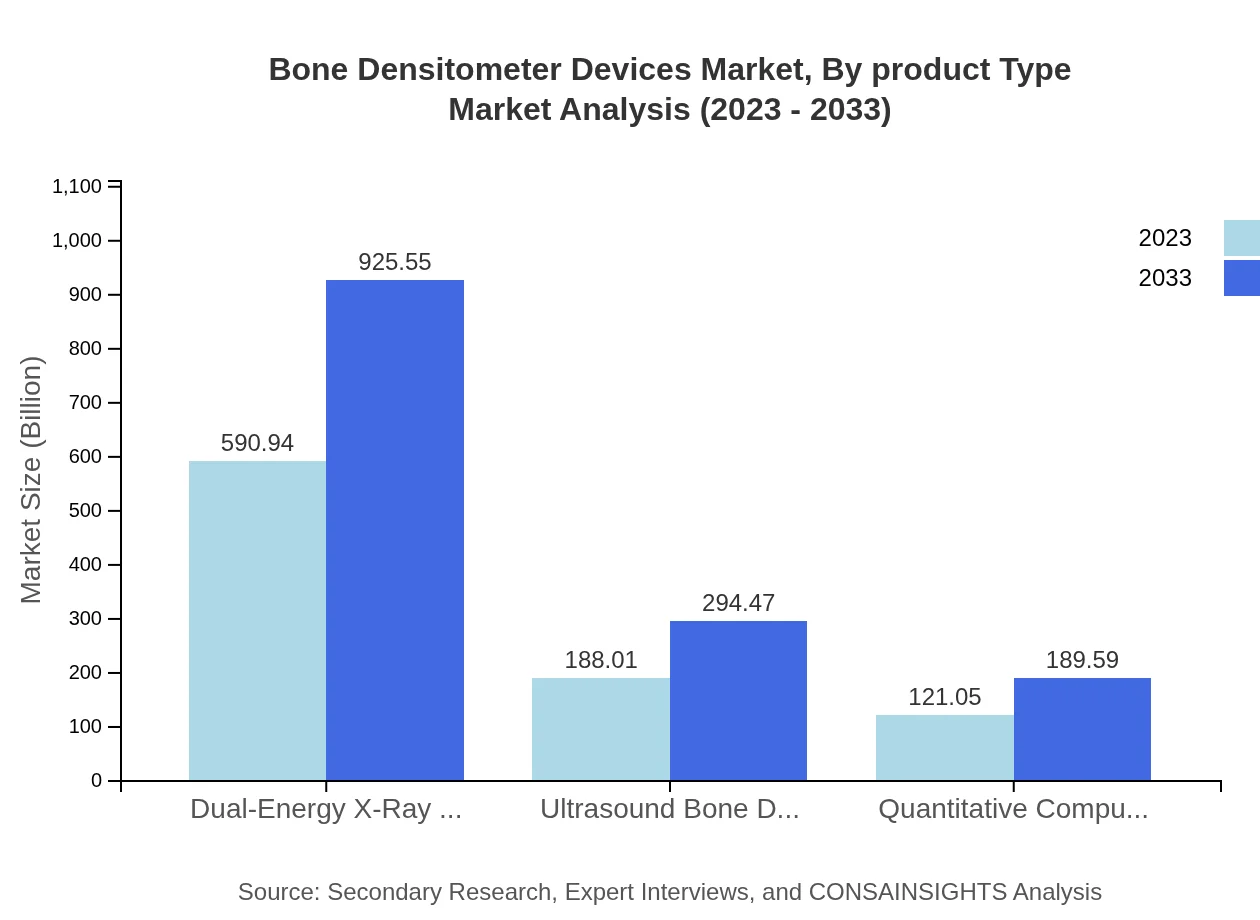
The market is led by Dual-Energy X-Ray Absorptiometry (DEXA), generating $590.94 million in 2023, projected to reach $925.55 million by 2033, dominating the segment at 65.66%. Ultrasound Bone Densitometers and Quantitative Computed Tomography (QCT) follow, with respective market sizes of $188.01 million and $121.05 million in 2023.
Bone Densitometer Devices Market Analysis By Application
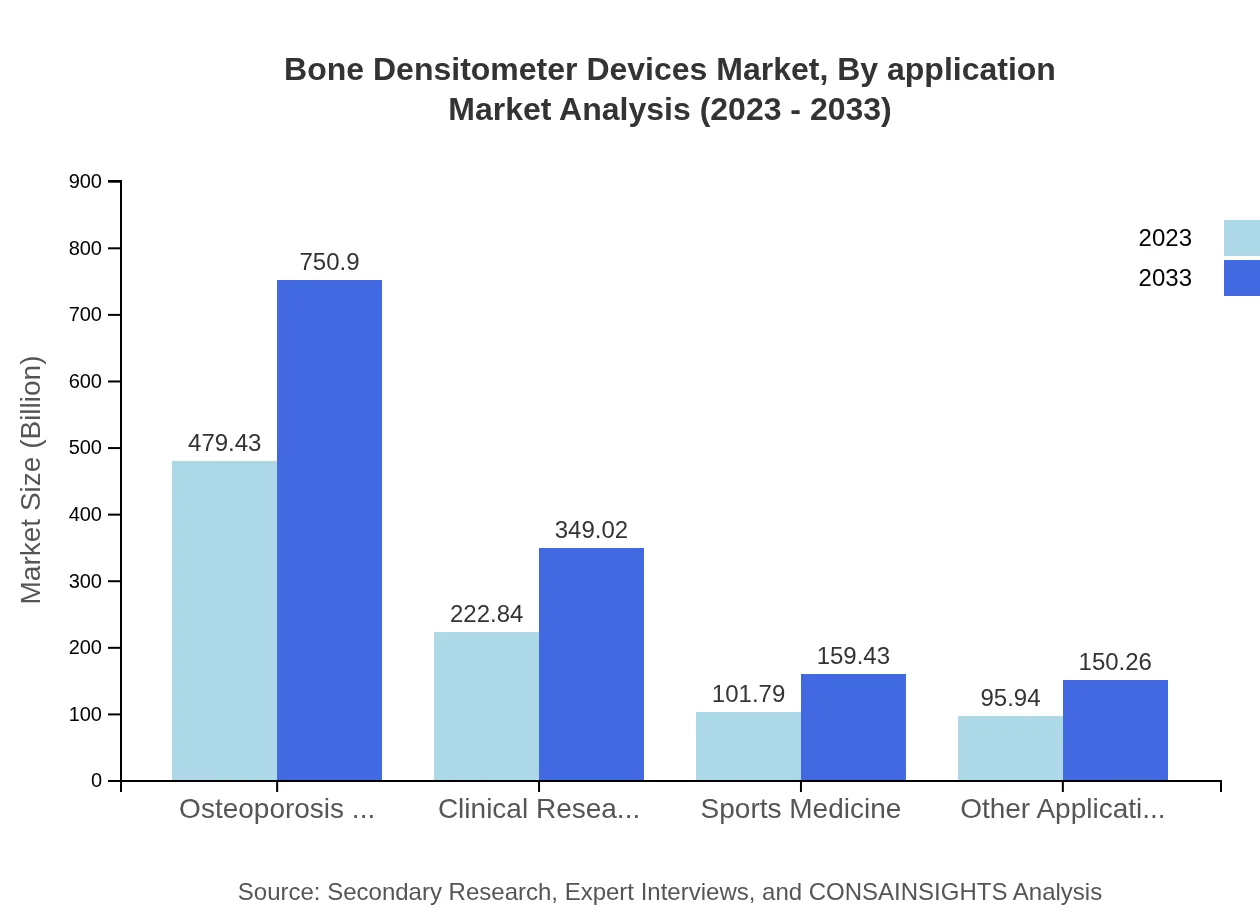
Osteoporosis Diagnosis and Clinical Research applications are crucial, each representing substantial market shares of 53.27% and 24.76% respectively. Their market values are projected to increase from $479.43 million and $222.84 million in 2023 to $750.90 million and $349.02 million in 2033.
Bone Densitometer Devices Market Analysis By End User
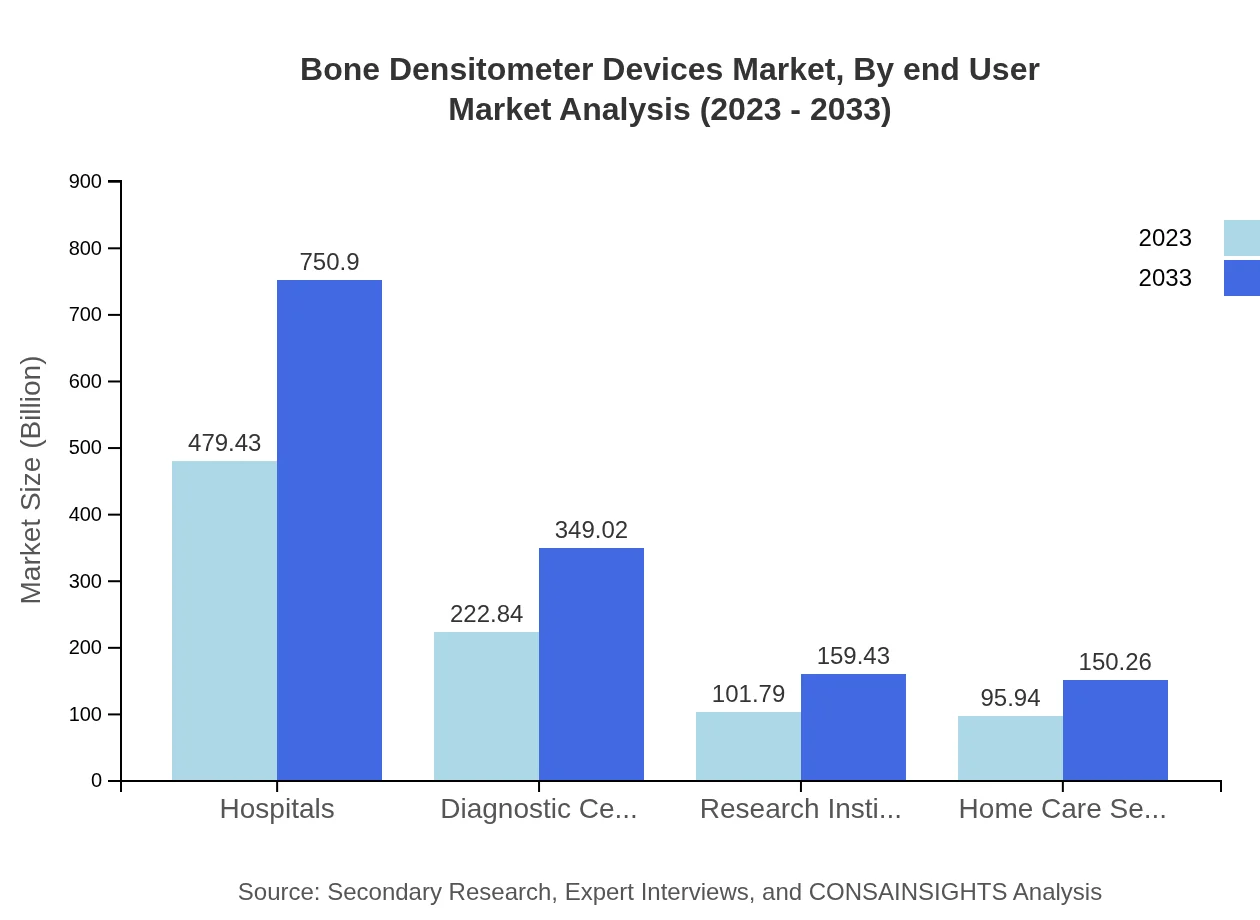
Hospitals make up the majority share of the market at 53.27%, with a market size rising from $479.43 million in 2023 to $750.90 million by 2033. Diagnostic Centers and Research Institutes follow with shares of 24.76% and 11.31% respectively.
Bone Densitometer Devices Market Analysis By Distribution Channel
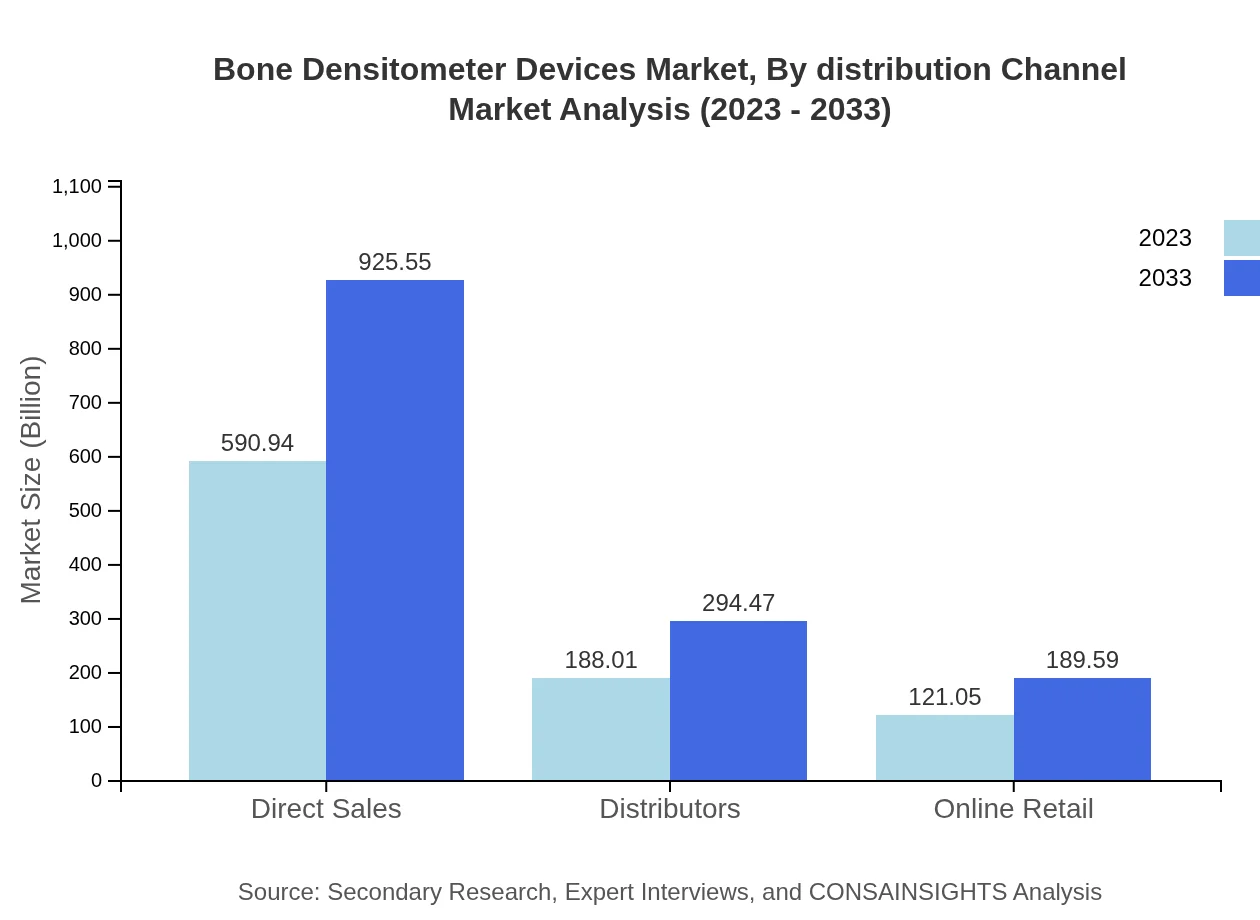
Direct Sales segments significantly impact the market, accounting for 65.66% in 2023, growing from $590.94 million to $925.55 million by 2033. Other channels include Distributors and Online Retailers, contributing growing segments to the overall market structure.
Bone Densitometer Devices Market Trends and Future Forecast
Tell us your focus area and get a customized research report.
Global Market Leaders and Top Companies in Bone Densitometer Devices Industry
Hologic, Inc.:
A leading manufacturer of medical devices, Hologic specializes in women’s health and offers advanced bone densitometry devices, renowned for their innovative and accurate imaging technologies.GE Healthcare:
GE Healthcare provides a wide range of healthcare solutions, including high-quality bone densitometers that are integral for diagnosing and managing osteoporosis and other bone diseases.Siemens Healthineers:
Siemens Healthineers offers state-of-the-art imaging solutions, including bone densitometry devices known for their precision and integration in comprehensive health assessments.Phillips Healthcare:
Phillips Healthcare is a prominent player in medical technology, focusing on advanced imaging techniques, including bone densitometers for accurate bone density evaluation.We're grateful to work with incredible clients.









FAQs
What is the market size in 2023?
The market size in 2023 is $900.00 Billion as provided in the report data, representing the baseline for the 2023 to 2033 forecast period.
What is the market size in 2033?
The projected market size in 2033 is $1409.61 Billion according to the supplied forecast figures for the 2023 to 2033 period.
What is CAGR for the forecast period?
The compounded annual growth rate for 2023 to 2033 is 4.5%, based on the provided market projections between 2023 and 2033.
Is there a single fastest Growing region in the Bone Densitometer Devices Market Report market?
No single fastest-growing region is stated for the Bone Densitometer Devices Market Report market because the top regional implied CAGR values are within 0.15 percentage points of each other, making the ranking too close to call reliably.
How big is the North America market in 2033?
North America's market value is $517.47 Billion in 2033, per the regional projections included in the input data.
Which companies are listed as top players?
Top companies identified in the report data include Hologic, Inc., GE Healthcare, Siemens Healthineers, and Phillips Healthcare.
Why is demand increasing for densitometer devices?
Demand is rising due to aging demographics, enhanced awareness of bone health, and technological advances that improve diagnostic accuracy and accessibility.
What are main product segments covered?
Key product segments specified are Dual-Energy X-Ray Absorptiometry (DEXA), Ultrasound Bone Densitometers, and Quantitative Computed Tomography (QCT).
Who are the primary end users?
Primary end users include hospitals, diagnostic centers, research institutes, and home care settings as listed among the subsegments.
How are devices typically distributed?
Distribution channels detailed in the input are direct sales, distributors, and online retail, reflecting varied go-to-market approaches.