
Reports >
Life Sciences
>
Orthopedic Prosthetics Market Report

Orthopedic Prosthetics Market Report
First published: 11 October 2024 | Last updated: 25 May 2026 | Report Code: orthopedic-prosthetics
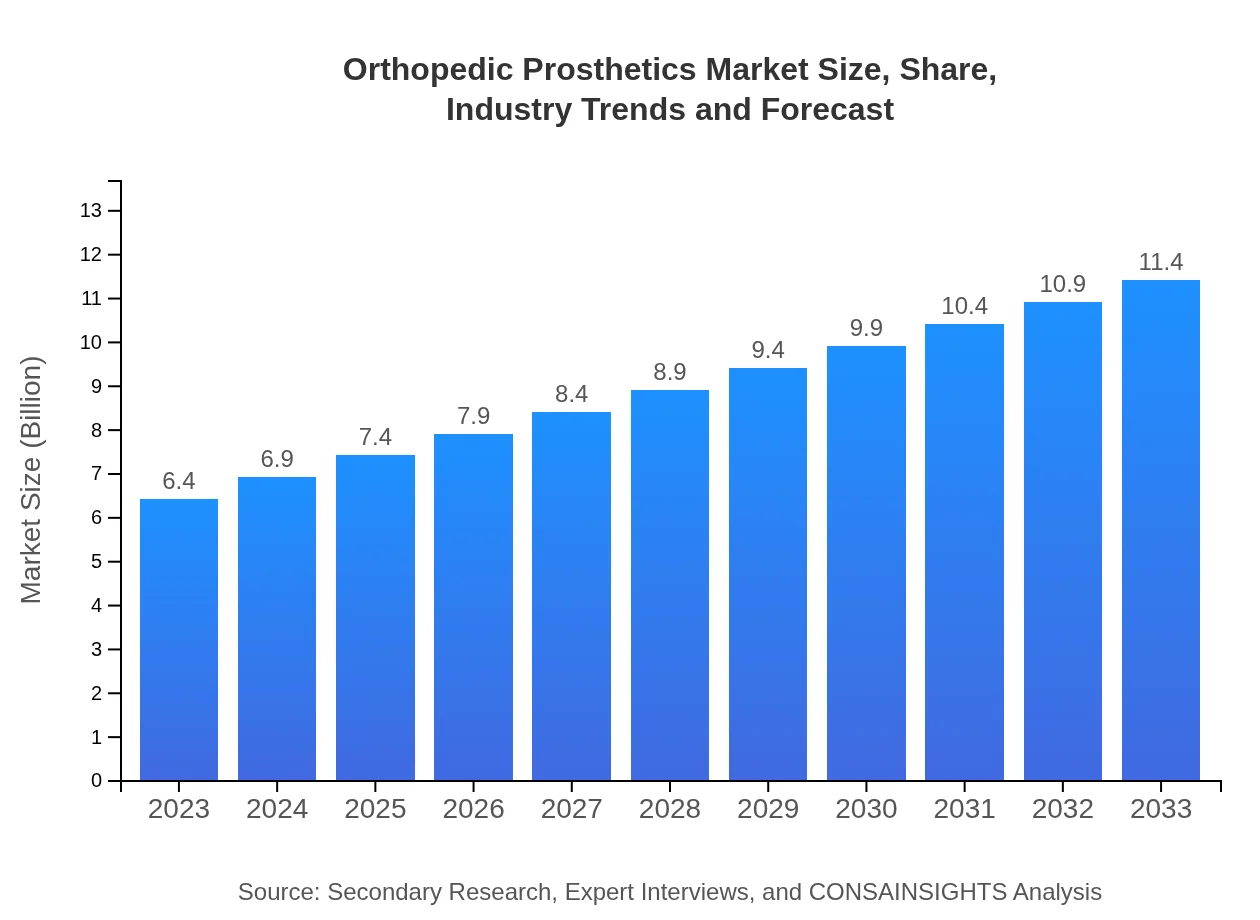
Orthopedic Prosthetics Market — USD 6.4 billion in 2023, Growing to USD 11.40B by 2033 at 5.8% CAGR
This report provides a comprehensive analysis of the Orthopedic Prosthetics market from 2023 to 2033, offering insights into market size, growth rates, industry trends, and regional performance. Key market segments and forecasts are also discussed to aid stakeholders in strategic planning.
Key Takeaways
- Global market expands from $6.40 Billion in 2023 to $11.40 Billion in 2033 at a 5.8% CAGR.
- North America is largest regional market, while no single fastest-growing region is stated because regional CAGR differences remain within 0.15 percentage points.
- Europe, Asia Pacific, Latin America, and Middle East & Africa also show notable growth through 2033.
- Industry innovation in materials and customization, alongside higher healthcare spending, underpins demand.
- Leading manufacturers cited include Össur, Hanger Inc., Stryker Corporation, and Smith & Nephew.
Orthopedic Prosthetics Market Report — Executive Summary
North America remains largest market by forecast-period value, while no single fastest-growing region is stated because top regional growth rates are separated by less than 0.15 percentage points. The orthopedic prosthetics sector shows steady expansion driven by rising demand for advanced limb replacement solutions and greater healthcare investment. Market size advances from $6.40 Billion in 2023 to $11.40 Billion in 2033 at a 5.8% CAGR. Growth is supported by material innovation, improved manufacturing techniques, and emphasis on patient-specific designs. Regional performance is diverse; North America holds the largest market value. Key participants such as Össur, Hanger Inc., Stryker Corporation, and Smith & Nephew are active in product development and market partnerships. The report covers product and end-user segmentation, distribution channels, and regulatory and cost challenges that shape adoption and commercialization strategies.
Key Growth Drivers
- Advances in materials like composites and titanium improving prosthetic durability and weight.
- Greater healthcare expenditure and rehabilitation services expanding access to prosthetic solutions.
- Improvements in manufacturing, including customization techniques, enabling patient-specific fittings.
- Rising prevalence of orthopedic conditions and trauma increasing long-term demand for limb replacements.
- Investment by major manufacturers to accelerate product development and clinical partnerships.
| Metric | Value |
|---|---|
| Study Period | 2023 - 2033 |
| 2023 Market Size | $6.40 Billion |
| CAGR (2023-2033) | 5.8% |
| 2033 Market Size | $11.40 Billion |
| Top Companies | Össur, Hanger Inc., Stryker Corporation, Smith & Nephew |
| Published Date | 11 October 2024 |
| Last Modified Date | 25 May 2026 |
Orthopedic Prosthetics Market Overview
Customize Orthopedic Prosthetics Market Report market research report
- ✔ Get in-depth analysis of Orthopedic Prosthetics market size, growth, and forecasts.
- ✔ Understand Orthopedic Prosthetics's regional dynamics and industry-specific trends.
- ✔ Identify potential applications, end-user demand, and growth segments in Orthopedic Prosthetics
What is the Market Size & CAGR of Orthopedic Prosthetics Market Report market in 2023?
Orthopedic Prosthetics Industry Analysis
Orthopedic Prosthetics Market Segmentation and Scope
Tell us your focus area and get a customized research report.
Orthopedic Prosthetics Market Report Market Analysis Report by Region
Europe Orthopedic Prosthetics Market Report:
Europe grows from $1.99 Billion in 2023 to $3.55 Billion in 2033. Growth in this region is linked to technological adoption, supportive clinical services, and ongoing development of materials and customization approaches for prosthetic devices.Asia Pacific Orthopedic Prosthetics Market Report:
Asia Pacific grows from $1.31 Billion in 2023 to $2.33 Billion in 2033. Expansion is driven by rising healthcare expenditure, broader access to prosthetic care, and uptake of improved manufacturing and fitting practices in several markets.North America Orthopedic Prosthetics Market Report:
North America is largest regional market, rising from $2.1 Billion in 2023 to $3.74 Billion in 2033. Regional strength reflects established healthcare infrastructure, greater adoption of advanced prosthetic technologies, and significant investment in rehabilitation services.South America Orthopedic Prosthetics Market Report:
Latin America grows from $0.46 Billion in 2023 to $0.82 Billion in 2033. Regional gains stem from improving healthcare access, growing awareness of prosthetic options, and gradual adoption of advanced materials and fittings.Middle East & Africa Orthopedic Prosthetics Market Report:
Middle East and Africa grows from $0.54 Billion in 2023 to $0.97 Billion in 2033. Growth factors include increased healthcare investment, rehabilitation service development, and gradual incorporation of improved prosthetic technologies.Tell us your focus area and get a customized research report.
Research Methodology
Orthopedic Prosthetics Market Analysis By Product
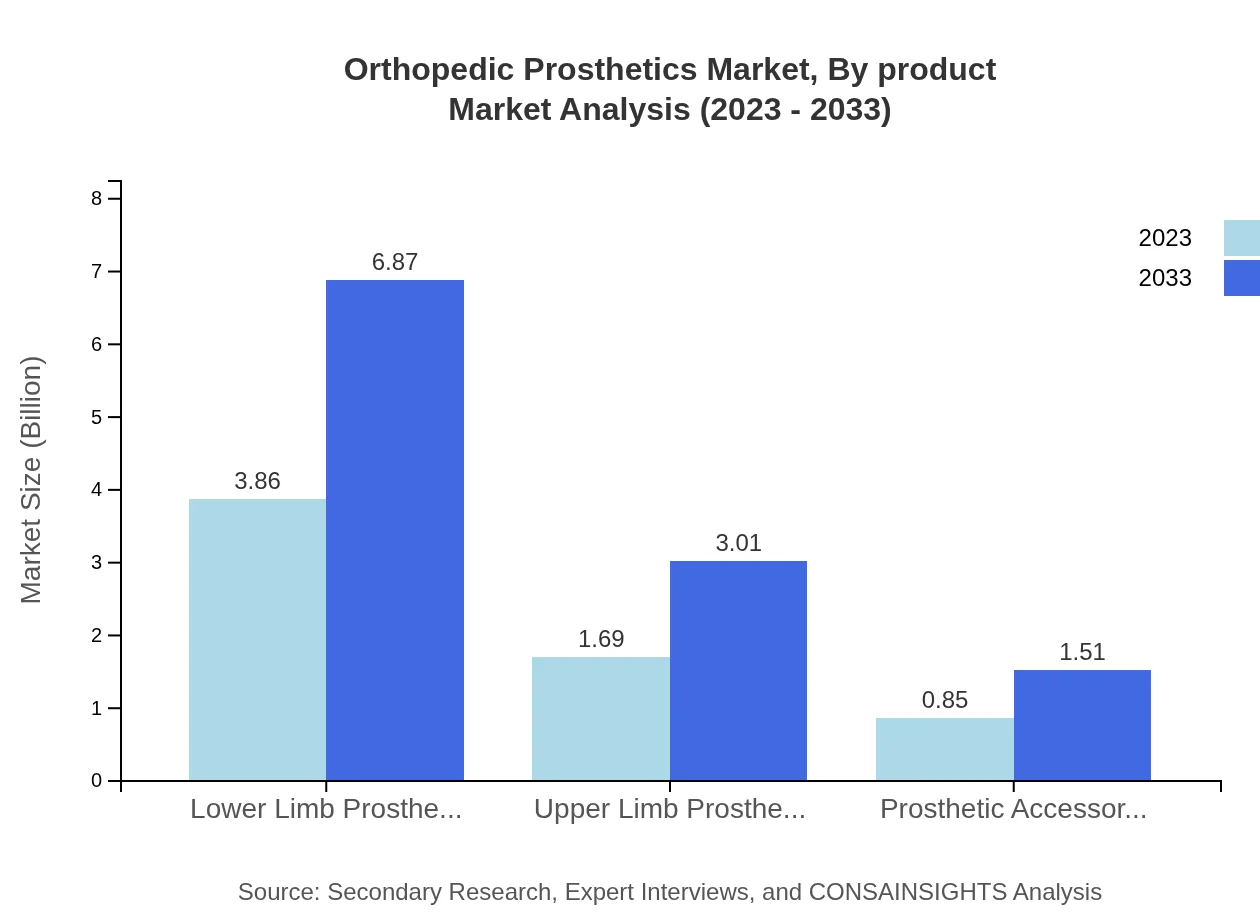
The Orthopedic Prosthetics market, segmented by product, emphasizes the significance of lower limb prosthetics, projected to grow from $3.86 billion in 2023 to $6.87 billion by 2033, retaining a significant market share of 60.3%. Upper limb prosthetics, while smaller, are expected to expand from $1.69 billion to $3.01 billion, holding a 26.41% market share. Prosthetic accessories, crucial for improving user experience, will see growth from $0.85 billion to $1.51 billion, representing 13.29% of the market.
Orthopedic Prosthetics Market Analysis By Application
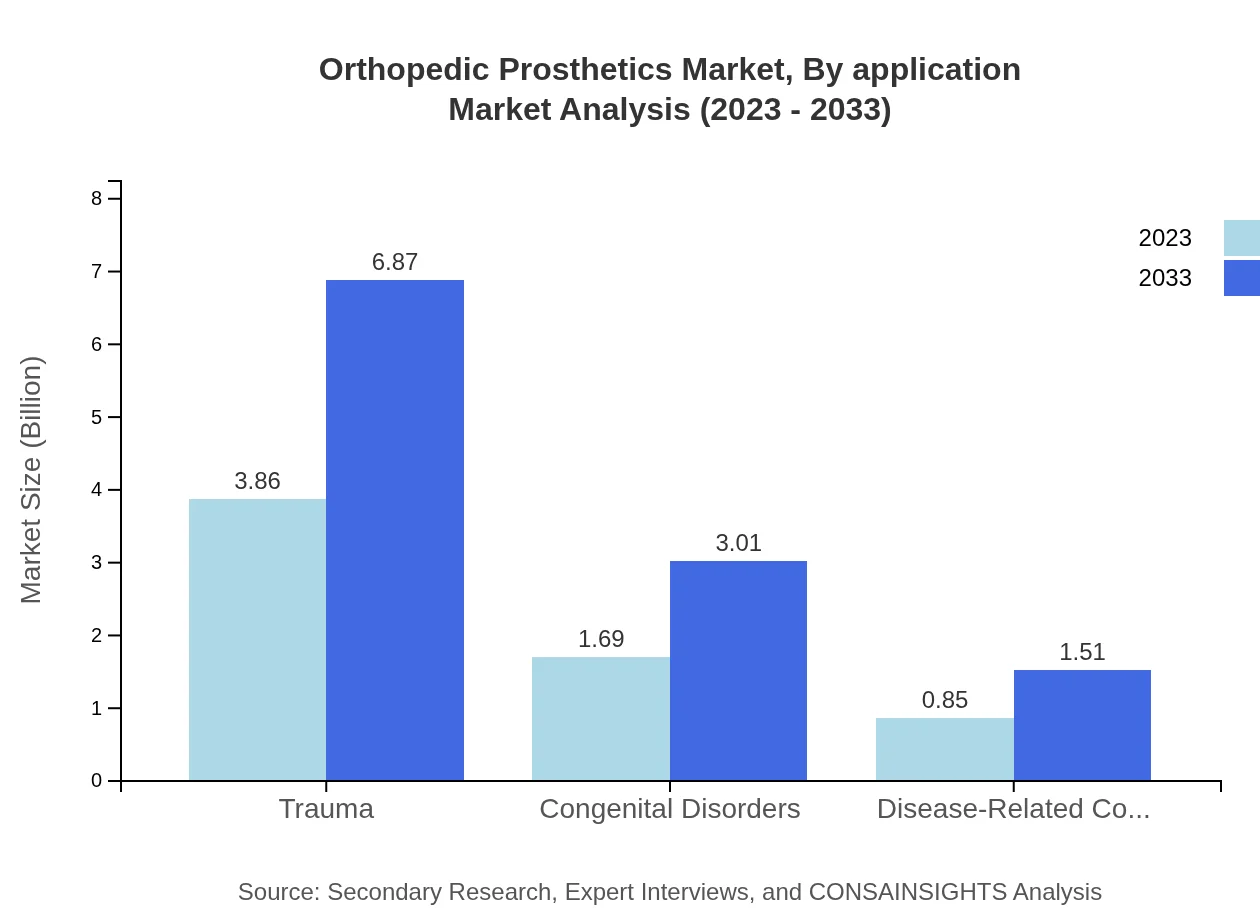
In terms of application, trauma continues to dominate the Orthopedic Prosthetics market, growing from $3.86 billion in 2023 to $6.87 billion by 2033, comprising 60.3% of the overall market. Congenital disorders and disease-related conditions are also significant, with shares of 26.41% and 13.29%, respectively, indicating sustained demand across various applications.
Orthopedic Prosthetics Market Analysis By Material
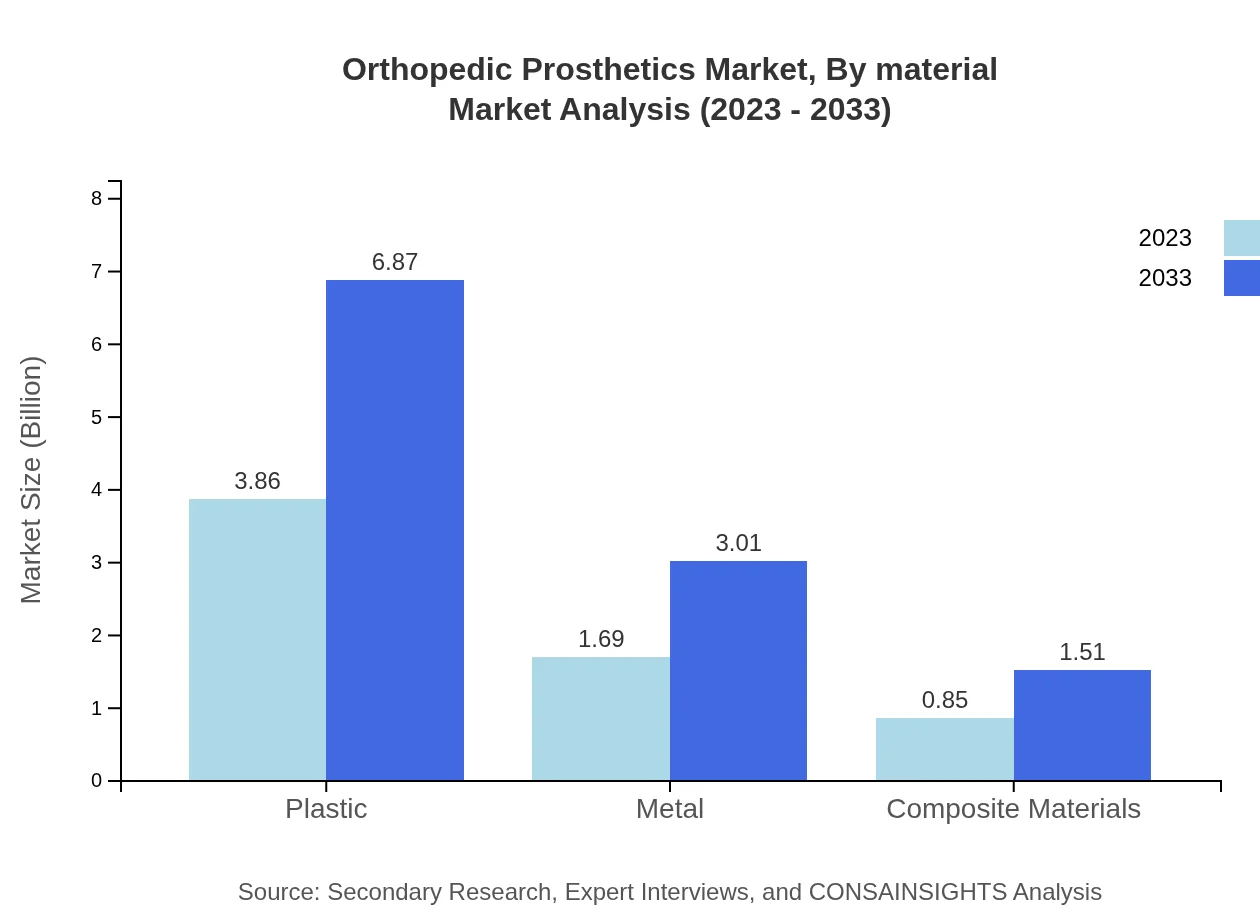
Analyzing the market by material reveals that plastic remains the predominant choice in prosthetic manufacturing, growing from $3.86 billion to $6.87 billion with a stable market share of 60.3%. Metal prosthetics are also prominent, expected to grow from $1.69 billion to $3.01 billion, while composite materials are less prevalent but projected to rise from $0.85 billion to $1.51 billion over the forecast period.
Orthopedic Prosthetics Market Analysis By Distribution Channel
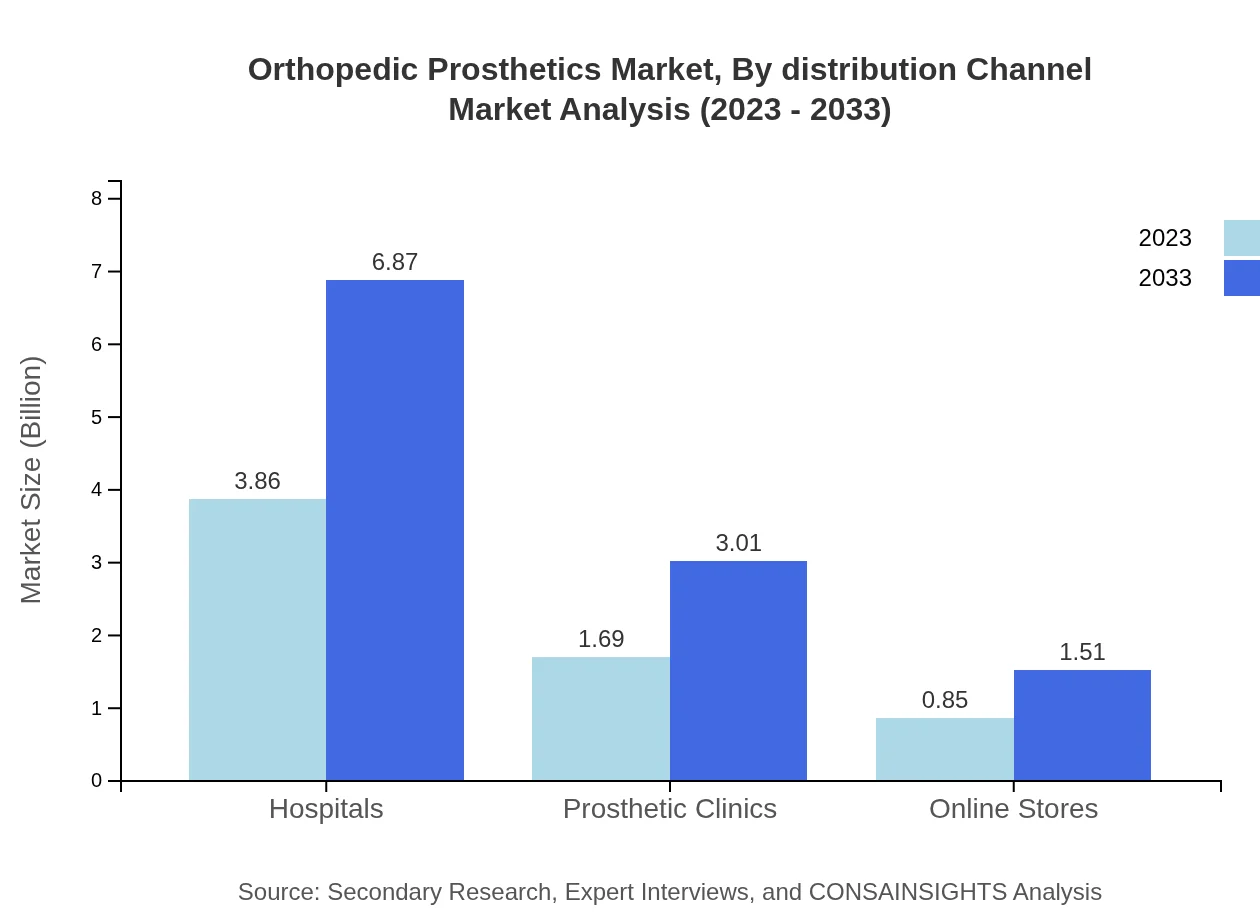
The distribution landscape for Orthopedic Prosthetics is varied, with hospitals capturing 60.3% of the market share and expected to grow from $3.86 billion to $6.87 billion. Prosthetic clinics and online stores follow, with shares of 26.41% and 13.29%, respectively, reflecting the growing importance of e-commerce and specialized care centers.
Orthopedic Prosthetics Market Analysis By End User
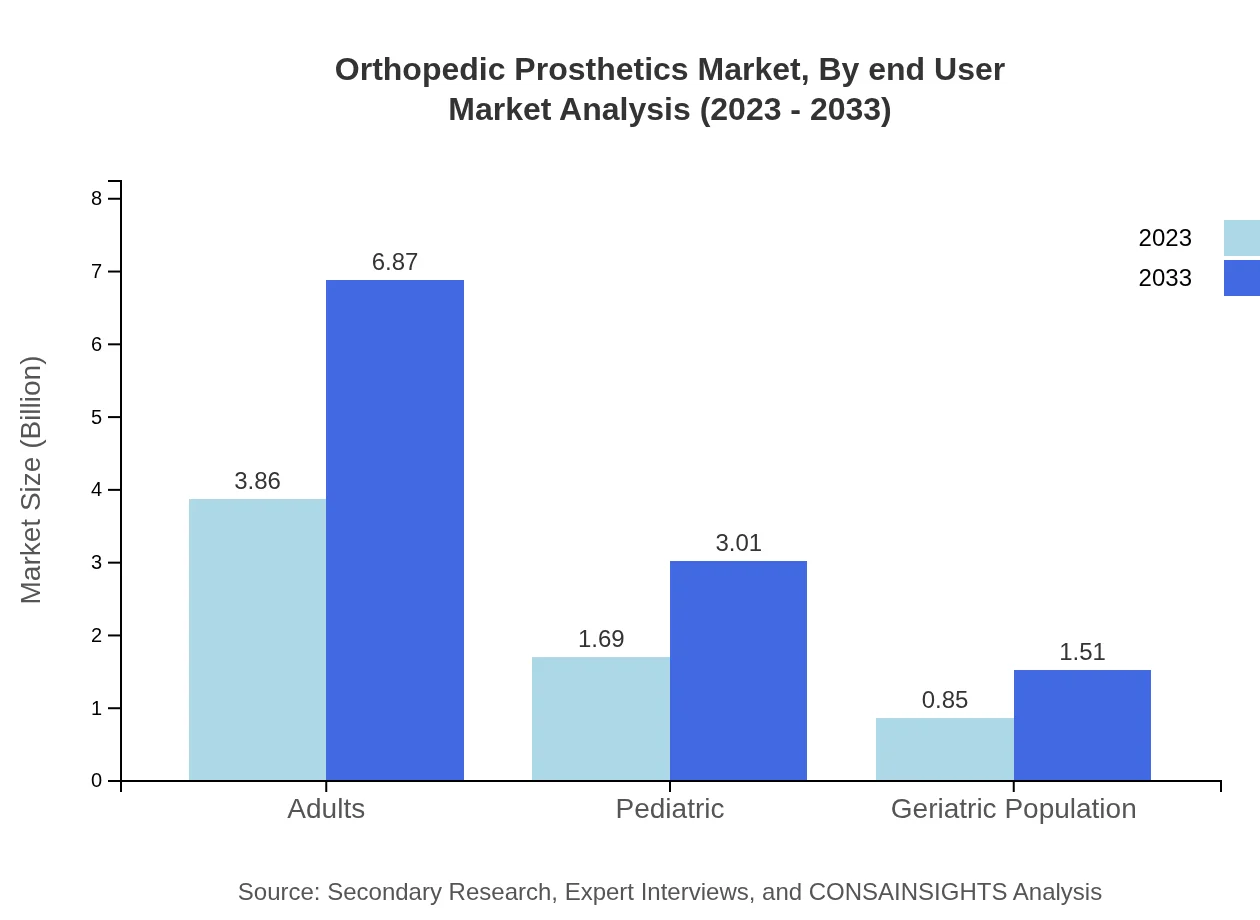
End-user segmentation shows that adults dominate the market, holding a substantial 60.3% share, with market growth from $3.86 billion to $6.87 billion. Pediatric use is also significant, projected to grow from $1.69 billion to $3.01 billion, while the geriatric segment, although smaller, is expected to expand from $0.85 billion to $1.51 billion.
Orthopedic Prosthetics Market Trends and Future Forecast
Tell us your focus area and get a customized research report.
Global Market Leaders and Top Companies in Orthopedic Prosthetics Industry
Össur:
Össur is a leading global provider of non-invasive orthopedics, including advanced prosthetic limbs known for their innovative designs and technologies enhancing mobility and comfort for patients.Hanger Inc.:
Hanger Inc. is a prominent player in the orthopedic prosthetics market specializing in rehabilitation services and custom prosthetics, with a strong commitment to improving patient outcomes through personalized care.Stryker Corporation:
Stryker Corporation is known for its broad portfolio in medical technology, offering state-of-the-art orthopedic products including prosthetic devices that cater to a diverse patient demographic.Smith & Nephew:
Smith & Nephew focuses on advanced surgical devices and orthopedic products, including innovative prosthetics with ergonomic designs that enhance comfort and ease of use.We're grateful to work with incredible clients.








FAQs
What is the market size of the orthopedic prosthetics market?
The market size was $6.40 Billion in 2023 and is projected to reach $11.40 Billion by 2033, based on the report’s stated values for the forecast period 2023 to 2033.
How big is the market expected to grow by 2033?
The market is expected to grow from $6.40 Billion in 2023 to $11.40 Billion in 2033, reflecting the exact values provided for the forecast horizon 2023 to 2033.
What is CAGR of the market over the forecast period?
The report specifies a compound annual growth rate (CAGR) of 5.8% for the forecast period spanning 2023 to 2033.
Is there a single fastest Growing region in the Orthopedic Prosthetics Market Report market?
No single fastest-growing region is stated for the Orthopedic Prosthetics Market Report market because the top regional implied CAGR values are within 0.15 percentage points of each other, making the ranking too close to call reliably.
Which companies lead the orthopedic prosthetics market?
Top companies named in the report are Össur, Hanger Inc., Stryker Corporation, and Smith & Nephew, identified for their roles in product development and market presence.
What are primary trends affecting the market?
Primary trends include material innovation, customization, and advanced manufacturing techniques that enhance comfort, functionality, and accessibility of prosthetic devices.
How do regional markets compare in absolute values?
Regional figures include North America $2.1 Billion to $3.74 Billion, Europe $1.99 Billion to $3.55 Billion, Asia Pacific $1.31 Billion to $2.33 Billion, Latin America $0.46 Billion to $0.82 Billion, and Middle East and Africa $0.54 Billion to $0.97 Billion.
What drives adoption among end users?
Adoption is supported by improvements in prosthetic comfort and customization, expanding rehabilitation services, and investments that make advanced devices more available to patients.