

T Cell Acute Lymphoblastic Leukemia Treatment Market Report
First published: 11 October 2024 | Last updated: 28 May 2026 | Report Code: t-cell-acute-lymphoblastic-leukemia-treatment
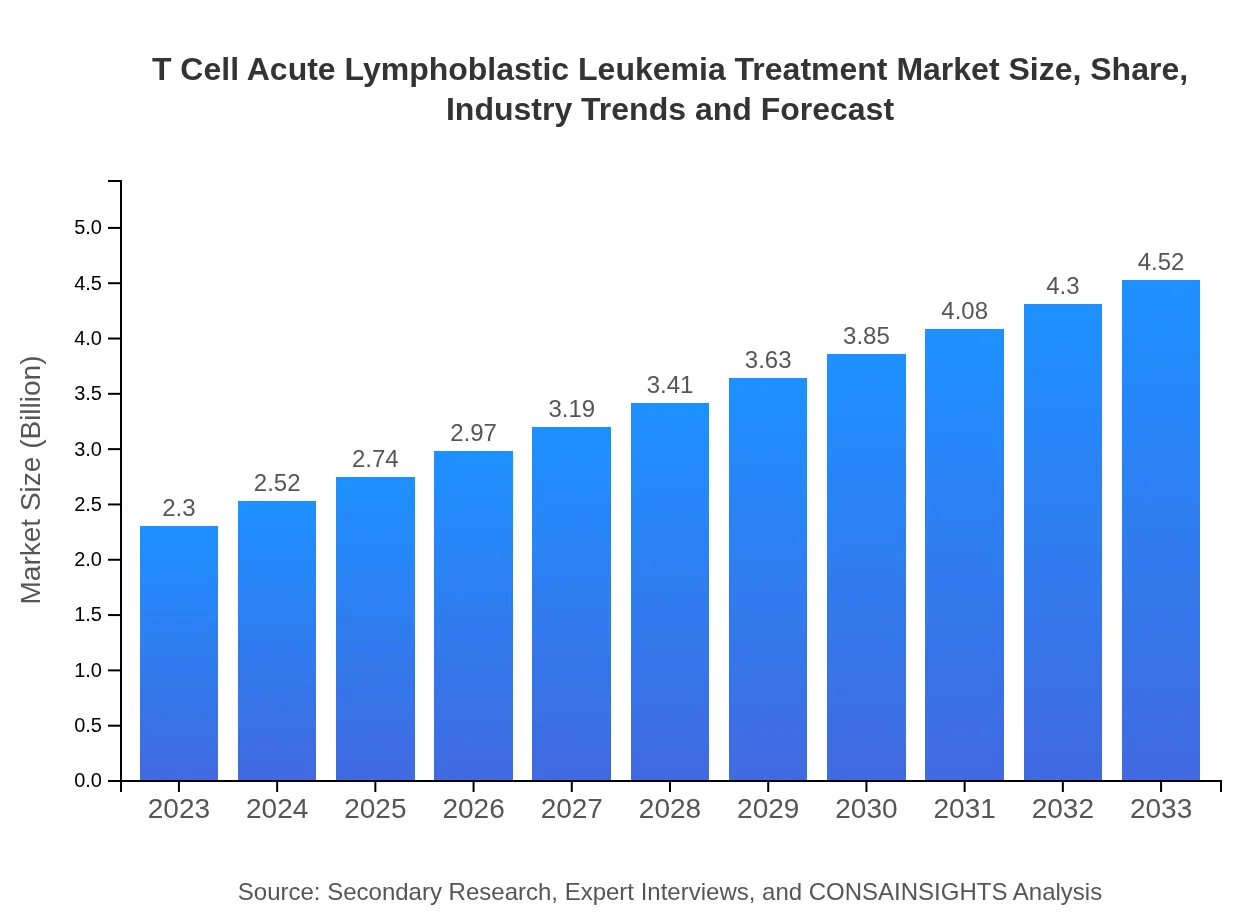
T Cell Acute Lymphoblastic Leukemia Treatment Market — USD $2.3 Billion in 2023, Growing to USD 4.52null by 2033 at 6.8% CAGR
This report provides a comprehensive analysis of the T Cell Acute Lymphoblastic Leukemia treatment market, including insights on current trends, market size, segmentation, and growth forecasts from 2023 to 2033.
Key Takeaways
- Global market expands from $2.30 Billion in 2023 to $4.52 Billion by 2033 at a 6.8% CAGR.
- North America is largest regional market, while no single fastest-growing region is stated because regional CAGR differences remain within 0.15 percentage points.
- Major treatment categories include chemotherapy, targeted therapy, and immunotherapy alongside varied administration routes.
- Top companies active in the space include Roche, Bristol-Myers Squibb, Novartis, and Pfizer.
- Care settings span hospitals, oncology centers, and home care, reflecting diverse end-user adoption.
T Cell Acute Lymphoblastic Leukemia Treatment Market Report — Executive Summary
North America remains largest market by forecast-period value, while no single fastest-growing region is stated because top regional growth rates are separated by less than 0.15 percentage points. This report examines the T Cell Acute Lymphoblastic Leukemia treatment market, which grows from $2.30 Billion in 2023 to $4.52 Billion in 2033 at a 6.8% CAGR. Growth is supported by development across chemotherapy, targeted therapies, immunotherapies, and advances in administration approaches. Regional dynamics show North America as the largest market by 2033. Stakeholders include major pharmaceutical firms such as Roche, Bristol-Myers Squibb, Novartis, and Pfizer. The market structure is categorized by treatment type, drug class, route of administration, and end-user settings, informing investment, clinical development, and commercialization strategies. Ongoing clinical research and collaboration between pharma and biotech are central to product innovation and improved patient outcomes.
Key Growth Drivers
- Rising clinical development activity and combination therapy research boosting new treatment options.
- Ongoing innovation in targeted and immunotherapy approaches expanding therapeutic choices.
- Collaborations between pharmaceutical firms and biotech companies accelerating drug development.
- Increasing focus on tailored regimens and administration methods improving treatment adoption across care settings.
| Metric | Value |
|---|---|
| Study Period | 2023 - 2033 |
| 2023 Market Size | $2.30 Billion |
| CAGR (2023-2033) | 6.8% |
| 2033 Market Size | $4.52 Billion |
| Top Companies | Roche, Bristol-Myers Squibb, Novartis, Pfizer |
| Published Date | 11 October 2024 |
| Last Modified Date | 28 May 2026 |
T Cell Acute Lymphoblastic Leukemia Treatment Market Overview
Customize T Cell Acute Lymphoblastic Leukemia Treatment Market Report market research report
- ✔ Get in-depth analysis of T Cell Acute Lymphoblastic Leukemia Treatment market size, growth, and forecasts.
- ✔ Understand T Cell Acute Lymphoblastic Leukemia Treatment's regional dynamics and industry-specific trends.
- ✔ Identify potential applications, end-user demand, and growth segments in T Cell Acute Lymphoblastic Leukemia Treatment
What is the Market Size & CAGR of T Cell Acute Lymphoblastic Leukemia Treatment Market Report market in 2023?
T Cell Acute Lymphoblastic Leukemia Treatment Industry Analysis
T Cell Acute Lymphoblastic Leukemia Treatment Market Segmentation and Scope
Tell us your focus area and get a customized research report.
T Cell Acute Lymphoblastic Leukemia Treatment Market Report Market Analysis Report by Region
Europe T Cell Acute Lymphoblastic Leukemia Treatment Market Report:
Europe grows from $0.68 Billion in 2023 to $1.34 Billion in 2033. Market momentum is supported by active clinical trials, collaborative research initiatives, and healthcare infrastructure that facilitates adoption of chemotherapy, targeted therapy, and immunotherapy in specialist centers.Asia Pacific T Cell Acute Lymphoblastic Leukemia Treatment Market Report:
Asia Pacific grows from $0.42 Billion in 2023 to $0.83 Billion in 2033. Regional growth is underpinned by increasing clinical research, rising awareness of T-ALL treatments, and expanding access to oncology services across hospitals and cancer care facilities.North America T Cell Acute Lymphoblastic Leukemia Treatment Market Report:
North America is largest regional market, rising from $0.89 Billion in 2023 to $1.76 Billion in 2033. Regional expansion reflects concentrated clinical research activity, strong pharmaceutical presence, and broad access to innovative therapies supported by hospitals, oncology centers, and specialized care networks.South America T Cell Acute Lymphoblastic Leukemia Treatment Market Report:
Latin America grows from $0.15 Billion in 2023 to $0.3 Billion in 2033. Growth drivers include gradual enhancement of oncology care capacity, increasing availability of treatment options, and partnerships that support clinical development and therapy distribution.Middle East & Africa T Cell Acute Lymphoblastic Leukemia Treatment Market Report:
Middle East and Africa grows from $0.15 Billion in 2023 to $0.3 Billion in 2033. Regional expansion is driven by improving diagnostic and treatment infrastructure, growing participation in clinical research, and heightened focus on access to specialized leukemia therapies.Tell us your focus area and get a customized research report.
Research Methodology
T Cell Acute Lymphoblastic Leukemia Treatment Market Analysis By Treatment Type
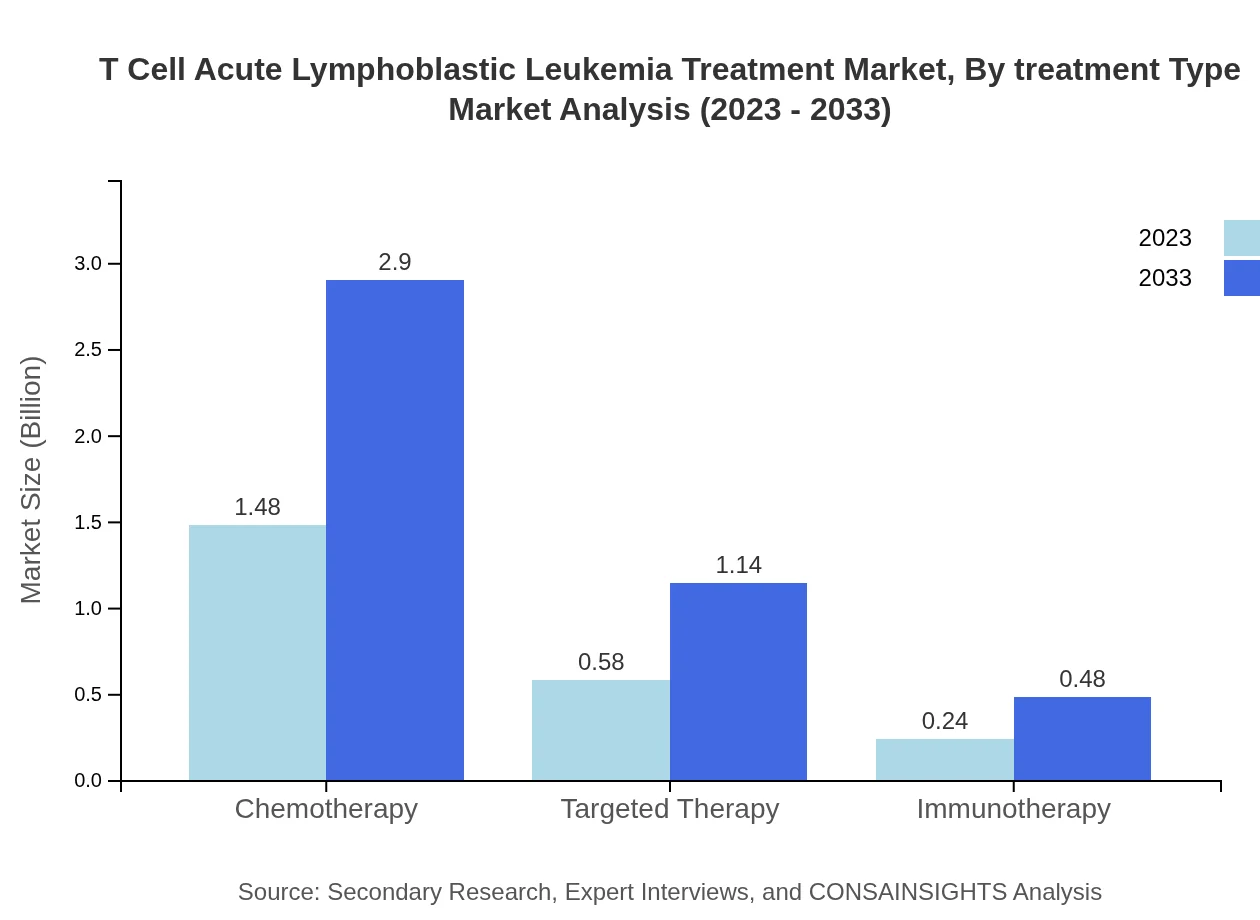
The T Cell Acute Lymphoblastic Leukemia treatment market is significantly influenced by treatment types such as chemotherapy and immunotherapy. Chemotherapy remains the most widely utilized treatment, accounting for approximately 64.26% of market share. Immunotherapy is gaining traction, with its share set to retain around 10.53% by 2033. Emerging treatment modalities, including targeted therapy, show promising potential for redefining care protocols.
T Cell Acute Lymphoblastic Leukemia Treatment Market Analysis By Drug Class
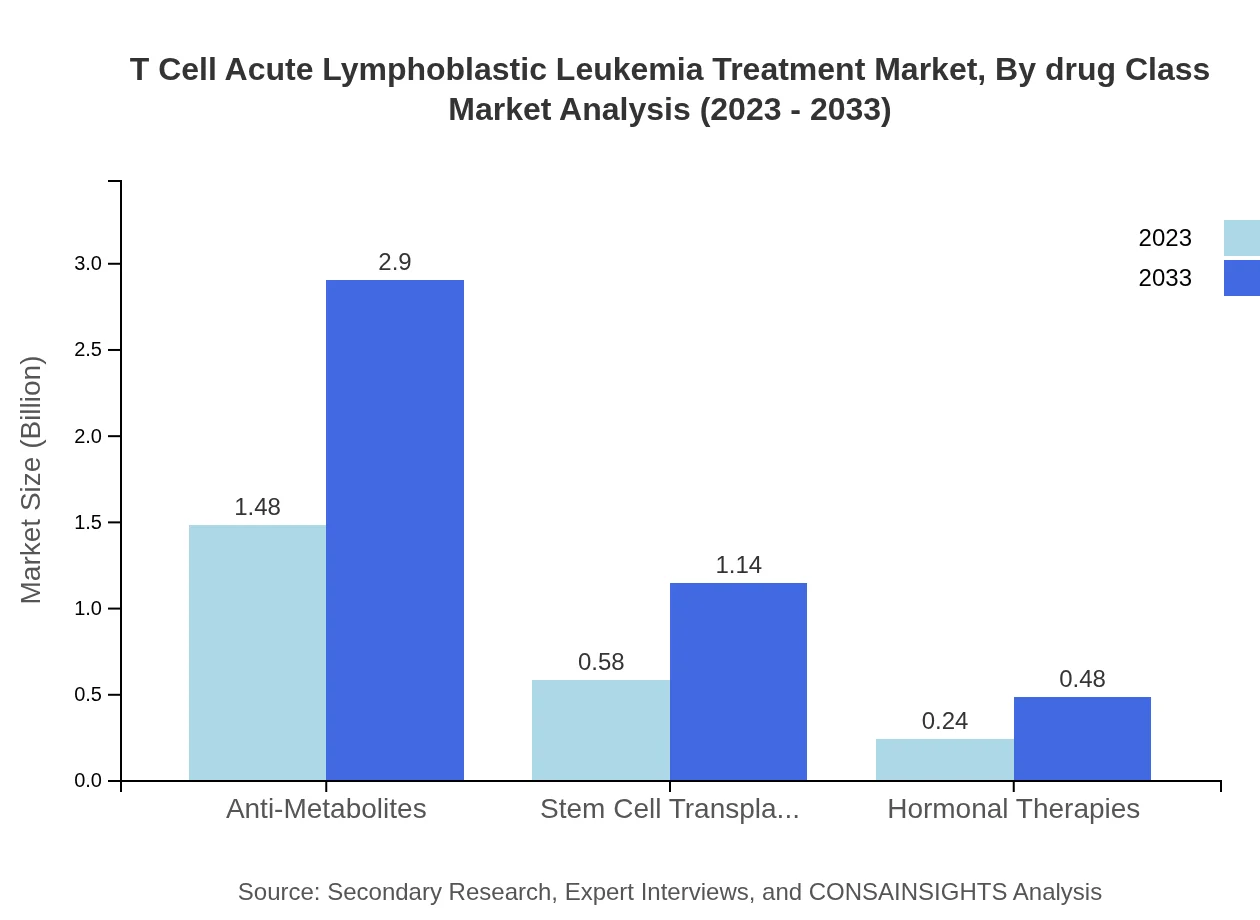
Drug class segmentation reveals that anti-metabolites and traditional chemotherapeutics dominate the T Cell Acute Lymphoblastic Leukemia treatment landscape. These classes, while effective, are being complemented increasingly by innovative therapies such as monoclonal antibodies and kinase inhibitors, which spotlight the industry's shift toward precision medicine.
T Cell Acute Lymphoblastic Leukemia Treatment Market Analysis By End User
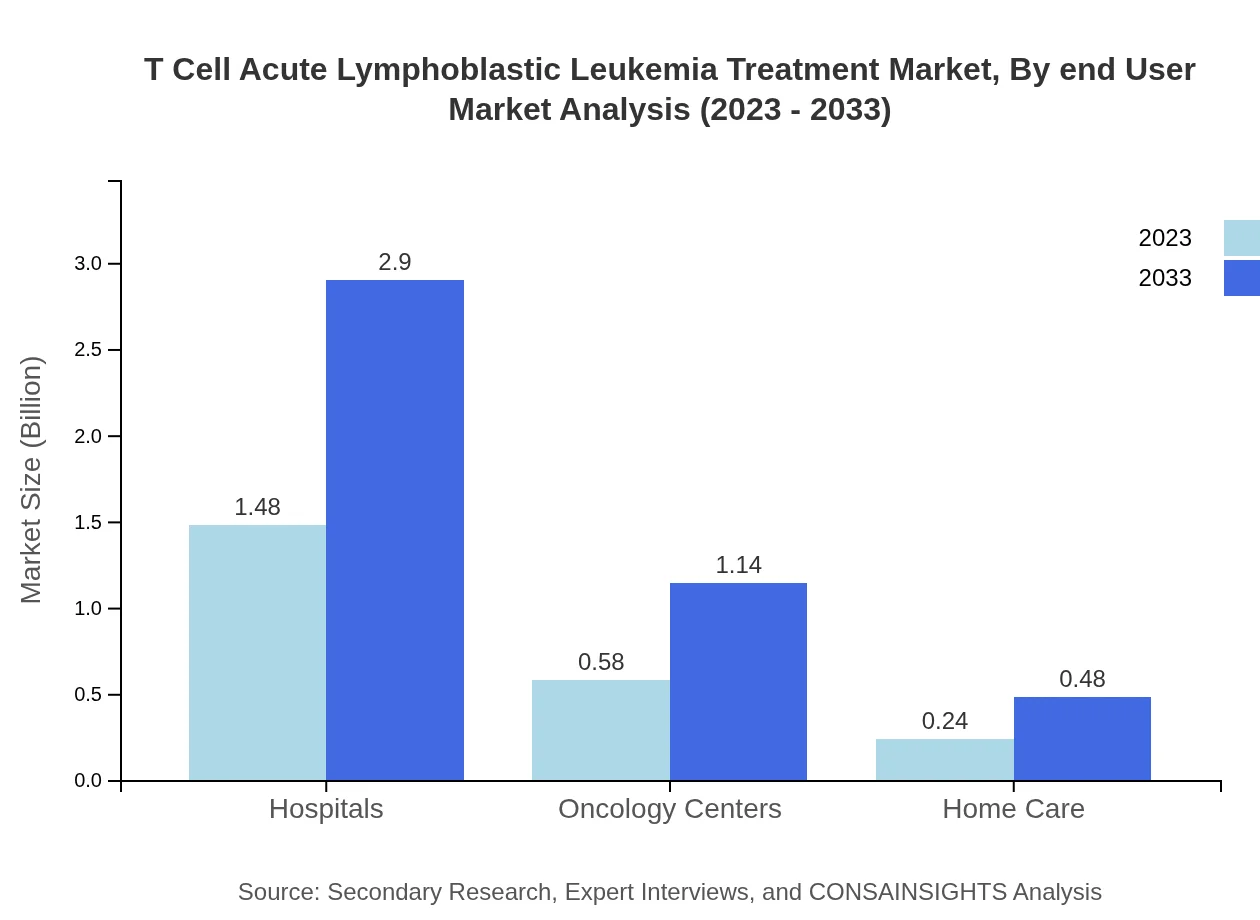
Hospitals represent the predominant end-user in the T Cell Acute Lymphoblastic Leukemia market, accounting for 64.26% of market share. Oncology centers are also pivotal, comprising approximately 25.21% of the market, while home care solutions are emerging as critical alternatives reflecting changing patient preferences for treatment settings.
T Cell Acute Lymphoblastic Leukemia Treatment Market Analysis By Route Of Administration
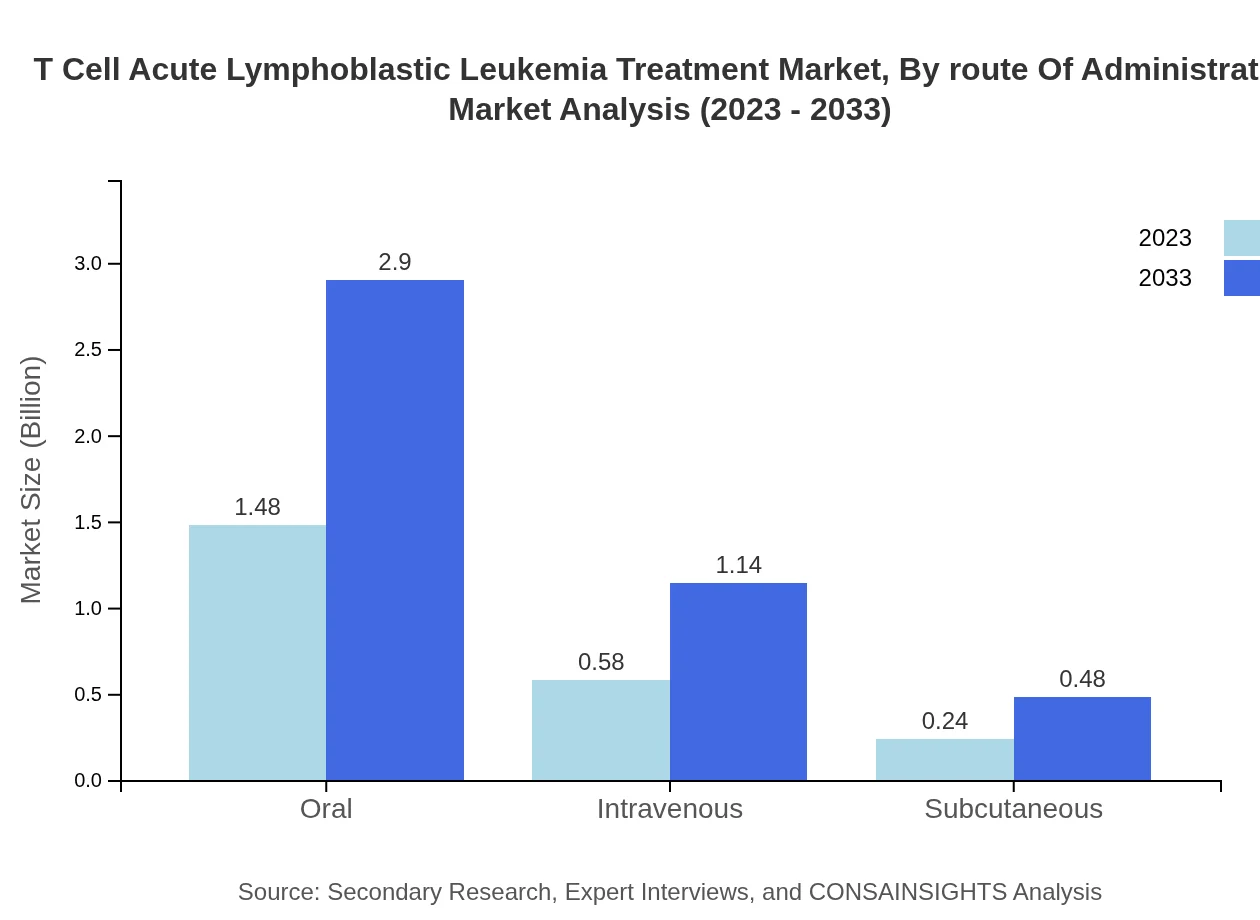
Oral administration routes account for a majority share of 64.26% in the T Cell Acute Lymphoblastic Leukemia treatment market, driven by patient preference for non-invasive options. Intravenous and subcutaneous routes follow, each bridging gaps in patient compliance and treatment efficacy.
T Cell Acute Lymphoblastic Leukemia Treatment Market Trends and Future Forecast
Tell us your focus area and get a customized research report.
Global Market Leaders and Top Companies in T Cell Acute Lymphoblastic Leukemia Treatment Industry
Roche:
Roche is a global leader in healthcare, focused on discovering and developing medicines tailored to individual patient needs, significantly contributing to advances in T-ALL treatment through innovative drugs and therapies.Bristol-Myers Squibb:
Bristol-Myers Squibb is known for its commitment to hematology and oncology, providing key therapies that reshape the landscape of T Cell Acute Lymphoblastic Leukemia treatments with novel approaches to immunotherapy.Novartis:
Novartis is at the forefront of cancer research, focusing on targeted therapies that address T-ALL, ensuring patients have access to the latest treatment options through its expansive pipeline.Pfizer :
Pfizer's innovative portfolio includes a range of targeted and combination therapies, enhancing treatment regimens for T Cell Acute Lymphoblastic Leukemia and solidifying its industry leadership.We're grateful to work with incredible clients.





FAQs
What is the market size in 2023?
The market size in 2023 is $2.30 Billion, based on the reported valuation for the T Cell Acute Lymphoblastic Leukemia treatment market.
What is the market size in 2033?
The market size in 2033 is $4.52 Billion, reflecting the projected end-period value provided for the forecast horizon.
What is CAGR for the forecast period?
The compound annual growth rate for the 2023 to 2033 forecast period is 6.8%, as stated in the market projections.
Is there a single fastest Growing region in the T Cell Acute Lymphoblastic Leukemia Treatment Market Report market?
No single fastest-growing region is stated for the T Cell Acute Lymphoblastic Leukemia Treatment Market Report market because the top regional implied CAGR values are within 0.15 percentage points of each other, making the ranking too close to call reliably.
Who are the leading companies?
Top companies named in the report include Roche, Bristol-Myers Squibb, Novartis, and Pfizer, as listed among active market participants.
What treatment types are covered?
The report covers chemotherapy, targeted therapy, and immunotherapy as primary treatment-type segments within the market.
How is the market segmented by end user?
End-user segmentation includes hospitals, oncology centers, and home care settings, reflecting where treatments are administered and managed.
Why is regional analysis important?
Regional analysis highlights market distribution and local drivers, using specific regional values to inform strategic planning and resource allocation.