

Spinal Cord Stimulation Devices Market Report
First published: 15 October 2024 | Last updated: 28 May 2026 | Report Code: spinal-cord-stimulation-devices
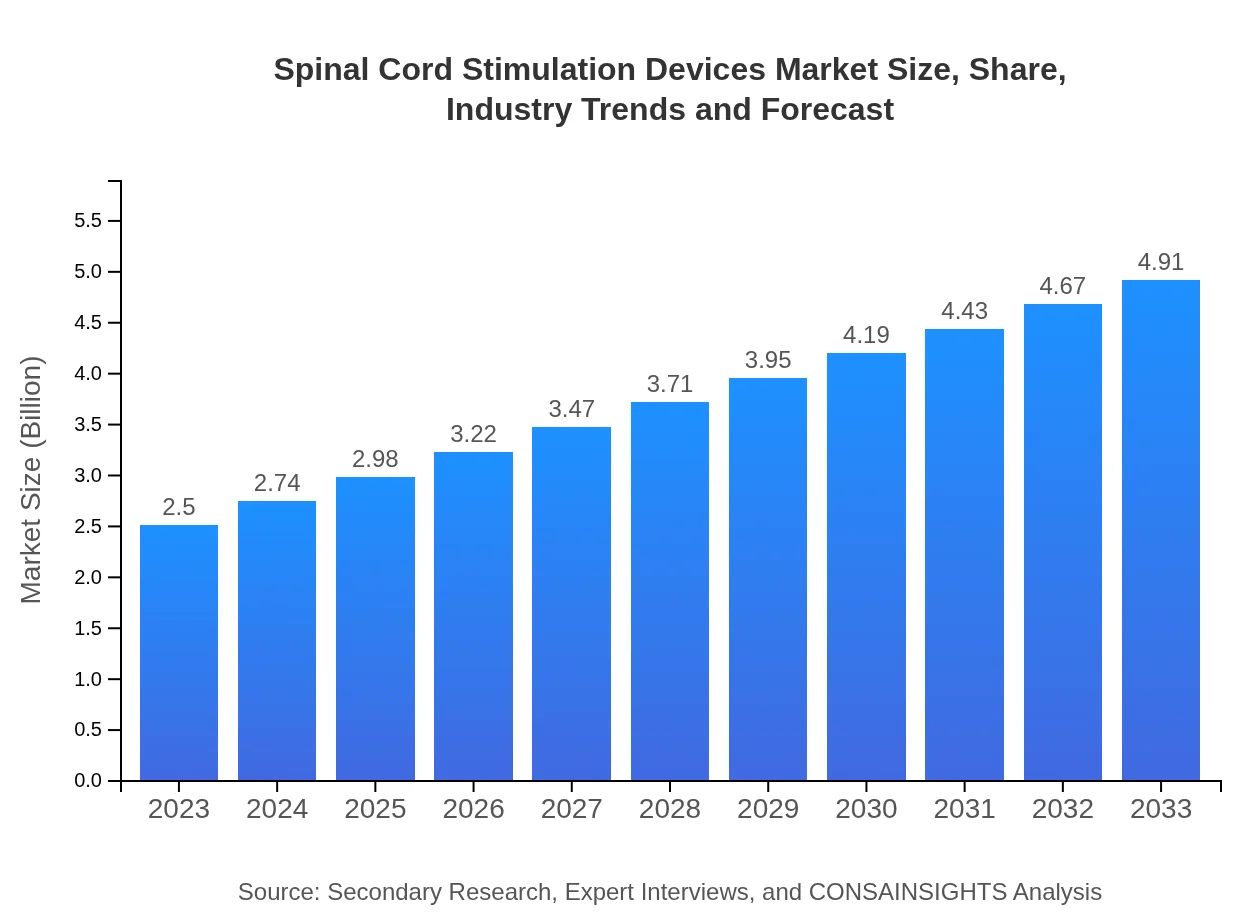
Spinal Cord Stimulation Devices Market — USD 2.5 billion in 2023, Growing to USD 4.91B by 2033 at 6.8% CAGR
This report provides an in-depth analysis of the Spinal Cord Stimulation Devices market, covering insights into market size, growth forecasts, regional variations, and technological advancements from 2023 to 2033.
Key Takeaways
- Global market grows from $2.50 Billion in 2023 to $4.91 Billion in 2033 at a 6.8% CAGR.
- North America is identified as the largest region, rising from $0.93 Billion in 2023 to $1.83 Billion in 2033.
- North America is largest regional market; Latin America is regional market region based on implied CAGR across 2023 to 2033.
- Europe and Asia Pacific show steady expansion, with Europe moving from $0.76 Billion to $1.49 Billion and Asia Pacific from $0.47 Billion to $0.92 Billion.
- Leading market participants include Medtronic, Boston Scientific, Abbott Laboratories, Nevro Corp., and Nuvectra Corporation.
Spinal Cord Stimulation Devices Market Report — Executive Summary
Regional analysis shows North America as largest market and Latin America as fastest-growing region by implied CAGR. The Spinal Cord Stimulation Devices market is projected to expand from $2.50 Billion in 2023 to $4.91 Billion by 2033, reflecting a 6.8% CAGR during 2023 to 2033. Growth is supported by device innovation, increasing clinician acceptance, and rising prevalence of chronic pain conditions. Product development emphasizes rechargeable and wireless systems and advanced neuromodulation techniques. Regional dynamics vary: North America holds the largest share, while Latin America records the highest implied growth rate. Market structure spans device types (implanted and external), therapy types (pain management and neuromodulation), applications (chronic pain management and neurological disorders), and end users (hospitals, ambulatory surgical centers, home care). Key players such as Medtronic, Boston Scientific, Abbott Laboratories, Nevro Corp., and Nuvectra Corporation are central to competitive activity, investing in clinical studies and partnerships to support adoption and reimbursement progress.
Key Growth Drivers
- Advances in neuromodulation technologies facilitating more personalized and adaptive stimulation systems.
- Rising prevalence of chronic pain and neurological disorders increasing demand for alternative therapeutic options.
- Product innovations including rechargeable batteries and wireless connectivity improving patient convenience and device longevity.
- Greater clinician adoption and more clinical evidence supporting efficacy of spinal cord stimulation therapies.
- Strategic collaborations and partnerships between device makers and healthcare providers expanding treatment access.
| Metric | Value |
|---|---|
| Study Period | 2023 - 2033 |
| 2023 Market Size | $2.50 Billion |
| CAGR (2023-2033) | 6.8% |
| 2033 Market Size | $4.91 Billion |
| Top Companies | Medtronic , Boston Scientific, Abbott Laboratories, Nevro Corp., Nuvectra Corporation |
| Published Date | 15 October 2024 |
| Last Modified Date | 28 May 2026 |
Spinal Cord Stimulation Devices Market Overview
Customize Spinal Cord Stimulation Devices Market Report market research report
- ✔ Get in-depth analysis of Spinal Cord Stimulation Devices market size, growth, and forecasts.
- ✔ Understand Spinal Cord Stimulation Devices's regional dynamics and industry-specific trends.
- ✔ Identify potential applications, end-user demand, and growth segments in Spinal Cord Stimulation Devices
What is the Market Size & CAGR of Spinal Cord Stimulation Devices Market Report market in 2023?
Spinal Cord Stimulation Devices Industry Analysis
Spinal Cord Stimulation Devices Market Segmentation and Scope
Tell us your focus area and get a customized research report.
Spinal Cord Stimulation Devices Market Report Market Analysis Report by Region
Europe Spinal Cord Stimulation Devices Market Report:
Europe grows from $0.76 Billion in 2023 to $1.49 Billion in 2033. Expansion is supported by increasing clinical evidence, investment in neuromodulation technologies, and broader adoption across hospitals and specialized centers.Asia Pacific Spinal Cord Stimulation Devices Market Report:
Asia Pacific grows from $0.47 Billion in 2023 to $0.92 Billion in 2033. Growth is influenced by rising awareness of pain management solutions, expanding healthcare infrastructure, and adoption of advanced device types in key markets.North America Spinal Cord Stimulation Devices Market Report:
North America is largest regional market, rising from $0.93 Billion in 2023 to $1.83 Billion in 2033. Regional momentum is driven by strong clinical adoption, advanced device development, and established reimbursement pathways supporting market penetration.South America Spinal Cord Stimulation Devices Market Report:
Latin America is fastest-growing region by implied CAGR, increasing from $0.22 Billion in 2023 to $0.44 Billion in 2033. 22 Billion in 2023 to $0.44 Billion in 2033 and is identified as the regional growth market at an implied 7.18% CAGR. Market gains reflect improving access to therapies and growing clinical acceptance of neuromodulation.Middle East & Africa Spinal Cord Stimulation Devices Market Report:
Middle East and Africa grows from $0.12 Billion in 2023 to $0.23 Billion in 2033. Growth drivers include gradual enhancement of healthcare services and increased availability of advanced therapeutic options for chronic pain.Tell us your focus area and get a customized research report.
Research Methodology
Spinal Cord Stimulation Devices Market Analysis By Device Type
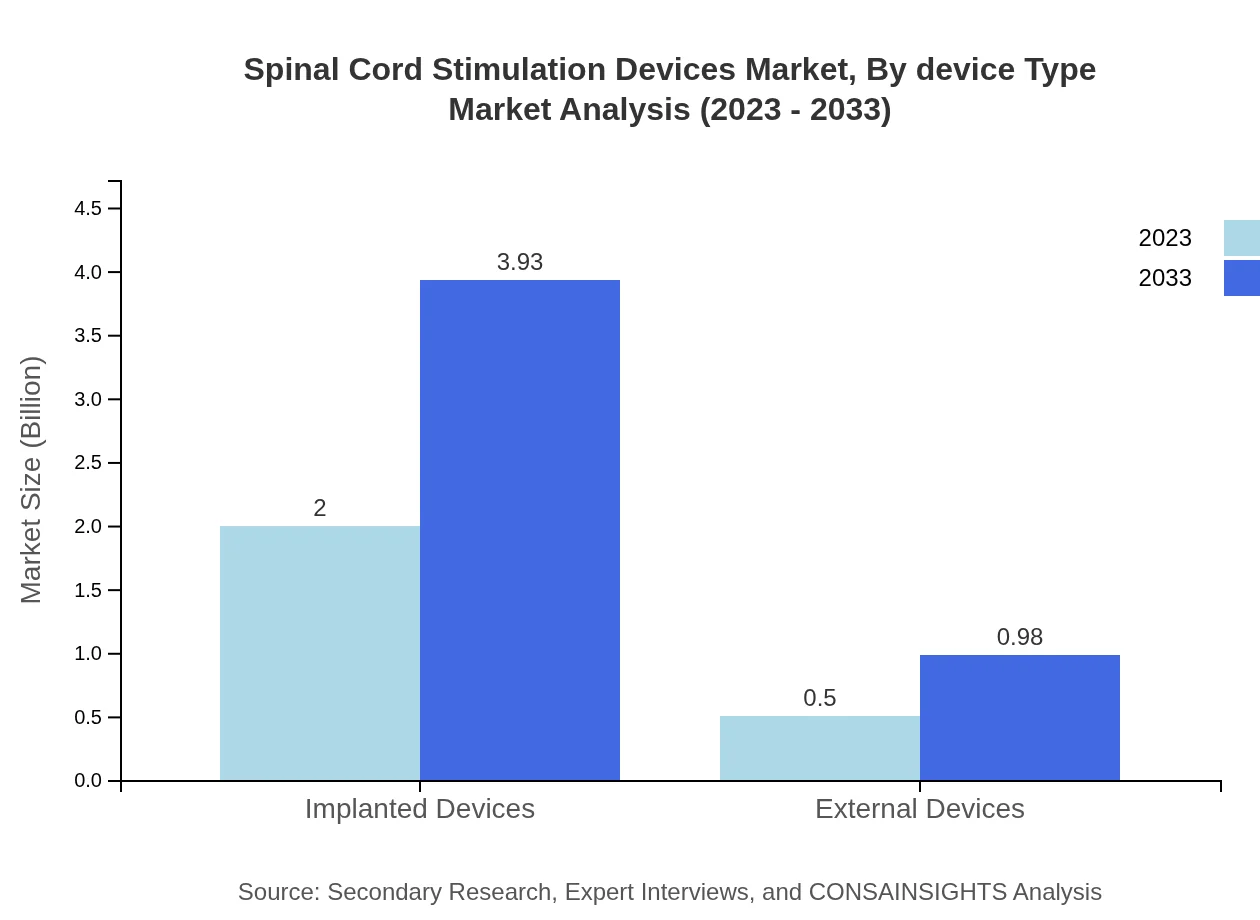
The market for Spinal Cord Stimulation Devices is analyzed based on device types, which are primarily implanted devices and external devices. In 2023, implanted devices are estimated to hold a significant market share of 80.06%, valued at $2 billion, with growth to $3.93 billion projected by 2033. Conversely, external devices, representing 19.94% of the market, show a scale of growth from $0.50 billion to $0.98 billion over the same period.
Spinal Cord Stimulation Devices Market Analysis By Therapy Type
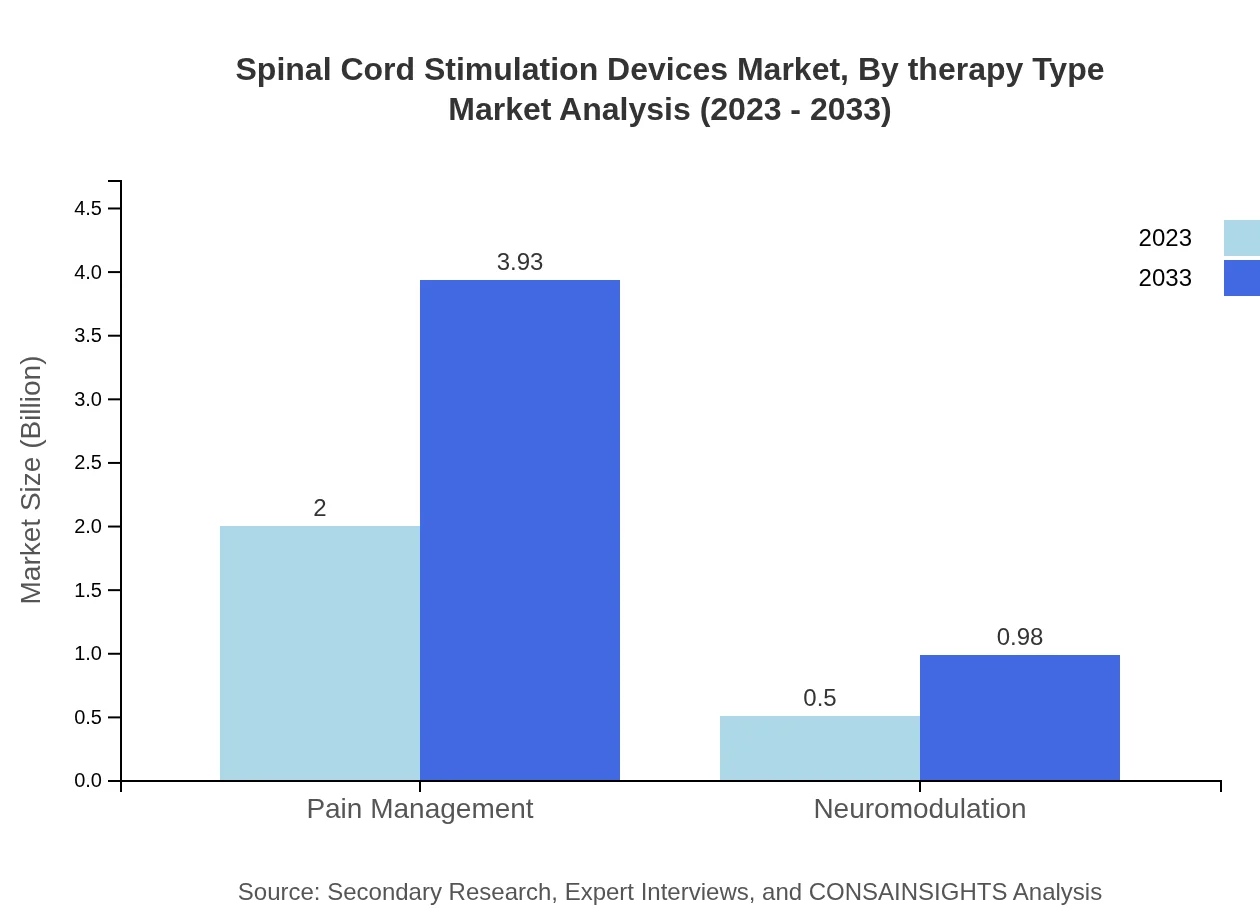
Market analysis by therapy type reveals that chronic pain management represents the largest segment, with a size of $2 billion in 2023, projected to increase to $3.93 billion in 2033. Neurological disorders follow, with a market value growing from $0.50 billion to $0.98 billion over the forecast period. This emphasizes the extensive reliance on SCS devices for effective pain relief and neurological management.
Spinal Cord Stimulation Devices Market Analysis By Application
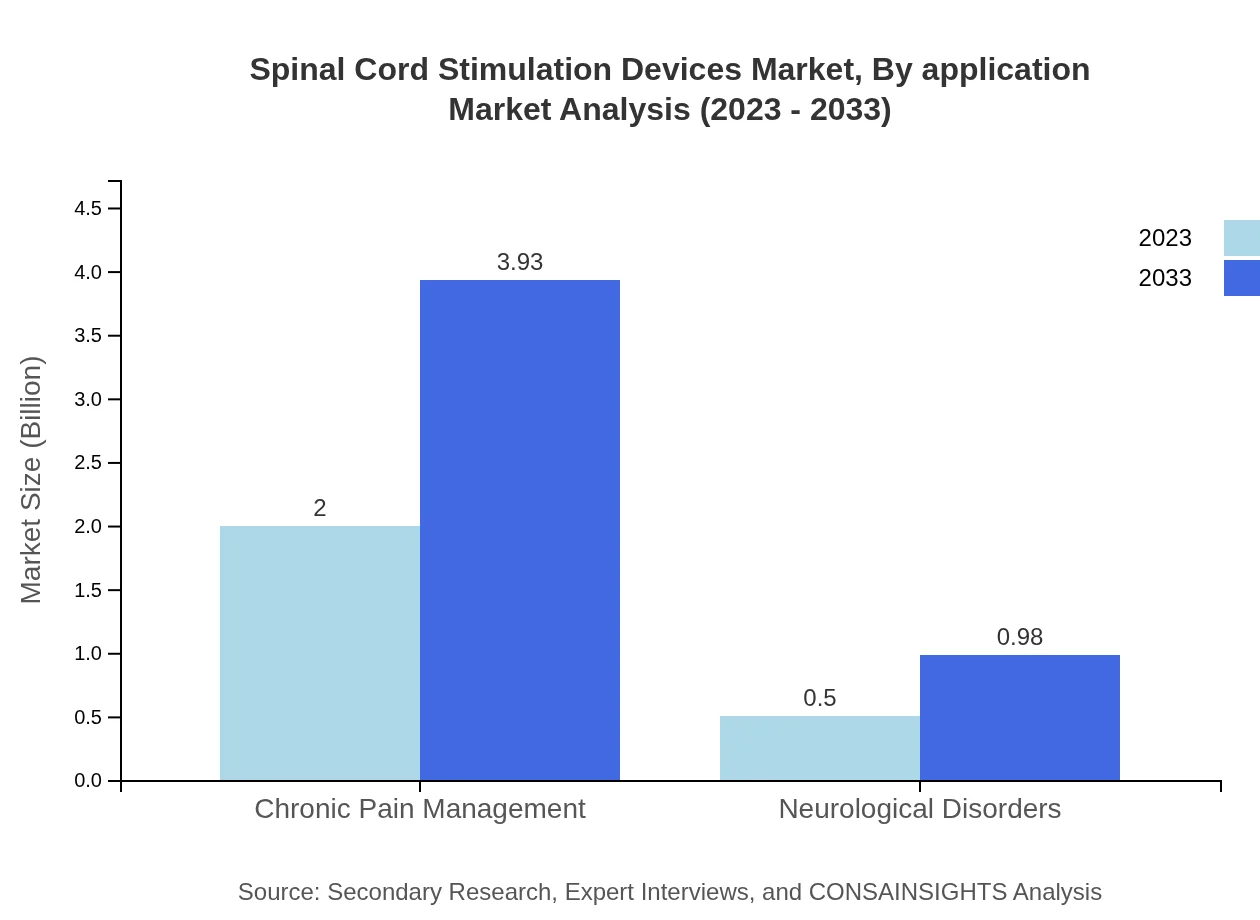
Applications of Spinal Cord Stimulation Devices are categorized into pain management and neuromodulation. Pain management accounts for 80.06% of the overall market share, with revenues expected to rise from $2 billion to $3.93 billion from 2023 to 2033. Neuromodulation contributes a smaller share, representing 19.94%, growing from $0.50 billion to $0.98 billion.
Spinal Cord Stimulation Devices Market Analysis By End User
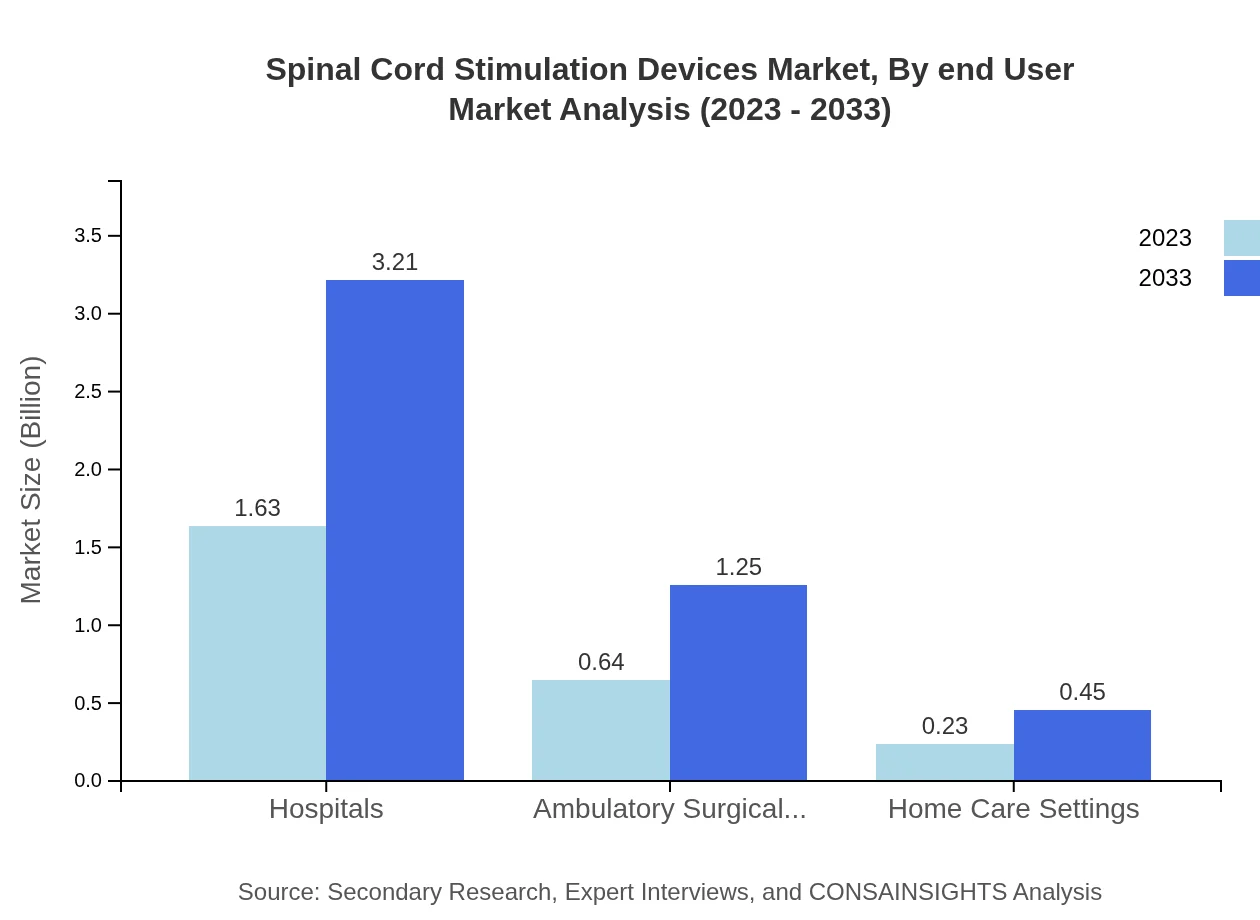
The primary end-users of Spinal Cord Stimulation Devices include hospitals, ambulatory surgical centers, and home care settings. Hospitals are the dominant end-user segment, holding 65.34% of the market share with revenues increasing from $1.63 billion in 2023 to $3.21 billion by 2033. Ambulatory surgical centers, accounting for 25.47%, will see their market value grow from $0.64 billion to $1.25 billion. Home care settings also play a vital role, representing 9.19% of the market and growing from $0.23 billion to $0.45 billion.
Spinal Cord Stimulation Devices Market Trends and Future Forecast
Tell us your focus area and get a customized research report.
Global Market Leaders and Top Companies in Spinal Cord Stimulation Devices Industry
Medtronic :
A leader in the healthcare industry, Medtronic manufactures and markets a wide range of spinal cord stimulation devices, emphasizing innovative solutions for chronic pain management.Boston Scientific:
Known for advancing less invasive treatment options, Boston Scientific offers state-of-the-art spinal cord stimulation technologies that enhance patient comfort and treatment effectiveness.Abbott Laboratories:
Abbott is committed to developing novel spinal cord stimulation devices that improve patient outcomes through advanced neuromodulation therapy.Nevro Corp.:
Nevro specializes in innovative and minimally invasive spinal cord stimulation solutions focused on providing superior relief for patients suffering from chronic pain.Nuvectra Corporation:
Nuvectra is dedicated to advancing spinal cord stimulation technology through its proprietary platforms, providing patients with individualized pain management solutions.We're grateful to work with incredible clients.









FAQs
What is the market size of the Spinal Cord Stimulation Devices market in 2023?
The reported market size for 2023 is $2.50 Billion, based on the input data provided for the forecast study covering 2023 to 2033.
How big will the Spinal Cord Stimulation Devices market be in 2033?
The forecasted market value for 2033 is $4.91 Billion as stated in the provided market projections for the 2023 to 2033 period.
What is CAGR of the Spinal Cord Stimulation Devices market for 2023 to 2033?
The compound annual growth rate for the forecast period 2023 to 2033 is 6.8%, according to the supplied data.
Which region is the fastest Growing in the Spinal Cord Stimulation Devices Market Report market?
Latin America is the fastest-growing region, projected to expand from $0.22 Billion in 2023 to $0.44 Billion in 2033, reflecting an implied 7.18% CAGR over the forecast period.
Which region is the fastest Growing for Spinal Cord Stimulation Devices?
Latin America is noted as the regional market region, rising from $0.22 Billion in 2023 to $0.44 Billion in 2033 at an implied 7.18% CAGR.
Who are the top companies in the Spinal Cord Stimulation Devices market?
Top companies listed in the report are Medtronic, Boston Scientific, Abbott Laboratories, Nevro Corp., and Nuvectra Corporation.
Why are implanted devices significant in this market?
Implanted devices are central because they deliver sustained neuromodulation for chronic pain and neurological disorders, representing a core device-type category in the market segmentation.
What end users are covered in the market segmentation?
The market segmentation includes hospitals, ambulatory surgical centers, and home care settings as primary end-user categories.
How are applications categorized in the report?
Applications are divided into chronic pain management and neurological disorders, reflecting primary therapeutic uses of spinal cord stimulation technologies.
What device types does the market include?
Device-type segmentation comprises implanted devices and external devices, covering the principal hardware approaches in spinal cord stimulation therapy.