

Telecardiology Market Report
First published: 21 October 2024 | Last updated: 28 May 2026 | Report Code: telecardiology
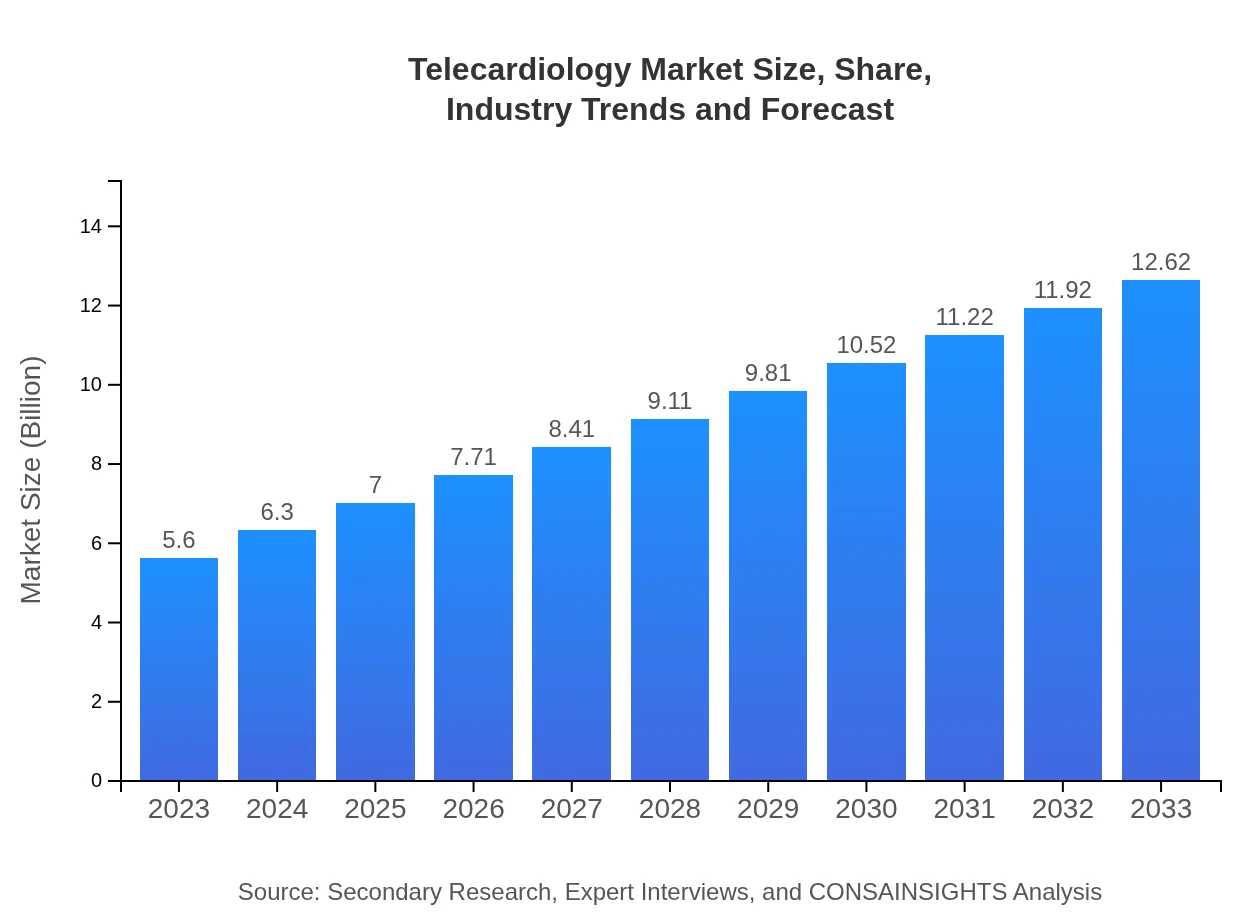
Telecardiology Market — USD 5.6 billion in 2023, Growing to USD 12.62B by 2033 at 8.2% CAGR
This report provides an in-depth analysis of the Telecardiology market, covering key insights, trends, technologies, and forecasts from 2023 to 2033. It aims to equip stakeholders with comprehensive data for informed decision-making.
Key Takeaways
- Global market grows from $5.60 Billion in 2023 to $12.62 Billion in 2033 at an 8.2% CAGR.
- North America is largest regional market; Middle East and Africa is regional market region based on implied CAGR across 2023 to 2033.
- Middle East and Africa is the regional market region, increasing from $0.39 Billion to $0.89 Billion.
- Major providers include Philips Healthcare, IBM Watson Health, Medtronic, CardioNet, and AliveCor.
- Technology adoption—mobile, cloud, and IoT devices—underpins service and device segmentation expansion.
Telecardiology Market Report — Executive Summary
Regional analysis shows North America as largest market and Middle East and Africa as fastest-growing region by implied CAGR. The report examines the telecardiology sector from 2023 to 2033, where the market increases from $5.60 Billion to $12.62 Billion at an 8.2% CAGR. Growth is propelled by rising cardiovascular disease prevalence, expanding remote patient monitoring, and advances in mobile and cloud platforms. Regional dynamics vary: North America holds the largest market, while Middle East and Africa exhibits the most rapid expansion. Product and technology segments span monitoring and diagnostic devices, software, mobile and IoT-enabled solutions. Key vendors named include Philips Healthcare, IBM Watson Health, Medtronic, CardioNet, and AliveCor. The study highlights regulatory shifts, wearable integration, and provider adoption as pivotal trends, and offers structured analysis across devices, end users, technologies, and applications to inform stakeholders and guide strategic decisions.
Key Growth Drivers
- Increased demand for remote cardiac monitoring due to higher cardiovascular disease incidence.
- Wider deployment of mobile and cloud technologies enabling real-time data transmission and analytics.
- Growing acceptance of virtual consultations and telehealth frameworks among providers and patients.
- Rising availability of wearable IoT devices that support continuous cardiac data capture.
- Regulatory adjustments and reimbursement developments that facilitate telemedicine services.
| Metric | Value |
|---|---|
| Study Period | 2023 - 2033 |
| 2023 Market Size | $5.60 Billion |
| CAGR (2023-2033) | 8.2% |
| 2033 Market Size | $12.62 Billion |
| Top Companies | Philips Healthcare, IBM Watson Health, Medtronic , CardioNet, AliveCor |
| Published Date | 21 October 2024 |
| Last Modified Date | 28 May 2026 |
Telecardiology Market Overview
Customize Telecardiology Market Report market research report
- ✔ Get in-depth analysis of Telecardiology market size, growth, and forecasts.
- ✔ Understand Telecardiology's regional dynamics and industry-specific trends.
- ✔ Identify potential applications, end-user demand, and growth segments in Telecardiology
What is the Market Size & CAGR of Telecardiology Market Report market in 2023?
Telecardiology Industry Analysis
Telecardiology Market Segmentation and Scope
Tell us your focus area and get a customized research report.
Telecardiology Market Report Market Analysis Report by Region
Europe Telecardiology Market Report:
Europe grows from $1.47 Billion in 2023 to $3.3 Billion in 2033. Growth is supported by increasing telemedicine acceptance, regulatory adjustments enabling remote consultations, and adoption of cloud-based cardiac monitoring solutions across clinical settings.Asia Pacific Telecardiology Market Report:
Asia Pacific grows from $1.18 Billion in 2023 to $2.65 Billion in 2033. The region's expansion is driven by rising cardiovascular disease burden, increasing mobile health penetration, and growing investments in telehealth platforms and wearable technologies.North America Telecardiology Market Report:
North America is largest regional market, rising from $2.09 Billion in 2023 to $4.7 Billion in 2033. This market benefits from advanced health IT infrastructure, strong provider uptake of remote cardiac monitoring, and significant vendor presence that accelerates product and service deployment.South America Telecardiology Market Report:
Latin America grows from $0.48 Billion in 2023 to $1.08 Billion in 2033. Uptake is influenced by expanding telehealth initiatives, broader access to mobile networks, and rising interest among providers to implement remote cardiac services.Middle East & Africa Telecardiology Market Report:
Middle East and Africa is fastest-growing region by implied CAGR, increasing from $0.39 Billion in 2023 to $0.89 Billion in 2033. The region’s rapid growth is linked to escalating demand for remote monitoring, expanding telemedicine infrastructure, and increased deployment of IoT-enabled cardiac devices.Tell us your focus area and get a customized research report.
Research Methodology
Telecardiology Market Analysis By Device
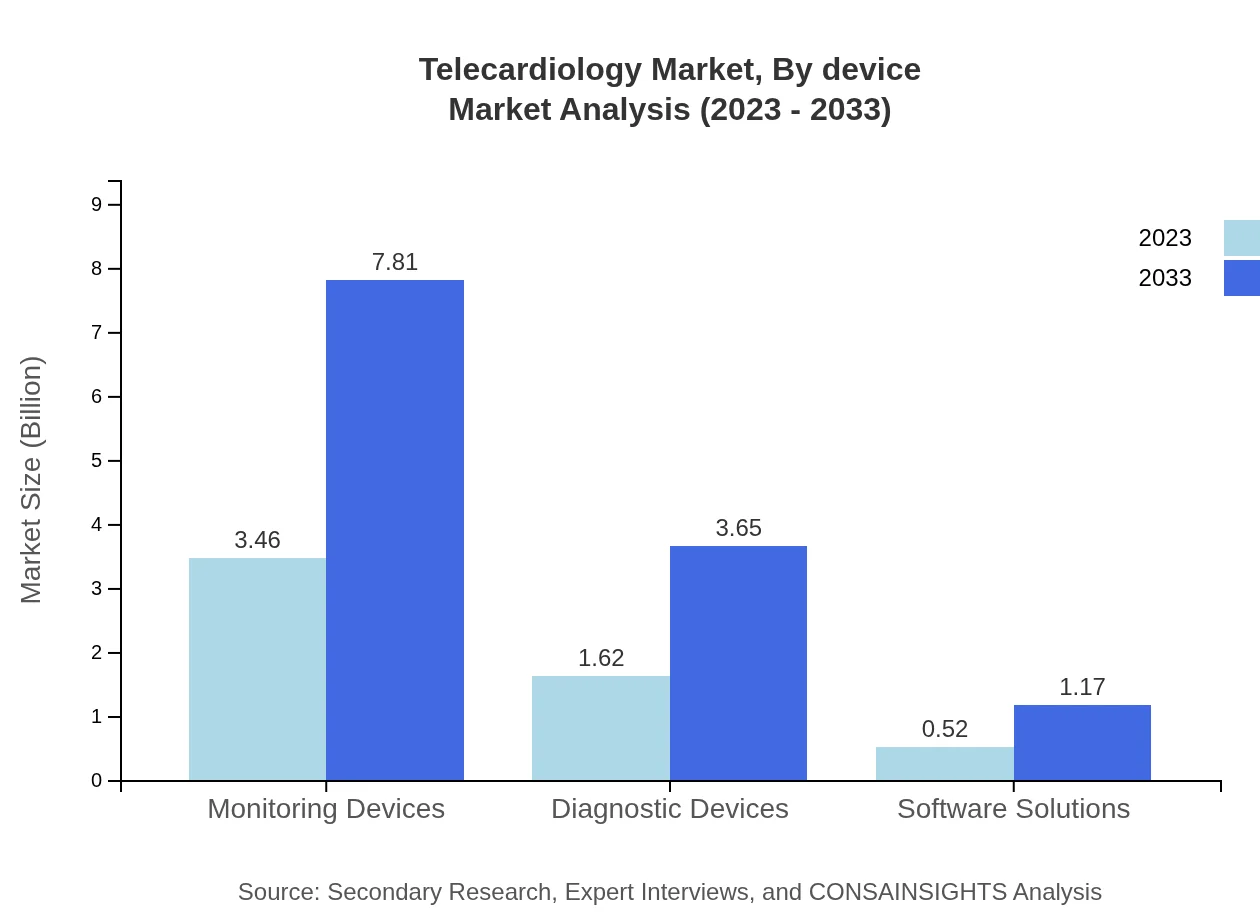
The market for Telecardiology devices is anchored primarily in monitoring devices, which accounted for USD 3.46 billion in 2023 and is expected to reach USD 7.81 billion by 2033. This segment holds a market share of 61.85% and is fueled by an increasing number of patients requiring monitoring for chronic conditions. Diagnostic devices follow, with expectations of growth from USD 1.62 billion in 2023 to USD 3.65 billion by 2033, maintaining a market share of 28.9%. Software solutions, while comparatively smaller, are forecasted to grow significantly, reaching USD 1.17 billion by 2033.
Telecardiology Market Analysis By Application
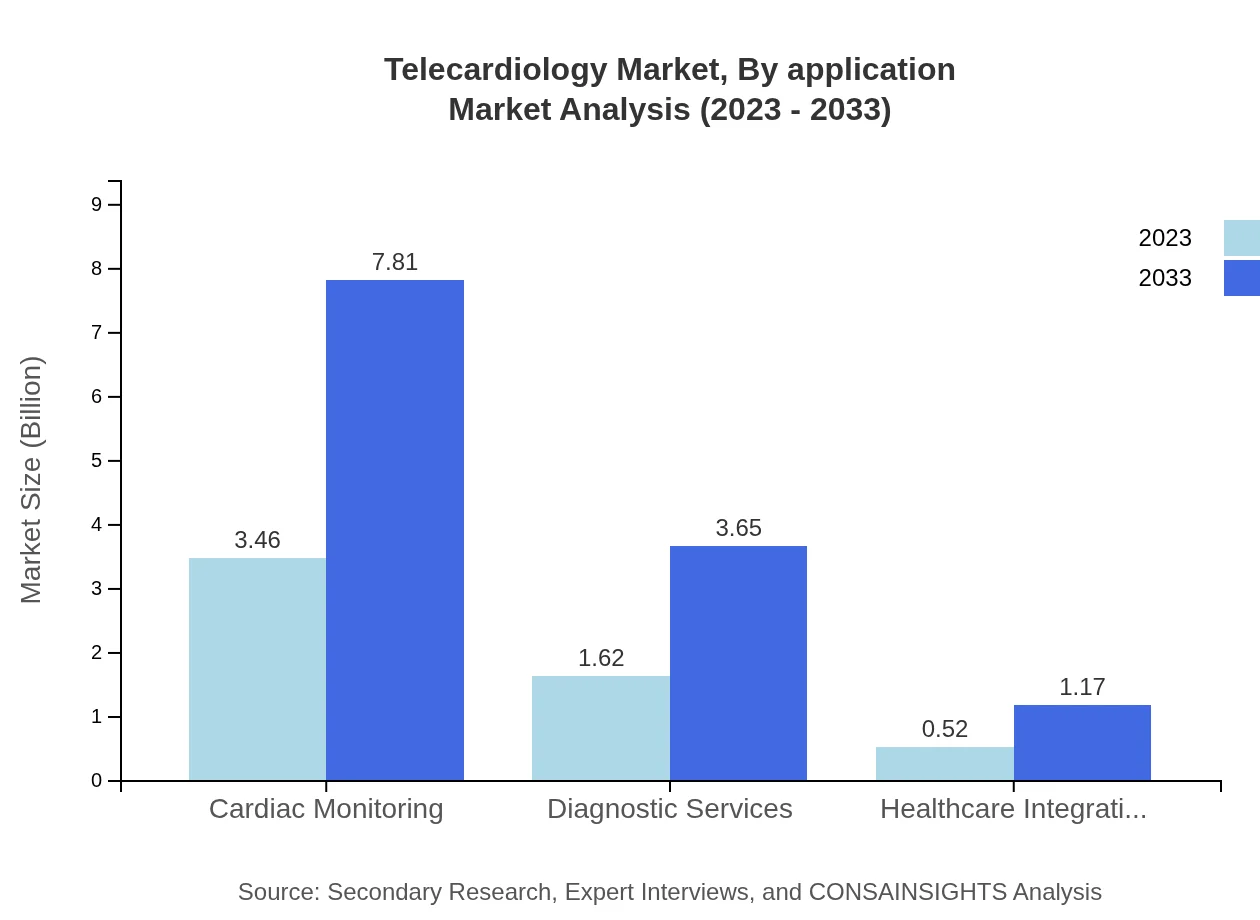
In terms of application, cardiac monitoring remains dominant, reflecting growing concern over heart health, with sales rising from USD 3.46 billion in 2023 to USD 7.81 billion by 2033. This application leads the market with a share of 61.85%. Diagnostic services, which also play a crucial role in patient care, are projected to grow from USD 1.62 billion in 2023 to USD 3.65 billion by 2033, capturing 28.9% of the market share.
Telecardiology Market Analysis By End User
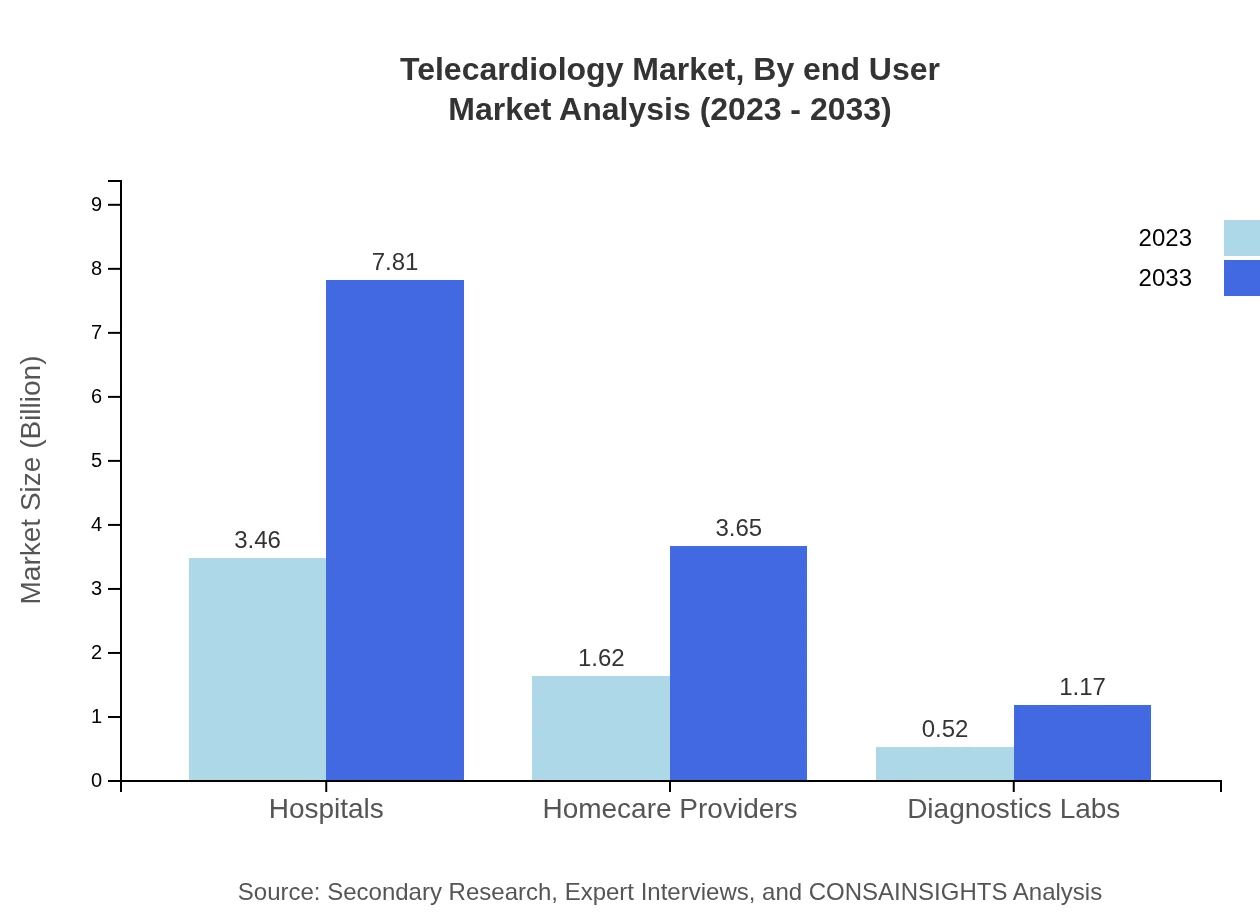
Hospitals are the largest end-user of Telecardiology services, with a revenue projection of USD 3.46 billion in 2023, expecting to grow to USD 7.81 billion by 2033, representing 61.85% market share due to their capacity and infrastructure to implement comprehensive patient monitoring systems. Homecare providers are increasingly significant, rising rapidly in adoption, expected to expand from USD 1.62 billion in 2023 to USD 3.65 billion by 2033, capturing 28.9% of the market.
Telecardiology Market Analysis By Technology
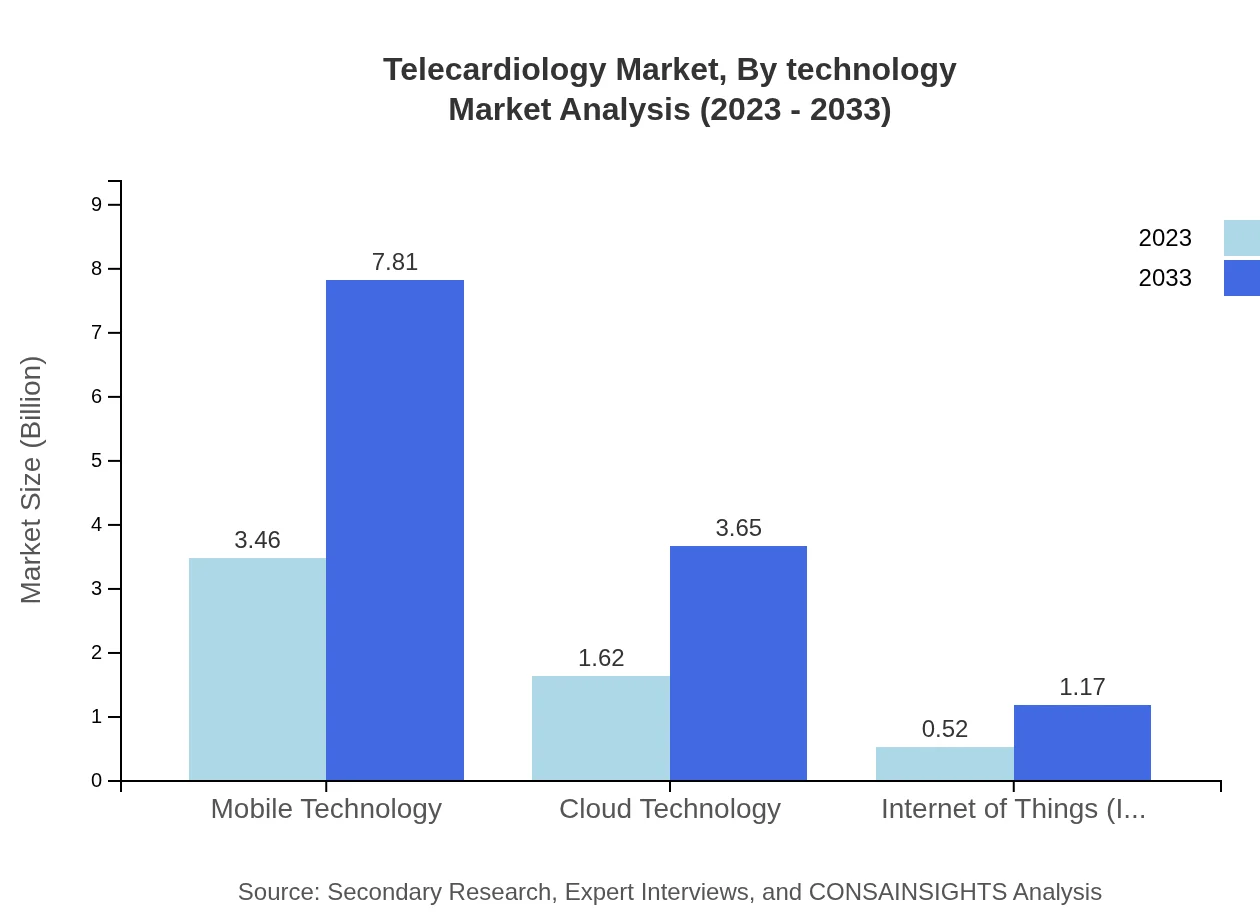
The global Telecardiology market is being increasingly influenced by mobile technology. Monitoring devices leveraging mobile applications are expected to generate substantial revenues, starting at USD 3.46 billion in 2023 and growing to USD 7.81 billion by 2033. Cloud technologies and IoT devices are also gaining traction, contributing USD 1.62 billion and USD 0.52 billion respectively in 2023, scaling to USD 3.65 billion and USD 1.17 billion by 2033.
Telecardiology Market Analysis By Region
Global Telecardiology Market, By Region Market Analysis (2023 - 2033)
Geographically, the management and implementation of Telecardiology solutions are expanding across all regions. North America stays ahead of the curve, while Europe follows in terms of technological adoption. The Asia Pacific region is likely to see the fastest growth owing to improving healthcare infrastructures and increasing funding for telehealth. Each of these regions has unique consumer challenges that influence their adoption rates.
Telecardiology Market Trends and Future Forecast
Tell us your focus area and get a customized research report.
Global Market Leaders and Top Companies in Telecardiology Industry
Philips Healthcare:
A global leader in health technology, Philips develops innovative solutions to improve people’s health and enhance patient outcomes, including advanced telecardiology applications.IBM Watson Health:
Known for its data analytics capabilities, Watson Health applies AI to Telecardiology, aiding in diagnostics and monitoring trends in patient health.Medtronic :
Specializes in medical technology, including cardiac monitoring devices and telehealth services to enhance the management of cardiovascular conditions.CardioNet:
Focused on providing innovative wireless cardiac monitoring services, leveraging advanced telecommunications technology.AliveCor:
Pioneering mobile health technology, AliveCor specializes in personal ECG monitors, transforming the management of heart health.We're grateful to work with incredible clients.









FAQs
What is the market size of the telecardiology market in 2023?
The market size for 2023 is $5.60 Billion, as reported for the global telecardiology sector.
How big is the telecardiology market expected to be in 2033?
By 2033 the telecardiology market is expected to reach $12.62 Billion according to the provided forecast figures.
What is CAGR of the telecardiology market for 2023 to 2033?
The compound annual growth rate for the forecast period 2023 to 2033 is 8.2% as reported in the data.
Which region is the fastest Growing in the Telecardiology Market Report market?
Middle East and Africa is the fastest-growing region, projected to expand from $0.39 Billion in 2023 to $0.89 Billion in 2033, reflecting an implied 8.60% CAGR over the forecast period.
Which region is the fastest Growing for telecardiology?
Middle East and Africa is identified as the regional market region, rising from $0.39 Billion in 2023 to $0.89 Billion in 2033 at an implied 8.60% CAGR.
Who are the leading companies operating in telecardiology?
Top companies listed include Philips Healthcare, IBM Watson Health, Medtronic, CardioNet, and AliveCor.
How do technologies influence market expansion?
Mobile, cloud, and IoT technologies enable continuous monitoring and data sharing, supporting broader deployment of telecardiology services.
What end users drive demand for telecardiology solutions?
Hospitals, homecare providers, and diagnostics labs are primary end users, each adopting remote monitoring and diagnostic services for cardiac care.